Showing posts with label cathy hannah. Show all posts

Tuesday, June 27, 2017

Minis From CAKE: S.Roberts, C.Hannah, M.Galloway, J.Campbell

The Chicago Alternative Comics Expo (CAKE) was one of the better shows I've ever attended. Here are a few minis I picked up, with this batch from locals.

Body Magik, by Scott Roberts. I reviewed an earlier comic by Roberts (Chemtrails), but I get the sense that this new comic is much more closely related to his real project as an artist. I was fortunate enough to talk extensively with him about his artistic interest and methods, and a lot of that conversation revolved around Gary Panter as an inspiration. Roberts is definitely in that "mark-making" school of cartooning, where the imperfection of the line itself is an important part of the aesthetic--much more so than its pure representational value. It's an aesthetic that borrows some aspects from abstract expressionism in that the line is an expression of emotion, but it's one where narrative is still a key aspect of that expression.

In the case of this comic, it's about a group of old friends who visit their now ultra-rich and somewhat spaced-out friend who created some kind of life-changing app. Printed on a Risograph, Roberts uses a two-color approach (blue and orange) as well as decorative effects that affect the actual narrative. There's an interesting tension between form & figure and environment, especially with regard to depicting hallucinogenic effects that warp perception and reality. Roberts starts the reader off on shifting sands when introducing them into the rich man's home: it's strange and almost alien in character. Then things get even stranger when he introduces them to an app that reads one's desires and creates a new, 3D-printed, perfected body.

The rest of the comic explores these new bodies: a centaur, a lumpy but masculine mass, a furry bear, a couple sharing the same body in the most intimate ways possible, etc. Roberts naturally explores the downside of this app. The couple sharing the body has become completely cut off from the outside world. The centaur runs away from intimacy. The man who became the bear did it only for his lover, whose near appearance as male is distressing to him. That leads to an interesting debate: "Did you love me or my body?", with the remarkably honest answer being "I don't know...both?" Throughout this series of explorations, Roberts is careful to continue to focus on the figures while providing decorative subtext that push themselves into text, like the character who becomes a caterpillar suddenly bursting into life as a butterfly. It's the ultimate symbol of unambiguously joyous transformation, and to see it juxtaposed against someone regretting their own change was an interesting narrative strategy. It also points to the idea that subconscious desires may not match up with one's own conscious narrative.


My Erotic Life, by Jessica Campbell. Humor comics are something I take very seriously, if I may venture into contradictory territory. I can enjoy something that's a humor comic even if I don't laugh out loud; I can generally enjoy them on a more conceptual level, even if it's tough to make me laugh like that. Of course, when I do find a cartoonist that elicits that reaction (Ivan Brunetti, Michael Kupperman, Lisa Hanawalt, Gina Wynbrandt, Lauren Weinstein, Peter Bagge), they become instant favorites. So is it also the case with Jessica Campbell. Her Hot or Not was a brilliant work of satire, and I've enjoyed her other illustrated minis that were mostly not entirely comics. But this collection of four-panel strips (the building block of humor) shows the artist going strictly for punchlines--and a lot of them land hard. The great thing about the strip titled "Oh, this old thing? It's just..." is not that she escalated the absurdity to build to a crescendo, but rather that she immediately elevated the absurdity and kept it a high level. From "Cheetos sprinkled on my feet" to "A trash bag with nipple holes" (with hilarious accompanying illustrations, this was the best gag in the mini.

Not all of her gags are conceptual. A drawing of her own tongue writhing in her mouth begins with the question "How hard is it to swallow your own tongue?" and ends with the statement "I smoked a little pot", giving perfect context to the prior four panels, especially since that kind of pointless tangent and staring off into space is precisely what happens when getting stoned. Campbell has clearly been working on her cartooning and drawing, as it is way more confident than it was even in her book. A side effect of that work provided another strong gag, where she starts off wanting to learn how to draw a nude man. She opens up a Google rabbit hole, simply saying "Huh!" for the next eight hours. As Campbell continues to refine her line, she has the opportunity to continue to clearly merge the visual aspects of her humor with the already razor-sharp wit that she possesses.

Nest, by Marnie Galloway. Rarely do I encounter cartoonists with a high degree of technical illustrating skill who also possess an intuitive, humane approach to art the way that Marnie Galloway does. Her Burrow was a personal meditation on motherhood (though not an autobiographical one) that explored the relationship between early motherhood, sleep deprivation, and the dream-like state (bordering on psychosis) that often occurs as a result of that lack of sleep. Nest is a non-narrative companion piece, juxtaposing drawings against Galloway writing out the Sophie Jewett poem "To A Child" on pages opposite the drawings. The drawings are similar to her Burrow style: Megan Kelso-esque in the use of a clear line, the bulky bodies with a powerful presence, the pastoral imagery of mothers and infants asleep together. It was printed on a Risograph, with green (of course) being the single color at work here. The most beautiful thing about this comic is its stillness: mothers and children asleep together: safe, becoming rested and rejuvenated, and sheltered. There's a sense of beautiful dreams chasing away the confusion of Burrow, if only for a little while.


Chicago In The Fall, by Cathy Hannah. Hannah's being doing memoir comics for a long time,but with her recent Springtime In Chicago and its sequel, she's really started to hit a new stride. Each daily strip is just four panels long, and she is careful with regard to what she chooses to talk about each day. This volume is a raw, honest look at her love life, as she still pines for one co-worker while sleeping with another one, a man whom some of her friends worry about with regard to his temper. Hannah has found her stride in part because she's found a way to simplify her line without sacrificing coherency or emotional content. Working with what looks like a fine-line marker, she's also attained a level of panel-to-panel consistency that resonates with the reader--especially her own self-caricature. With a few lines for bangs, dots for eyes, and a prominent nose, her profile pops on the page.

Hannah switches subject matter from her current job, to job interviews, to therapy sessions (mostly talking about jobs, the guy she's sleeping with, and the guy she's still obsessed with), time alone with her ailing cats, and eventually anxiety over the 2016 presidential election. There's a strip where she turns away from sex because her partner is drunk; initially she thinks to do it just to get over with then realizes that's precisely the wrong thing to do. This later leads to a fight, which leads her to question why she's even in this arrangement, other than for sex: "Trust me, it's not that glamorous". Strips like that are balanced with Hannah experiencing delight with regard to things coming in the mail or getting goofy with friends, as it's clear that personal connections are a big part of her happiness, even as she tends to be a homebody by nature. Hannah goes round and round a bit and even cops to it at the end: there's no conclusion to this comic because her life wasn't wrapping up neatly either. There's a sense that this comic is one long holding pattern, waiting for other shoes to drop: Trump, the health of her cats, her job, the guy she's dating, and the guy she's in love with. The fact that none of the shoes other than Trump dropped, so to speak, add a certain amount of tension to her life, but it's clear by the tone of the strips that simply writing about these events is therapeutic in its own way.

Tuesday, June 6, 2017

Ten Artists To Seek Out At CAKE 2017

I will be attending the Chicago Alternative Comics Expo (CAKE) this Saturday and Sunday, June 9th & 10th. I'm excited to meet a number of Chicago-area artists for the first time, and of course will be looking for comics for review. On Sunday at 3pm, I will be moderating a panel titled "Place As Character", featuring the artists Emil Ferris, Laura Knetzger, Sophie Goldstein and Mita Mahato. All panels will take place on the third floor of the Hoover-Leppen Theatre. CAKE has a tremendous amount of talent, perhaps the most per capita of any American art festival. This is a show with special guests like Gary Panter, the explosively popular Emil Ferris, Simon Hanselmann, Kevin Budnik and many more. Here are ten artists you might be less familiar with that you should consider visiting if you attend the show.

1. Haleigh Buck (Table 315). This autobiographical cartoonist from Baltimore is making some of the rawest, densest comics about dealing with mental illness as part of everyday life, including how she dealt with an enormous breakdown. Her naturalistic style has a surreal edge to it and she maintains a wicked sense of humor throughout.


2. Chris Cilla (Table 205). His book The Heavy Hand is one of my favorite comics of all time, fusing a variety of styles together seamlessly to create a psychedelic, hilarious journey that defies all of the genre conventions that the book explores. His minis are also excellent, creating his own brand of underground comics that acknowledge all of their forebears without being beholden to any one in particular.


3. Cathy Hannah (Table 410). Hannah is another autobio cartoonist who writes about the intersection of the personal and political in interesting ways. She spills a lot of ink in delving deep into her own mental illness issues, her feelings about relationships and documenting her own therapeutic breakthroughs in real time. She uses an inviting, cartoony style to tell her stories.


4. Sophie McMahan (Table 403). Ever since one of her comics appeared in my mailbox, I've been astounded by the sophistication of her critiques of beauty, image and the male gaze through the use of body horror and distorted versions of 1950s-style advertising illustrations. Every one of her comics is both aesthetically beautiful and thematically challenging.


5. Carolyn Nowak (Table 505). She's doing some fantastically funny comics about sex, gender identity, culture and intimacy, with her recent Diana's Electric Tongue especially notable. A winner of the Ignatz award last year, her comics have a sense of lived-in warmth that's part of her sharp critiques. Her work is questing, curious, warm, funny and extremely smart.


6. Ben Passmore (Table 307). He just earned an Eisner nomination for his breakthrough short comic Your Black Friend, a pointed meditation on racial alienation. However, his other comics, like his postapocalyptic-autobio series Daygloayhole, are every bit as provocative, dealing with issues like addiction, isolation and connection, told with a weary sense of humor and razor-sharp intellect.


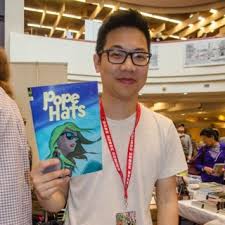
7. Ethan Rilly (Table 405). Rilly's Pope Hats series is one of the best things going in comics. Its serialized storyline about a law clerk named Frances features characterizations that rarely found in comics, gorgeous character design and an unerring ability to use stillness and pauses as a key part of his storytelling. His comics are subtle, beautiful and immensely satisfying.


8. Yumi Sakugawa (Table 220). This is an artist whose sharply-observed observations about art and gender dovetail beautifully with her sense of composition that makes extensive use of negative space. There's also a slightly exaggerated sense of reality to be found in her comics, often mediated through her frequent use of a reserved or deadpan narrative voice. UPDATE: Yumi Sakugawa has cancelled.


9. Eric Kostiuk Williams (Table 510). Williams' gained a lot of notice with his Hungry Bottom Comics series, a comic that mixed autobiographical essays about being young and queer in Toronto with surreal dreamscapes. Williams' potent mix of incredibly fluid draftsmanship and a probing mind helped get an Eisner nomination with his recent Babybel Wax Bodysuit, and his recent Heartbreak Condo Disco from Koyama Press.


10. Jenny Zervakis (Table 105). It's a conflict of interest to suggest that her debut collection of Strange Growths could very well be the book of the show, given the fact that I interviewed her for a section at the end of it. However, I'm not the only one eagerly awaiting this book that collects the first 13 issues of her minicomic, mostly from the 90s when she was a publishing mainstay. That John Porcellino had been planning to do this kind of collection for years speaks to the respect he has for her work. Her thin, penciled line tells stories that are poetic, still, funny and sharply observed.

Tuesday, March 7, 2017

The Minicomics of Cathy Hannah

Chicago-area cartoonist Cathy Hannah has been remarkably prolific over the past few years. Her autobio comics tackle topics that range from body image to depression to eating disorders to simply finding one's purpose in life. Let's take a look at her recent output, starting with three one-off minis. Sometimes an autobio cartoonist is afraid to, as my fellow critic Rob Kirby likes to say, "spill some ink". In other words, go really deep about their feelings and thoughts, no matter how ugly or embarrassing. Hannah has absolutely no problem going deep, using her comics not just as a kind of self-therapy, but also as a powerful feminist manifesto rooted in vulnerability. In Kitten Pits, for example, she talks about her history with her own body hair and how much she hated it and felt disgusted by it. There's even an embarrassing anecdote about having an infected hair follicle which she has to have seen by her doctor, which was kind of an intense distillation of a lifetime of viewing herself as imperfect. The ending, where she stops shaving, finds a moment of validation that's powerful.

Uglyfat takes on body image and eating disorder issues directly, as Hannah reveals that she hated her nose and thought she was too fat from a very early age, thanks to comments on the schoolyard and media. Using an eight-panel grid and a highly expressive, sketchy style, Hannah whips the reader through a life where she was judged for her size and appearance, which only amplified her self-hatred when she did find people who wanted to be with her. Simply put, she wasn't wrong when she saw thin  and conventionally attractive girls get preferential treatment. When she finally did lose weight (in order to become a better skater for the roller derby team she hoped to join), it wasn't the validation she needed. Instead, the mini ended in a spiral of depression.

We Are Gonna Be Friends touches on a lifetime of not just being sad, but actually chasing that feeling. It starts with an anecdote about wanting to watch Old Yeller again and again, which then moves to the modern day, where that sadness has metastasized in the form of being unable to understand how someone could possibly consider giving birth, knowing that your child will suffer and die. It's almost a sort of hyper-empathy that in Hannah's case stopped being functional. This mini is inked with a much thicker line and there's a wash that gives it a nice texture. Like most empathetic people, Hannah immediately perks up when she learns her brother and his wife were going to have a child, because she could be the cool, empowering aunt. When given a chance to nurture others, she was there in a shot, even if there was still a great deal of anxiety. Hannah is actually quite skillful at transforming her anxiety and awkwardness into highly effective cringe humor, like in a scene where she drunkenly shocks her sister-in-law's conservative, religious mom by suggesting they name the boy Lucifer. Hannah avoids easy, convenient endings in her work, so the mini ends with her attempting to bond with her nephew but still not feeling 100% sure about her feelings about bringing a baby into the world or that its mere existence would make her happy, though she just can't help feeling warmth regarding her nephew.

Alas is Hannah's main autobio series, consisting of short stories, story fragments and observations. The essence of this highly self-aware artist is something she talks about in a special convention issue of Alas, in which she notes that she lives a very easy, privileged life: she doesn't have to worry about food, has a fun job, gets to bike to work, is supported by her parents, etc and yet is still deeply depressed and unsatisfied. This is because she still doesn't feel she has a purpose, and also because she feels terribly lonely and wants the validation a relationship can bring as well as an opportunity to heap affection on another person. In other words, the idea of a relationship is just as important to her as the actual potential person. The first issue of the regular series starts an occasional serial about her father's experiences in Viet Nam, but it's also about the ways she depends on him as a source of strength and validation. Hannah often speaks about herself through the language of depression, as she catastrophizes, declares herself useless and an idiot. Of course, the reality is that Hannah is inquisitive, philosophical and mindful of social justice and the circumstances that affect others' lives; as noted before, she's an empath who is unable (because of her mental illness) to turn a little of that empathy on herself.

The second issue focuses on the details of a 2012 march in Chicago against NATO and war in general, and Hannah's observations of what she saw and heard were especially astute. For someone who is so passionate about her cause, she has a remarkable sense of overall fairness and went out of her way to record the thoughts of the police, for example. Contrasting the stories of war veterans apologizing for their actions to her father's memories of the sheer banality of being in the war made everything political in this comic that much more personal, down to romantic protester vibe that she witnessed and secretly wished was a part of. The third issue matches up her father's war stories with her recollection of 9/11; her observations about fatalism creeping into pop culture were especially interesting.

The fourth issue is a dense grab-bag: from feeling betrayed at not getting a gallery job despite her many hours spent as a volunteer to more body image exploration and personal history to profiles of obscure artists Hannah clearly finds interesting to her father's war story (this time about hauling a soldier who had been hit by napalm to an evacuation helicopter) to a follow-up to her book from over a decade ago, Winter Beard. That book, which won a Xeric Grant, was about Hannah writing a comic over time to express her feelings to her male best friend. His response was not to express that he was in love with her, but that he was unsure of her real feelings, considering that she was about to move away. The story here follows up on that as she attends his wedding, gets drunk and desperately wants to hook up with someone, to no avail. The story ends as many of her stories do--with Hannah crying and no real sense of closure. The running theme in her comics is that of someone who finds herself relentlessly inadequate, yet she never stops trying to improve herself, to do and try new things and to maintain social contacts. Despite these setbacks, Hannah sets out, Charlie-Brown like, and keeps plugging away.

The fifth issue was my favorite. Hannah's drawing just continued to get better from issue to issue, adding greater moments of depth and texture and varying her line weights to give certain scenes more emotional resonance. Hannah is a talented illustrator as well as a cartoonist, as evidenced by certain of her drawings and her elaborate covers, and each issue of Alas provides a few of those treats to the reader. This issue concerned meeting up with an old flame now in recovery for substance abuse, which made Hannah (someone who likes to drink and who smokes pot every day) highly uneasy. That made for some awkward moments in the story, but it's also the kind of raw honesty that she relays so well. Her frustration with being alone boils over into a hilarious fantasy sequence about being Albert Camus' lover, as her core as an existentialist spills over into her daily life. Being aware of death's inevitability can sure get in the way of one's daily happiness, but that's part of who Hannah is. Finally, the sixth issue flashes back to family: a brilliant aunt who was usually ill when Hannah was a child and her cool older cousin who was kind to her and showed her all sorts of cool stuff. There's some remarkable confessional stuff as well as a harrowing scene of how her father got his Purple Heart (took shrapnel in an explosion).

Hannah's most recent comic is Springtime In Chicago, which sports a beautiful, colorful color and a striking, naturalistic self-portrait. In many respects, it's a companion piece to Winter Beard, but with a number of significant differences. First, she long ago cycled through the Jeffrey Brown influence that marked her earlier work. Second, Hannah used a strict, daily diary comics approach. Third, as seen in the book's third strip, Hannah is in therapy and is making this an important part of the narrative. Of course, the main similarity is that there's a guy at work she has a crush on, and she can't quite work up the courage to tell him--so she does comics about it (and other stuff) instead. There's a hilarious strip where she smells his sweater, is swept up by his scent for a moment, and then immediately castigates herself for her obsessive behavior. There's a running story involving the health of her beloved cat and the helplessness she feels with regard to him, dealing with depressive spells, self-care in the form of baths, and many funny little anecdotes. Working in a four panel strip form pushed Hannah to cartoon like a strip cartoonist, down to using punchlines and packing the biggest punch in the final panel. It worked nicely on a number of levels, especially when Hannah was able to really establish her self-worth in a powerful way and understand how much love she has to give, as opposed to needing love from someone else. There's a lot of radical acceptance in this collection of strips, and that emotional punch that came from the breakthroughs she was making were every bit as important as the comic punchlines that came through in her funny strips.

There was a little more artifice in the way that she structured these strips than in her earlier work. Part of that was the format, to be sure, but there was a solidity to her storytelling that marked a significant change from the more fragmented quality of her earlier comics. While there was always an emotional through-line to follow in those comics, there wasn't much in terms of narrative. The strip format is a concise one, and it clearly forced Hannah to make some difficult choices here and there as to what to include and why. That's important because Hannah has a lot to say as an artist, both with regard to personal and political issues (and their intersection, of course). She could write any number of different kinds of memoirs detailing one or two of these issues, but I think the daily strip format is best-suited for the wide variety of stories she wants to tackle. In many respects, she embodies the existentialist's dilemma: understanding that we are truly alone while at the same time trying to figure out exactly how we should deal with others.