Showing posts with label emil o melia. Show all posts

Monday, December 30, 2024

45 Days Of CCS, #30: Emil O'Melia

Emil O'Melia's The King Of Cats Is Dead is a beautiful, surreal, nightmarish, and colorful saga about a demonic cat named Spider who steals the soul of the King of Cats upon his death. This comic is truly a tour-de-force when it comes to combining deeply powerful & meaningful color with a strong use of line and spotting blacks. While it's a pleasure to just look at this comic, O'Melia uses a propulsive storytelling style with excellent panel-to-panel and page-to-page transitions. The story follows Spider as well as the Prince of Cats, who was supposed to ascend to the throne. 


Spider has to outwit and outlast hordes of followers in order to deliver the soul he devoured to some kind of demonic cat overlord. It's clearly a decision he starts to regret once he's done it, but there's no going back now. At the same time, the Prince delays a search party for increasingly vague reasons, until he declares he no longer intends to be king. This mini does not feature the conclusion of the story, but it's so beautifully made and with such attention to detail that hopefully it will be finished soon. 


Haunted Bathrooms is self-described as "a horror-poetry-comics chapbook," and that's about right. The mix of illustrated text, splotchy paintings, emo horror figures, and a stunningly sad story called "$950 Toilet" about the realities of exploitation under capitalism. The image of "renting a few hundred cubic feet...floating" is such a stark one, and the watercolors here add to the blunt starkness of this realization. "The Men's Room" captures a different kind of horror--the fear of one's own gender expression being literally illegal and impeding a basic human function. O'Melia's skill with color and having the right vehicle for expressing it has really led to them levelling up.

Thursday, December 8, 2022

31 Days Of CCS, #8: Rachel Bivens and Emil O'Melia

Emil O'Melia's I Think Someone's In There is a poetic exploration of identity and existence, told in a scrawled, scribbly line with the iconography of Catholicism. The narrator struggles with the very concept of the soul, but it also seems to be a metaphor for other kinds of identity and transformation as well. The scribbly denseness of the comic is especially effective as O Melia dives into intense cross-hatching and spotting blacks to immerse the reader in their own uncertainty. When the cracks start to form in the iconography of identity and O'Melia suddenly alternates it with a totally blank page, save some dialogue, it's a shocking and effective technique that forces the reader to confront the narrator's existential crisis. 


There's also a different crisis: not just the worry about oblivion after death, but about not being recognized or seen while they are alive--especially by family. This is heart-rendingly illustrated by the narrator's figure disappearing in the second panel of a four-panel grid, then the entirety of their environment unraveling. The story ends with a defiant assertion of identity and existence, even if the possibility of acknowledgment and connection is unclear.  The vulnerability of this exploration is well-matched by the quavering quality of the line.

Patches, by Rachel Bivens. This is a romance comic in the truest and best sense of the word. Structurally speaking, there are usually two kinds of romance comics: one where the protagonist is lonely and seeks out a partner, or one where the protagonist is partnered but encounters some kind of problem. That second type can be a bit more complex, because their motivations can vary a lot more. Bivens' Patches falls into that second category, as Kristy has a beautiful girlfriend named Jordan but is perpetually obsessed with her own acne. Jordan is loving and accepting of her girlfriend, so that's not the conflict. Rather, the conflict is Kristy's own sense of self, measured up against someone she sees as perfect. 

The conflict is mediated by Brandi, Kristy's best friend, who tries to support her but is tired of Kristy's self-obsession making them late for class and essentially sucking all of the oxygen out of the room. That kind of body dysmorphia can't be reasoned or reassured away, but it's also something that destroys boundaries and ruins friendships if left unchecked. Bivens doesn't need to introduce an artificial misunderstanding or other conflict; this one, and Kristy's obsession with applying decorative "patches" to her acne, is plenty. There's a gentleness to Bivens' work here, as the conflict is resolved in a humane and believable manner, even as no easy solutions are proffered. The cute line that is heavy on facial expressions soaks up the bright but not overly vivid color palette. 

Sunday, December 19, 2021

31 Days Of CCS, #19: Emil O Melia

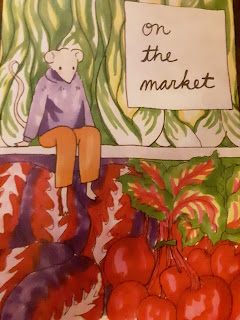
Emil O Melia is an example of a first-year CCS student who makes the most of the standard assignments. In On The Market, for example, this is the Aesop's Fable assignment about a young mouse who thought a rooster was threatening and a cat was friendly, until her mother told her not to judge appearances. Melia drew a story featuring anthropomorphic characters, as a mouse named Yon took a job at a farmer's market and was immediately seduced by a cat. The next day, when she was befriended by a rooster, the cat revealed that she was just trying to make her girlfriend jealous when she made out with Yon. It's a gentle jab of a story, one where Melia's delicate touch with their pencil and vivid use of colors carried the gently amusing narrative. 


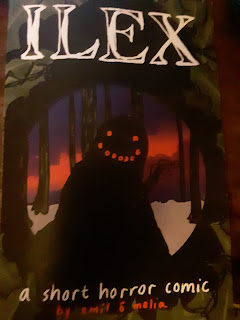
Ilex is the classic CCS application comic, which must feature a robot, a snowman, and a piece of fruit. Melia turned it into a horror comic. Melia spotted a snowman with a tangled piece of downed power line as an arm on a walk after contracting food poisoning. What they slowly realized was that the snowman's arm was dropping poisonous holly berries into their meds and tea in an effort to murder them. The comic doesn't outlive its welcome, and though it looks like it was drawn quickly and digitally, there's a spontaneity to the line that's appealing. 


Twin Flame is the Ed Emberley assignment. Melia really got into the spirit of absolute minimalism, with the slight cheat of relying heavily on color for narrative clarity. It's a story of two best friends who seem to have some kind of godlike or spiritual role in the world. Separated by distance, they meet in dreams and in the forms of their creations, who are all in their image. It's a touching, gentle romance of a story. Melia is clearly just trying to figure things out as an artist, but there's a light touch to their storytelling that's highly appealing.