Showing posts with label summer pierre. Show all posts

Monday, May 26, 2025

Jonathan Baylis' So Buttons #14

My review of Jonathan Baylis and his collaborators' new issue of So Buttons (#14) comes at a momentous time for the writer, as this issue was just nominated for an Eisner Award for Best Anthology. It's unusual for a self-published minicomic to be nominated for any award, so this is quite an achievement. The funny thing is that while I think it has his single best story to date, the issue as a whole is uneven. Or rather, the content of the first half is jarring compared to the content in the second half. That's understandable, given that the tonal shift occurred because Baylis' mother died while he was making the comic, and he chose to honor her with a memorable story and reprints of stories that featured her. 


The cover, by MariNaomi, is mixed photography and Shrinky-Dinks. It's an eloquent tribute to his mother, the pages of his comic scattered across the ocean. Baylis tries to frame the nature of the issue by framing it as "Life & Death," but as he points out in the afterword, the first part may as well have been called "Starfucker." Essentially, these are extended, amusing name-dropping stories. It wasn't any one story in particular that was bad, it's just that the whole theme, with this many stories, felt excessive and self-indulgent. 


The first story, drawn by Box Brown, was about his love of the Howard Stern show, and the producer, Gary Dell'Abate, in particular. This ties in with Baylis' stint working for the Topps card company, as he dropped off some Pamela Anderson trading cards. The actual anecdote where he meets Gary is exceedingly brief; this story is more a reflection of how much he liked the whole Stern experience. The whole aesthetic (Brown chose a yellow-orange palette that was vaguely nauseating) was off-putting, but then that's part of the Stern experience. 

The second story, with longtime partner T.J. Kirsch, was about how much he loved Chester Brown and how ironic it was that it was his wife, Ophira, who wound up meeting and interviewing him first. This wound up being a more interesting anecdote, as Baylis spotted him riding his bike to TCAF, and Brown slowed down, walked with him, and bought his comic! Kirsch's washed-out brownish hues were perfect for this story, and the whole point (comics is a small world, you should reach out to your heroes) is well-made. 


"So...Ballistic" is a mirror image of the previous story. Drawn by Sophia Glock, it's about Baylis' relative lack of interest toward the classic comic series Love & Rockets (amusingly, with Glock hectoring him about his lack of critical acumen). It's really just an excuse for the punchline of Baylis seeing Jaime Hernandez, asking him to look at a comic, and then being flustered when Jaime walks away with it. At two pages, it's just the right length. His collaboration with Craig Campbell about James Earl Jones was great when it focused on how Baylis was inspired by Jones overcoming his stutter (especially with Campbell putting on a cartooning clinic with multiple art stories and an impressive use of shading) and less so when it focused on Star Wars references (at this point, more than one is one too many). 


The second half of the issue kicks off with a sweet story drawn by Summer Pierre about Baylis teaching his young son about the concept of the "rally cap." Baylis has a real talent for taking a minor anecdote and turning it into either a solid punchline, a poignant moment, or a powerful memory.  Steven Arnold's cartooning for a story about a beloved former comic dealer who died had its moments (the bit where Baylis is drawn wearing his trademark cap at various ages was cute), but Baylis' text overwhelmed it in a way it doesn't usually do with his collaborators. 


"Take A Penny...Leave A Penny" is the piece Baylis wrote about the death of his mother, and it was drawn by Karl Christian Krumpholz. This was an excellent choice, because Krumpholz's dense and expressive style was a perfect match for this story. In the span of two pages, Baylis connected saving a young girl's life thanks to CPR training with seeing his mother suffering a stroke and dying in a way that felt organic and not overly mawkish. Krumpholz's use of dutch angles and thick lines for the opening segment but then decreasing his line weight for the latter part of the story was a nice way of smoothing out the narrative, and the brief flashbacks to previous stories featuring his mom was wonderfully restrained. Baylis let the moments speak for themselves. 

That's followed by reprints of those stories, which reminded the reader of the tenderness of Baylis' relationship to his mother. The final story, "So...Buttons" reveals to the reader the origin of the series' name, as it was something his mother said to him when he was sassing her about cleaning his room. The artist, Ayoko Nito, follows up on this origin story gag with a back cover joke featuring Baylis crouching on a rooftop like Batman. The back half of the issue was as good as anything as Baylis has ever written. Not just because of the subject matter, but because there was a lot less explaining of backstories and more letting things unfold on their own. 

Tuesday, October 11, 2022

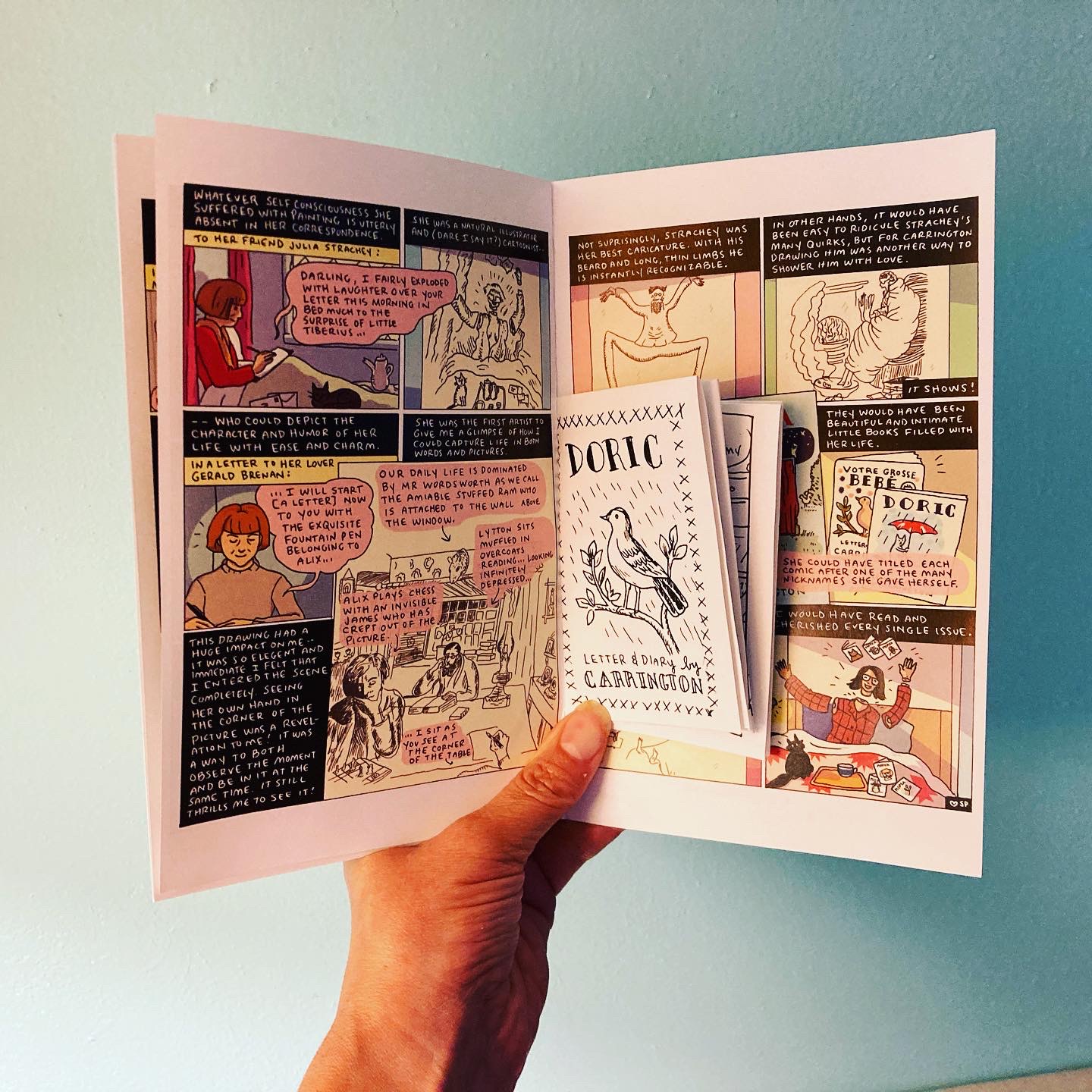
Summer Pierre's Carrington's World

This slender mini by Summer Pierre, Carrington's World, was nominated for an Ignatz Award in 2022. Pierre's clear-line style that allows just a bit of sketchiness is simply pure pleasure for me to read, especially when her comics are published in color as they are here. While Pierre is known for her pleasantly insightful memoir work, the comics I like best from her are what I call "autobiographical biographies." Thoroughly researched, and often using primary resources, these stories are not only insightful in their analysis of the subject and highly informational, they also offer up a glimpse into qualities that Pierre treasures most. By revealing what she admires to the reader, she often gives a clearer picture of herself than with conventional memoir comics. 


In this case, the subject is Dora Carrington, an artist in the famed Bloomsbury Circle in England that included Virginia Woolf, E.M. Forster, and others. Initially thought of just as the companion (?) of writer Lytton Strachey, she was also a painter and illustrator whose work was discouraged by a prominent critic. Pierre carefully untangles the sexism endemic to the era from the genuinely quirky (and likely neurodivergent) behavior of both Carrington and Strachey. Pierre's charming cartooning got me invested in caring about the life of this artist I knew nothing about before I read this comic, and her imagined encounters between these people is part of that charm. Pierre's lettering is also highly attractive, and alternating white lettering on a black background for the captions with black lettering on colored backgrounds in the panels and word balloons added weight to her authorial voice while strongly differentiating it from what she imagined these people were saying. 


Above all else, it is Pierre's delight in the ilustrated letters of Carrington that is the highlight of this story. She asserts that Carrington's caricatures and drawings that went along with her writing revealed a budding cartoonist. She imagines Carrington thriving in putting out quirky, funny minicomics that she might have enjoyed--and then inserts a micro-mini comic into the comic itself! I could read an entire volume of Pierre writing about other artists. The only thing I lamented in this comic was that Pierre needed a proofreader, as there were multiple spelling errors. Otherwise, Pierre followed her storytelling whims to some delightful places. 

Wednesday, October 10, 2018

Retrofit/Big Planet Comics: Summer Pierre's All The Sad Songs

Summer Pierre's short autobiographical vignettes in her minicomics series Paper Pencil Life have established her as a sensitive, philosophical and quirky presence in the ever-growing comics memoir genre. Her dedication to exploring her interior life creates its own set of narratives, often complete with punchlines. All The Sad Songs is her first extended work at over a hundred pages, and it's on the surface a love letter to the role that music has played in her life. Of course, what becomes evident about halfway through is that the book is really about Pierre's unprocessed PTSD and her subsequent treatment.

Pierre's art emphasizes a heavy use of black, dense hatching and a strong sense of atmosphere. At the same time, her figures are warm and inviting to look at, drawn in a beautifully clear style that accentuates gesture and expressiveness. The result is deeply intimate, as Pierre warmly welcomes the reader into her story and invites us to be there with her through every moment of pain and joy. There's little use of negative space, as Pierre asks the reader to immerse themselves into her world and memories. It's a daring approach for an entire book, but Pierre's gentle wit assures the reader that the experience will not be a suffocating one.

The running theme throughout the book is not just that music was something that had a powerful effect on her, even as a teen, but that it was something she felt the urge to share with others. As such, the book pays loving attention to the clunky old mix tape. It's a format that's now dead, but at the time, having the power to record music off the radio or an LP was remarkable, especially when portable formats became available. Moreover, a mixtape was a personal message: a juxtaposition of songs given new meaning by the intentionality of the person making them. It's a testament to the fact that editing is its own art form and means of expression, like a good editor with an anthology.

Mixtapes were a way of expressing excitement, affection (especially for new crushes) and friendship. And the technology had something to do with this particular expression, because it was often a tedious, long process to make a mix tape. Furthermore, when you listened to a mix tape, it wasn't easy to simply skip a track and go to another one if you didn't like a song. Listening to a mix tape was just as much of a commitment as making one. There were no other options for recording music until the CD burner came along and the digital music revolution. It's in this setting that Pierre's book takes place.

If her book is really about PTSD, then its twin themes are intentionality and seeking meaning. As a child of a musician and someone in the rock business, music was just something that was part of her natural atmosphere. It was like breathing; she didn't even have to think about it. As such Pierre notes that a lot of the mix tapes she made in her youth and young adulthood were a reflection of that river of music that was was floating down. It surrounded and carried her, rather than being something that felt like it was hers. For a young person, finding that song or band that just gets you can be a crucial process, one that she didn't achieve until the riot grrrl movement of the early and mid 1990s. More to the point, it pushed Pierre from the passive act of listening to actually learning how to play guitar.

That led her to become a part of Boston's folk music scene. She played every open-mic night, every bar, every shop that would let her play. The key section of the book is her articulating chasing the feeling "of being found, of being known, of being heard in songs", looking for a specific kind of sublime aesthetic experience that can't be forced; you must be lucky enough for it to reveal itself to you. It's an experience that binds song and listener together, conjuring from thin air a combination of words and melodies that explains how they feel as someone living in this world. For a moment, that itch in the back of one's brain is finally scratched. We have peeked behind the curtain and saw the glory of creation, and we get to remember it for a little while.

That feeling does not make us immune to pain and trauma, nor is it a cure for it. Leaning on it too heavily can be like any form of self-medication: effective until it reaches the point of diminished returns--and then no longer effective. Pierre describes in detail how denying one's own pain eventually comes at an enormous cost, one with somatic as well as psychological symptoms. For Pierre, she described this feeling of anger and betrayal that led to "the brick"--a feeling in the pit of her stomach that made it hard to breathe. It was a panic attack, brought on by years of PTSD being exacerbated by a continuous loop of bad relationship choices.

Music is something that was recommended to her by her first therapist, who used the "talking cure". At the time, music was the only thing that gave her pleasure and didn't cause anxiety. Her former loves writing and drawing led to those somatic experiences of PTSD as well. The problem was that Pierre sought validation, redemption and tranquility by chasing relationships, no matter how ill-advised they were. The more she chased the sublime as a means of self-medicating, the further away it got from her. It was only when she picked up, moved across the country and got a new therapist who focused on how her mind and body were out of synch that she began to get better. Focusing on mindfulness of her body when she felt anxious, breathing techniques and other meditative therapy made all the difference.

The book emphasizes that the experience of art, and music in particular, is an essential part of what it means to be human. Be it listening for that song that hears you or performing music as an expression of living in that joy, music has powerful, positive effects on us. What Pierre points out is that these effects are not the same thing as therapy, no matter how much we channel our emotions into it. Pain has to be dealt with openly and in a therapeutic setting as a way of putting us on the right course, and/or with the intervention of medication. Doing so allowed Pierre to write her first love song for a man who was leaving town and couldn't get involved with her.

It was a song about that feeling of sadness "without rage", without trying to get someone to do something, without trying to wound or lick a wound. It's a beautiful grace note of an ending, especially with the sly use of the book's framing device. The book was told in past tense as Pierre looked over her old mixtapes and letters, and one of the final images is a current image of her husband and son--and her husband looks an awful lot like that man who had to leave her many years ago. It's a beautiful grace note as she offers up music not as a cure, but as a hook--something that lets us know that we are alive, we are heard and we are seen. Sometimes that's all we need to point us in the right direction to make our lives better.

Wednesday, September 12, 2018

Fifteen Artists And Publishers To Seek Out At SPX 2018

As always, it's a pleasure to compile my annual list of artists and publishers to seek out at SPX. I always make an effort never to repeat a name, and that's a tribute to the continuing depth of talent in alt-comics these days. There are also a few veterans here and there who are making their first appearance.

1. Laura Lannes. Table B11-B. This Brazilian autobio cartoonist made a big splash with By Monday I'll Be Floating In The Hudson With The Other Garbage, a painfully honest account of a doomed relationship. Her acidic sense of humor and sharp observations about life as a single person combined with her loose, fuzzy line made for a remarkably coherent & memorable series of vignettes. I believe she'll have a new comic at this show. 

2. Leila Abdelrazaq. Table M13-A. She's a Palestinian cartoonist based in Detroit who specializes in personal and political strips about alienation, persecution and identity. She recently finished as the first-runner up for the Locher Award, given to editorial cartoonists under the age of 25.

3. Conundrum Press. Table W66-B. They are one of the most underrated publishers in comics, consistently releasing daring, unusual comics. They're known for publishing works in English for the first time, giving a platform for young Canadian cartoonists, reprinting key comics and collecting truly strange comics. I don't think publisher Andy Brown will be there, but Max de Radigues will be there, repping his book Weegee.

4. Richie Pope. Table E11-A. Pope's magnificent issue of Frontier about fatherhood was one of the most memorable of the entire series. I'm eager to see his other comics.

5. Perfectly Acceptable Press. Table N13-A. Publisher Matt Davis is one of the premier purveyors of exquisitely-produced art objects (via Risograph) that are also excellent comics.

6. Rina Ayuyang. Table W1-4. Rina's a long-time favorite of mine who is debuting a book from Drawn & Quarterly soon called Blame This On The Boogie. I also have the pleasure of being the moderator for a panel she's on.

7. Silver Sprocket. Table J1. Avi Ehrlich's punk DIY aesthetic is the engine behind this burgeoning publishing concern. He publishes the personal and the political.

8. Iona Fox. Table D13. She's one of the brightest young voices in the embarrassment of riches we as readers are enjoying with regard to memoir and diary comics. She draws from experiences that are quite different from the average city dweller.

9. Matt Emery. Table F2. He's the brains behind Pikitia Press from Australia, and he's introduced me to a number of excellent cartoonists.

10. Summer Pierre. Table I11-A. In a year where the theme of the programming is memoir and there are so many great cartoonists in that area, Pierre stands out as one of the best of the best. Her line is as engaging as her storytelling, which is full of wit and warmth.

11. M.S. Harkness. Table M12-B. Her Tinderella was a hilarious but poignant autobiographical book that was remarkably frank and upfront about desire, loneliness and the sheer indignity of dating.

12. Maria Hoey. Table L14. One half of the Coin-Op team, she will be there with a recent issue of the comic as well as the collection from Top Shelf. She's one of the best illustrators around.

13. Julia Kaye. Table N1-A. Her book Super Late Bloomer is one of my favorites regarding the experience of transitioning. Her line is endlessly fun to look at.

14. Taneka Stotts. Table I1-A. A fine writer in her own right, Stotts is also a superb editor. Her Elements: Fire rightfully won the Eisner award.

15. Fred Noland. Table G5-A. This is "Fredo's" first SPX in some time. His minis from the early 2000s were some of my favorites.

Wednesday, August 16, 2017

Minis: Summer Pierre, Colin Lidston


Paper Pencil Life #5, by Summer Pierre. Pierre's quickly become one of my favorite autobio artists, thanks to an approach that is full of warmth, wit and intelligence. Pierre's ability to balance light and dark on a page, as well as her cartoony self-caricature with figures drawn from photo reference, make every page a pleasurable experience to read. That ability to balance form and content in such an intuitive manner is rare, even in the rare strip that's heavy on text. Pierre works in vignettes focusing on a single topic, like "Dappled Light". I've reviewed this elsewhere, but its focus on the family TV sitcom as a form of escape for young Pierre was both poignant and understated, as her cute-as-a-button child caricature roved around the world of Leave It To Beaver, eating cake and taking naps in the Cleaver household as her abusive father was left behind.

"Radio Radio" is one of the wordier pieces, yet Pierre's skill in evoking the warmth she feels in not only hearing the songs that radio stations across the nation play, but also the sense of location and community they create, makes this comic enormously satisfying. Music is a big touchstone in this issue, as another story about her finding an old mixtape and remembering the friendship and incredible depth of musical knowledge of someone from years earlier once again was evoked by Pierre's use of blacks as she depicted a night drive. Pierre's ability to zero in on small but important moments, both past and present, is in the tradition of John Porcellino and Harvey Pekar. Whereas Porcellino is most interested in the poetry of the moment and Pekar the profundity that can be found in the ordinary, Pierre seems to be fascinated with mindfulness and soaking in the joy of a moment. Whether that moment is a series of fun thing she spontaneously did with her son or if it was remembering a moment that she felt lost as a person, there's a fundamental sense of gratitude, of being glad for the joy of existing that can be felt in her work.

The second half of the comic is interesting because it addresses the election of Donald Trump. Suddenly, quotidian and timeless observations became rooted in specific events. It reminded me, to a much lesser degree, of the career of Jen Sorensen. She mostly did silly, funny cartoons until George W. Bush got elected, and then went full-on political and hasn't stopped since. I don't think Pierre will ever move in that direction, but she did clearly start to use her drawing board as a kind of escape and therapy from how upset she felt about the election's results. Interestingly, her non-political strips really got back to basics: doing a strip about taking a run and the way it made her feel in the moment, as well as a "24 hours in the life" comic that crammed 40 panels into two pages. There were more comics about her son and family (like a touching story about her uncle). The strips were more directly about comfort, like drawing a scene from Love & Rockets are having a day to herself. The issue finishes up with "I'll Never Be Cool", a hilarious list of how and why Pierre is a hopeless square, and a comic about a party she attends in New York with Francoise Mouly and Art Spiegelman that takes a rather astounding turn before the reader is clued in on what's happening. That was Pierre having a little chuckle at the reader's expense, a sort of cheery wink at the reader that reveals that her sense of humor is more than intact. It's a great capper for a collection that's over fifty pages but never once feels stale or repetitive. Pierre is in a great groove right now, and hopefully she will keep it going.


The Age of Elves Issue Two, by Colin Lidston. This continues the slice of life saga of four high school friends who are avid role playing gamers, set in 2000. This comic is once again interesting because of the incredible amount of detail Lidston devotes to showing off his understanding of gaming, yet despite that it's not really about gaming. It's about relationships, and how the sort of person who views gaming as a major part of their lifestyle and identity interacts with others. There's social awkwardness to be sure, but there are also more nuanced, intragroup conflicts that arise thanks to seemingly trivial differences between group members. It's the paradox of gamer culture both being welcoming of outsiders but also frequently rigid with regard to thinking. That plays out in this comic in a long road trip to a huge gaming convention, as nerdy thought questions turn into arguments, with the two more conservative members of the group teaming up against the Goth guy.

Lidston reveals that there are both cracks and connections with everyone in the group, as the sole girl (Sarah) gets into it with the others when she critiques the awful writing from a panel description. There are times that the art got a little murky, as Lidston chose to go with a fairly heavy line weight throughout the issue. It didn't help that Lidston also chose to spot a lot of blacks on already-dense pages. That said, Lidston's line also had a spontaneous quality that allowed for expressive figure drawings. There's a sense that Lidston knows everything about these characters, down to the tiniest details, and that shows up on the page in terms of their body language and small facial expressions. That's the key to this comic, as long-term friendships among teens (especially among boys) are often dependent on that kind of visual signifier if they're unwilling to actually talk about their feelings.

Monday, October 24, 2016

Minis: Summer Pierre

I had the pleasure of meeting Summer Pierre at this year's SPX, and she gave me a couple of her minis. I first became aware of her when it was revealed that she was a judge at this year's show, and I wondered how she had escaped my notice considering that her kind of work is right up my alley and I know a lot of people in her circle. Her Paper Pencil Life #4 is a reflective, easy-going account of being an artist, a mother and a person with an inquisitive and open mind. It's difficult sometimes for me to put my finger on what makes a diary comic successful or interesting, but reading Pierre's comics started to make that clear: it's the quality of writing. There is always artifice in doing diary comics, as it is only "true" as far is it describes a certain event at a certain time from one person's perspective. The key is in that artifice to take some risks, to spill some ink and open up a space of vulnerability.

From the very first strip, the clarity of her writing and point of view shines through on the very topic of writing itself. Working from photo reference, she draws a number of female writers at work through the years, imagining herself in the same position. The irony of the strip is that its conclusion talks about how she gave up writing, knowing it would never happen, only to find her voice as a cartoonist. Pierre's usual working style is a Frank Santoro-style 3x3 grid, with elegant flourishes here and there and a penchant for filling up her panels with detail but also giving them just enough breathing room. In a strip where she used a lot of cross-hatching, the narrative captions are in white in order to easy the burden on the reader's eye. In another strip that had more negative white space, she used black captions with white print. Her line is simple, malleable and expressive, reminiscent of Jessica Abel's work. It's also clear that she's looked at John Porcellino's work, as she has a penchant for trying to be in the moment and write & draw about that. Pierre never gets to Porcellino's level of stillness, but it's obviously something she thinks about while her brain is whirring.

There's one interesting strip where she abandoned her naturalistic and expressive style for an Ivan Brunetti-style geometric approach, and it was a fascinating departure because it worked remarkably well. That style was a bit colder than her usual approach, however, and that warmth is key to her overall storytelling aims. Pierre isn't talking at the reader nor keeping them at arm's length; instead, one feels warmly welcomed, as though Pierre was a long-time friend who was catching us up on her life. Even that level of intimacy involves a certain performative aspect, as Pierre often couches her observations in funny stories like being constantly mistaken for Tina Fey. The same is true for "Kiss (Extended)", which is a meditation on the way friendships continue in gifts given--especially the gift of music, because it's a way of quickly accessing old memories. "How I Came To Comics" is another funny story, this time about Pierre's relationship with various arts in the form of anthropomorphic versions of comics, poetry, painting, music and fiction. This is Pierre at her best, her wit showing both in terms of the slightly ratty line and the funny conceptual nature of the strip.

While those are strong strips, I enjoy her quieter, more quotidian strips as well. Pierre's strips about improving her health and fitness, her obsession with coffee (a tired subject to be sure, but one that Pierre acquits herself well on), time spent with her friends, and musing on the town's energy after a big storm. While her son and husband show up quite a bit, they are very much secondary characters, as she prefers to think about her own reactions and feelings rather than delve too much into what they might be thinking. That said, family is something she thinks about a lot, usually in the context of a photo or other object that jogs a memory loose. That really gets at the heart of this comic, which finds Pierre either exploring a memory or desperately trying to stay present enough to hold onto that memory. The final strip more thoroughly explores that idea, as a long drive made mostly in silence finds her thinking about other trips and small kindnesses, as well as how different and better her life is now.

Memory is another key factor in her travel diary Souvenirs, as she points out that that word is French for "memories". Pierre discusses her struggle between trying to stay in the moment and connect with the various friends she was with on her trips to The Hague, Amsterdam and Paris and then later trying to record these memories. That struggle is evident on the page, as her drawing is understandably more rushed and far less confident than her other strips, especially as the book goes on. Her writing feels more scattered and there are fewer clever through-lines, and she finds few hooks in exploring the cities she's in as anything but a tourist (which is something she's trying to avoid). Pierre had trouble finding ways to distill the essence of each place she visited on the page in a meaningful way. What did come across loud and clear, especially in the Paris section, was just how much her friends meant to her. Especially as someone in her forties who doesn't have the benefit of being around old, close friends as much as they would like, that sense of living in a bubble of fun when hanging around them now was both giddy while she was in it and heartbreaking when she had to leave. She and her friend Mindy in Paris bonded mostly over food and simply being in each other's presence, and that got at something a cab driver said later in the book. He and others said that no Parisian is ever happy living there, that it's only a good place to visit. Pierre reflected on that without necessarily drawing any conclusions, but as someone who grew up in a place that depended a great deal on its tourist trade, tourist-oriented activities are almost always invisible to natives. It's impossible to stay present and focus on the beauty of a city like that when the city makes money off its beauty. Pierre asks, "It's still a kind of love, isn't it?" for a tourist to love a city, and it is. But it's not a lasting love; rather, it's a souvenir.

Even in an effort handicapped by illness, jetlag, fatigue and activity, Pierre's intelligence and inquisitive mind is on display. She's not afraid to to ask questions for which there are no immediate answers. There's a remarkable comfort in her drawing style, which mixes solid chops and excellent storytelling. In the ideal Pierre comic, everything moves at its own, languid pace, giving her the time and space to reflect both on the moment and the memories it triggers. Pierre certainly puts the lie to the notion that not having a traumatic life can make autobio boring, because she's making observations that anyone can relate to, even if their lives are nowhere near as comfortable as hers. Pierre's ability to write multipage stories does lead me to wonder if she's got the itch to do a longer narrative focusing on some key memories in her life; given her way of weaving themes in and out of her stories, I imagine it could be quite successful.