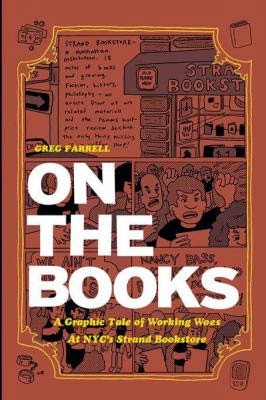
Greg Farrell is the sort of young cartoonist who started self-publishing minis that reflected the ways in which he was very much a work-in-progress. However, his devotion to comics showed in the way he worked relentlessly to become a better draftsman, cartoonist and writer. His On The Books, about his experience as part of a union working for New York's Strand bookstore, was a huge leap forward for him. It reflected a purposefulness that had been largely absent from his meandering earlier comics, and a cartoonist without agency is one who is going to flounder. Farrell's collection of shorter stories, Hipster!, reflects a similar level of maturity even as the subjects are much more familiar. Indeed, much of Farrell's early work focused on gag humor that he never quite got right, but his more personal stories had a raw energy and brutal honesty that was compelling.
Farrell takes that energy, refines it just a bit, and creates a loosely-crafted narrative that connects all of these stories. It begins with Farrell describing a life growing up in the Long Island suburbs and dreaming of moving to New York or Brooklyn. It's a life he describes in great detail, for good and ill. For example, "Plagued Out" describes the reality of living with roaches, mice, rats and other vermin in old apartments, with bedbugs being the most hated pest of all. The energy and immediacy of the city has many trade-offs for someone who is not extremely wealthy, and that includes the frequent necessity for getting flatmates and having to deal with noise from one's upstairs neighbors. None of these are exactly revolutionary subjects, but Farrell's blunt, cynical and funny takes on these subjects makes them worthwhile. Farrell has a slight air of detachment when telling these stories; often, the more upsetting the subject happens to be, the more Farrell makes it seem like it's happening to someone else.
That's true in his story about an abusive, mentally ill ex-girlfriend and their massively dysfunctional, toxic relationship. According to his narrative, she would often initiate physical abuse in her anger after issues threats and insults, and his aim was to diffuse it as much as possible until she calmed down and apologized--and then sex would generally ensue. Farrell is pretty matter-of-fact about the whole thing, backing up some of his claims with statistics, even if his is a narrative that's not common in everyday conversation. In many respects, this story is where his art shines. Farrell's art is ugly, blunt and direct. His aim is to tell a story by doing the basics in terms of figure work and not much more. This is a blunt and ugly story, and the grotesque qualities that Farrell brings to his art (the panels where he draws himself with an especially hairy ass stand out) bring out that raw ugliness in a way his more dispassionate prose does not.
Farrell writes lovingly about local restaurants, growing up with video games and the way it bonded him with his brothers, his obsession with a certain rap album, his relationship with marijuana and his experiences dealing with sensitivity to electronics. There's also a brutally on-point comic about the inevitability of humanity's destruction at the hands of climate change that was originally published in World War III Illustrated. Throughout the book, the reader is given a sense of being given a pleasantly rambling tour of Manhattan & Brooklyn as well as Farrell's own life. It's a tour for insiders, with a few popular tourist destinations here and there but mostly about hidden spots that tourists don't know about. Farrell touches on a lot of typical autobio topics, but he also veers off in some interesting directions. The book has an uneven quality at the end, as he starts writing essays (with a few support strips here and there) about teaching comics for the first time. This really merited a full narrative treatment, and I'm not sure why Farrell opted for the essay format. On the other hand, he wrote a fascinating essay about his dealings with legendary (and controversial) small press publisher Microcosm, who published On The Books and from whom he has received no royalties, thanks in part to a bad contract he signed. Cartoonists rarely talk openly about business like this, and once again Farrell's hyperbole-free, matter-of-fact attitude about the experience was interesting, especially in how it led him to crowdfunding this book. In fact, Farrell makes pointed arguments that publishers in general may be completely obsolete from a practical, not just moral position. Farrell is by no means a finished product as an artist, but one can definitely see that he's starting to find his voice.
Showing posts with label greg farrell. Show all posts
Tuesday, July 4, 2017
Monday, October 6, 2014
Activist Week: On The Books
Greg Farrell's book On The Books (Microcosm) is an interesting departure for a cartoonist best known for autobio and humor material. Both of those elements are still present in this story about a labor dispute at The Strand, the famous New York bookstore, but they're muted in favor of bigger issues. On The Books presents a struggle that's a microcosm of larger labor and wage equality movements happening in the US, along with protest moments like Occupy. While Farrell does his best to provide the historical background regarding The Strand's ownership and its unionized workers, the book is more journal than cohesive narrative. Farrell admits this up front, noting that opinions he held earlier in the book don't necessarily carry over as time went on. By setting himself as an unreliable narrator with his own personal stake in the events of the book (Farrell is an employee of The Strand), he makes the complex, murky and shifting elements of the struggle easier to understand. Farrell himself is unsure of the right moves to make, making this less a polemic than an attempt to understand the conflict, its components and the issues at stake.
The primary issue at stake was renegotiating the union's benefits contract with the store. The Strand, citing worldwide publishing downturns, wanted to introduce fairly harsh cutbacks and a new wage tier such that new employees would make less money. The struggle that Farrell and his co-workers faced was not only a management that appeared to be negotiating in bad faith, but union representatives who seemed disinterested at times and all too eager to roll over to management. The book details a variety of protests, worker meetings, dissemination of literature designed to inflame and unite his fellow workers at the store. All of this sounds heavy, and it is: people's livelihoods depended on the vote, and the workers were not in agreement regarding what the proper course of action was. The naturally goofy Farrell balances all of the seriousness with an elastic, cartoony line that frequently drops in gags and silly jokes to counter the dryness of the narrative. This approach doesn't always work and isn't always necessary, as many of the story's details are fascinating in their own right. For example, he plays it more or less straight when he describes The Strand's policy of turning on sprinklers early in the morning as a way of dispersing the homeless. At times, though Farrell overdoes it on trying to lighten the mood.
That said, Farrell's narrative voice is also angry and engaged, yet tuned into the concerns of those with other points of view. Those with families who depended on that job were less willing or able to take the time to join strategy sessions. Then there were their allies from Occupy Wall Street, including those with fringe political agendas that had nothing to do with the Strand workers' concerns. There was anger reserved for management, who used strategies designed to pit worker against worker, as well as union leadership, who frequently seemed arrogant, out of touch and unwilling to really help their constituents. Farrell starts off the book as somewhat skeptical toward those emphasizing direct action and protest, but by the end, he's full throttle in favor of resistance. This ideological shift comes through the background of protests (including a memorable May Day shutdown protest that paralyzed the store for hours), tactical disagreements, groups growing and then fizzling and management's ever-more-disingenuous negotiating tactics. Farrell printed minis of what later wound up in the book, and even those comics caused some controversy.
This is an ambitious book that at times feels more like a solid first draft instead of a finished product. Farrell's line is shaky at some points, especially when he tries to draw dozens of different characters. It's admirable that he tried to capture the voices (many different from his) of so many different people, but he didn't quite have the chops to pull it off effectively. Balancing satire and simple lampooning was also tricky. A running gag of changing the Strand's sign outside the store (Old Rare New) to something topical ("Used--like our staff") was one of the funnier devices he used. Somewhat unrelated gags in dialog proved to be distracting. Despite the book's aesthetic shortcomings, it was still fascinating to see Farrell document this struggle in real time while trying to inform the reader as to who all of the major players on both sides were while still offering up his own point of view. It's a remarkable, raw and emotionally charged account of a labor dispute from an insider who wanted to own his own narrative of a historically important struggle.
The primary issue at stake was renegotiating the union's benefits contract with the store. The Strand, citing worldwide publishing downturns, wanted to introduce fairly harsh cutbacks and a new wage tier such that new employees would make less money. The struggle that Farrell and his co-workers faced was not only a management that appeared to be negotiating in bad faith, but union representatives who seemed disinterested at times and all too eager to roll over to management. The book details a variety of protests, worker meetings, dissemination of literature designed to inflame and unite his fellow workers at the store. All of this sounds heavy, and it is: people's livelihoods depended on the vote, and the workers were not in agreement regarding what the proper course of action was. The naturally goofy Farrell balances all of the seriousness with an elastic, cartoony line that frequently drops in gags and silly jokes to counter the dryness of the narrative. This approach doesn't always work and isn't always necessary, as many of the story's details are fascinating in their own right. For example, he plays it more or less straight when he describes The Strand's policy of turning on sprinklers early in the morning as a way of dispersing the homeless. At times, though Farrell overdoes it on trying to lighten the mood.
That said, Farrell's narrative voice is also angry and engaged, yet tuned into the concerns of those with other points of view. Those with families who depended on that job were less willing or able to take the time to join strategy sessions. Then there were their allies from Occupy Wall Street, including those with fringe political agendas that had nothing to do with the Strand workers' concerns. There was anger reserved for management, who used strategies designed to pit worker against worker, as well as union leadership, who frequently seemed arrogant, out of touch and unwilling to really help their constituents. Farrell starts off the book as somewhat skeptical toward those emphasizing direct action and protest, but by the end, he's full throttle in favor of resistance. This ideological shift comes through the background of protests (including a memorable May Day shutdown protest that paralyzed the store for hours), tactical disagreements, groups growing and then fizzling and management's ever-more-disingenuous negotiating tactics. Farrell printed minis of what later wound up in the book, and even those comics caused some controversy.
This is an ambitious book that at times feels more like a solid first draft instead of a finished product. Farrell's line is shaky at some points, especially when he tries to draw dozens of different characters. It's admirable that he tried to capture the voices (many different from his) of so many different people, but he didn't quite have the chops to pull it off effectively. Balancing satire and simple lampooning was also tricky. A running gag of changing the Strand's sign outside the store (Old Rare New) to something topical ("Used--like our staff") was one of the funnier devices he used. Somewhat unrelated gags in dialog proved to be distracting. Despite the book's aesthetic shortcomings, it was still fascinating to see Farrell document this struggle in real time while trying to inform the reader as to who all of the major players on both sides were while still offering up his own point of view. It's a remarkable, raw and emotionally charged account of a labor dispute from an insider who wanted to own his own narrative of a historically important struggle.
Monday, October 14, 2013
Minicomics: Seitchik, Farrell, Skelly, Dinski, Taylor
Brendon and Going Rate, by Greg Farrell. There's no question that these comics are a major step forward for Ferrell. His Yo Burbalino comics had amusing moments, as it was clear that he was a good storyteller with no end of interesting anecdotes to share, but the stories felt rushed and the execution underworked. He also relied on the cheap joke and shock because they were both easy. With Brendon, a story obviously based partly on his own experiences (though it's explicitly noted as a work of fiction), Farrell retains the crude charms of his previous comics with a far greater sense of restraint and subtlety. This is a really sharp story that has a knowing sense of just how pre-teen boys relate to each other. The story revolves around a porn mag that "Greg" trades with the titular Brendon, a Hispanic kid who's become his best friend. Farrell homes in on the frequently homoerotic relationship young boys have with each other, even as there's a hyperawareness about not really being gay. That extends as far as actually performing sexual acts on each other as a sort of way of less expressing real attraction and more as a way of using their bodies. Farrell also relates tales of cruelty, betrayal and confusion, creating a book that is light on nostalgia and heavy on lives as they were lived, warts and all. Farrell keeps his line simple and utilitarian, rarely varying line weight or using many effects. Instead of using a grid, Farrell has an open page layout, which works because of the way memories and experiences bleed into each other.
While Brendon was Farrell's best effort to date, a look at his short story collection, Going Rate, reveals that this change didn't happen in a vacuum. "White Whale" is an interesting account of Farrell's obsession with one particular missing hip-hop album from his collection, and how he feel actually he after acquires it. "Jumbo Jockey" is about the B&H lunch counter in Manhattan, and Farrell does a great job capturing the essence of the place, the kind of food they serve and the sorts of people who eat there. "420" starts out as what seems to be another tedious story about someone's personal drug habits but turns into a story about personal responsibility and being a role model, all without taking on any kind of faux-moral tone. "I Am The Son Of A Small Business Owner" talks about the realities of the internet and corporations destroying small businesses and talks about the only way a small business can survive is to provide knowledgeable and personable customer service for those who happen upon their store. There are other, more-hastily drawn stories in the book, and while they're appropriately expressive, Farrell's line is too loose in those stories.
Children of Divorce and Still Life #1, by Daryl Seitchik. Seitchik is one of my favorite young cartoonists, and she flexes some different aspects of her talents in these two minis. Still Life has strips in the vein of her recent comic Sub: meditations that dip into magical realism and stream of consciousness thinking. Seitchik uses a very simple, fluid line in relaying stories about wanting to be a ghost (and how she suddenly realized that she had become one after getting high), hilariously overreacting to her toe going numb while watching a show in bed, and flashing back to remembering the sound of an ocean she heard in a beloved sea shell while using it as an ashtray while listening to music now. The way Seitchik draws herself as tiny goes beyond simply being short, as exemplified in the strip "Dinner With An Adult", where she draws herself as just a few inches tall, sitting in a gigantic chair opposite someone asking her if she's depressed and where she sees herself in ten years. These are comics about drifting, about the feeling of being betwixt and between. Fortunately for the reader, they are stylishly drawn and quite funny. The strip where the internet gives her possibilities for why her toe is numb is amusingly drawn, as she conflates "inflamed" with "enflamed" and draws herself on fire. In other strips, the way she spots blacks to create dramatic negative space is striking.
Children of Divorce is not quite as assured in terms of the drawing, but Seitchik displays some skill in the ways in which children act cruelly toward each other. The physical version of this comic is in black and white, which actually wound up flattering her character design a bit more than the way she used color online. The main character fancies herself a witch, giving out fortunes. While she's the lead, she's far from sympathetic, as she's jealous of her best friend giving attention to "Medusa", a girl with a lazy eye who is nonetheless one of the popular kids. I loved the way Seitchik drew thin, flailing limbs and skinny legs looping around. Best of all are her exaggerated faces with contortions worthy of Peter Bagge in some panels and subtle, tiny lines that nonetheless are packed with emotion in others. Seitchik will have a comic out with Oily Comics soon, and I imagine she will shine in that format, especially since she seems comfortable with her style and storytelling abilities. I'm interested in seeing what kinds of stories she'll tell from here.
Operation Margarine #2, #3, by Katie Skelly. Skelly seems really at home in this mod-inflected road story about two women whose paths cross in interesting ways. The first issue set things up for Margarine, a rich girl frequently kept in a mental institution by her mother, and Bon-Bon a tough girl on a motorcycle who simply punches out a guy who hassles her after selling her out. These issues set up what Skelly really wants to do: draw images of the open road, introduce mysterious guys with scars and stylish women with different-colored eyes to hassle them. There are motorcycle and arms dealers in the middle of the desert and a funny diner scene wherein a long-suffering waitress is made to look every bit as interesting as the leads. Skelly clearly loves combining glamor and menace, as Bon-Bon pretty much exudes that on every page. She's like a ronin on a motorcycle, waiting for something to do and someone to protect while trying to think about her past as little as possible. Margarine has been broken for so long that she's looking for someone to put her back together in an entirely different environment. Skelly really plays to her strengths as an artist here: character design, gesture and body language. She minimizes background detail in such a way that it's not lacking on the page when needed, but doesn't interfere with the two leads when she wants the reader to zero in on them. This series will be collected by AdHouse and will undoubtedly look great.
Alarm Clock, by Will Dinski. I've been reviewing Will Dinski's comics since I began High-Low over seven years ago, and he continues to produce thought-provoking, funny and occasionally disturbing work. This mini is a grab-bag of shorter work by Dinski, including an extended sketchbook section. The cover, a tribute to Gluyas Williams' work from the 1930s, leads to a hilarious punchline when one opens up the back cover as well. It's a well-designed gag that adds an enormous amount of character detail in the service of pulling the eye in one direction. Even though this is a series of shorts, Dinski manages a callback gag in the last story from the first in two stories that otherwise have nothing else to do with each other. One's a bit of hyperbole about a man who's always late and the extreme measures he takes to try to reset the clock, and the other's a droll bit of satire about a cruel but dim executive who prefers delegating unpleasant tasks to underlings. In general, each of the strips carries the titular quality of nothing happening and then alarms going off; In "Wait", a man is anxious to shake things up, but his friend tells him to sit still despite an ever-escalating series of crazy events, until the craziest event of all is an opportunity to act. "A Fine Job In The Execution" is about a watch and a conversation a man has with himself sitting alone in a room, imagining various men of authority praising his work.It's an inner dementia at work here, an alarmed mind that is stirred by a timepiece and a possible reminiscence of being a state executioner. Dinski uses a variety of color schemes here to reflect the action; the first story employs shockingly bright colors and exaggerated figures, while "Wait" employs a red and green scheme for key phases of the story, with green representing calm and red representing action. This is a fine sample of work from a smart cartoonist with an impeccable sense of design.
Stethoscope Microphone, by Whit Taylor. This is a real change of pace for Taylor, who generally tends to do autobio and semi-autobio comics. This is a comic about the rise and fall of The Doctors, the greatest funk band of all time, and Taylor takes every music trope she can think of, puts them in a blender, and sets it on Space Bass. Taylor throws in elements from Parliament-Funkadelic, Rick James, the Beatles and every other Behind the Music idea and lets the absurdity flow. Taylor works in color here, which gives her very thin line some definition and greater structure, allowing her to pull off the kind of images she needed for the story to work. Taylor isn't afraid to get very silly, making a woman adopting the persona of Betsy Ross as the main love interest of the narrator. Overall, this is a pleasant diversion that's actually quite well-researched in its own way, and fans of funk in particular will enjoys some of the references.
Labels:
daryl seitchik,
greg farrell,
katie skelly,
whit taylor,
will dinski
Subscribe to:
Posts (Atom)