Showing posts with label grant thomas. Show all posts

Friday, August 21, 2015

More Autobio: Durham Comics Project, Give Thanks, Grant Thomas

Give Thanks, by Philip Weiss. This is the first published comic of an artist who spent time at SAW (Sequential Artists Workshop), and while aspects of it are raw, it's clear that Weiss already has a few things going for him as a cartoonist. First, he's embraced his own style of cartooning and focuses on what's important on each page. Second, he understands how to depict body language, especially his own slumped body posture. Third, he understands how best to use restraint as a cartoonist. He doesn't over-render or over-explain this story. It's about Weiss avoiding his mother for some unspecified reason and spending Thanksgiving by himself. After watching TV and puts a lasagna in the oven, he goes out on a bike ride and eventually comes face-to-face with a bison. When he comes back home, he calls his mother and starts to unpack why he was avoiding her. The reason is never stated, nor was it necessary. The life-and-death nature of encountering such a huge and majestic creature and silently acknowledging each other's presence is not discussed, only depicted. Whether it was fear, or awe, or shock or some combination thereof, this was an experience that motivated Weiss from avoiding emotions to feeling them. It was obviously a potent enough memory to commit to the page.

The Durham Comics Project, edited by Amy Godfrey. I wrote the blurb for this anthology, and I think it's worth reprinting here: "The stories submitted for The Durham Comics Project range between whimsical observations about daily life, personal demons that make every day a struggle, a child's delight or disappointment in learning something new about the words, and an adult realizing that the world they live in is bigger than they think. Encouraging non-artists to express themselves on paper as well as publishing seasoned cartoonists, The Durham Comics Project is a fascinating mix of styles and visual approaches. In each case, the joy of self-expression and the opportunity to relate personal stories is evident in both the scrawled cartoons of young children and the fine lines of experienced artists."

To add a little background, Godfrey is a children's librarian here in Durham, NC. She's also a cartoonist. She's organized countless Drink 'n Draws and comics-related events at the library, including the yearly Comic Fest which has brought in the likes of Jason Lutes, Raina Telgemeier, Nate Powell, Nick Bertozzi, Willow Dawson and many others. She commissioned the creation of a device known as the Comics Contraption, an "infinite jam comics machine" that advances one panel at a time, so each person draws a single, large panel on a long scroll. The Durham Comics Project was born out of her interest in giving people who had never told their stories a chance to do so in comics form, as she ran classes and encouraged all comers to draw, regardless of ability. The end result was an anthology that's a snapshot of a particular group of people at a certain time and place. It's less interesting as comics qua comics than it is as a cultural document, since so many of the pieces were drawn by absolute newcomers, but it is intriguing nonetheless. The pieces by experienced cartoonists like Eric Knisley, Jape and M.R. Trower were unsurprisingly the best, but I loved Jesse Crossen's account of being recognized as the reincarnation of the friend of a famous Indian musician for its matter-of-factness in the face of weirdness. Bernard Liles' stick-figure account of just trying to hold on to his sanity is powerful; one gets the sense that he has rarely had an outlet with which to express himself. It's less an anthology of results and more of an anthology of process, which in itself worthy of interest.

Dodo #4, My Life In Records #3 and #4, by Grant Thomas.  Thomas is a comics formalist, interested in how the plastic qualities of the comic itself affect the narrative and reading experience, as well as how different narrative tricks play out. In Dodo, Thomas, uses a brush and ever-splotchier ink to tell a story about how the raven and the loon got their colors, which involves a brush getting disturbed and flinging ink. "Oblique Strategies" is a palindrome, in which the drawings in the panels read the same backward and forwards, with only the text changing. Then there was a strip, heavily festooned with decorative flourishes that play up the religious art quality of the subject, that's about a monk who "for 3 years kept a stone in his mouth in order to teach himself silence." Thomas uses this as a chance to rapidly cycle through variations on this idea. Here, you can see Thomas stretch and explore comics in clever ways that don't outstay their welcome.

He turned his autobio-by-way-of-music into what he describes as thinly-veiled autobio in his series My Life In Records. Each square-bound mini is meant to mimic an old fashioned CD booklet. The concept of each issue is fascinating: the third issue is about how Star Wars proved to be a formative experience in different anecdotes surrounding relatives, music and pets. It's less about the movies than it was about those memories being with his grandfather and brother. The fourth issue is all about growing up Christian and being taught that rock and roll was the devil's music, but also finding inspiration and solace in Christian music. That slight veil of fiction works well in this regard, allowing Thomas some poetic license with regard to specific events and feelings to create a narrative that has an emotional honesty. The problem with these comics is that going to color was a disastrous idea. His color scheme is at once too conventional and way too all over the place, and his line simply isn't strong enough to withstand it. Every page looks like a mess, especially when he tries to draw famous rock stars. This is a case of the production values overwhelming the work rather than enhancing it.

Friday, May 17, 2013

Comics-as-Poetry: Rothman, DW, Thomas, Bean


Abzernad, by DW (Hic 'n Hoc). DW's first full-length comic is like a cross between Gary Panter, Will Elder, Jim Woodring and psychedelic art (what he calls "psychedoodles"). Each page is its own puzzling mix of psychedelic wave drawings, scratchily-drawn and slightly amorphous characters, found text impositions, and eye-pops hidden in wave after wave of drawing. There is a kind of narrative carry on from page to page, as the main character is featured interacting with both words and images, but the effect is almost like discovering a series of mysterious cave drawings. Some of the text is random, but much of it obliquely comments on the action on the page, especially the many excerpts for a sort of mask to be worn at night to help with one's skin commenting on the waves of destruction on each page. The comic also has a densely visceral quality, as there are many scenes of cartoonish violence, predation, and other ordeals.  At the end, it feels like the main character (and the reader) have survived a harrowing rite of passage that was as much about the psychological makeup of the main character as it was about its physical presence. It's DW's most ambitious work to date, to be sure, and it coheres in a way that's surprising


Dodo Comics #3, by Grant Thomas. This is an all-abstract comics issue, as Thomas carefully uses panel placement and design as a kind of anchor for the abstract images he places into each one. Much like John Hankiewicz, he uses panels and marks to create a kind of visual rhythm, something that's emphasized by titling each piece as a sonnet or "untitled poem". Thomas especially seems to like rising and falling of lines and splotches from panel to panel, "rhyming" them throughout the piece in a complex and intuitive manner. The reading experience is explicitly shaped by the number of panels and tiers he uses on each page. The first "sonnet" has four tiers with 3/2/3/3 panels on each respective tier; the second page goes 3/3/3/3, the third page 4/4/4/4 and the final page has two tiers going 4/2. That rising and falling of each mage allows one to think of the lines as water, wind or anything that flows. That's even more explicit in the other pieces, where a definite sense of motion is implied from panel to panel, even if that motion is ultimately static. I don't get a sense that Thomas is going after provoking an emotional reaction (despite the use of the nomenclature of poetry), but is rather more interested in a more visceral reaction to the way lines on paper react against other lines and the expectation of the reader for a sequential narrative when we see one panel placed after another. These are explicit abstractions, and what they're abstractions of is entirely up to the reader. That's what makes comics like this so interesting to read.


Watching What You Say, by Alexander Rothman. This is a "versequential" book of comics-as-poetry by Rothman, who very carefully tries to balance word and image off of each other in a series of short, snappy works. Rothman spares no expense in this limited run of minis, using full color for every strip. Some of the poems are narratives: I love the phrase "On the last day of the Great Depression"; it reifies an amorphous historical period in a visceral way as a farmer drowns his no longer utilitarian bees. The story/poem "Still, Small" cycles through a group of people sitting in a church pew, "waiting in a field of quiet fires for a glimpse of the flowering fern". The illustrations here are a bit on the nose with relation to the fantastical, metaphorical language of the text, but they nonetheless get across that anxiousness one feels in trying to connect with the divine. On the other hand, the text for "Muses" hilariously acts against the text, introducing the author both as a kind of monkey and someone who draws inspiration from a certain kind of thought. "Praise Poem" uses a nearly static image of a turtle to depict a quick deceleration and a sense of awe as the narrator runs into it. "Processing" takes some sensitive prose and drives it way over the top with the page-stuffing depictions of a chicken getting gutted. It's not that the images themselves were inappropriate, it's that Rothman unnecessarily lays it on a little thick. All told, there's an enormous amount of potential to be had with Rothman's technique. His best works are those where text and image don't repeat each other, but instead reveal different aspects of the same event in interesting ways, like in "Euglossine Bees". In his work, Rothman is trying to reveal something about how we relate to nature, both intentionally and inevitably. That's an ambitious topic to tackle, and this comic is the result of Rothman experimenting with any number of different methods in getting at that elusive relationship. Some succeed more than others, but he's certainly on to something here.

Gorilla Year #1-2, by Cara Bean. This is an amusing stream-of-consciousness series wherein the author gets involved in a series of gorilla-related situations. In the first issue, Bean writes a short auto-bio strip that basically answers the question of "Why Gorillas?" When in art school, she decided to observe gorillas as part of an animal behavior class, an activity she found comforting in the face of anxiety. It wasn't until years later, when she started making comics, that it occurred to her to incorporate these images into a sequential narrative. The results remind me a bit of the surreal storytelling one sees in an Eric Haven comic: there's a slightly sketchy but naturalistic line telling a story where strange events flow into other strange events. The main character watches a movie starring herself turn into a gorilla, which leads that character to witness Mount Rainier erupt and a giant gorilla emerge. Then we see her back in the audience, where her fellow audience members are squirrels, gorillas, cats or dogs. There's a nice fluidity in the story, as Bean's stand-in is always moving forward, leaning at an angle that keeps the reader's eye propelled along the page. She later gets literally swept up by music, boards a bus that says "Finish Art School" and finds herself surrounded by gorillas. I took these images to mean that she surrounded herself with positive and comforting images and events in the face of doubt, fear and even loneliness. Drawing them in a story is almost a way of summoning these comforting feelings and concretizing them in a way that's funny but still very personally meaningful.

The second issue goes into more depth regarding that tumultuous time in a variety of clever ways that still manage to eschew a lot of standard narrative devices. The first story sees Bean walking through an art museum where all the pieces have narrative captions aimed directly at her. Most of the pieces are scenes of nature, but some include drawings of alcohol, food ("secret sadness snacks") and coffee leading the uncomfortable narrative that essentially zeroes in on her every weakness and attempt to mask those weaknesses. The piece segues into her feeling trapped, as though in a cage, which leads back to the narrative of drawing gorillas becoming a therapeutic method of dealing with the tumult in her life and the fact that she is unable to discuss it with anyone. The next story involves gorillas explicating an essay about conceptual art in her fluid but dynamic style, a juxtaposition that I found amusing. The last pieces in the book deal more directly with her art school difficulties, like being forced to live in her school art studio in secret. It's written in a sort of deadpan, matter-of-fact manner in the present tense, even as her being unable to sleep leads her to become unhinged. There's a great scene where Bean shrinks in size at dinner, beds down with a napkin and kisses the fork goodnight as she falls asleep. It's this kind of whimsy and magical realism that makes so many of her stories so memorable.While her comics have more straightforward narrative trappings than the other comics on this list, there's no question that her use of imagery and the way she juxtaposes it against text act to create an entirely different kind of meaning than either one on their own.

Friday, August 24, 2012

Autobio Minis: Cohen, Thomas, Williams, Yanow


Primahood #1 & #2, by Tyler Cohen.  These are attractively drawn & colored, slightly trippy and brutally true accounts of being the mother of a young girl. Interspersing her "observations" of the Primazons (a fantasy overlay of her interactions with mothers and their children) with her own stories about raising her "fierce" daughter, Cohen's stories ring true precisely because a parent has only so much control over a child's beliefs, behaviors and fantasy life. A progressive feminist, Cohen is alarmed when her daughter picks up concepts like princesses, marriage and other heteronormative, stereotypically gendered ideas from pre-school. At the same time, Cohen's refusal to bottle up or force her daughter to conform (or in this case, not conform) to societal norms allows her to retain a certain wild individuality, where even the most stereotypically feminine concepts are warped through her daughter's quirky lens.

The second issue is conceptually tighter and better drawn than the first, which isn't surprising considering that the first issue was Cohen's return to comics after years away from the drawing table. Cohen is very clearly interested in the concept of play as a serious form of activity vital to the sanity of children, and views it through her Primazon lens: as a sort of tribal activity performed by untamed and almost feral females. They are all almost entirely naked, other than decorative trappings, with abstract and vaguely animalistic heads. It's a way of making these otherwise familiar forms feel slightly alien and Other. It's a tribe that one cannot ask to join, but that one is forced into when one has children. Play is at the heart of the second issue, and the concluding story "Miss Education" (concerning her daughter's entry into kindergarten and all the new questions it raises) switches between particularly distressing and difficult anecdotes with Primazons playing a hand-slapping and rhyming game/ritual. This is a great take on the newly-burgeoning motherhood comics sub-genre, joining the likes of Lauren Weinstein, Carol Tyler and Francesca Cassavetti in providing an honest look at what it's like as a mother and as an observer of a child's behavior. I hope Cohen keeps this going.

My Life In Records #2: Into My Heart, by Grant Thomas.  Thomas writes autobio stories with the hook that they're mediated through his memories of how music has affected his life. This issue deals with the intersection between two critical events: his near-death by drowning when he was a toddler and his childhood fascination with the actual mechanics of how Jesus enters one's heart. This is a full-color comic, something that is irrelevant (and sometimes even distracting) on some pages but is crucial during those sequences where he's falling deeper into the swimming pool, the water taking on sickly dark blue and green hues. Thomas segues from that event into discussing how a particular christian record aimed at children made such a big impact on him, in part because it came with its own set of crayons. What follows after that is Thomas recreating the sort of theological debate a child might has when debating whether or not to (literally?) open up one's heart and let Jesus live there. His slightly older brother (like Thomas, depicted wearing a bunny mask), explains in his own way about the concept of the Holy Ghost, adding a level of complexity to young Grant's world (good ghosts and bad ghosts?). All of this leads up to his choice of becoming baptized, which in many Protestant circles, involves full submersion. There are some more beautiful pages with the background of a lake, the words of the song "Come Into My Heart Lord Jesus" melding into the background before they loop into a record player, and young Grant practicing baptism in his own bathtub. The final image is one of relief as much as it is joy--a fear conquered and a new step taken in spiritual development. Thomas is deliberately vague as to whether religion continues to be important in his life, but that wasn't relevant to the conflict presented in this issue: fear vs faith. The baptism, as experienced by Thomas here, was a sort of shock therapy after he had prepared for the moment, in much the same way therapists try to help people with phobias of any kind.

Hungry Bottom Comics, by Eric Kostiuk Williams. I've read a number of autobio comics from gay cartoonists detailing coming-out experiences, the awkwardness and excitement of cruising and how one manages to deal with one's own feelings of self-loathing, but Williams' account of his experiences is my favorite. That's because of his wit, his intelligence, his hard self-reflection and a naturalistic drawing style that nonetheless has a rubbery quality to it that allows for some flights of fancy. Indeed, his style reminds me a bit of Phoebe Gloeckner in terms of both his figure work and the way he blends text and image to create a slightly dreamy whole. This collection of strips mixes in single-panel gags about experiencing life as a young gay man, gently mocking both himself and the scene as a whole, with longer and more introspective stories. There's a rough chronology here as his coming-out story with his mom is toward the beginning, and it is hilarious. The fact that his mom basically browbeats him into coming out while washing dishes is alleviated by the fact that Williams depicts her as glamorous singer Kelly Rowland (with the disclaimer; "May not actually resemble Kelly Rowland.")

Those longer pieces highlight Williams' philosophical take on being gay, quoting Camille Paglia and Jean Genet at length, while still going into great detail about clubbing, cruising, drinking, and having lots of anonymous sex. His comics about dating and the disconnect between many gay men's private and sexual spheres are especially thought-provoking, leading to his account of being in a relationship and the unique joys and heartaches that experience generated. When he has an AIDS scare after a condom broke, it understandably forced him to reevaluate himself and the scene; memorably, he excoriates both for pretending that AIDS was over, slowly shifting a scene of dancers at a club into iconic Keith Haring figures. The comic concludes with the campy yet highly self-analytical strip where a despondent Williams meets his "diva totem", who forces him to confront his shame and self-loathing about his own feminimity.  Williams is careful to note that the lesson to be learned here is not simply self-acceptance, but also "admitting the extent to which I've been complicit in instances of cowardice and disrespect". That's heady stuff for such a young person to have come to grips with, but I think his own sense of humor about himself (the title of the comic comes from a vaguely insulting thing someone said to him once) is what makes that possible. The humorous, philosophical, sexual and quotidian aspects of his life all come into play in this comic, as Williams ultimately rejects the sort of cordoning off of one's life that many in the scene choose to do.  I hope he continues to juggle all of these concerns in his future work.

In Situ #2, by Sophie Yanow.  Yanow is one of my favorite new autobio artists, thanks to her interesting stylistic choices, poetic narrative choices and her intense desire to merge personal and political concerns. Generally holding to a six-panel grid, Yanow often fractures her narratives by eliding words, stretching words out over time and space through panel-to-panel transitions, crossing out words and making clear scratch-outs in her art, and numerous other tricks to indicate the flow of consciousness and a genuine sense of inner conflict. Living away from her beloved home city of Oakland in its hour of its greatest political uprising and awareness, Yanow feels guilt for not being there as well as frequent contentment in the equally-bustling and creativity-sparking city of Montreal. There are lighter-hearted moments, of course, especially those that address her sex life and sexual identity. There's one scene where she and a lover are having an inane, drunken conversation where Yanow winds up thinking to herself "Oh my god...really?"; as in all of her strips, Yanow depicts herself wearing glasses that obscure her eyes to distance herself slightly from the reader in the tradition of Harold Gray's Little Orphan Annie. The next strip, where she and her lover are lying in bed listening to Joni Mitchell lyrics, prompts her lover to exclaim "What is this self-made lesbian hell?" Yanow reflects on her health, her feelings of weakness, her battle with depression, her conflicting feelings about being with others, and the politics of wearing a jacket with a Neil Young patch at a doom metal show. Yanow is part John Porcellino, part Gabrielle Bell, and her work is some of the most exciting from the autobio arm of alt-comics today.

Sunday, April 15, 2012

A Couple of Worthy Fundraisers

Just wanted to bring a couple of worthy fundraisers to your attention.


First, Sparkplug is still about $5,000 away from meeting their goal of fully funding their next three projects. This is their first publishing effort since the death of Dylan Williams and meeting their goal would go a long way in allowing them to continue to publish new work. The perks included in this fundraiser are pretty great, so please consider donating.

Second, interesting new cartoonist Grant Thomas is trying to fund the second issue of his series My Life In Records. I reviewed his work here, including the first issue of his series. Check it out.

Monday, January 30, 2012

Three Minis By Grant Thomas

Grant Thomas is a cartoonist who enjoys working with and around formal constraints to achieve varying effects. His one-man anthology series Dodo provides a grab-bag of stories told in such a manner, revealing his interest in the way other arts can be expressed through comics. In #2, his "Homage To Leone" is a series of panels derived from the Sergio Leone "spaghetti Western" The Good, The Bad and the Ugly. Given that that film is famous for its tight close-ups on the principal actors, it was only natural to take that a step further and freeze those famous images on paper. I like the looseness of Thomas' pencils here in avoiding a simple copy of frames, but he loses it a bit in the final panel with a figure that's too sloppy. "Drawing From Life" is an amusing but unremarkable anecdote about art school and nude models, with a whimsical line that heightens the humor of the situation. "Visions of Johanna's Concert" is a Comics Pantoum, which involves a repetition of panels from line to line in a specific, rigid pattern. It's comics-as-poetry of a different kind, emphasizing form over content. That form was somewhat interesting but ultimately didn't make much of an impact in terms of how the strip was read. "Why Have You Shut Your Eyes?" shows Thomas using a more decorative line as a sort of homage to religious art in this anecdote about an encounter between a man and a demon.


His mini My Life In Records #1 has a much tighter focus: autobiography as mediated by his experience listening to records. Starting from his earliest memories, this issue focuses on anecdotes about him and his younger brother. They are represented as anthropomorphic versions of the stuffed animals they held dear: in Thomas' case, a rabbit, and in his brother's case, a bear. It looks very much like they're wearing animal masks, a familiar but effective trope. This book reminds me a bit of Jesse Reklaw's Couch Tag autobio series in that deeper personal truths are expressed through a mediating factor of some kind, but there's not much darkness to be found in this comic. Indeed, it's more a spirited tribute to his brother and the memories they shared experiencing and creating art. That creativity is at the heart of Thomas' work, a kind of restlessness that demands thinking about storytelling in a number of different ways and trying to find any number of different methods of expressing oneself.


As a cartoonist, Thomas' formal thinking sometimes exceeds the grasp of his draftsmanship. Some of his images look over-rendered and more under-rendered, as though he's struggling to find a style that he's fully comfortable with. That struggle emerges in the micro-mini Submarine, which cleverly folds in on itself to amusingly tell the tale of a doomed vessel. The drawings themselves just aren't quite interesting enough to hold my attention, nor is the joke beyond the format itself funny enough to prevent that from mattering. Thomas is certainly getting more assured as he continues to experiment in public, and I expect his formal boldness to match up with the maturity of his linework sooner rather than later.

Saturday, August 20, 2011

Comics-As-Poetry: Badman, Moulger Digest, G. Thomas, Moreton

More cartoonists are engaging in the creation of comics-as-poetry. That's both in terms of trying to come up with formal constraints that act like rules such as meter and rhyme scheme in standard poetry, as well as giving the reader images that they must parse and attempt to understand on their own. Here are a few recent examples.


The Escapologist #1, by Simon Moreton. This is Moreton's most explicit dip into comics-as-poetry, dipping into the playbooks of Warren Craghead and Kevin Huizenga here. This 10-page mini follows the author dissolving into a ghost-like figured trailed by lines, squiggles, symbols and geometric figures (the kind of lines you might see in a Craghead story/poem) and concentrates on the phenomenology of everyday observation. As we see the ghost/spirit drift out over the city and then the sea, Moreton ties the carefully-rendered naturalistic drawings with brief lines of text, noting "These dunes/this sea/this paper, this ink/these lines/we hold it all together/just being". The idea that our own observations of the world create that world in much the same way that the artist creates the images on the page is an interesting one. More to the point, the close observation of the environment qua environment (as opposed to our everyday use of the environment) is posited as a valuable end in and of itself, whose smallest details might yield interesting connections. Moreton's line is especially sharp in this comic, featuring enough detail to give the reader the flavor of each observed setting without drowning it in too many lines.


Dodo Comics #1, by Grant Thomas. This is a highly structured series of strips that each feature a different set of formal constraints. The intent is to create a visual rhyme scheme and meter for comics in some, and to emphasize certain aspects of the comics reading experience in others. For example, "Where Do Ideas Come From?" uses a scheme called "reducto", which alternates between a medium shot and a close-up of either one or many figures, closing with a shot with no entities in the final panel on the page. It's an interesting idea, although the resulting comic here is mostly fluff and not especially interesting to look at. More successful is "Visions of Gehanna", a reinterpretation of a Bob Dylan song as a vision of hell. Here, Thomas employs smudges to interesting effect, duplicating the original song's suffocating quality through visuals. "The Duel" and "Chase" were also interesting, as Thomas took panels from other comics and removed every thing from them except speed lines, rain lines and indicators of light. Given just the title of each, it's quite easy to contextualize it in terms of the stated subject.


Untitled by Rusty Jordan & Andrew Smith. This is a flip-book, where each artist does half of the mini. Jordan's half features figures heavily influenced by underground figures like Robert Crumb but also appropriates the rubber-faced and lipped aspects of how black characters were once drawn in comic strips. The character in this story is not written so as to be explicitly African-American, and that distinction adds a bit of key dissonance to the proceedings, because there's a disconnect between image and story. Smith is one of the few cartoonists who focuses on scatology whose work I actually like, because he goes beyond simply doing a shit joke and creates something a bit more transgressive. Smith is an ace draftsman but goes deliberately simple and crude for this story involving a woman jogging who is accosted by a would-be rapist. She oddly bends over for him, only to violently defecate in his face. Given the way that Smith keeps the dialogue deliberately light and banal, this image becomes all the more powerful and hilarious. It's a gag-inducing gag and an effective one at that.

Moulger Bag Digest #3, by Brent Harada & Rusty Jordan. This is an almost wordless, densely drawn comics that features a series of very loose narratives. The emphasis here is on the reader's reaction to individual images and then reprocessing them as a gestalt on the page. One of the key recurring motifs is the way images break down: fracturing, going into fractals, melting, warping, etc. Harada & Jordan employ a number of familiar techniques here, including collage, psychedelic art (in terms of both op-art effects as well as Skip Williamson-style figures), comics-as-poetry "rhyming" (like when a plant and then a chair act as stand-ins for a lonely man and his life) and sheer, grotesque figure-work. I found this to be the most refined and approachable of their comics, which probably has something to do with their approach as well as something to do with the way my approach to comics like this has changed.


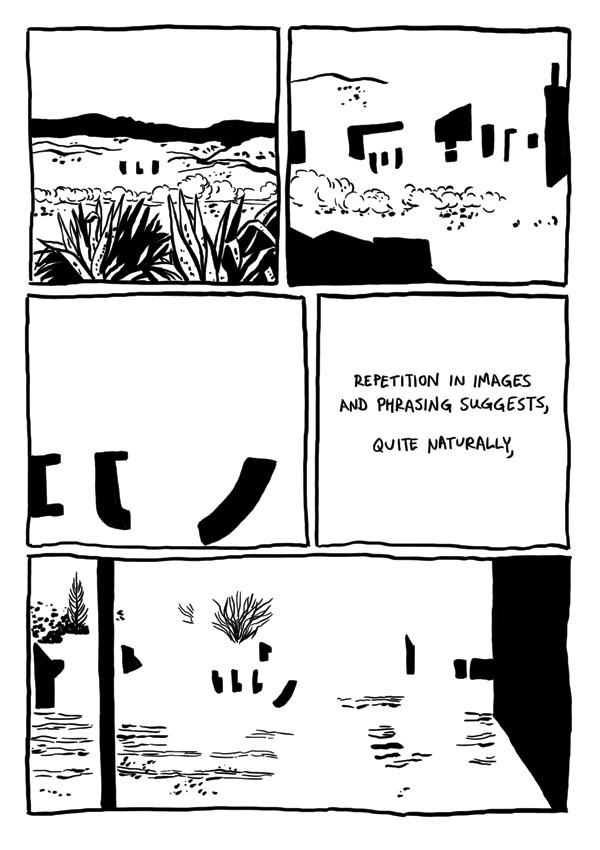
Badman's Cave, by Derik Badman. This was the most interesting instance of comics-as-poetry in the group, given its ambition and complexity. Badman reinterpreted the art from a Jesse Marsh-drawn issue of Gene Autry Comics and placed in text from random internet searches. Like Thomas, he removed the original figures from his drawings. Badman goes a step further by mixing the Western backgrounds of mountains, deserts, forests and traditional town with abstractions. Clouds and dust drift by almost sentiently, while buildings turn into geometric figures as Badman makes extensive use of blacks to get the eye to roll across the page. Badman's selection of prose is also quite interesting, as he comments on the repetition and "rhyming" of images by noting that "the world speaks, but mysteriously, incompletely closely associated with a metaphor within." As the comic flips between abstract and concrete, Badman is suggesting a greater sense of connection between the two worlds, an essentially mysterious connection "grasped in repetition, images and phrasing suggests a glimpse of the dark portraying the gods". Meditating on and considering the images can provide, in flashes, that deeper sense of connection between the conceptual and the real, the perceived and the actual, between time and place. The mini would have benefited from better paper and darker, richer blacks to make that black/white contrast really pop on the page. I think it would also have made his individual images a bit more distinctive. Still, this is Badman's most fascinating and successful comics experiment to date.