Showing posts with label emily zea. Show all posts

Friday, January 10, 2025

45 Days Of CCS, #41: Fantology 4

The fourth volume of Fantology is probably the weakest volume overall, but there's still plenty of interesting material in there. A lot of it felt strangely rushed; there were numerous spelling errors and the margins were so tight that I couldn't read some of the stuff toward the middle. Some of the pieces were so sloppy that I was surprised they were published, and the sequencing of the stories also felt somewhat off-kilter. That said, the best stories were excellent, and the overall concept remains sound. 


This is an anthology of fantasy stories set in the same world, based around a central map. Some of the stories are continuing serials, and others are one-shots. This volume's theme is "maps," which is a great theme for a fantasy anthology. There are a number of non-CCS folks in here as well, but I'll start with CCS artists first. Whiteley Foster kicks off the book with a 7-page story that simultaneously feels like it's too long and totally insubstantial. It's about two characters arguing about taking a job as surveyors. Her character design is so Disney-cute and exaggerated that it was hard to see them as characters. Alex Washburn's latest Clan Zargs chapter is something I covered earlier in this feature, but suffice it to say that he makes great use of the map to further his narrative, and the focus on surprising character twists added a lot of spice. 


Carl Antonowicz's unsurprisingly downbeat story follows a religious pilgrim and two servants going on a quest in a deadly desert. The attention he lavishes on world-building is actually a clever misdirection, as the quest itself ends in failure. It's the relationship between the characters that's most interesting. I wasn't crazy about his use of a digital font considering how sketchy his linework was. 


Catalina Rufin has another winning entry in her Barbarian Family series. With the burly barbarian dad Brono and his teen daughter Satu going on a map-led quest, Rufin explores family dynamics in a way that transcends the usual limits of the genre. With Brono harshly critical of Satu's ideas, Satu is vulnerable to a deep gnome's sweet words and promise of magic. Rufin asks some tough questions here, and her character design is sharp and expressive. 


Rainer Kannenstine sketchy and cartoony story about a lonely explorer in over his head in a dungeon takes advantage of old-school Dungeons & Dragons map construction to build the narrative. The looseness of the art gives it a lot of energy and helps play up its whimsical, funny aspects. It even has a genuinely emotional end.


It was such a pleasure to see co-editor Kristen Shull return to her serial. It's about a down-on-her-luck mage and her unlikely partnership with a princess whose quest is to assassinate a god to save her people. Even switching over to drawing digitally and working with a surprising lack of detail, Shull shines doing fantasy work in a way she doesn't in other genres. Her pacing, her understanding of how to depict action, her sense of humor, and her flair for the dramatic make each chapter a rousing success. 


As for the rest, there are a few highlights. F.Ostby's story about young rabbits exploring a forest at night for a treasure rachets up the tension but has a delightful payoff, with a pleasant mix of cartoony characters and a naturalistic setting. Niloufar Lari & Soroush Elyasi have perhaps the best-looking strip in the book, and it's about a quest of transformation and the intimacy of dance; only the digital font detracts from its elegance. Emily Claire's short story about a soldier finding his way back to his lover after three years is quietly devastating. PMK's bar crawl story is hilarious and exceptionally well-cartooned, and it embraces the map concept fully. Finally, Stephen Pellnat's story is a masterful piece of narrative misdirection. The cartooning is excellent, and the swerve is set up early on in a way that is easy to ignore. I missed a few serials from previous issues, which likely led to some replacements, but hopefully, they will be followed up on in the next volume. 


Monday, December 26, 2022

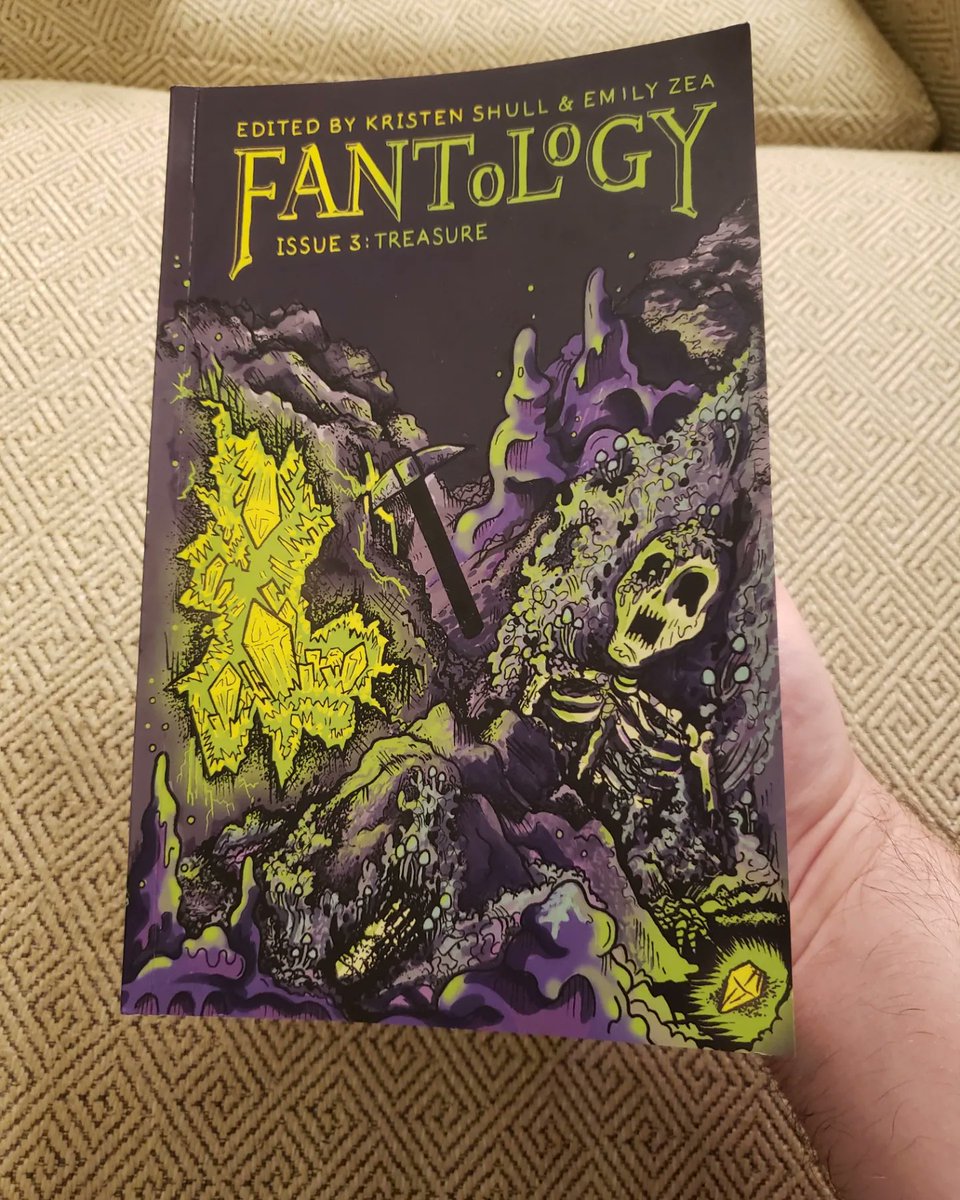
31 Days Of CCS, #26: Fantology Volume 3

Kristen Shull and Emily Zea have produced another winning edition of Fantology, with probably the strongest issue from top to bottom. Its central conceit is that the artists have to work within an established world delineated by a map, which of course is similar to but not as rigidly prescribed as the fantasy minicomic series Cartozia Tales. The theme for this issue is "treasure," and that's a solid basis for stories because it instantly gives protagonists something to want.  


Kat Ghastly's "Lore" kicks things off, and their inventive layouts and page composition make this piece truly stand out. It's as much horror as it is fantasy, as it details a deadly prophecy concerning the new sorceress of the kingdom. Ghastly uses open page layouts, zooms in and out on key characters, uses tiny details to provide narrative and decorative flourishes, and provides rich and provocative characterization. This feels like a long book in the offing. Tay James' work is text-heavy, but the weird lettering choices and bonkers page design help with the light-hearted humor of the piece. Sage Clemmons' entry alternating illustrations with hand-written letters detailing a couple separated by life circumstances is deeply emotional, and ideal for an anthology. Natalie Norris' wordless tale of two mermaid lovers discovering a trove of human treasure is the emotional and narrative opposite: two lovers with no regard to the outside world, inseparable. The treasure amounts to simple baubles for them, instead of life-or-death plunder, and if there's one thing Norris is aces at drawing, it's slender, elegant, beautiful women. 


Emily Claire's piece about disaffected undead employees in a dungeon is funny and has a sharp punchline, although the dependence on grayscale shading made the visuals bland. A pet is a major aid in that story and in Chelsi Fiore's entry about an elf and his small steed being trapped in an underground city. These are breezy transition pieces that lead to the third chapter of Shull's ongoing fantasy story about two accidental traveling companions who both carry secrets. Shull's boisterous and bawdy style of fantasy is propulsively fun, as she pairs a serious (but horny) character with a light-hearted (but also horny) character who loves carousing, singing, dancing, and playing games of chance. Shull has a way of adding a slice-of-life touch to fantasy proceedings that centers the story around her protagonists, and both of them are memorable--both in terms of how they're drawn and their personalities. Hopefully, this makes it into a book one day. 


Michael Beachy's treasure-hunter story is a little visually overwrought, but he reins it in just enough to tell a clear and funny story. Mona's story about a bored wizard staging a tournament because he loves violence is heavy on pen-and-ink pyrotechnics, but her command over her line and clever storytelling techniques makes this fun, right on down to its cut-off ending. I get that it's part of a larger story, but not having any real closure in the story was distracting. The scratchiness of that story is followed by Stephen Pellnat's painstaking detail in service of some dynamic storytelling about a cat adventurer getting more than he bargained for on his adventure, and learning a valuable lesson along the way. There's another stylistic shift, to a sketchy, hatching-heavy story by Jackson Maceo Schleicher about a lack of honor among thieves as they look for a wishing egg. 


Rainer Kannenstine's piece is yet another visual shift, as it looks like scratchout white-on-black, with a simple, blocky line to tell this story of a grappler named Urta whose use of brute force eliminates the need for skill or magic in taking a dragon's treasure. She also has no problem declaring herself the sole recipient of the treasure and turns the dragon into her pet. My vote for most improved feature is Alex Washburn's newest entry about Clan Zargs. These ragtag adventurers get into genuine trouble, and Washburn tightens up everything here: his line, the storytelling, and even the characterizations. On the other hand, co-editor Zea's piece about a pirate challenging her family's lineage with the help of her hostage/protege/niece feels overblown and self-indulgent. She seems so delighted in her Captain Trub character that everyone else in the story is a means to the end of extolling her awesomeness. The story is still well-drawn, although the use of digital lettering takes me out of the actual story. 

While that story was a misfire, Fantology 3 not only holds up well on a story-to-story basis, the sequencing is also fluid and creates contrasts that make each story stronger. For an anthology with an open submissions policy, they did a remarkable job of putting together such a strong group of creators. It helps that there are regulars to anchor it, but this was the best all-around group to be featured in an issue so far. The conceit of Bartlebee the Bard introducing each chapter is fun, but it seems wholly unnecessary for one-shots. Given that some strips are in their third chapter, a summary of prior chapters would have been useful for readers. This volume will definitely delight readers looking for something a bit off-beat in their fantasy comics. 

Thursday, December 31, 2020

31 Days Of CCS, #33: Fantology Issue 2

The second issue of Kristen Shull and Emily Zea's Fantology arrived just under the gun for inclusion in this feature. Unsurprisingly, this issue was generally superior to the first, often in surprising ways. For editors figuring out how best to assemble an anthology, the second issue is the one where all the kinks are generally hammered out in terms of process and production. In an anthology where very little is at stake in terms of money but a lot is at stake in terms of editorial credibility, young editors have to take risks on the kind of work they accept. There were a few newcomers in this issue and the returns were fairly positive on them; indeed, some of these stories were the best in the whole volume. 


One of the more surprising and delightful aspects of this volume is that the shared-world conceit of the first volume not only carried over here, but that some artists used the creations of other artists from the first volume to strong effect. This is another similarity to the Cartozia Tales series edited by Isaac Cates, only without the OuBaPo-style rigidity with regard to rules and switching every issue. This felt like a relaxed and fun one for artists to play together in the same world. Speaking of relaxed, the issue's theme of "Flora & Fauna" struck a nice balance between having no theme and having one that produced too much of the same thing. Each artist was simply compelled to come up with a new animal or plant during the course of their story. Some of them were incidental, and some of them drove the plot. 

While fantasy stories often devolve into world-building exercises, it was clear that Fantology's artists were generally far more interested in character-building. The characters drove the plots, and in the cases where they were returning characters, the stories served to expand on their histories and personalities. All of this is also tightened up by the anthology's narrator and gimmick Bartlebee the Bard, who not only informed the readers as to the anthology's theme, but also introduced each story and served as a natural piece of interstitial material. Unfortunately, one thing that got by the editors was matching up page numbers and the table of contents, which only had a passing resemblance to each other for many entries. 


The continuing adventures of several characters were certainly highlights. Shull's own saga of Sabi and Kata (the elf and the wizard) once again had an episode that was not only entirely satisfying on its own merits but also moved along the larger plot. It even hooked in a character from a group introduced by Leise Hook in the first issue. Given that the main characteristic of the character was his lusciousness, this was right up Shull's alley. Catalina Rufin's continuing adventures of Brono and Satu, the barbarian and his child, continued to be pitch-perfect. While retaining a rough fantasy aesthetic, the gentle quality of the story belied its concept. Filipa Estrela's gentle saga of Frill and Frond, the mushroom person and goblin who became partners in the first issue, is expanded here as the parameters and boundaries of their relationship are tested. Indeed, this is less a fantasy comic than it is a comic about relationships with fantasy trappings, although Estrela made those trappings delightful. Emily Zea's "Troubled Waters" continues the adventures of Princess Trudy and pirate captain Troub. It's a funny and compelling story, as it's made clear that Troub is more closely connected to Trudy than she first let on. Zea's linework here seems considerably more rushed in this issue than the first, however. Alex Washburn's story about a group of dysfunctional explorers maintained its humor thanks to Washburn's thick line and irreverent storytelling. 


The most interesting artists that were new to me were Tao Tao Jones and Chelsi Fiore. The former wrote a compelling story about the Pea from the "Princess and the Pea" becoming a cherished heirloom to a family of servants, until one of them broke away and created her own country based around the pea's growth. Jones' line is thin and scribbly, which suits the material, although I found myself wishing her script was a bit larger. Fiore's story about a desert traveler encountering a fuzzy little potato-like animal was imaginatively drawn and worked well with its short length. It was not just a story about reuniting a child with their family but also about an explorer who respected the environment they traveled in. 

This anthology was filled with pleasant interactions in this particular world, proving that not every fantasy story has to be about conflict. Eddie O'Neill and Kay Brand told a story about a couple going hunting for eggs and herbs so they could have brunch together; the plot was thin, but it was all about fleshing out their dynamic as a couple. Emily Bradfield's story had a little more action, but it was about a witch and a new witch wishing to be her friend and work comrade and how routine can often prevent us from making connections. Rainer Kannenstine's story is a send-up of boastful fantasy tropes. Kat Ghastly offered up more of a psychedelic bit of lore than a story, but it worked as a visually impactful opener. 


There were three stories that particularly stood out. Keren Katz's detailing of how the coin-people introduced in the first issue reversed their process and undid everything that was purchased with them was both conceptually fascinating and heart-rending. In terms of style, there's no one who draws with her level of detail and conceptual power. Kevin Fitzpatrick's meaty story about a potions-master and his imprisonment was full of fascinating character details, ethically thorny dilemmas, and extensive mastery of light and dark contacts. Emil Wilson's story about hunters discovering a bear with an orange tree growing on it not only had an exciting blend of naturalism and weirdness, it also was emotionally complex and touching. 

At 252 pages, the volume felt a little bloated. There were several stories that were had to parse or process visually that could have been eliminated. While the slighter stories were enjoyable, this issue felt unbalanced in that direction. The more complex stories really stood out in this volume, but their tone was subdued by the lighter fare in some of the other stories. Creating a balance in an open-call anthology is extremely difficult, but it's a credit to Shull and Zea that they were able to sequence things in such a way that they were nearly able to pull it off. 

Saturday, December 26, 2020

31 Days Of CCS, #26: Fantology

Every year, someone from CCS always seems to step up to do the work of editing and publishing an anthology. It's a time-tradition that has produced some excellent comics, including Sundays, Irene, Maple Key Comics, and most recently Brainworm. This time around, it's Fantology Volume 1: Origins, edited by Kristen Shull and Emily Zea. It's a straight-up fantasy anthology that makes no apologies for its subject matter and celebrates it with gusto. Not everyone in the book is a CCS student or grad, so for the purposes of this review, I will mostly focus on the CCS contingent.


While there are some solid entries in this anthology, the care that editors Shull and Zea put into make it greater than the sum of its parts. From Tess Scilipoti's simple but eye-catching cover design to the interstitial rhymes of Bartlebee the Bard to the choice of paper stock, this is a cohesive-looking and attractive book. Shull and Zea also chose to put these stories in a shared world (similar to what Isaac Cates did in Cartozia Tales), with a map at the beginning giving readers a rough understanding of that world and where the stories take place. It's a clever device that helps draw together a number of disparate styles and as well as skill levels.


Catalina Rufin's "The Quest" is one of the highlights of the anthology. Rufin went all-in on a thick line weight and spotting blacks and it works well with her relatively simple but expressive character design. It's an interesting contrast, because fantasy art with this kind of line usually tends to be more naturalistic and dramatic, but with the story's actual emotional narrative arc, that contrast between dramatic and pared-down made sense. The story follows a warrior and a young apprentice magician sidekick, and his supposed quest against a powerful witch. Rufin touchingly and hilariously subverts this trope in a way that still makes sense within the genre but also makes fun of warrior-types who can't express their feelings.


Filipa Estrela's "Discovery" is another delightful, warm story about a goblin who happens upon an island inhabited by mushroom people called Mycelia. Estrela cleverly sets the entire paradigm of an explorer on its ear, as Frond the Goblin realizes that she can't report her discovery of the island to anyone, lest it be despoiled by invaders. There's a delightful romance between Frond and Frill, the Mycelium who greets her on the island, and it leaves off on a note that implies that there could be future stories featuring this couple. The one problem with this story is that Estrela's line is light to the point of illegibility at times; it looks more like detailed thumbnails rather than a completed story. The story is also highly text-heavy, and there's some awkwardness with word-balloon placement. This was also a story that fairly cried out for color to add some weight to its pages, but the anthology was of course in black and white. 

I reviewed Alexander Washburn's "Clan Zargs" last year, as he submitted it as a separate feature. It's a nice fit in the anthology, as his anthropomorphic animal character design, thick line weight, and use of negative space allow the pages to breathe while he tells his silly and funny story about a newly-formed group of treasure hunters. I also reviewed Shull's "Thirsty" in her entry this year for CCS, and it perfectly encapsulated the best of fantasy fiction. It's not just telling a fantastical story, but introducing characters who are trying to tell their own story and create their own identity. 


Rainer Kannenstine's "The Apotheosis Of Jahk" is a well-realized story of a fisherman and a malevolent being named Titanis who at first offers friendship and wisdom to Jahk and those around him, but later inspires bloodlust and conquest. It's a story of a seemingly impossible moral problem and how Jahk failed it. Kannenstine's bold use of black and white contrasts matches his simple line nicely; it's a good example of creating a powerful set of images without overrendering.


Zea closed the anthology with "Seas The Day," a delightful coming-of-age fantasy story about a young princess who wants to be a warrior like her older brothers and the pirate who raids their city. Zea's sketchy pencil drawings and spare but powerful inking make each drawing pop off the page without losing any of their expressive power. 

Natalie Wardlaw and L.S. Hook both contributed short pieces. Wardlaw's was a silent story about finding a fairy with torn wings and mending them. It's simple, sweet, and drawn in Wardlaw's signature elegant line. Hook's contribution isn't so much a comic as it is a series of hunky drawings of men on an island that so enchanted the explorer that they chose to remain there. Both are the kind of short, intermediary pieces that provide flavor in anthologies like this. Amy Burns' "When The Gods Grew Bored" is a powerful creation myth for a particular group of people that's well designed and cartooned. Burns' attempt at a naturalistic approach didn't quite land because her character design was too crude; her lettering was also all over the place, which was distracting. 

Other interesting contributions included Jared Beerman's highly atmospheric fumetti photos of miniatures telling a story, Eliot Crow and Keren Katz's haunting story of a people turned into currency in the desert and what ultimately happens to them; Emily Bradfield's story of an official trying to thwart poachers and its surprising outcome; and Tay James' funny story of a young potion-maker trying to decide her future. 

Another volume of this anthology has been produced, and I'll be curious to see what kind of a jump the dedicated creators, as well as the editors, made. The second volume of an anthology tends to be the one where the editors figure out how to fix the errors they made in the first volume, so I'm eager to see what kind of leap they all make. 

Monday, December 10, 2018

Thirty One Days Of CCS #10: Natalie Wardlaw, Emily Zea and Alexander Washburn


Full Bore, by Emily Zea. This comic is only four pages line, but Zea offers up a lot of clues as to what kind of cartoonist she is. This brief story is the first part of a longer saga about an outlaw family in the old west. There's a nice swerve in this story, as what seems to be an innocent victim is actually the newest member of the family, helping her father rob a train. Zea has a loose, expressive line and a strong command of page composition. Her varied line weights add an emphasis to her characters in motion and her mix of difference perspectives makes this a visually interesting comic. For something so short, Zea packs a lot of information into this comic and makes it a single, satisfying unit. 


The Tortoise and the Hare, by Alexander Washburn. I believe a story involving the tortoise and the hare is a regular early assignment at CCS. This one involves martial arts (a ninja tortoise?) in addition to the classic race. Washburn goes all-in on using a thick line and over-the-top expressiveness in telling this story. It's all about flop-sweat, arched eyebrows, clenched teeth and emotions yelled out loud. It reminded me of something like Naruto as much as anything, only on a much smaller scale. I have no idea what Washburn's interests as a cartoonist will be, but he definitely has the fundamentals to do an action strip in the vein of a Stan Sakai. 

Rehabgiving, Chronic, The Princess In A Suit Of Leather, Run, Trigger Warning, and Just One Branch, by Natalie Wardlaw. This is an astounding suite of comics by an excellent young talent. The order in which I read them worked out well, as more and more of Wardlaw's frequently traumatic life was revealed in each subsequent zine, as well as her process of healing. Just One Branch is her version of the Aesop fable "The Man and the Wood", and like Issy Manley, she provided a feminist take on it. However, the take was a bit different; in her version, the lumberjack is a seductive man slowly but surely insinuating his way into the life of the tree (who is feminized with a human face) until he cuts her down and rapes her. The reaction of the nearby tree: "Well, she did let him have her branches". It's a brutal story that illustrates how consent can be given but then brutally overstepped, leading to a reaction of "she was asking for it."

Similarly, her take on the story The Princess In A Suit Of Leather finds her own attitudes toward the ending shifting as she aged and understood that men and relationships were not going to save her. In the story, a girl who was raped by her father runs off to the woods and manages to put herself in the skin of a fierce animal. She winds up with a prince who cuts away her skin. When she was younger, she thought the prince freed her, but now she looks at the story as a man cutting away a woman's defenses before she was ready to give them up. It's a cogent critique, and one that makes sense in terms of the tone of the story.

Chronic has a medical intake form as its cover, which is filled out on the third page. It's a story about Wardlaw's chronic pelvic pain suffered from age 15 to age 21. It's especially brutal and poignant because it's not only true that modern medicine has a horribly limited understanding of women's health issues, it actively ignores symptoms and information in favor of throwing ibuprofen at it. Wardlaw had to suffer through three operations before they got it right and she was freed from a life of pain, though she notes that the reminders of pain are something she holds on to, because in a time when she had no voice of her own, the pain was all she had. Her naturalistic art is simple, effective and powerful.

Run was inspired by the simple Ed Emberley technique of drawing with basic geometric figures and building on them. This is done as a fairy tale where Natalie goes out to the desert and things seem to be going well, but a guy moves into her house who is violent and abusive. Of course, everyone makes excuses for him, and he keeps threatening to get her. The metaphor of fear as a little animal in her head telling her to run is a powerful one, especially at the end where she kills it. There's a common thread in these comics of numbing and detaching herself as a way of coping with extreme trauma, and that carries over into the next comic, Trigger Warning. 

This is a brilliant, harrowing piece of art told in six separate anecdotes. One shows images of trying to pretend fear wasn't there by pretending she didn't feel it, until she was proven horribly wrong. Another is the swing between feeling suicidal and homicidal as she goes through emotional swings, as well as the cycle of whether or not autobio comics about trauma are helpful or harmful. There are strips about feeling like she had "asked for" sexual assault and/or manipulation because of substance abuse, strips about her shifting body image, and a funny and awful strip called "The most truthful thing I ever said after sex". In that one, a guy asks her if she wants to be his girlfriend (in so many words) after sex and she replies, "I'm sorry, I can't...I have problems". This is an emotionally raw comic with delicate, assured drawings and a powerful emotional narrative, one that doesn't have an easy or pat conclusion. Indeed, being in a place where trauma was no longer actively happening had its own set of difficulties, making her wish for that time when all she had to concentrate on was trying to survive in the moment.

Finally, Rehabgiving is about checking herself into a clinic where she was treated for addiction, among other things. The interesting thing about this comic is her focus on other people's issues in terms of narrative. It makes sense, so most addiction recovery groups focus on group work and being there for others, caring enough to hear their stories in a non-judgmental way. The beginning of the comic is a tarot reading that outlines a road to recovery and strength, while the end notes that the clinic did not "cure" her, but started the process of recovery in a powerful way. It's a strong statement of its own in a remarkably coherent way. Wardlaw has a powerful narrative voice, and as she refines her already-strong storytelling skills, she has the potential to turn her life into an unforgettable comics narrative, if that's the path she chooses.