Showing posts with label emil wilson. Show all posts

Tuesday, December 24, 2024

45 Days Of CCS, #23: Riffraff

The Gutter is a substack anthology that mostly publishes very short stories or serials. Of late, they've gotten more serious about things, going to a paid subscription model for comics in 2025 and releasing their first print anthology, Riffraff, in 2024. The anthology also had a digital component, but I'm going to focus on the print edition here. 


It's edited by two CCS alums, Cathy Mayer and King Ray, and there are several CCSers who contributed stories. Emil Wilson opens with "Recycling Husbands," which is fitting since this issue's theme is "Trash." Wilson leans into the concept from the beginning, as a wife puts her "husband on the curb with the recycling. I decided I didn't need a husband anymore." It follows the logic of this statement in an even-handed and slightly dispassionate way, as she finds the husbands are "crushed into compressed blocks." Eventually, some of her friends get recycled husbands. Wilson's art is partly scribbly and partly looks to be inspired by advertising art designed to invoke a 1950s America feel, but the power reversal here is amusing and understated. 


Sofia Lesage's "Digital Wasteland" cleverly uses the short format with a repetitive gag that lands because it's only six pages. The protagonist is beset by a buxom bot begging for her attention while she scours the internet for something else, only the digital wasteland is a real one. This is a rare example where a digital font (for the bot) is an effective storytelling tool. The ending doubles down on all of this, as the protagonist's desperation leads her to make a critical mistake. 


Ana Two once again proves their capacity for innovation with "Throw Your Past Away." Once again, it's a smart use of a limited number of pages, as Two uses the Riso format to create a ghostly, foggy background. The protagonist talks about leaving messages behind on napkins revealing the sensation of wanting to be thrown away, to be drained, to be hollowed out of their depression and turned into something new. It's a striking combination of spectral images and beautifully concrete text. 


Violet Kitchen's "Birdhouse" reveals yet another strong story for the young artist, who has been on an incredible roll. Kitchen's line is scribbly and expressive; it reminds me of a certain kind of cartoony naturalism from artists like Michel Rabagliatti. However, their understanding of composition is incredibly advanced. Here, the open-page layout of hipster friends attending a garage sale transforms into one of them feeling the sincerity of an old woman's joy in the simplicity of her understanding of beauty. Kitchen's ability to subtly evoke emotion through visual cues is extraordinary.


In the other stories, Faye Harnest's "Books" makes interesting use of shapes in discussing how she felt when the books she was forced to dispose of weren't taken by anyone. Stephanie Guralnick's story about dumping out one's heart is less a story than a tone poem. Betsy Hudson's story of an unhoused man building his own tarp castle in the alley next to some friends' apartment was touching, especially with the tender, scribbly line. Abi Inman's story of a robot and a bird feels a little familiar, but it's well-executed. Quinn Stephens' ridiculous "Rick Garbage" short is just the injection of ridiculousness that this otherwise fairly sincere and serious anthology needed. Overall, this is a very well-edited anthology that makes good use of its theme while providing enough variance to prevent things from getting tedious. 

Thursday, December 31, 2020

31 Days Of CCS, #33: Fantology Issue 2

The second issue of Kristen Shull and Emily Zea's Fantology arrived just under the gun for inclusion in this feature. Unsurprisingly, this issue was generally superior to the first, often in surprising ways. For editors figuring out how best to assemble an anthology, the second issue is the one where all the kinks are generally hammered out in terms of process and production. In an anthology where very little is at stake in terms of money but a lot is at stake in terms of editorial credibility, young editors have to take risks on the kind of work they accept. There were a few newcomers in this issue and the returns were fairly positive on them; indeed, some of these stories were the best in the whole volume. 


One of the more surprising and delightful aspects of this volume is that the shared-world conceit of the first volume not only carried over here, but that some artists used the creations of other artists from the first volume to strong effect. This is another similarity to the Cartozia Tales series edited by Isaac Cates, only without the OuBaPo-style rigidity with regard to rules and switching every issue. This felt like a relaxed and fun one for artists to play together in the same world. Speaking of relaxed, the issue's theme of "Flora & Fauna" struck a nice balance between having no theme and having one that produced too much of the same thing. Each artist was simply compelled to come up with a new animal or plant during the course of their story. Some of them were incidental, and some of them drove the plot. 

While fantasy stories often devolve into world-building exercises, it was clear that Fantology's artists were generally far more interested in character-building. The characters drove the plots, and in the cases where they were returning characters, the stories served to expand on their histories and personalities. All of this is also tightened up by the anthology's narrator and gimmick Bartlebee the Bard, who not only informed the readers as to the anthology's theme, but also introduced each story and served as a natural piece of interstitial material. Unfortunately, one thing that got by the editors was matching up page numbers and the table of contents, which only had a passing resemblance to each other for many entries. 


The continuing adventures of several characters were certainly highlights. Shull's own saga of Sabi and Kata (the elf and the wizard) once again had an episode that was not only entirely satisfying on its own merits but also moved along the larger plot. It even hooked in a character from a group introduced by Leise Hook in the first issue. Given that the main characteristic of the character was his lusciousness, this was right up Shull's alley. Catalina Rufin's continuing adventures of Brono and Satu, the barbarian and his child, continued to be pitch-perfect. While retaining a rough fantasy aesthetic, the gentle quality of the story belied its concept. Filipa Estrela's gentle saga of Frill and Frond, the mushroom person and goblin who became partners in the first issue, is expanded here as the parameters and boundaries of their relationship are tested. Indeed, this is less a fantasy comic than it is a comic about relationships with fantasy trappings, although Estrela made those trappings delightful. Emily Zea's "Troubled Waters" continues the adventures of Princess Trudy and pirate captain Troub. It's a funny and compelling story, as it's made clear that Troub is more closely connected to Trudy than she first let on. Zea's linework here seems considerably more rushed in this issue than the first, however. Alex Washburn's story about a group of dysfunctional explorers maintained its humor thanks to Washburn's thick line and irreverent storytelling. 


The most interesting artists that were new to me were Tao Tao Jones and Chelsi Fiore. The former wrote a compelling story about the Pea from the "Princess and the Pea" becoming a cherished heirloom to a family of servants, until one of them broke away and created her own country based around the pea's growth. Jones' line is thin and scribbly, which suits the material, although I found myself wishing her script was a bit larger. Fiore's story about a desert traveler encountering a fuzzy little potato-like animal was imaginatively drawn and worked well with its short length. It was not just a story about reuniting a child with their family but also about an explorer who respected the environment they traveled in. 

This anthology was filled with pleasant interactions in this particular world, proving that not every fantasy story has to be about conflict. Eddie O'Neill and Kay Brand told a story about a couple going hunting for eggs and herbs so they could have brunch together; the plot was thin, but it was all about fleshing out their dynamic as a couple. Emily Bradfield's story had a little more action, but it was about a witch and a new witch wishing to be her friend and work comrade and how routine can often prevent us from making connections. Rainer Kannenstine's story is a send-up of boastful fantasy tropes. Kat Ghastly offered up more of a psychedelic bit of lore than a story, but it worked as a visually impactful opener. 


There were three stories that particularly stood out. Keren Katz's detailing of how the coin-people introduced in the first issue reversed their process and undid everything that was purchased with them was both conceptually fascinating and heart-rending. In terms of style, there's no one who draws with her level of detail and conceptual power. Kevin Fitzpatrick's meaty story about a potions-master and his imprisonment was full of fascinating character details, ethically thorny dilemmas, and extensive mastery of light and dark contacts. Emil Wilson's story about hunters discovering a bear with an orange tree growing on it not only had an exciting blend of naturalism and weirdness, it also was emotionally complex and touching. 

At 252 pages, the volume felt a little bloated. There were several stories that were had to parse or process visually that could have been eliminated. While the slighter stories were enjoyable, this issue felt unbalanced in that direction. The more complex stories really stood out in this volume, but their tone was subdued by the lighter fare in some of the other stories. Creating a balance in an open-call anthology is extremely difficult, but it's a credit to Shull and Zea that they were able to sequence things in such a way that they were nearly able to pull it off. 

Sunday, December 20, 2020

31 Days Of CCS, #20: Emil Wilson

When Emil Wilson came to CCS, he had a career in graphic design and illustration. He knew how to effectively design a page. After a year in the program, he's also become an excellent writer and cartoonist. His dry sense of humor and ability to plumb the depths of human despair in interesting ways reminds me a great deal of Will Dinski's work, especially when one also considers the formal and design qualities of their work. 

The Final Results follows the final journey of Carl, a man who dies in his sleep and stops at an afterlife computer terminal that is there to answer his questions about anything. Carl asks how many times he had sex, who stole a childhood bicycle, and if the Cubans killed JFK. Then he goes deeper: who was his soulmate? What was his ideal career supposed to be? Occasionally, the computer would tell him things like "the future is not supported on this device," which was clever. The comic was done in black and white, with the ink line droppping out for Carl. He was drawn in a spectral blue with a blue sky background, which was a smart visual solution in depicting his non-corporeal state. Wilson's figure drawing is still a work in progress, but the actual character design was excellent, as he excels in crafting ordinary-looking schlubs. 


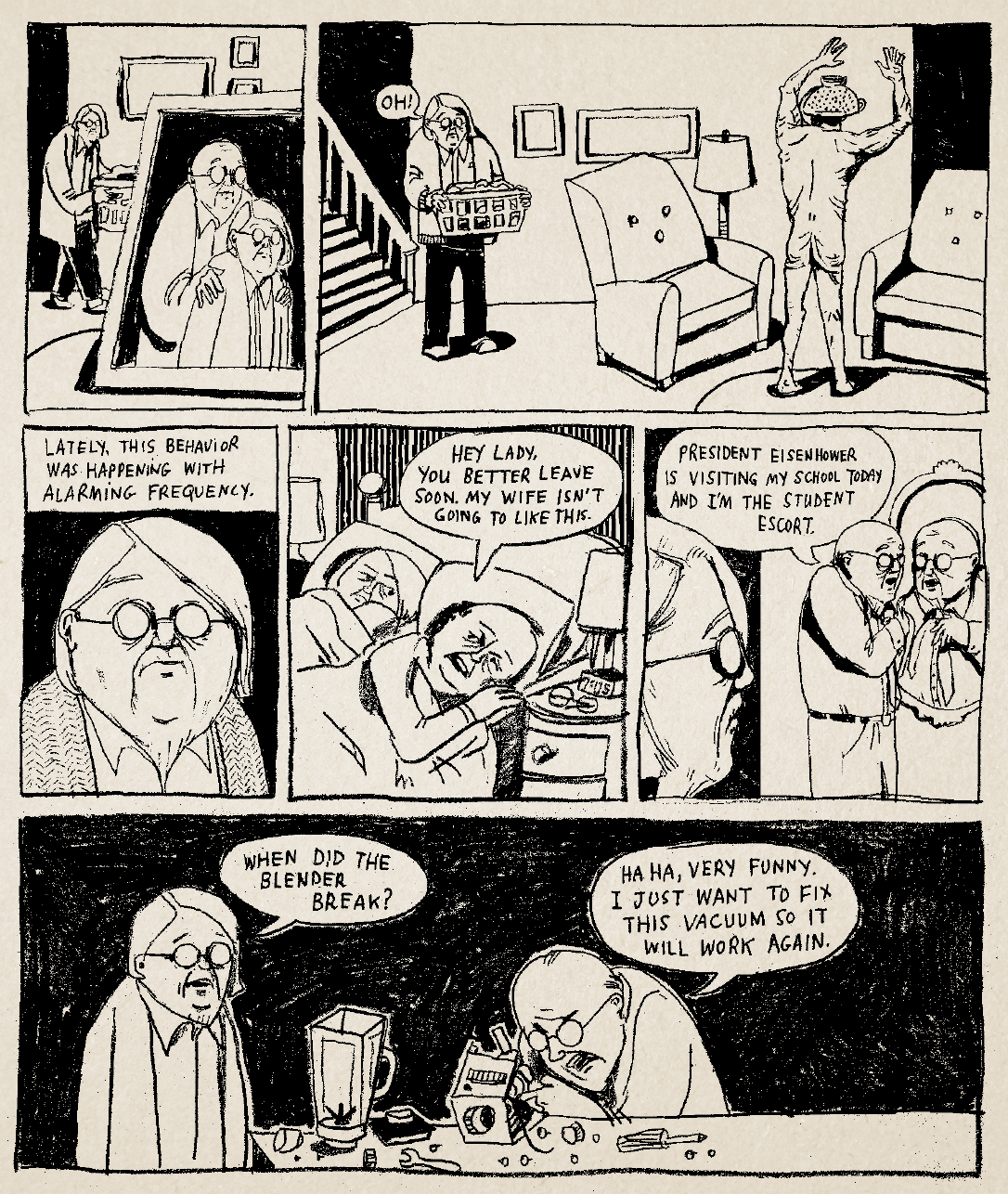
Potato, Potato, Potato was a sweet comic about dementia. A quick note: Wilson excels at typography and lettering. He's a smart and sharp designer with regard to fonts and overall design and has a knack for knowing what will work for each story, because he never repeats the same design. His lettering is bold but organic and never lacks for clarity. This comic was about an old married man and woman and his creeping dementia. When he appeared naked in the living room with a collander on his head one morning, she knew what was happening. After the usual round of doctors and advice from her children, she gave him a photo book in an effort to jog his memory. He responded by trying to eat one of the photos. In a marvelous, hilarious twist, she joined him in his nonsensical behavior--yelling at the trash can, putting all the furniture outdoors, etc. But she also put on dance records at random and he responded to that. The final page, where she tells him about a tree and he responds, "Potato," was especially sweet, because she responds in kind and it is comforting for them both. Here, Wilson's character work is absolutely spot-on. Gesture, facial expressions, and especially the way the characters interact in space are so intimate it's almost painful. It's an absolutely lovely, charming comic.

The Sorry Man is yet another visual experiment. It's a comic with an unusual open-page layout, where images are matched with lines of dialogue. The story is about a man whose job is writing elaborate apologies to aggrieved customers of a particular airline. Whatever the complaint, no matter how small or petty, he had a way of completely acquiescing to their emotional demands. It's not just a matter of apologizing though; it's wording it in a very precise but passive-aggressive manner that relieves his employer of responsibility. The parallel story was that his young daughter was dealing with a mean-spirited bully at school. After the usual advice of being extra-nice to her backfired while he was dealing with an incident where a psychotic flier was restrained with duct-tape over her mouth, he snapped. He told his daughter it was OK to get mad, and she promptly beat down her bully and made her bleed. His ultimate solution to both problems in the form of letters was cutting, dark, and hilarious. The moody brushwork and innovative lettering solutions that added clarity to the piece were indicative of a cartoonist who carefully thought out the solutions to visual and narrative storytelling problems.

(Probably) The Last Time is a memoir of COVID and his dying father. Once again, it's a visual departure from his other comics. Wilson's versatility is one of his best qualties as a cartoonist, because he can work in a wide variety of styles. This was done scrapbook/collage style, with hand lettering. It's a series of two-page spreads, with some dominant header often done in the style of an advertising font. The story follows Wilson visiting his father on the west coast after he was told that he probably had just three months to live. His sarcastic sister, needy mom, and suddenly emotional and open father are all part of the cast of characters, as is Wilson's husband Giacomo. A memoir about a specific set of emotions regarding his father went absolutely haywire when COVID struck and forced Wilson to make a number of difficult choices regarding his schooling, and it got even more complicated when his husband got sick. This is a bracing, funny, and knowing story about a family that for all its dysfunctions, was still incredibly important to Wilson. The moments of affection and honesty his dying father gave him were depicted as almost overwhelming in the way they surprised him. The visual bag of tricks Wilson unleashed on the reader made every spread exciting and challenging. I'm especially excited to see Wilson's senior thesis project, given his progress and ambition as a cartoonist. 

Friday, December 27, 2019

31 Days Of CCS #27: Emil Wilson

Emil Wilson is a CCS outlier. Not quite a trailblazer, but definitely an outlier. At 53 years old, he was already established as an art director and illustrator in San Francisco. He's married. But like a few other older cartoonists, the muse took him to White River Junction in order to learn how to tell stories. Wilson is already quite skilled and has a fully realized style. What will be interesting is to see him learn how to craft narratives and work entirely within the discipline of cartooning, which is related to but quite different from illustration.

The urge to be a cartoonist is something that's clearly been burning in him because he was already quite prolific even before her arrived at CCS. Let's take a look at his comics. There are a few one-pagers, like The Great Sex Talk Of 1973. Right away, Wilson establishes his visual style: slightly distorted and grotesque figures with rosy cheeks and a restrained but prominent use of color. He's also quite funny, as this story follows seven-year-old Emil having read a book about sex and asking his mother about it. When he asks about the possibility of him impregnating her, her chain-smoking disaffectedness swats his inquiries down until Emil brings up Jesus as the reason he couldn't do it. How To Pronounce My Name is another funny one, as a barista mistook his name for "Anal" and even wrote it on his cup. This one's all in gray-scale shading with a bit of a Ben Katchor rattiness to his line. Once again, his instincts as a humorist are sharp. All About Me! The Body Edition is a single page illustration of his body, relative to various things that happened to it at various ages. Again, Wilson knows how to work a meaningful anecdote, including bits related to his husband and a lot of positive self-esteem.

Telling People is a clever mini where Wilson details the various conversations he had with people when he told them he was going to art school. The first strip outlines every second thought he had about it, from feeling isolated and out of place with younger cartoonists, to being separated from his husband, to worrying about encountering death due to Vermont's icy weather. His friend only reacted when Wilson pointed out that there were no Starbucks there. Again, Wilson has great comic timing, and visually, the page serves as a text-delivery mechanism, as he doesn't want to detract from the gag. The rest of the strips are variations on a theme, with the one where he's talking to his deluded mother being the best.

Killing Simon is a mini, I think, that may well portend Wilson's future. It's about a man who accidentally kills a family's cat right in front of them at a yard sale. He feels horrible about it, but his attempts at making amends only lead him into weirder and more awkward situations. It's an extremely uncomfortable comic that gets cringe-worthy in all the right ways. However, here we also see Wilson's limitations as a cartoonist. His figures are stiff at various points, and he doesn't have a sense of how to draw figures interacting in space. His use of gesture also needs some refinement.

Silent Witnesses was Wilson's try-out comic for CCS, and it immediately showcases two things: he's a funny writer and a distinctive stylist. However, this isn't really a comic in any traditional sense. This is illustrated text. The Turtle And The Bunny, Wilson's take on the CCS Aesop assignment, is another viscerally droll comic. Here, the layout is somewhere between illustrated text and an open-page comics layout, as a jealous pet bunny's own paranoia eventually does him in. The juxtaposition between the ornate lettering and cute use of color with the eventual grisly violence is a striking one, and the page of morals is grimly hilarious. The Princess And The Turnip is another whimsical and absurd fairy tale about a woman who falls in love with various inanimate objects, until she finally finds love with an umbrella. Once again, there's a nice contrast between the scratchy line and the elaborate lettering and lush use of color. The Taking Tree is a parody of Shel Silverstein's classic The Giving Tree, only the boy, in this case, is Donald Trump. As a parody, it's amusing; as political satire, it's a bit of a blunt force object.

Eight Nates is a funny kids' comic about a lonely kid who manages to conjure up seven copies of himself as playmates, to disastrous effect. This had an odd mix of black & white and color; I couldn't quite tell if this was deliberate. Introducing Erin Williams is a true story about a woman who stutters, and it's told as a kind of interview comic. Stuttering is an executive functioning neurological issue that is poorly understood by the lay public. This is a sharp, colorful comic that makes great use of naturalism and body language. We Will Never Be Happy Again is, as was stated in the mini itself, an illustrated poem. It's more of Wilson's grim sense of humor on display. Finally, The Pillow Of Your Dreams is a funny, well-designed "User's Manual" for a pillow that creates vivid dreams for its users. Wilson's obvious facility with this kind of drawing is what made the humor in this comic all the more effective.

I can't quite yet tell what kind of cartoonist Wilson is going to be. He's extremely skilled in some areas, but certain habits of illustration have to be un-learned before one becomes a good cartoonist and visual storyteller. Wilson is very funny, especially with regard to cringe humor, and I could see him going in that direction. The stuff he wrote about his family and friends is also funny, in an often bleak manner. CCS is a perfect place for him, because cartooning and storytelling are the bedrocks of their curriculum.