Showing posts with label ed luce. Show all posts

Thursday, October 25, 2018

Minis: Ed Luce

WANC: Hell On Ice Special, by Ed Luce. This is a black & white version of what will be a full color feature in Luce's upcoming Wuvable Oaf volume for Fantagraphics. One thing I've always liked about Luce's work is that he's innovated all sorts of clever gimmicks (not unlike a wrestling gimmick) in self-publishing his work. From special lanyards for the bands featured in the comic to centerfolds and all sorts of special editions, Luce has always had an eye on catching the eye of casual fans with something spectacular. Here, he mimics the old WWF magazine as the story follows Oaf from his days as a professional wrestler in WANC (Wrasslin' Association of National Champions). It even has a centerfold featuring Goteblud and Luce as a referee.

While Wuvable Oaf has always been a romance comic first and foremost, it's also been a comic about pro wrestling and a comic about death metal, all with queer themes. It's been Luce's mission to show queer characters doing things you wouldn't necessarily see in either mainstream or queer-themed work. He goes out of his way to feature characters who are "bears", for one thing, and the model on the cover of the magazine portraying Oaf (as his wrestling character Goteblud) is there in all his hairy glory. Luce also has a strong understanding of the ring psychology and storytelling that are a part of wrestling, only his imaginary territory is one far more open to queer characters than most wrestling associations these days. (That is changing a bit, though...)

Most of the issue is an absurd gimmick match between Goteblud and his opponent, Dr. Avalanche, in a "Hell on Ice" match where the ring was coated in ice. The entirety of the issue features this match, but Luce also works in a romance angle, a backstage business intrigue angle, and the tension that Dr. Avalanche wasn't going to let his young foe "get over", i.e., he wasn't going to let him win even thought that's what the script said. Where Luce was most successful here was presenting absurd, over-the-top action while still making the story all about character and incorporating queer themes throughout. Now, those themes are somewhat subordinated to this particular story, but that will even out in the upcoming book, I would imagine. Fans of the Oaf will want this no matter what; casual fans can wait til the book comes out. That said, it's a pleasure to see the fine details of Luce's line art on display.

Wednesday, November 8, 2017

Minis: N. Van Sciver, E.Luce/M.Wobensmith


His Last Comic, by Noah Van Sciver. This is Mini-Kus! #60, and it's a jokey story from Van Sciver that he ran on his Facebook page. Van Sciver excels at drawing schlubs and losers, and this is a sort of second cousin to Dan Clowes' old Dan Pussey stories. It's about a worker drone who's been self-publishing his shitty superhero comics to no acclaim for years, and he wonders if he should just give up on his dreams of being famous and getting to go out with this particular woman at his job. In a plot twist that hinges on EC Comics' Old Witch selling him a magical potion which will solve all of his problems. When he pours the potion into the ink that's used to print his comic, he finds that no one can resist the actual object...but no one cares about the story. This is a hilarious send-up of comics as a speculator's item, wherein their perceived "value" was more important than their feelings about the story and art. The main character is an exaggerated loser with no redeeming qualities (even Van Sciver's sad-sack narcissist character Fante Bukowski was likable in some ways), existing to serve a gag and to get his just desserts with an EC-style twist ending. For such a goof of a story, Van Sciver can't help but make beautiful pages that actually add pathos to the narrative. The above image of the artist walking in the snow is gorgeously rendered, giving the reader a sense of the fully-developed world that the artist lives in but can't quite see because his imagination is occupied by adolescent nonsense.


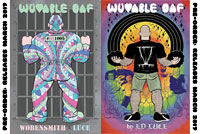
Wuvable Oaf #5, by Ed Luce & Matt Wobensmith. Three years in the making, this 40 page comic book-formatted effort sees Luce going in some different directions, even as he continues to be a genre and boundary-smashing artist. It's not just that this is a gay romance comic; it's a gay romance comic that's about death metal, pro wrestling and features a number of characters who are "bears", or large, hairy men. There's also a strong magical realist component to the comic which resembles Jaime Hernandez's work a bit, only in a different context. Oh, and kitties.

The first few issues of the series focused on the titular Oaf, a former professional wrestler, who developed a huge crush on Eiffel, the diminutive lead singer of death metal band Ejaculoid. The last issue featured their (despite all sorts of weirdness) adorable first date, and the back-up story beginning in this issue deals with the ramifications of Oaf and Eiffel being in a couple while Ejaculoid is on tour. There's a reason why the story is titled "Yokoaf Onoaf", which is one of my all-time favorite story puns. Luce is a skilled illustrator and cartoonist, and there's an astonishing two page spread filled with literally flowery detail when Oaf walks into the hotel holding the gig and finds it filled with flowers and ferns. It's precisely the opposite of the sort of grit and grime usually seen in this comic and it's a marvelous comedic turn. After singing "Fatty Daddy Baby Batter" (an ode to sexy, chubby dads), we are introduced to Marx, who apparently commands black, magical mind-control tentacles but is mostly looking to get laid on Ejaculoid's tour as its manager. (He hooks up with Simon Hanselmann's Megg character here, for instance.) It's silly, it's weird, and it's funny, even as Luce cooks up some band melodrama for further episodes.

On the other hand, the other side of the comic (it's a flip book) follows Smusherrrr, the "artist" who once was obsessed with Oaf to the point of stalking and is now obsessed with Oaf's friend Bufu. This section was written by Wobensmith, and Smusherrrr is presented as a character who is desperately in search of an identity, and often tries to find that identity in his obsessions with others. There's a hilariously creepy scene where Bufu, who is African-American, is "accidentally" run into by Smusherrrr and his grocery cart, which contains nothing but chocolate items. After an over-the-top and uncomfortable scene where Smush essentially begs Bufu to be his, there's a hilarious drug sequence (inspired by smoking hair of various people and animals) where he confronts aspects of himself that he was unwilling to come to terms with. This leads up to his attending a support group for fake people; in other words, people who appropriate or fetishize other cultures and races. The best character there is Killrrrrr, who is drawn like a grown-up Charlie Brown (including using the same lettering style as Schulz!) wearing a Dodgers jersey and a do-rag whose biggest ambition is to break into "the inner circle of Hollywood gangster character actor extras." Satirizing racial and ethnic  stereotypes & appropriation is a tricky matter, but Luce does a lot to make it work with his exaggerated, cartoony drawings. He's an exceptional caricaturist (it's perhaps his greatest skill) and putting in jokes like adding in the Tupac hologram (from Coachella 2012) as a literally fake racial persona went a long way in making the situation funny, rather than relying on drawing a lot of stereotypes. I'm not sure what the ultimate point of this storyline will be (an epiphany for Smusherrrr? a tour of racist appropriations throughout history? leaving Smusherrrr as a clueless, narcissistic parasite?), but Luce has thus far heightened the humor and defused what could have been a number of problematic elements.

Monday, July 20, 2015

Mini Round-Up: E.Brubaker, Luce, L.Suburbia


Reich #12, by Elijah Brubaker. Ten years and 260-odd pages after he began this series about psychologist Wilhelm Reich, Elijah Brubaker finally finished it with this twelfth and final issue. It's a tribute to new Sparkplug publisher Virginia Paine that she's found a way to raise the funds to see this project through after the death of former publisher Dylan Williams. The final issue, which covers his eventual imprisonment and death, deals with Reich in much the same way Brubaker did throughout the entire series. Reich was both a moral crusader with ideas about sex and sexuality that were way ahead of his time and a hypocrite consumed by jealousy over imaginary situations and dismissing jealousy from others. Reich was almost always the smartest person in the room but also lost touch with reality, conflating real threats with imagined ones in what resembled a schizophrenic breakdown. His unshakable belief in himself and his discoveries was both his admirable quality and the eventual cause of his downfall. Brubaker treats Reich as a fascinating, brilliant, flawed and damaged person; he is sympathetic to his plight and even-handed with regard to many of Reich's theories, but is interested in the gestalt of Reich's life, both good and bad.

Brubaker's detailing Reich's early sexual experiences in a previous issue is a crucial but understated way of showing how many of his theories originated in encounters he couldn't fully process as a child. Making Reich the narrator of his own story also helped keep Brubaker's explicit opinions out of narrative, giving Reich himself the opportunity to state his own case--for good or ill. The angular, shadowy and cartoony nature of the art allowed Brubaker the flexibility to make this as much an emotional narrative as it was a chronological one. To his credit, Brubaker never shoots for visual or narrative pyrotechnics throughout the story, no matter how bizarre Reich's stories of battling with UFOs with orgone energy became. Indeed, one question left for the reader is that given that many of Reich's theories about sexuality were so progressive, what aspects (if any) of his orgone-related research (including seeding clouds) are valid? Brubaker asks that while Reich may have been delusional and jumped to some incorrect conclusions, it doesn't mean that many of his ideas weren't worth pursuing, albeit using different methods. Reich was a fantastic series about the ways in which ego and personality conflict with seeking the truth, and how those conflicts affect those around us.


Oafanthology, edited by Ed Luce. Luce's Wuvable Oaf is a genuine comics phenomenon, but one underrated aspect of that book is how much Luce loves to collaborate. This "collection of Wuvable Oaf drawings & stories" allowed Luce to work with fans, friends and admirers with his characters. The series (recently collected by Fantagraphics in a superbly well-designed hardcover) has always been part romance comic, part pro wrestling comic and part rock 'n roll comic. The fact that the titular character is a "bear" and that most of the characters are gay somehow manages not to matter much with regard to the above genres, yet the fact that most of the characters are gay is crucial to the series' DNA. It's assumed, uncompromising and direct, as Luce doesn't dilute his content for a crossover audience, yet the wacky but somehow relateable characters clearly appeal to a relatively wide audience. Fantagraphics wouldn't be publishing it if they didn't think so.

Oafanthology takes this crossover appeal and runs with it. For example, Luce's collaboration with Tom Neely, having Oaf meet Neely's "Henry and Glenn" characters, reflects Luce's own contributions to Neely's anthology and their shared aesthetic and cultural touchstones with regard to metal. The same is true for "The Spawn of Goteblud", drawn by Josh Bayer, who has used his scratchy line to write about pro wrestling elsewhere. Edie Fake's comic about Oaf's crazy cat working for the sadistic chef character is hilariously over the top. The Katie Skelly-drawn strip about the character who loves to wear dead cat skins is perfectly in Skelly's wheelhouse in drawing fashionable characters. In the same vein, Vanessa Davis's story about Oaf's grooming is perfectly her. There are a number of interesting pin-ups as well, including a mind-bending Junko Mizuno drawing, an appropriately disgusting one by Johnny Ryan and even one by mainstream artist Stephen Sadowski. None of this will make a lick of sense to non-Oaf fans, but it's a perfect supplement for those who are in the know.


Cyanide Milkshake #6, by Liz Suburbia. Suburbia just had her first book released by Fantagraphics, but this series is a catch-all for her other interests. This is the sort of one-woman anthology that's stuffed with gags, brief vignettes, a running serial, autobiographical notes and more. Suburbia's foice is clear and distinctive, and her line is both clear and expressive. A memory of nearly being kidnapped into a stranger's car and barely outrunning him is chilling, especially in the way she contrasts the terror of the moment with the calm of hiding out in a fenced-in yard with a rabbit staring at her. The post-apocalyptic romance "G.B.A" is exciting, funny and charming, mixing the Gary Panteresque style with a vividly detailed relationship story, one where commitment, choices and killing zombies all go hand-in-hand. Suburbia effortlessly blends fantasy, rock, feminism, punk, autobio, dogs and superhero gags into a surprisingly coherent package, held together by a singular aesthetic. This is the laboratory of a percolating and unique talent and indicative of the ways in which younger creators draw inspiration from a huge variety of sources.

Wednesday, July 18, 2012

New Comics From Rob Kirby: Three #3 and Ginger


Rob Kirby really went all-out in producing the third issue of his queer anthology Three.While the past two issues contained three stories by three different artists, the format of this issue is a bit different. There are still three features but also a number of shorter pieces that manage to incorporate threes in some manner. For example, the opening page is a 3 x 3 grid, with each panel featuring art by a different cartoonist. Mari Naomi contribute an image of a woman in three successive moments in time, eating a piece of fruit. It's a beautiful, evocative drawing, as she is nude and being watched by a prone figure. Marian Runk did a one-page bird strip featuring three different backyard birds.About the only cartoonists who don't fall into this pattern are Matt Runkle and Janelle Hessig, in their delightful strip about making a pilgrimage to see Dolly Parton in concert and discuss why she's so inspiring.

Those features are nice little changes of pace for the feature stories, all of which are dramatically different from each other. "Oh No!", a jam "where something bad happens every three panels" is entirely self-explanatory and quite silly. Borrowed from what was going to be content from an upcoming volume of Jennifer Camper's anthology Juicy Mother, an all-star lineup of queer creators passes the narrative baton every three panels and cycles back through one more time to each artist. The story is nonsense, as a one-legged, one-eyed African-American lesbian is struck by a struck in the first strip by Ivan Velez Jr, and it gets crazier from there as exorcisms occur, we view donkey's getting blown in hell, Paris Hilton being born to the devil, dead characters rising up and killing their creators, a demented Peanuts pastiche, etc. Camper, Kirby, Ellen Forney, Diane DiMassa, Joan Hilty, and Howard Cruse all obviously have a fun time, and the strip looks great in color.

The real highlights of the issue are Carrie McNinch's "Fly Like An Eagle, her story of spending a year in a Christian middle-school; as well as Ed Luce's "Love Lust Lost". I count Luce's Wuvable Oaf as one of my comics blind spots (just haven't gotten around to picking it up yet) and I'm sure some of the nuances of this strip were lost on me, but there's no doubting the absolute command he has over a comics page. This ingeniously designed and paced story of three "bears" draws the reader in from the first image, even as the silent nature of Luce's imagery is quite bizarre at times. One man with red eyes and a fearsome beard plays endlessly with his tiny kitty-cats, a second does some kind of fetish cosplay/furry play with a group of men dressed as pigs, while a third man with a bunny-eared motorcycle helmet zips through traffic on a mountainside in order to deliver flowers at a spot where a former loved one died. This story is cute, touching and bizarre all at once as it plays upon the theme of "three" in a number of different ways. It's one of the best short stories I've read all year.

McNinch's story is in that same league. It's one of her longest stories, and one written in her voice as a teenager. It's an account of struggling to deal with life in a restrictive Christian school, the fellow burn-out girls that she befriends, and the creeping realization that she's gay. It's a story that goes from isolation to the understanding that she's not alone, that there's a community waiting out there for her to join. Seeing McNinch's simple line in color is lovely, as the color really adds a lot to the emotional content of the story as well as assisting in evoking the era (late 70s/early 80s). As always with McNinch's work, it's her strong attention to tiny details that makes this comic come alive, from the fashions and drugs of choice to the ways in which she is able to grasp and comprehend her own thoughts and emotions.  It's certainly the strongest story I've read from this long-time comics and zine veteran.

I also wanted to highlight Ginger, a short collection of strips about Kirby's dog. She's a beautiful, affectionate chocolate lab, and it's Kirby's skill at drawing her that makes these stories so much fun. From the poem "Birch" (written by Karen Shepard) that is an image of Ginger asking "You gonna eat that?" to a story about a squirrel falling out of a tree and straight into the waiting dog's mouth, Kirby evokes the joys and occasional headaches of owning a strong-willed, energetic dog. I'd love to see an expanded version of this at some point.