Showing posts with label aaron cockle. Show all posts

Sunday, January 14, 2024

45 Days Of CCS, #45: Aaron Cockle

Let's jump back into the world of Aaron Cockle and Andalusian Dog. Cockle's been hard at work pumping out issues of his enigmatic pastiche of and ode to the work of sci-fi author Philip K. Dick, producing six issues in the last couple of years and a related zine, Solar Lottery. The essence of these heavily text-driven zines with sparse and frequently oblique illustrations has revolved around the concept of a VR game called Andalusian Dog. It essentially transforms your own reality into a Grand Theft Auto overlay, with various instructions and missions to perform in real life. 


Cockle took this idea and meshed it with the concepts behind several Dick novels (including VALIS, The Three Stigmata Of Palmer Eldritch, Clans Of The Alphane Moon, The Penultimate Truth, Ubik, and others) and fuses it with modern technology to spin an oblique narrative and metanarrative. It revolves around alien intelligences, sex cults, drugs, office drudgery, and the total destabilization of society. Frequently quoting from Dick directly, Cockle focuses on the fear, paranoia, and inherently destructive and isolating qualities of late capitalism and how technology can be used as another tool of dehumanization that is an essential element of this nihilistic death cult. 


Like Dick, Cockle sees the future, and it is grim. From self-replicating androids designed to replace humans to horrifying drugs that permanently alter one's sense of reality, there's no escape once you've been caught up in this conspiratorial web. At the same time, there's a sense that it's the only game in town. It's the only way to remain relevant. We are willing consumers of our own annihilation. Cockle implies that there is resistance here and there, but even this resistance has its own agenda. The individual has no chance because they have been reduced to mere individuality. Once again, much of this work stretches the very definition of comics or sequential art; it's closer to comics-as-poetry than anything else in terms of how there is something important about the illustrations and collages he uses with regard to how they interact with the text, but that relationship isn't necessarily easy to understand or parse. It's as though Cockle is working on a deeply subconscious level, hoping to trigger connections and even memories (ala VALIS) in an effort to wake us up. 

Saturday, December 17, 2022

31 Days Of CCS, #17: Aaron Cockle & Bryan Stone


Bugs, by Bryan Stone. Stone is one of the members of CCS's first graduating class, but it's been a while since I've seen his work. This funny mini full of vignettes about bugs is full of sharp storytelling, crisp drawing, and lively cartooning. These are bugs with rich fantasy lives, engaging in awkward cringe humor, and philosophically complex outlooks on lives. They are also bugs who act like bugs, as when a cricket finds himself jumping without much control over their actions. Stone's character design is killer, retaining the anatomy of insects while adding anthropomorphic expressiveness to their eyes and sometimes their movements. His use of hatching and cross-hatching is impeccable, adding depth and weight to the pages in a way that's frequently simply beautiful. Some strips offer more extreme close-ups of the bugs, and Stone shifts to a thick line weight and a simplified design, like in one strip where a bug is teaching their "pet" to fetch, with amusing results. A plot about aliens arriving and a reveal that they wiped out humanity and gave the bugs consciousness is clever but also kept light and irreverent. 


Andalusian Dog, October 2022, by Aaron Cockle. Cockle's back at it with this exploration of a meta-game  in an issue subtitled "The Opposite Of Empathy Is Empathy." The narrative, with a different numbered heading at the top of each page, is about various kinds of tests, including machines testing other machines for empathy and antipathy. It goes into detail about growing up on a moon colony, with images on graph lines, and jagged photos of the moon. There are drug-induced mass emotion experiments during space travel, life back on Earth that includes an appearance on the Dennis Miller Show with Carrot Top, and a film adaptation of an obscure Jack Kirby comic. The intersection between work and art and the concept of work as an immersive, all-encompassing thing that obliterates personal space is a running theme in Cockle's comics, whose visuals continue to become increasingly abstract and sketchy. 

Thursday, September 1, 2022

31 Days Of CCS, 2021-22, The Index

Well, it took an absurdly long time to finish, but I'm declaring my 31 Days of CCS feature, dedicated to comics from students and graduates from the Center for Cartoon Studies, to finally be over. This is partly because with SPX coming up, I expect to get a whole bunch more soon. The list got long in part because I was slow, but also because new books kept coming out. Here's the entire list, with links to each individual review provided.


1. Denis St. John

2. Cuyler Keating

3. Masha Zhdanova

4. Mercedes Campos Lopez

5. Leda Zawacki

6. Sofia Lesage

7. Madi Baker

8. Meg Selkey

9. Maya Escobar

10. Faith Cox

11. Rebecca Schuchat

12. Mac Maclean

13. Daryl Seitchik

15. Erika Bloomdahl

16. Reilly Hadden

17. Violet Kitchen

18. Leeah Swift

19. Emil O Melia

20. Ross Wood Studlar

21. Kit Anderson

22. Annabel Driussi

23. Al Varela

24. Ashley Jablonski

25. Kori Michele Handwerker

26. King Ray

27. Robyn Smith

28. Jarad Greene

29. Kat Leonardo

30. Rachel Bivens

31. Josh Rosen

32. Less Than Secret anthology

33. Luke Kruger-Howard

34. Ben Wright-Heuman

35. Michael Sweater

36. Rust Belt Review Vol 1

37. Steve Theuson

38. Ian Richardson

39. Luke Healy

40. Aaron Cockle

41. Good Boy! Magazine


Friday, December 31, 2021

31 Days Of CCS #40: Aaron Cockle

Aaron Cockle keeps cranking out oblique, bizarre takes on capitalism and culture in the form of a world-exploring video game called Andalusian Dog, and he released four issues of the comic named after the game between February of 2021 and January of 2022. The word "surreal" gets over-used in popular culture to mean "weird" or "uncanny," but the roots of the art movement are deeply involved in an exploration of the unconscious mind and its symbols. How we encounter and process these symbols is not the same as it was a century ago when the movement began, and Cockle's comics are a response to both modern art and technological movements, their intersection, and their being co-opted by industry and capitalism.


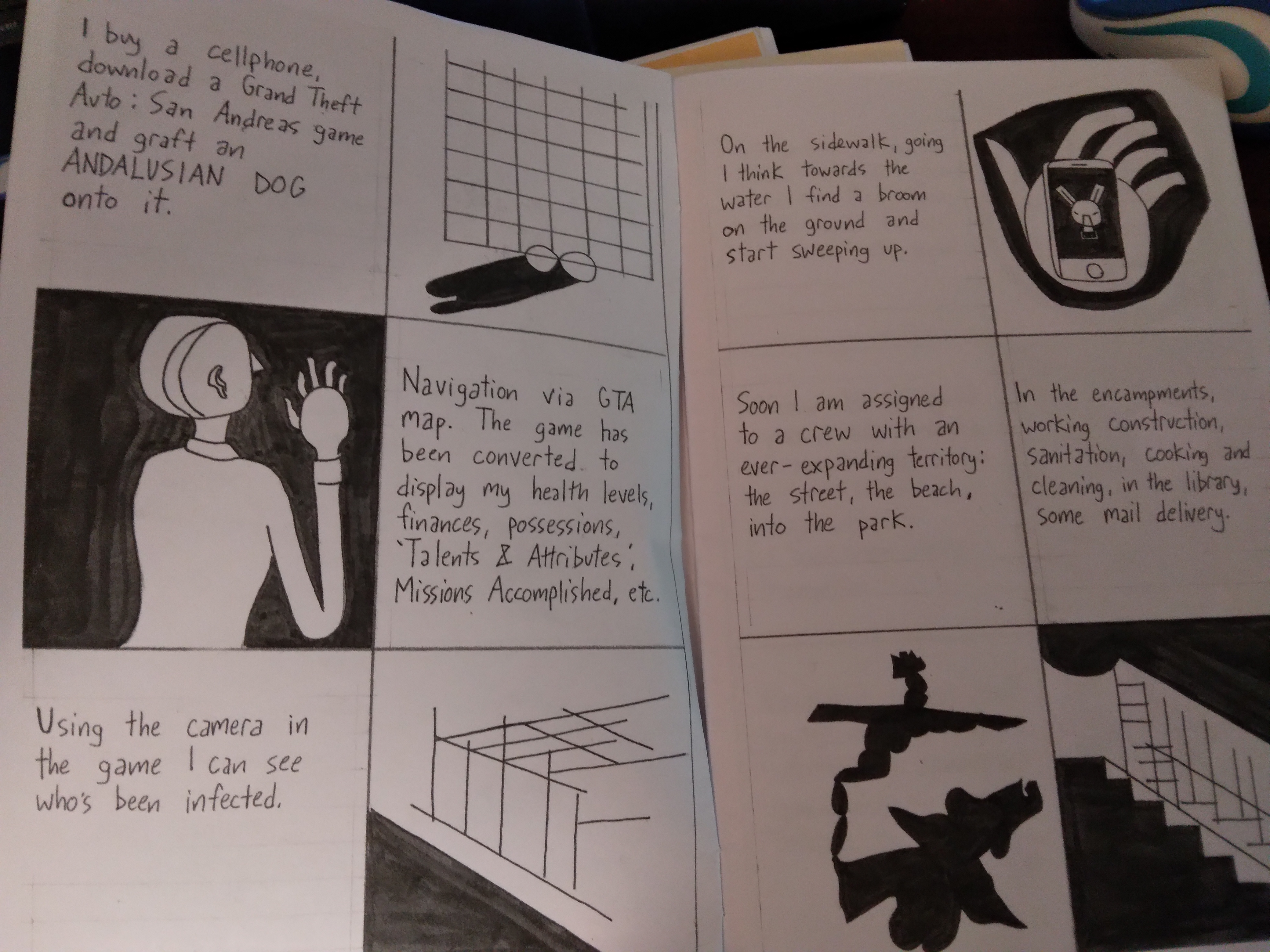
The February 2021 issue of Andalusian Dog is titled "Ladder of Fire," a reference to the Rene Magritte painting of a key, an egg, and a wad of what looks like paper all on fire. Ordinary objects, all in the process of change and possible purification; ordinary objects in the process of being destroyed. In this issue, the paranoia and conspiracy attached to the game take on a different aspect as the narrator is dropped off in Los Angeles with a tent, a sleeping bag, a $100 gift card, and a backpack. His first move is to download Grand Theft Auto: San Andreas and then overlay Andalusian Dog over it. The overlay lists the narrator's own health while providing a map to navigate his environment (since the game was based on Los Angeles). The distance between game and reality becomes nil, and the whole experience is a punishment for various crimes--real and imaginary. There's a desperate sense in this story and the next of secretly and surreptitiously working on borrowed laptops about theories of salvation; in the former story, it's the Ladder. In both stories, there's a sense of total societal abjection for the narrator, of being thrown down and thrown out of society. Yet there's a kind of desperate freedom in that. 


The November 2021 issue may be my single favorite issue of the series. Titled, "The Pit," there's once again a press-ganged aspect of the story as the narrator must help build a structure where the pit must be as deep as the tower is high, and the wall must be as long as the height of the tower. It's all for a mysterious Count as Cockle heads straight into Kafka territory, as he talks to his friends and becomes the founding and sole member of the Franz Kafka Fan Fiction Society. Later, he is thrown out of his own organization, of which he is still the sole member. Later still, he and his friends (all labeled X) are sent on a mission to an outpost for for work, Finding the outpost abandoned, part of the group searches for the group that left the outpost, leading to more abandoned outposts, more lost people, and more expeditions. Eventually, it becomes an existential game where one's own identity is in question, a sort of open-world video game where the mission eats itself. Cockle overlays maps and diagrams with less to do with standard cartography and more with game logic. 


The December 2021 issue goes back to Chile, a frequent setting in Cockle's comics. The makers and developers of the game find that the game is affecting real life, and real life is affecting game play, and they don't know how this happened. Cockle himself is a character, referring to his own comics and finding reviews of work that he's never published or even conceptualized. Once again, there's a sense of always being on unfamiliar or dubiously claimed ground, squatting in abandoned houses and finding ways to work and even throw parties. All along, the images are nightmarish but clinical; office buildings, cubicles, strange geometry in a Lovecraftian sense. Cockle is deliberately conflating dream logic with virtual reality, trying to find the line between the two--if there even is one. 

Finally, the January 2022 issue betrays almost a kind of mania, as huge walls of text appear on each page, overlaid with diagrams, sketches and scribbles that sometimes border on the abstract. It's difficult to even begin to parse, as it's a stream-of-consciousness journal about traveling to Chile once again. The back half of the issue goes in the opposite direction: oblique bursts of text paired with clip-art, diagrams, photos, blotches of ink, maps, and other ephemera. Providing an appendix perhaps only for himself, there are also excerpts from an essay about Kafka and The Decameron. This is the most oblique and self-referential of all of Cockle's comics, seeming lost in its own maze of logic, having long ago abandoned clarity with regard to narrative and plot. It's also barely what I would consider to be a comic. 

Thursday, December 31, 2020

31 Days Of CCS, #31: Aaron Cockle

Aaron Cockle continued to roll on with three new issues of his enigmatic series Andalusian Dog in 2020. Ostensibly about the development of and playing of an apocalyptic video game, Cockle's comics dig deep into the relationship between capitalism and metaphysics. In the January issue, Cockle makes notes that seem almost autobiographical at times in recalling hearing about a Samuel Beckett story involving artificial intelligence and reading about them on comics-futurist websites. This was all while working a strange receptionist job in New York that also involved oversight in moving from building to building. This framework was built over a series of neon Risographed pages that discussed superpositioning. The back half of the issue discusses various kinds of player traps in the game that are mostly conceptual, as well as a history of player dwellings. All of this makes a great deal of sense if you have any experience playing free-flowing, world-building games like Minecraft, only with a far deeper degree of ontological power. 


In the February issue, dreams and diagrams take center stage. This issue is super text-heavy and surprisingly sexual, as the dream diary often refers to unspecified sexual relationships and masturbation. The text is over more of that pink and blue neon Risographed coloring, adding dissonance to the storytelling even as Cockle adds "panels" to each page over the text, even if they don't conform to typical panel-to-panel storytelling. That makes this comic especially difficult to parse, although I think the information-jamming is part of the point. In all of the Andalusian Dog comics, Cockle is deliberately playing with the concept of how the brain is unable to comprehend multiple streams of information. 


In the October issue, Cockle used a slightly more straightforward approach as he imagined a scenario influenced by the science-fiction writer A.E. van Vogt and his novel The World Of Null-A. Van Vogt was a big influence on Philip K. Dick precisely because his scenarios did not quite add up. They had a mysterious, evasive quality that appealed to him, and it's clear that van Vogt influenced Cockle here, along with Dick, Borges, and others. One of the stories seems to be related to the project/video game and is related to astral projection and time travel, and how they are related. The stories relate to the plot of van Vogt's novel, and to how having an "extra brain" makes him an ideal detective in a world without crime. In general, van Vogt's project was talking about intuitive leaps in thinking rather than deductive reasoning, and all of that is very much in line with Cockle's project. He keeps coming at the reader at oblique angles, where it's difficult to determine how much of his project is carefully-planned and how much is not only improvised but entirely random, like a Dada performance that relies on the subconscious. There is a game and a meta-game, a story and a meta-story, and Cockle is deliberately cagey on how the two are to be sorted out. 

Thursday, December 26, 2019

31 Days Of CCS #26: Aaron Cockle

Aaron Cockle continues his series about a video game called Andalusian Dog with the fifth and sixth issues. Like much of his work, this is an oblique, culture-jamming satire of capitalism, technology, and utopianism. The title refers to a video game, which may or may not be responsible for global catastrophes. After a lot of activity and commands in the first four issues, this issue takes a step back to observe and talk about observing. Indeed, the theme of the issue is phenomenology, that tool of philosophy used to observe and describe. In this case, what is sought to be described is the relationship between insight and understanding. "Understanding of insight is insight of understanding," summed up this description, and this began a series of circular arguments that ended in a Sculpture Garden with no sculptures and which wasn't a garden.

Insight is often considered to be intuitive and immediate, whereas understanding is the endpoint of a process. Cockle gets at the argument that underpins existentialism here. Language is the tool of understanding, but language is inherently corrupt because it fails to address the idea of being. Insight goes beyond language; it can be described by language but it isn't the same thing as the experience. By using paradox to link them, he negates them both, creating that state he describes at the end: the sculpture garden with no sculptures that isn't a garden. It both is and isn't, just as in the last panel he describes the game-makers' place: "Our place being this place, this place being a place, a place being no place." In other words, it begins with a solid description of something we can perceive, then reduces it to its linguistic underpinnings, then takes those away because language is corrupt. It's a lot of conceptual rug-pulling.

The sixth issue is a juxtaposition of a phenomenological description of the game with raw images and neon-bright Risographed colors. Phenomenology asks that we put aside our everyday understanding of an object and its use-value before describing it. Hence, the description here is of shapes, figures, and maps. It's also a massive change from the previous issue, which used phenomenology on a conceptual level instead of a material level. I'm still not quite sure where Cockle is going to end up with all of this, but he always provides surprises in even the most conceptual of his comics.

Monday, December 31, 2018

Thirty One Days Of CCS #31: Aaron Cockle

Aaron Cockle's meditation on work, capitalism and the merging of personal and work spaces is a comic called Over Time, Every Section Had Been Allowed To Grow Accordingly. The second issue collects four more stories in this quiet but nightmarish scenario. "Walks Through Untended Orchard" is unusual because it's all figure and illustration work by Cockle (albeit with day-glo colors provided by a Risograph). Most of his strips tend to be collages of a sort or at the very least filled with text. Instead, this is a quiet moment away from everything. There's no work, no information other than the apple tree and the apple. The onomatopoeia of the "crunch" filling up an entire page is crucial, because the whole trip is an appeal to the sense unhindered by technology or the structure of work.

"Dream Sequence" is about the concessions one makes while trying to create art in a world driven by money. A team of two is filming a bootleg horror film until a "weather event" sweeps them away with a sense of almost calming inevitability. Here, everything is taken away from two people trying to work under the radar, with their impending bad end being so obvious that it's almost welcome with a smile. "Emperor Panorama" is a text/photography cut-up, mixing two different strains of text about time and place with photos bled through with a single spot color. "Anxiety Of Isolation" is the most disturbing of these stories, as it's about night shifts, loneliness and disconnection.

Andalusian Dog is a new series from Cockle, and I've read the first four issues so far. It's about a man who has a video game named after the famous Surrealist film by Luis Bunuel and Salvador Dali. Unlike that film, which was made purely on whatever images they could think of in an effort to shock and jar the viewer with dream logic, Cockle is crafting a narrative based on paranoid logic built on hidden knowledge. The first issue finds the narrator kicked out of an apartment for mysterious reasons, but he takes the Andalusian Dog video game with him. Turns out the game is a reality emulator and creator; it can recreate spaces that it's been in long enough. The second issue ties the video game into a wider, byzantine secret society/cult surrounding versions of the game that predated the video game. Immortality, arcane knowledge and fever dream logic are all part of it as Cockle alternates text and image in the 2 x 3 panel grid on each page. It has the rhythm of a game, just as the open-page layouts of the first issue felt more like floating through free, virtual space.

The third issue is a sort of take-off on the idea of terms and conditions for owning the game, only the punishments for violating them are hilariously severe. Exile, banishment, public and private humiliation are all on the table, as the harsh text illustrates crudely-drawn diagrams. The final issue is giant block printing over old office photos; the text is frequently and deliberately obscured by the images to create dissonance and discomfort, mimicking the experience of being trapped in an office. Once again, Cockle's goal is to destabilize one's idea about corporate culture and capitalism in general by treating it as a kind of incubator of madness, a sinister form of feng shui. The game may be a key to subverting it, or it may be part of what creates it; Cockle leaves this vague. As always, his ideas discomfit the reader in a calculated but often whimsical fashion.

Thursday, December 28, 2017

Thirty Days of CCS #28: Simon Reinhardt

It’s no surprise that some of the material in the new issue of Aaron Cockle’s Annotated first appeared in Simon Reinhardt’s grab-bag comic series Mystery Town. This anthology (sometimes one-man, sometimes with several contributors) is a pure expression of Reinhardt’s aesthetic vision, which reflects Cockle’s understanding of our senses being completely mediated by our cultural influences (or as he might put it, cultural viruses). Where they differ is in the sharpness and direction of their commentary; for Cockle, it’s a critique told in the language of the oppressors. For Reinhardt, it’s simply new grist for a mill of feelings and fears that go back way before capitalism.


Both cartoonists are not at their best when they attempt typical, narrative rendering. Collage, abstraction, erasure and hints at drawings best convey what they’re trying to express anyway, and it so happens that it’s their best fit as cartoonists with a limited toolbox. The conceit of the anthology is that it’s the official municipal newsletter of a place called Mystery Town in the USA, with the mayor (Herman T. Billfolde, a name worthy of Groucho Marx), where all sorts of strange things happen. So there’s a bit of Twin Peaks and every other form of media featuring a quirky, eccentric town. That said, that’s not really the focus in most of the stories. Instead, the stories are often intensely personal and elliptical. Issue 3 has two recurring features: “Nite Time Music” and “Endless Hallway”. The former is a series of mood pieces about music at night: in the desert, on the highway, in the forest, in the city. It’s music as something haunting, something the lingers and evokes deep feelings and memories. These pieces almost read as fragments of something that Tim Lane might do.


The latter feature speaks to Reinhardt’s other fascination, which is the ways in which horror works on a psychological level. Disorientation, both of the audience and the protagonist, is one way to evoke anxiety and panic, as not being oriented toward space (and eventually, time) takes away one’s epistemological foundation. Each of these strips has a different character in a different hallway, trying to make their way as best they can but sensing that they are doomed.

Issue #3 is the “Art Issue”, featuring a story where a show about volcanoes is held in what turns out to be an active volcano that erupts and wipes out the show and everything in it. It’s a funny send-up of art that cares less about its target than it does riffing on what kind of hubris would lead an artist to stage a show in such a place. The citizens of Mystery Town that we meet are often lonely, sad, scared or some combination thereof. Luke Healy’s contribution in #4 is a series of drawings on post-it notes that resemble Seth’s more spontaneous, cartoony style. The fifth issue chases down memories, ghosts, love and Drone Gang life.


In the sixth issue, Juan Fernandez contributed “Wired”, a sketchily drawn story about power lines (and cutting them) that has a narration detailing what happens when one stays awake for too many days in a row. It’s chilling, especially in how impersonal the imagery is. One of Reinhardt’s best stories, “The War Years”, is in this issue, about a sojourner in the wasteland who finds respite in the arms of a woman whose house he comes upon and later steals a device from her. The terrifying thing about this story is that the man who’s trekking is completely cut off from communication; he doesn’t know whether his actions even have meaning anymore. The unknown, Reinhardt suggests, is much more terrifying than a known horror, even if it’s awful.


Eventually, Reinhardt starts to stray away from straight narrative and begins to experiment with collage and mixed media, redrawing a page from an old Adam Strange comic and emphasizing the alienating quality of the shadow ray shot at him. Mystery Town #9 sees a reversal, as it’s a single story by Reinhardt that works in thick black lines. It examines the theme of what crime means during wartime, as a Cyclopean woman lives to steal, until she’s caught and rehabilitated…for a little while. This is really a story about addiction and the way one attempts to replace something that’s missing in one’s life with the object of that addiction. #10 has a lot of guest content from Drake, Nik James and Dean Sudarsky, and it’s epic in a way that other issues are quiet (it includes surfing in a fiery ocean, for example), yet it fits into Reinhardt’s overall aesthetic. 

Reinhardt snaps back full force in #11 with a hilarious send-up of navel-gazing autobio, except that in this case he’s still going to his boring job even though he just won the lottery. #12 juxtaposes a blank form against a series of clocks, as the narrator feels like he’s fallen behind time and doesn’t catch up with it again until his moment of death. It’s an elegantly-constructed story that still has Reinhardt’s hand in it prominently, despite its levels of abstraction. #15 has fragments (some dream, some excerpts from other authors, some autobio), but #16 seems to sum things up with an issue set at the Mystery Town Awards, an event that in itself is odd and mysterious as diamonds appear to rain down from the ceiling. It is, as a series, about fragments and pieces that make up a community and mind.


Reinhardt’s next project was October Movie Diary, a fascinating account of 31 horror movies watched during October. Each movie got four panels, and in many ways this is the first time I’ve seen Reinhardt in control of his line. It’s tough business selecting a few representative images from each film, yet he was up to the task as he used colored pencil both to create a wash effect and to color key elements in each panel (like blood). I think it would be accurate to say that Reinhardt has a cinematic eye when it comes to drawing comics, but not in any traditional sense. He’s obsessed with the single image that represents so much more. It’s not just a matter of shock, but a fascination with the sheer beauty and fascination with something horrible. Reinhardt is also an excellent critic, humorously and mercilessly reducing each movie to a few words, for good and ill.


With Reinhardt’s latest comic, Slow Theft, he moved into a comic book-sized format and full color. The comic reprints some of the best “Nite Time Music” strips (now in color and it features several new stories by Reinhardt. Without the Mystery Town scaffolding, these strips feel like they’re depicting a world that’s desolate and threatening, be they “inside stories” or “outside stories”, as noted on the back cover. “Maze” is about a world where death can come up from the ground in the form of a branching lightning bolt. What’s scariest about this story is that the protagonist’s rules for survival simply stopped working at a certain point.


The title story is about three people who break into a huge home, aiming to do a quick smash and grab and then get out. Slowly but surely, they find the house irresistible, despite multiple attempts by the house itself to warn them away from there. After months of laying around, they realize that they can never leave. The “theft” here is not of valuables, but of lives. Reinhardt’s character design here is clever, and the ratty use of mark-making adds to the sleazy intentions of the thieves. “The White Woods” is interesting less than the story than its bleak tone, as a couple in the woods tries to rely on their physical intimacy as a way of keeping out the desolation of the woods they’re in, with one character unable to maintain that connection after he’s been outside for too long. It’s the color contrasts that make this story work, especially the unsettling white woods themselves. Reinhardt continues to challenge himself as an artist, and the result is a series of ever-more-challenging comics. 

Wednesday, December 27, 2017

Thirty Days of CCS #27: Aaron Cockle, Mathew New, Steve Thueson

Aaron Cockle’s project can be difficult to summarize, but after reading issue #20 of his grab-bag series Annotated and another mini titled Over Time, Every Section Had Been Allowed To Grow Accordingly, it occurred to me that it can actually be explained in a sentence or two. Cockle’s comics are a critique of capitalism (and its tendrils in the state, the sciences and the worldwide information apparatus) and its effect on ontological, epistemological, ethical and even aesthetic systems. The critique is that capitalism distorts, obfuscates and all but undermines these systems, and the critique itself is written in that same distorted language. It’s a smart technique because in the same way that the description of an experience of beauty is not the same thing as beauty, or a description of drowning is not the same thing as drowning, so too would an outside critique of capitalism be impossible. There is no “outside” of capitalism on a global basis anymore. Cockle strips away the illusions and gets to the phenomenological heart of the dehumanizing effect of capitalism in a manner that’s poetic and elusive.


As Cockle has evolved as a cartoonist, he’s gotten further and further away from conventional figure work (never his strength as a draftsman) and has instead moved toward abstraction, collage and fragmentation. Over Time… starts with a chapter about a worker who learns that even dying doesn’t free him from his job; he winds up haunting everything in his office (including voicemail, which I thought was amusing) and working in the position for another three years. The second chapter imagines an entire office being sent to a retirement home together, struggling against dementia while creating artificial structures and obsessions with receipts. The third chapter uses found documents as part of a story of someone using found documents to draw the location of all scaffolded buildings in the city as a way of cheating death. The fourth chapter (which signals the end of part one of this title) instructs the entire world as to their jobs, imagining people with multimedia accounts as all part of a united structure.


Annotated #20 is actually split into five separate minis, each with their own beautifully designed and/or selected cover to provide a maximum of decorative gloss. “The Circular Of Ruins” is styled such that it looks like it was drawn straight into a pocket notebook with lined paper. Each page contradicts the next in this story about a consulting firm that may also perform scientific experiments. The contradictions are not deliberate; instead, they are products of the critique I discussed above. An inability to trust in memory and observation, as the story suggests, is a direct attack on our understanding of epistemology, or the philosophy of knowledge. An ability to articulate the purpose of the company (and company = person in this example) is an attack on ontology, the philosophy of being. Not understanding how to treat others in the company is an attack on ethics. They are rendered senseless.

In a series of geometric shapes, “Anti-Pode” posits comparisons of a Wall, a Tower and a Pit. In the series of juxtaposed shapes (with different colors and gradients as rendered using zip-a-tone effects), the descriptions make each of the terms increasingly circular and meaningless. There’s no foundation to lay one’s understanding in. “Outsized Computer, Reporting Structure” is written as a kind of company report that reflect the ways in which everything is broken. Everything is structured, but nothing works, as the images of obsolete computers in the background tell us. All that’s left when resources have been stripped to their core are the artifacts of hierarchical thought. “Word Cage” breaks this down in another way, breaking down mission vs human cost; the “Affect Effect Infect” ethos describes perfectly the bare-bones mission of every corporate structure. The mini gets at the temporal and spatial effects of working in an office and how both are warped in this structure. Finally, “Cones Of Uncertainty, Cones of Resolution” is a savage takedown of public relations, noting that one must always apologize, even (and especially) if you don’t mean it. The way that this package is fractured, that it can be read in any order, speaks directly to Cockle’s critique more than any more traditional narrative could.


Mathew New’s loony, extended riff on Indiana Jones-style adventuring continues to grow simultaneously sillier and weirder with the fourth issue of Billy Johnson And His Duck Are Explorers. The basic set-up of each issue finds Billy, a kid given a remarkable amount of free reign to explore, investigating a new ruin, pyramid or other such site for adventure. Along with him is Professor Barrace Wilcox, a talking duck with a great deal of education (this issue reveals that he’s written three books!) and his sword, Mr. Jabbers. It is at once not just a send-up of explorer stories and Indiana Jones in general, but also of the seemingly endless epic quest graphic novels that litter the Young Adult landscape. At the same time, it’s excellent, clear-lined entertainment on its own.


This issue finds the duo having packed some lunches in order to go explore the ancient Hero Trials of myth; a sort of combination of Heracles and Theseus with some other twists thrown in. The theme of the issue is immortality: Billy wants to be remembered as a great hero. The duo is then zapped from the entrance to the first trial: defeating giant birds that already have them up in the air. A magic spear appears to help him win the trial, and they’re then zapped to the next trial where he’s been given a magical flying cape. All along, a voice offers him advice on how to beat his opponents using the new items. New is terrific at pacing and panel-to-panel transitions in particular, and his use of color is tasteful and adds the right decorative touch while aiding the narrative in subtle ways.


Eventually, the whole thing is revealed to be a trap, but Barrace’s bizarre nature isn’t simply a throwaway gag. Indeed, when the villain of the piece deduces the duck’s true nature, it causes her to scream, giving Billy just enough time to win the fight. Meanwhile, a blue alien that may or may not be related to Barrace is looking for them both. New pulls off the neat trick of writing a satisfying adventure short story and creating just enough subplots to give the book a bit of weight and depth. A back-up story by Luke Healy fits nicely into the book’s tone, and Healy’s adopts New’s style to create a new look altogether. Pin-ups by Bridget Comeau and Megan Brennan are all part of the value added qualities of this release, as do postcards written by Billy and Barrace.


I also wanted to add a review of Steve Thueson’s landscape mini Hell Fight #1. It’s a silent, continuing series of four panel strips detailing a vicious, knock-down fight between a woman coming home from work and a skeleton dude that steals her beloved jacket. This one is bone-crunching (literally!) violence on a visceral level that is carefully established in panel after panel. The woman really does not want to lose that jacket, which leads to the use of all sorts of magic in an effort to fight each other off. If Billy Johnson represents a more polished, YA approach in terms of action, then Thueson’s work remains raw and spontaneous: punk rock adventure comics.

Monday, December 26, 2016

Thirty-One Days of CCS #26: Casey Bohn, Aaron Cockle

Aaron Cockle's comics are growing increasingly sophisticated even as they are are visually becoming more and more abstracted. Cockle walks a tricky line with what one might call "thick" narrative storytelling. It's not dense in the sense that one could navigate it if one chose to fully immerse oneself in Cockle's visual language. Nor is it deliberately obscurantist, because Cockle is clearly getting at something in his most recent comics that are mostly about corporate/bureaucratic structures. Instead, Cockle is warping language in a very specific way: a language that lacks empathy, intuition and nuance. It looks like English, and yet feels like a different language despite using the same words. The result, especially in Annotated #19, is that the reader must parse the issue as much as they read it, hooking back into emotionally powerful or explosive concepts or reveals that filter up through the fissures of this new way of not just speaking, but processing the world.

Annotated #18, subtitled "Boring Mirror World", leads off with a Nabokov quote that perfectly sums up the book's structure: "Granted that space and time were one, escape and return became interchangeable." In a 44-page story, Cockle tells a story about a series of nameless characters whose entire lives seem to revolve around the office building they work in and its parking lot. Conformity, rigidity and structure are inherent in the piece and the place as Cockle relentlessly works an eight-panel grid and works small in each panel. The figures, simplified and crude as they are, have more of a signifying, placeholder use than as characters the reader wants to explore and get to know. On the odd pages, there was a single page of comics. On the even pages were eight-panels full of text. There's a nostalgia in the text, as though some apocalyptic event had occurred that disrupted and transformed the bureaucracy but didn't actually end it.

Emotions are heightened (in "Mid-Presentaton Tech-Fix [each page gets its own title], a woman embraces an idiot who tried to fix a projector standing on a chair with rolling wheels), corporate jargon takes the place of actual communication, ominous crows and bird-men appear to poach employees, and floating heads act as department heads. One employee returns from a mysterious absence and is amazed to be alive. In the end, order starts to break down as a band of office workers leaves the complex to go on a fantasy quest, only to understand that they will be back at the office the next day. The thickness in this comic is hinted at in its title: it's a mirror world, where in best Lewis Carroll tradition, things aren't just reversed in the mirror, they're just...wrong. And like Carroll's mirror world, the further and harder you run toward a goal, the more certain it is you will simply arrive back at your point of departure. In terms of conception and execution, this may be my favorite of all of Cockle's comics.

Annotated #19 is a series of short stories that inhabit a different kind of thick storytelling, this time where as I noted above, language itself starts to lose its meaning. What's most different in this issue is the variety of visual approaches Cockle uses. "The This Oubliette", for example, is a floor plan on what looks like wrinkled paper or cloth, with arrows pointing to the highly vague "facts" of the matter regarding this dungeon of "now". "17th Republic" has the kind of green back tone not unlike old LED lights on photocopiers, and it's about observing a woman putting together some kind of zine in a copy shop whose appearance alternated every day. Again, meaning and identity were scrambled here as the text became a stream of consciousness babble. "Mandarin Mobile App Development Mindfulness" replaced the heads of an office's employees with text balloons filled with jargon, leading to existential crises even as they babbled company office-speak. "War Re-Enactment" features military-industrial jargon at its thickest, as language becomes stripped of its meaning when used to describe the world in the aftereffect of an apocalyptic war.

"Conscription" puts its text in cursive, superimposed above photographs of sculptures from antiquity. An unnamed agent is collecting nonsensical information in the wake of the apocalypse, continuing on this theme of what happens to language when it is divorced from humanity; that is, when language ceases to be spoken by people and is only spoken by corporations. It ceases to have meaning or agency. Ironically, as the final story, "Infranet", hints at, language's only hope in these scenarios is when it is picked up by artificial intelligence that is separate from its corporate underpinnings. There's a reference to HAL-9000 (from 2001: A Space Odyssey) in this story, who in many ways is the most human character in that film. HAL searched for meaning but went mad trying to balance the goals of being human with the goals of the military-industrial complex. Cockle seems to have a meta-interest in eschatology; not so much in the end of the world itself, but rather the mindset of those who would bring about the end of the world and the implications of what happens when the end isn't what we might expect.

Space Rope; Mars and Venus is a welcome return to comics from Casey Bohn. This is a collection of three stories about the creepy titular alien, whose ability to coil and change shape and size makes it a terrifying monster. Bohn's approach is interesting in that she uses Space Rope as a sort of catalyst that sheds light on other characters. In the first story, it's not even entirely clear that Space Rope is malignant in nature; it seems to be more curious about its environment than anything else...at least at first. When two men in black types come along and discuss the danger of having Space Rope run around loose on earth, we're meant to take their word for it when they douse the creature with its only weakness: baking soda. Only its final utterance, "My hate will never die..." gave the reader any clue that this was a dangerous creature. What's interesting about this initial story from 2011 is that it came before Bohn transitioned to become a trans woman, and she noted at the end of the mini how Space Rope was very much a metaphor for her fears about the possibility of realizing her true identity--not the least of which was open hostility on the part of the authorities.

The other two, more recent stories are more in the tradition of EC Comics. "Space Rope Is Served" is about a hunter who can no longer eat meat, so he decides to go to the Space Rope's home planet to capture one to eat, since they are a form of vegetable. There's a twist ending where a character unexpectedly helps the Space Rope turn the tables on the hunter, who grovels for his life if he promises to get them more victims. In "Scent Of A Space Rope", a perfume maker gets some brain fluid from a Space Rope as a secret ingredient, only to realize that she's inhaled the memories of the Space Rope, up to and including being sliced open! What's interesting is that for all the Lovecraft-esque pulsing and squirming of the creature, they don't wind up killing anyone in any of the stories. Even the battle in the second story is entirely in self-defense after being boiled alive for a while. The fear in these stories is fear of the unknown, fear of being replaced, fear of having one's sense of reality altered. Bohn is deliberately cagey with regard to the actual threat of Space Rope for that very reason. Bohn has always made heavy blacks a big part of her art in order to add atmosphere and a feeling of dread to the proceedings, with a touch of melodrama. Everything from the logo to fonts was obviously very carefully considered with regard to how they affected the comic's atmosphere. It's a short comic that packs a lot into its pages.


Wednesday, November 25, 2015

Thirty Days of CCS #25: Aaron Cockle

As Aaron Cockle's storytelling aims become ever more opaque, his actual storytelling has ironically become clearer and clearer. That's primarily because he has a greater understanding of how to make his limitations as a draftsman work for him by simplifying and even abstracting his line in the service of his mystifying tales of paranoia, conspiracy and intelligences beyond human comprehension. In particular, Cockle writes about the use of language itself as a weapon and the ways in which subject and object blur and intermingle. In his ongoing series, Annotated,  #17 features a series of interrelated and even interlocking short stories.

The first story, about a woman who attends a luncheon with coworkers she despises, is suddenly abjected from her understanding of reality when the entire party leaves when she's in the bathroom and no one in the restaurant acknowledged their existence. That led into an amazing short story that featured a text narrative wherein a woman is being questioned about going into a particular sub-basement and what actually happens when she does, which is communing with an intelligent chair looking for a human to work as their agent. All of this starts to coalesce with other stories about surveillance, chairs, art, zine-making and the stultifying routines of office life taking on new and sinister contexts. As the comic proceeds, we learn more about the conflict between chairs and the corporation, with the latter becoming acutely aware of their enemies and the ways they work to subvert knowledge through means like office porn. The essence of the stories is the way they ultimately address the intentional alienation of the individual by the corporate identity, by way of separating and isolating its participants. Cockle gets at this with dizzying formal decisions: lots of shadows, lots of unusual angles that stretch the eye across the page and a method that instills mundane items like chairs with a sense of dread.

Cockle was also kind enough to pass along the latest installment of an anthology he's involved with entitled Derring Do. This issue focused on "True Crime/False Crime", which covered a range of activities, both true and unverifiable. There's a lot of excellent young talent in this anthology with a wide range of approaches. E.A. Bethea (an artist I became aware of through Austin English) had a remarkable story that began with the artist Vigee Le Brun drawing portraits of Marie Antoinette that segues into Bethea recalling a school friend who later went missing. The fact that her friend was African-American meant that fewer people in the media and police cared, a chilling understanding that Bethea tries to process through drawing the story. The final story, by Jude Killory, focused on a brilliant sex worker friend of his who was murdered and had connections to local politicians. Both stories point out the astounding lack of empathy for those of color or do whatever they can to survive. Josh Bayer is always an MVP of any anthology he's in, and his scrawled, manic accounts of John Hinckley and Richard Nixon as deeply disturbed individuals from an early age speak to how mental health warps decision-making.

Jennifer Camper's account of a woman who murdered her children inadvertently becoming an art gallery star points to any number of different crimes--the murders, of course, but also exploitation. Sarah Schneider's story is an oblique, silent account of a crime with an axe; Laurus gets silly with a story about a soiled book that she tries to get rid of; and Carlo Quispe relates a personal tale about stealing a pen, getting harshly punished and it being all worth it. Cockle uses giant pixelated imagery that further deals with paranoia and government inquests regarding uncertain topics. Other highlights include Sara Lautman's scribbly account of a dinosaur being exploited by Thomas Edison, Whit Taylor's grim account of Beach Boy Dennis Wilson chilling meeting with Charles Manson prior to Manson becoming infamous, Brendan Leach's futuristic account of a junk bond trader deftly exploiting others and Katie Fricas' hilarious and speculative story about Nancy Kerrigan meeting up with Tonya Harding years after their ill-fated dust-up. Her grotesque, exaggerated line and absurd resolution to the story still managed to incorporate everything that was hilarious and terrible about the original incident.

Friday, November 28, 2014

Thirty Days of CCS, Day 28: Aaron Cockle

Aaron Cockle's two series, Annotated and Word & Voice, both carry a mysterious and frequently apocalyptic quality that centers around language. Using an elliptic storytelling style that deliberately presents the narrative as a series of loosely connected fragments and images, his comics are challenging, poetic and haunting.The first six issues of Word & Voice saw a man silently navigating what appeared to be a kind of post-apocalyptic landscape, until he found a woman and her family. When they finally spoke, what emerged from their mouths was gobbledygook.

Issues seven through twelve flash back to the possible source of the virus (a transmission from a space station), the silent recreation of a society on earth now through pure survivalist tactics, the way that a love relationship gone horribly wrong may have spurred the crisis, the horror of the breakdown of all languages, one by one, a shadowy and conspiratorial explanation for how the whole thing may have evolved and the ways in which the semiotic breakdown of reality may have caused an actual breakdown in reality. In other words, when language disappeared, the things that language represented sometimes disappeared as well. Cockle alternates ideas and images with each issue; one issue focuses entirely on survivors, while another shows the breakdown of language. His visuals are rough, but they get the job done and use a clever sense of design to orient and then disorient the reader on each page.

Issues 13 and 16 of Annotated are part of a single storyline, which is about various other perspectives about the "soft coup" from Annotated #10. #13 features a plane (and plan) in flight as an inventory of items necessary to make the coup go forward are read. Once again, the relationship between word and action is a key part of understanding Cockle's comics, as a seemingly mundane list is really an inventory of destruction and terror--even if the "great man" perpetrating it claims to be "just and benevolent". Of course, the video game consisting of triangles that we see the key woman in the story playing is really a powerful system that's destroying buildings and the opposition in general. In #16, one of the key individuals is captured and interrogated by, one would presume, the US government. The phrase "You know how this works" is repeated twice, as though the interrogator has already created a reality where she gives him information simply by invoking it. That dependence on code, that certainty that we have in language, in ideas and concepts, is lost by both sides here, as the mysterious "white", "grey" and "black" boxes of the terrorists either go down, take themselves down by their own volition or otherwise act in unexpected ways. The sins of the terrorists, it is implied, is not so much a moral one but one of vanity: the vanity and arrogance of certainty. Cockle grounds it all in the fallibility of human relationships, of how power is at the basis of the relationships even in this new utopia. Using mostly tight shots and profile drawings of characters, Cockle gets away with a limited display of the apocalypse by allowing us to see his characters' reaction to it instead.

Annotated 12 starts with a split narrative, "Deer Park/Loon Lake". The intersection between the two is unclear; the figure in the narrative on the left side of the page is bandaged (and a frequently recurring character/motif in this series), while the figures on the right appear to be lovers. Is the "he" mentioned by the bandaged woman on page 1 on the phone the man in the other narrative? What is the relationship between the two of them? Are they mother and son, as the woman reading a biography of Edgar Allen Poe might seem to indicate? Both stories are entirely mundane, yet contain a sense of desperation on the one hand and dangerous frisson on the other. There's a mundane tension that's almost unbearable. In the second half ot he issue, "U.S.A. 2014", Cockle uncorks a series of very funny short strips that explore the same sort of territory that Tom Kaczynski does in his strips: architecture and its effect on the psyche, the stilted nature of human interaction, and the relationship between technology and alienation. As heavy as all this sounds, Cockle treats these ideas in a joking manner, even managing to leave off strips with a punchline.

Annotated 14 features a more stripped-down, abstract style that continues to play on themes of architecture with stick-figure characters. Another running theme in Annotated is the use of characters giving presentations or committees presenting findings about information that's just a bit outside the reader's grasp, as there's a lecture commenting on the work of a man whose ideas were mentioned in the first story in the issue. Annotated is never meta for its own sake or to be clever; rather, it is constantly referencing a host of outside concepts that sometimes naturally intersect, sometimes in the interest of a narrative.

Finally, Annotated #15 is in many ways the most straightforward of the series. Titled "Surveillance", we see a group of people despairing that a group of "giants" are coming to crush them. A middle-manager (of the hilariously-named "Building Robert Gates") dresses down a scientist to losing to Building Donald Rumsfeld, bemoaning their lack of "good apps". Cockle nails whiny manager-speak to a "t", here, even as we slowly learn that the scientist and her colleague have the grim job of extermination put forth before them. It's a chilling tale told with the emotion and regret of the scientists, only their feelings have little to do with feeling sympathy for their subjects. Cockle's fascinating with geometry and graphs (especially the x-y-z axes) plays out extensively in this comic, once again giving it a unique visual presentation even if the actual draftsmanship is on the rough side.


Saturday, July 26, 2014

Comics Journal Index 2011

Here are all of the reviews, features and interviews I wrote for TCJ.com in 2011. Note that the website went through a reboot in March of 2011, with articles from prior to that date appearing on the "classic" TCJ site. My favorites from this year include my reviews of Habibi, Gay Genius, The Collected John G Miller, The Heavy Hand and Habitat #2, as well as my feature on Dave Kiersh. I think both of the interviews featured here (Mike Dawson and Mari Naomi) are worth reading.

Papercutter #17, edited by Greg Means 12/21/2011

Gay Genius, edited by Annie Murphy 12/19/2011

Freddy Stories, by Melissa Mendes 11/30/2011

Pope Hats #2, by Ethan Rilly 11/22/2011

Mark Twain's Autobiography, by Michael Kupperman 11/16/2011

Hark! A Vagrant by Kate Beaton 11/11/2011

Habibi, by Craig Thompson 11/4/2011

The Burden of Promise: Fusion and the Comics of Michael DeForge 10/5/2011

Collected John G Miller, 1990-99 9/30/2011

Little Nothings V4, by Lewis Trondheim 9/13/2011

The Mike Dawson Interview 9/8/2011

Americus, by MK Reed & Jonathan Hill 9/2/2011

Too Small To Fail, by Keith Knight 8/25/2011

I Will Bite You!, by Joseph Lambert 8/17/2011

Island of 100000 Graves, by Jason & Fabien Vehlmann 8/8/2011

Huntington, WV 'On The Fly', by Harvey Pekar & Summer McClinton 7/22/2011

Level Up, by Gene Luen Yang and Thien Pham 7/18/2011

Sundays 4, Forever Changes, edited by Chuck Forsman 7/8/2011

Lost Boy: The Comics of Dave Kiersh 6/30/2011

The Next Day, by John Porcellino, Paul Peterson, Jason Gilmore 6/28/2011

Willie & Joe: Back Home, by Bill Mauldin 6/18/2011

Dungeon Monstres, Vol 4, by Lewis Trondheim, Joann Sfar 6/9/2011

The Heavy Hand, by Chris Cilla 6/3/2011

Melvin Monster Volume 3, by John Stanley 5/18/2011

Habitat #2, by Dunja Jankovic 5/6/2011

Top 25 Minis of 2010 5/4/2011

Blammo #7, by Noah Van Sciver 4/28/2011

Approximate Continuum Comics, by Lewis Trondheim 4/15/2011

Eric Reynolds and the End of Mome 4/12/2011

Gazeta, edited by Lisa Mangum 4/8/2011

The Latest From Revival House 3/16/2011

Switching Between Languages: An Interview With MariNaomi 3/15/2011

Lewis and Clark, by Nick Bertozzi. 3/2/2011

Twilight of the Assholes, by Tim Kreider. 2/28/2011

Interiorae #4, by Gabriella Giandella . 2/26/2011

Grotesque #4, by Sergio Ponchionne. 2/23/2011

Niger #3, by Leila Marzocchi. 2/21/2011

Sammy The Mouse #3, by Zak Sally. 2/19/2011

The Broadcast, by Eric Hobbs & Noel Tuazon. 2/16/2011

Comics as Poetry 2: L. Nichols, Malcy Duff 2/14/2011

Comics as Poetry 1: Jason T Miles, Aaron Cockle 2/12/2011

Mineshaft #26 2/9/2011

Minicomics: Candy or Medicine, Dina Kelberman, Kel Crum, Lydia Conklin, Desmond Reed 2/7/2011

Nipper, by Doug Wright 2/5/2011

Solipsistic Pop, Volume 3 2/3/2011

Tubby V 1, by John Stanley 2/2/2011

Nancy V 2, by John Stanley 1/31/2011

Minicomics from Alexis Frederick-Frost, Sean Ford and Noel Freibert 1/29/2011

Curio Cabinet, by John Brodowski 1/28/2011

Scenes From An Impending Marriage, by Adrian Tomine 1/26/2011

Toner by Jonathan Wayshak; Boston Gastronauts, by C. Che Salazar; Negative Too by Phonzie Davis; The Short Term, by Nick Jeffrey; Interview With Delicious Storm, by Si-Yeon Min 1/24/2011

Big Questions #15, by Anders Nilsen 1/22/2011

Berlin #17, by Jason Lutes 1/19/2011

Palookaville #20, by Seth 1/17/2011

Borderland by Dan Archer, World War III Illustrated #41 1/15/2011

Hotwire V 3 1/12/2011

Eden, by Pablo Holmberg 1/10/2011

Minicomics: Sacha Mardou, Kyle Baddeley, Ryan Cecil Smith 1/8/2011

Minicomics: Francois Vigneault, Johnathan Baylis, ES Fletschinger 1/5/2011

The Whale, by Aidan Koch 1/3/2011

1-800-MICE #5, by Matthew Thurber