Showing posts with label steve thueson. Show all posts

Friday, December 6, 2024

45 Days Of CCS, #6: Steve Thueson

Steve Thueson's comics are in that sweet spot between comedy and straight-ahead genre stories, with a heavy helping of slacker dialogue. Whether it's fantasy comics, kids' adventure comics, or a horror spoof with his The Night Never Ends, Thueson is careful to give the reader a satisfying genre story as the foundation for his nonsense. The beauty of doing slasher-style horror is that the best examples of that genre work in a lot of character development stuff, especially early on. Creating memorable characters gives your story greater stakes for the audience, rather than a series of anonymous victims. 

Thueson establishes that a group of friends who are starting to age out of youthful shenanigans are getting together for the birthday of Kate, who is turning 30. She wants to hang out at a well-known abandoned house that is rumored to be haunted. Her childhood Brett is there, along with Kate's friend Trey, who is hilariously detached from everything going on. Also attending are a couple, Alison and Em. It's very much a modern-day quintet, with multiple queer characters, including a non-binary person in Trey. 

Trey is an incredible character, in that they embody every Gen-Z stereotype imaginable. From their ridiculous mullet to their facial tattoos to their Instagram handle (anarchocumslut69), Thueson creates a hilarious and recognizable caricature of a person who is constantly glued to their phone, speaks in mostly monosyllables, and is totally disinterested in interacting with anyone. At one point, as the group is using a Ouija board as part of Kate's birthday fun, Trey suggests going to a secret concert. Trey is just the worst, in so many ways. 


This could have led to a perfectly fine slice-of-life comic involving all of these characters. Instead, Thueson essentially shoves all of these characters into an entirely unconnected narrative involving a group of murderous cultists who are using human sacrifice in an attempt to complete some kind of satanic ceremony. What they are actually doing is completely irrelevant; they are just a plot device to kick-start a long chase scene, as the group of friends runs away on foot. Thueson cleverly removed the one thing that would have short-circuited the plot: Kate is mad that her friends are on their phones, so she grabs them and throws them in a closet. Being separated from technology forces them to try other solutions, but it also forces Kate and Brett to re-examine the last vestiges of their fading youth and how everyone is reacting to growing older. 

The climax of the story smartly brings in a dangling plot thread as a sort of deus ex machina, and it doesn't skimp on blood-splattering violence, a house in flames falling down around everyone, and over-the-top thrills that the slacker protagonists must endure. Thueson's overall character design is a little more boring in a more conventional setting than in their fantasy comics and sometimes relies too much on agitated character expressions. There's not much in the way of subtlety in their cartooning, and while it works well for the action sequences, it's not quite as interesting in the quieter character moments. That said, the book fits like a glove in Silver Sprocket's catalog, as it's pop punk in its purest form. It's definitely a cousin to Benji Nate's Hell Phone, with a tighter focus on action than character mysteries. As always, Thueson's dialogue is hilarious and sustains even the slower scenes, and they have a wonderful handle on how group dynamics work. 

Tuesday, December 26, 2023

45 Days of CCS, #26: Steve Thueson

Steve Thueson has been doing irreverent genre fiction for some time now. They started with a fantasy parody in the same spirit as Lewis Trondheim & Joann Sfar's Dungeon with a series called Quest Mania, and that led them to what is new a 2-book series about a reptilian James Bond type named Timothy Dinoman. The second volume, Timothy Dinoman And The Attack Of The Dancing Machines is 50% pure nonsense, 45% rock-solid spy thriller, and 5% queer romance. It's because Thueson respects that 45% spy thriller that the whole thing works, because the action sequences are excellent: well-paced, exciting, and unpredictable. Much like Trondheim and Sfar love fantasy but also enjoyed poking fun at it, so too does Thueson lampoon the excesses of the spy genre while staying entirely within its world-building rules. 


Spy stories are heavy on setting and plot and light on characterization. The protagonist rarely has a motivation beyond stopping the villain, who sets the plot in motion in interesting settings. It's no different here, as Dinoman's origin story isn't even referenced here; the fact that he's an anthropomorphic iguanadon isn't mentioned once. Like James Bond, he's also a bit of a conundrum: a world-famous spy. Hilariously, his disguises always fool the bad guys. The first 37 pages of the book are an extended infiltration and ski shootout sequence between Timothy and a gang of robots. The ski chase is a classic spy thriller trope, and Thueson nails it visually, with fluid and logical action sequences that still have a touch of humor. 


Thueson mixes that with some very light romance with Timothy's work partner Jen and her potential love interest Kris. The book's real plot involves Timothy going undercover as a journalist at the headquarters of a tech bro genius named Ellis Heron. Heron decides to throw a global party where he unveils his robots, to whom he teaches a choreographed dance routine. Jen despises Heron (a former classmate) and all he stands for, but the somewhat naive Timothy enjoys the tech bro's celebrity impressions. 


The rest of the book unfolds as one would expect: Heron has sinister plans involving the robots, and the heroes are in a race against time to find a way to stop them. Thueson has several spectacular action sequences, including one where Timothy barely survives being on a runaway jet plane. There are nice twists that play into the slice-of-life elements introduced early in the book. There's also a little bonus story that's funny on its own in a Scooby-Doo sort of way that also connects to the main narrative. Thueson hits that middle-grade sweet spot with jokes that tweens will understand and appreciate as well as action that will keep their attention. 

Saturday, December 24, 2022

31 Days Of CCS, #24: Michael Sweater, Good Boy!

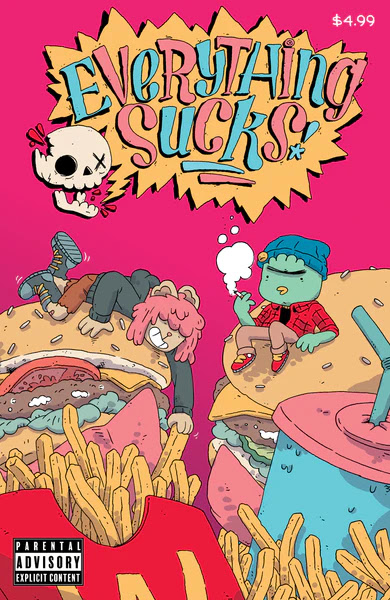
Michael Sweater embodies the aesthetic of much of Silver Sprocket's publishing output. I'm not exactly sure what to call this--cutepunk? Nerdpunk? Stonergeek? What his work in particular reminds me of most is an update on comics like Hate!, only updated for a modern audience and drawn in an anthropomorphic style. In his Everything Sucks! comic, stoner housemates Noah and Calla go in search of a crappy fast-food burger. Noah is the classic Buddy Bradley irascible nerd with a secret sensitive side. Calla is a free spirit like Lisa, and their annoying, shit-stirring friend Brad is in the mold of Stinky. Brad urges them to get tacos instead, but Noah has that self-righteous, faux-rugged individualist energy that pushes him to ignore the feelings of everyone else. A disgusting act from Brad is later followed by his accidentally starting a grease fire, an escalation of comedic circumstances. Noah winds up unhappy in the end, of course. 


Sweater has always been one to organize with others, and in the most recent instance of this, he's co-editing the anthology Good Boy! with Benji Nate. I've actually reviewed the second issue of this, which was stronger than the first issue, which I'm examining now. Unsurprisingly, Nate's comic (which leads off the issue) is one of the standouts. Nate has been extremely prolific and continues to evolve as a cartoonist; this story is about a former Magical Girl who was part of a Sailor Moon-type team who is now trying to figure out life as the mother of a teen, especially as the former leader of her group is now mega-successful AND a mother. The story ends abruptly, which makes me think it's part of a larger project. This would be quite welcome, as Nate has a knack for translating that Naoko Takeuchi energy into a more naturalistic and far sadder setting. 


Flower Alligator's story takes the cute to a meandering extreme, while Konstantinos Moutzouvis' story feels stylistically derivative of Ron Rege' in a way that's largely incoherent. CCS grad Daniel Rinylo's stories about cats and frogs are beautifully spare, strange, and funny. The pencils vary between fragile and dense, while the added drawings at the bottom of the page add to the odd quality of these stories. Dave Mercier's comic about the Mario character feels like more filler. Sam Grinberg's story of anthropomorphic geometric figures obnoxiously getting in conflicts at a casino is interesting to look at, but the cringe humor falls flat. Bastian Najdek's three page sci-fi story is yet more filler. 


Fortunately, the back half of the anthology is pretty strong. Steve Thueson is another good example of this nerdpunk aesthetic, though he writes for a YA audience. His story is about a space messenger named Jake who gets roped into helping a rebel alliance. It is completely silly and absurd, but it works because Thueson has a deadly-serious approach to depicting the actual action. The character design and characters themselves can be silly and cartoony, but the stakes are absolutely life-and-death, which gives his story a great deal of energy. Joseph Romagano's lettering project out in the wild is the kind of experimentation I'd like to see more of in this anthology. 


Sweater's own "Everything Sucks!" story concerns Calla and Phillipe, the latter of whom gave Calla a ride in the comic reviewed above. This story involves them camping out in a cemetery and a highly casual offer from Calla to make out, which Phillipe objects to because he feels like a last option instead of something she really wants to do. Of course, this all leads to them encountering a serial killer whom Calla falls for and starts making out with. I normally associate Ashley Robin Franklin with horror, but her black-and-white story about a creep trying to capture a wild Catboy is absolutely hilarious. Of course, there is a total gross-out moment (it is Franklin, after all) but it just makes it funnier. 


The issue concludes with two artists that are among my favorite in the newer group of Silver Sprocket cartoonists. Alex Krokus nails that Peter Bagge-style of fucked-up, weirdo housemates even more acutely that Sweater, as he makes sure to include the dilapidated brownstone as part of this particular roommate drama. His harsher use of color and less cute character design (they are still anthropomorphic animals, like many of the characters in this anthology) adds a gritty quality that makes it funnier. Finally, Grayson Bear's mix of cute and psychedelia is some of the strongest work visually in the anthology, as their use of red wash and zip-a-tone adds a great deal of weight and depth to the page.  

The most interesting thing about Sweater and Good Boy! is this kind of cultural blender approach he takes with his work. This is a generation of young artists who have grown up reading and watching everything--generations of comics at their fingertips, all kinds of cartoons streaming, etc. The result is a genre mishmash that ranges from cluttered and confused to innovative and hilarious, mixing ideas and images from outside of comics as well as being deeply rooted in their history. 

Friday, December 31, 2021

31 Days Of CCS, #37: Steve Thueson

Steve Thueson's kids' comic Timothy Dinoman Saves The Cat works on a number of different levels. It is a parody of just about every James Bond spy trope imaginable. Unlike the way this was spoofed by the Austin Powers movie, the ridiculousness of each trope is more-or-less allowed to stand on its own without a lot of extra silliness or meta humor tacked on. Thueson is totally invested in the action portion of this comic, with its humor inherent in its premise and the side relationships. When Timothy Dinoman is fighting a madman's henchman atop a train, it's serious (if fun!) business. In this regard, this comic moves a lot like a Jeff Smith Bone comic or a Carl Barks Donald Duck comic. 


The premise, which is not explained in the main story, is there's a good-guy spy who is a walking, talking iguanadon, wearing a smart black turtleneck and blazer. He also wears an eyepatch. His mission is to stop a Blofeld-style Bond supervillain named Bowman from stealing a satellite and enacting his evil scheme. Thueson does something very important in how he writes this comic. Most spy storiess suffer from a protagonist problem: their only goal is to fulfill a mission, which doesn't have much emotional impact. In fact, their antagonists usually have a much more impassioned story and reason for doing things. It may be evil, but it is sincere. 

Thueson side-steps this problem by making Timothy's real purpose saving and then adopting the villain's pet cat. It also ties into his friendship with his tech partner and friend Jen, and even cleverly becomes part of the plot when Timothy realizes there's a tracker on the cat that allows Bowman to kidnap her. This adds a layer of emotional depth to the story that's needed, making the mission personal. 

Timothy has to battle Bowman's henchman and outwit a thief Bowman hires, in addition to rescuing his cat and best friend. Thueson's problem-solving in figuring out the mechanics of fights, flying around in jetpacks, fighting on top of a train, and finally using shoe-jets to fight near a blimp are all accentuated by his thick, color-absorbing line. His character design is amusing but he doesn't use funny drawings, per se. It's all part of respecting the genre aspects of the comic while still gently spoofing it. The back-up feature, detailing his origin story, is well-suited to providing a fun info dump, instead of shoehorning it into the main story. It allows for fluid, logical storytelling that doesn't bog down in extra details. All we care about are Timothy, the cat, his friend, and the mission; all other details are extraneous. The silly details he does add (like the thief being obsessed with waffles) simply add to the fun of a successful book for kids. 

Sunday, December 16, 2018

Thirty One Days Of CCS #16: Steve Thueson, Ben Horak


Timothy Dinoman and Borsq, by Steve Thueson. Thueson mashes up genre comics with a punk rock ethos and emo melodrama, and these two comics see him branch out a bit from sword and sorcery comic. Borsq is a note-perfect Star Wars parody in the sense that it's about a bounty hunter going after a ne'er-do-well pilot. Thueson lays the visual supports on thick, with a spot red tone acting as creepy alien clouds and the color of the title character's cloak. He's made to cut a fearsome pose, until Thueson shrinks the panel size and zips the reader along quickly until he confronts his bounty target, Jake Caper. Caper is mooning over his ex-girlfriend, and the rest of the comic is split between hilarious dialogue about the ways he's trying to be OK with her seeing someone new and a running laser-gun fight and eventual daring escape. Thueson expertly meshes these together, understanding that all genre stories have melodrama at their core; he just gives the content of that melodrama a modern update.

Timothy Dinoman is a Bond-style spy caper with absolutely no context. That includes no explanation as to why the suave spy is an anthropomorphic dinosaur. It's a clever idea, because many action films are built around set pieces and have plot & dialogue added later. As a reader, we simply walked in in the middle of one of these set pieces, as the titular agent is chasing after a bad guy with a briefcase chained to his arm. Because it's a Thueson comic, there are also little comedic moments, like the spy needing to use a guy's phone. Mostly, this feels like an idea ("dinosaur spy!") that popped into Thueson's head, and he simply took it to its logical conclusion. At this point, I'd love to see Thueson tackle a long-form adventure in this vein. He knows how to push action while distracting the reader away from it with funny dialogue that deliberately feels borrowed from a different kind of story.

Daydreamin' Dave may be Horak's best comic yet. Fusing and undermining tired comedy tropes, absurd imagery and visceral, graphic horrific violence, Horak deliberately tries to create an unsettling but humorous experience for his reader. This comic starts with a Walter Mitty-esque fantasy vibe, as the titular Dave goes through his day fantasizing about various objects being alive and talking to him in a cartoonish way. There are still some weird close-ups that feature Horak's specialty (heavily hatched and labored art meant to act as a contrast to his rubbery, loose style), but it's more off-putting and weird than deliberately upsetting. Of course, Horak is playing the long game here, including adding tropes like a laugh track at the bottom of each panel where something "funny" is said. Horak keeps things under control with a steady nine-panel grid, which mitigates some of the stranger imagery.

Horak spends the first nine pages meandering, introducing us to Dave's world and acclimating the reader to this particular brand of magical realism. Then dopey Dave is introduced to a couple of bank robbers, and the various cartoonish characters he sees tell  him to be a hero. For his troubles, he gets shot right through the head in a two-page, grid-busting bit of visceral and graphic gore. It's a genuinely shocking scene, but then Horak makes everything from earlier in the comic pay off. The shooter makes a joke and starts to hear a laugh track. Every ridiculous thing that Dave saw and heard is experienced by this guy. The rest of the comic, as a result, is a relentless, hilarious and escalating nightmare. Every image and trope used in the first nine pages of the comic come back to torment the robbers in increasingly bizarre and fourth-wall breaking ways. Horak's command over his line was the key to making this work, because he had to nail every detail to draw the reader in before he completely flipped around the comic's premise.


Wednesday, December 27, 2017

Thirty Days of CCS #27: Aaron Cockle, Mathew New, Steve Thueson

Aaron Cockle’s project can be difficult to summarize, but after reading issue #20 of his grab-bag series Annotated and another mini titled Over Time, Every Section Had Been Allowed To Grow Accordingly, it occurred to me that it can actually be explained in a sentence or two. Cockle’s comics are a critique of capitalism (and its tendrils in the state, the sciences and the worldwide information apparatus) and its effect on ontological, epistemological, ethical and even aesthetic systems. The critique is that capitalism distorts, obfuscates and all but undermines these systems, and the critique itself is written in that same distorted language. It’s a smart technique because in the same way that the description of an experience of beauty is not the same thing as beauty, or a description of drowning is not the same thing as drowning, so too would an outside critique of capitalism be impossible. There is no “outside” of capitalism on a global basis anymore. Cockle strips away the illusions and gets to the phenomenological heart of the dehumanizing effect of capitalism in a manner that’s poetic and elusive.


As Cockle has evolved as a cartoonist, he’s gotten further and further away from conventional figure work (never his strength as a draftsman) and has instead moved toward abstraction, collage and fragmentation. Over Time… starts with a chapter about a worker who learns that even dying doesn’t free him from his job; he winds up haunting everything in his office (including voicemail, which I thought was amusing) and working in the position for another three years. The second chapter imagines an entire office being sent to a retirement home together, struggling against dementia while creating artificial structures and obsessions with receipts. The third chapter uses found documents as part of a story of someone using found documents to draw the location of all scaffolded buildings in the city as a way of cheating death. The fourth chapter (which signals the end of part one of this title) instructs the entire world as to their jobs, imagining people with multimedia accounts as all part of a united structure.


Annotated #20 is actually split into five separate minis, each with their own beautifully designed and/or selected cover to provide a maximum of decorative gloss. “The Circular Of Ruins” is styled such that it looks like it was drawn straight into a pocket notebook with lined paper. Each page contradicts the next in this story about a consulting firm that may also perform scientific experiments. The contradictions are not deliberate; instead, they are products of the critique I discussed above. An inability to trust in memory and observation, as the story suggests, is a direct attack on our understanding of epistemology, or the philosophy of knowledge. An ability to articulate the purpose of the company (and company = person in this example) is an attack on ontology, the philosophy of being. Not understanding how to treat others in the company is an attack on ethics. They are rendered senseless.

In a series of geometric shapes, “Anti-Pode” posits comparisons of a Wall, a Tower and a Pit. In the series of juxtaposed shapes (with different colors and gradients as rendered using zip-a-tone effects), the descriptions make each of the terms increasingly circular and meaningless. There’s no foundation to lay one’s understanding in. “Outsized Computer, Reporting Structure” is written as a kind of company report that reflect the ways in which everything is broken. Everything is structured, but nothing works, as the images of obsolete computers in the background tell us. All that’s left when resources have been stripped to their core are the artifacts of hierarchical thought. “Word Cage” breaks this down in another way, breaking down mission vs human cost; the “Affect Effect Infect” ethos describes perfectly the bare-bones mission of every corporate structure. The mini gets at the temporal and spatial effects of working in an office and how both are warped in this structure. Finally, “Cones Of Uncertainty, Cones of Resolution” is a savage takedown of public relations, noting that one must always apologize, even (and especially) if you don’t mean it. The way that this package is fractured, that it can be read in any order, speaks directly to Cockle’s critique more than any more traditional narrative could.


Mathew New’s loony, extended riff on Indiana Jones-style adventuring continues to grow simultaneously sillier and weirder with the fourth issue of Billy Johnson And His Duck Are Explorers. The basic set-up of each issue finds Billy, a kid given a remarkable amount of free reign to explore, investigating a new ruin, pyramid or other such site for adventure. Along with him is Professor Barrace Wilcox, a talking duck with a great deal of education (this issue reveals that he’s written three books!) and his sword, Mr. Jabbers. It is at once not just a send-up of explorer stories and Indiana Jones in general, but also of the seemingly endless epic quest graphic novels that litter the Young Adult landscape. At the same time, it’s excellent, clear-lined entertainment on its own.


This issue finds the duo having packed some lunches in order to go explore the ancient Hero Trials of myth; a sort of combination of Heracles and Theseus with some other twists thrown in. The theme of the issue is immortality: Billy wants to be remembered as a great hero. The duo is then zapped from the entrance to the first trial: defeating giant birds that already have them up in the air. A magic spear appears to help him win the trial, and they’re then zapped to the next trial where he’s been given a magical flying cape. All along, a voice offers him advice on how to beat his opponents using the new items. New is terrific at pacing and panel-to-panel transitions in particular, and his use of color is tasteful and adds the right decorative touch while aiding the narrative in subtle ways.


Eventually, the whole thing is revealed to be a trap, but Barrace’s bizarre nature isn’t simply a throwaway gag. Indeed, when the villain of the piece deduces the duck’s true nature, it causes her to scream, giving Billy just enough time to win the fight. Meanwhile, a blue alien that may or may not be related to Barrace is looking for them both. New pulls off the neat trick of writing a satisfying adventure short story and creating just enough subplots to give the book a bit of weight and depth. A back-up story by Luke Healy fits nicely into the book’s tone, and Healy’s adopts New’s style to create a new look altogether. Pin-ups by Bridget Comeau and Megan Brennan are all part of the value added qualities of this release, as do postcards written by Billy and Barrace.


I also wanted to add a review of Steve Thueson’s landscape mini Hell Fight #1. It’s a silent, continuing series of four panel strips detailing a vicious, knock-down fight between a woman coming home from work and a skeleton dude that steals her beloved jacket. This one is bone-crunching (literally!) violence on a visceral level that is carefully established in panel after panel. The woman really does not want to lose that jacket, which leads to the use of all sorts of magic in an effort to fight each other off. If Billy Johnson represents a more polished, YA approach in terms of action, then Thueson’s work remains raw and spontaneous: punk rock adventure comics.

Monday, December 4, 2017

Thirty Days of CCS #4: Luke Howard, Steve Thueson, Dan Nott

After Luke Howard finished the emotionally devastating, formally challenging comic Our Mother, it made sense that for his next comic, he wanted to do something as a palate cleanser of sorts, something that wasn’t as draining. The comic turned out to be The Big Mystery Case (subtitled “A Crime Comedy”), which threw every trope and cliché’ imaginable from hard-boiled detective stories and creepy serial killer cases and reimagined them as a kind of easy-reader primer for kids. The result is hilarious, as Howard’s deliberately spare line leaves only basic storytelling scaffolding plus whatever visual jokes he wanted to throw in. There is inane repetition that starts at the beginning, as the detective gets a call that says “We need you for the big mystery case” and he says out loud, afterward, “They need me for the big mystery case”. After he finds a clue, he says to the cops, “Take this back to the lab and do lab things to it.” You get the idea. 

There are mentions of a dark past and a trail that leads to the awesome Bad Boy bar, where a guy with a Mohawk is wearing a skull-bedecked top that says “Crime Shirt”. At one point, the detective says “We can do this easy way or the hard way” and the bar dudes hilariously say “Oh, then I say we go with the easy way”, simultaneously calling out action clichés and subverting them. There’s a Mystery Cave, flashbacks, a memory of a memory of a partner eaten by a shark in the caves, a memory of another partner being killed in a unique manner by an eagle and the discovery of a second detective, with whom a reluctant partnership is formed.

The back half features an encounter with a jailed serial killer (ala Hannibal Lecter) for information and a final confrontation in a basement (“Our descent is a metaphor”) that leads to an anticlimax. Nothing else would have suited this narrative, really. Howard doesn’t draw distinct faces in this story and also uses deliberately awkward poses, with the main detective tending to hunch his shoulders forward. He’s identifiable mostly by his moustache, just as the other detective he meets is made distinct by her hair (and otherwise identical detective outfit). This comic is 132 pages of silly, complete with an inspirational, shoegazing ending with a surprise character. There’s even a fan letter written by the killer to his inspiration stuff in an “envelope” glued to the inside back cover. 

In the package for the comic, Howard threw in a second comic, The Little Mystery Case. It’s a send-up of his own send-up, as the detective finds a lost puppy, tries to squeeze out of his underground connections and accuses the Big Fat Boss of the crime. The end is inevitable and heartwarming, even if he did insult the Big Fat Boss (his name is Steve and he’s sensitive about his weight). Howard basically inserts a puppy into crime clichés and it slowly dawns on him that this doesn’t make much sense. Howard goes big on every page, as it’s a page per panel. He invites the reader to go as quickly as possible in reading the story, and the images don’t really encourage the eye to linger; Howard is careful to make his jokes quickly apparent. Howard is a funny cartoonist, and I’d welcome seeing variations on this formula in the future.


In Quest Mania, what Steve Thuesen does here can only be described as “crusty punk D&D adventures”. In the newest, full-color comic book (titled “The Swamp”), the unnamed adventuring duo have been hired to retrieve a crown from a tomb. They’re having all sorts of trouble: the male half of the duo’s ears are painfully ringing due to a show he saw a few days prior; the swamp isn’t even on their map, they are attacked by a monster, and they have their stuff stolen by a goblinoid creature. The guy is especially miffed when his mixtape he made for a girl gets stolen. When the creature leads them to the tomb, she speculates that he perhaps has a fetish, which sparks an argument. The genius of this comic is the way Thueson transfers the template of two crusty punks and the things they argue about and bond over to a magical fantasy-adventure world. Indeed, the transfer is surprisingly seamless. It helps that he’s equally adept at drawing monsters as he is punks; there’s no character or style clash on any of the pages. The pierced, schlubbily dressed punks just happen to be carrying huge swords and know how to use them.

In The Fastest Mile I Ever Ran, Thueson draws himself as a kind of punk duck in this story from high school. He establishes early on his generalized anger toward pretty much everyone around, but especially his homophobic and generally awful schoolmates. That rage wound up fueling him when it was time to run the mile in physical education, as he wound up doing a six minute mile--way ahead of his classmates. Of course, he also made the mistake of drinking an orange soda earlier in the day and nothing else, so his body--pushed to its limits-reacted accordingly by vomiting. The worst part of the story was him having to lay on the floor as other kids came in and then being forced by the janitor to clean it up. He's saved from the bell after working on this disgusting job for a while, but as the end of the story reveals, he learned nothing from it. Once again, Thueson's ability to draw disaffected punks in any setting, with attitude fully on display, is his greatest skill as a cartoonist.

Belling the Cat and Spy Blimp, by Dan Nott. Belling The Cat is a collection of three short stories, and it's a classic CCS move for a student to collect their student work in such a mini. Nott is graduating this year, and these comics show a cartoonist trying a number of different things. The first story, "9.11.01" uses the Ed Emberley simple-shape model (everything is either a circle, square, triangle, rectangle or oval) to relate his experience of 9/11 as a sixth grader. Using a 2 x 4 grid, it's odd now but made sense then that the teachers were trying to keep the event under wraps, but all it took was one student who had a doctor's appointment in the morning to rely this information. It's a comic that's interesting for its portrayal of cognitive dissonance on the part of the panicking adults, which bent the brains of the kids who were used to their authority figures being sure of everything that was going on. The Emberley style adds to that sense of a kid drawing the story and being unable to capture the complexity of an emotionally fraught situation.

The best story was Nott's adaptation of "Belling The Cat", based on an old folk tale. What I liked most about it was Nott's delicate, cartoony line in service of depicting a genteel mouse society menaced by the random violence of cats. It's a great story because it's about the way an idea can go a long way without anyone closely examining the viability of its premise. In other words: "Who bells the cat?" "Election Day" is about the 2016 election and suggests that there was a poor contingent of non-racist white people who voted for Trump because life was hard, his rhetoric had appeal, his racist friends liked him, and he didn't like being called a racist by someone outside a polling station. Nott tries to build up this character as reasonable and likable (with the light red wash being a subtle signal of what kind of voting area he was in). I'm not sure if Nott was setting this guy up as a good guy who got goaded by an asshole into voting for Trump, or simply a weak-willed person who got pushed into voting by Trump by the more passionate around him, despite his better judgment. Either way, considering the number of white people (and men in particular) who voted for Trump nationwide, I didn't find the strip's conclusions (such as they were) to be all that enlightening. The way Nott slipped between naturalistic drawing (the main character in particular) and the cartoonishness of the more extreme characters was clever.

Nott's work was much tighter overall on the whimsical, weird Spy Blimp. The first chapter is all about "Fat Albert", an aerostat (a stationary blimp) docked near Key West in Florida. Its purpose was unclear, although it was eventually revealed to be a spy blimp that also transmitted US TV to Cuba. It also had a tendency to have its anchor rope snap under high winds from time to time, and Nott depicts two fishermen tying it to their boat so as not to let it get away. Fat Albert had other ideas, taking the men and their boat into the sky. Incredibly, it was shot down by the Air Force, putting the poor fishermen into the ocean. It's a wonderfully absurd series of images in this nine-panel grid. The second story is an awesomely cynical one about a defense contractor trying to unload the JLENS (Fat Albert, essentially) as an anti-cruise missile deterrent. Its testing disastrous (causing power outages thanks to it getting away), the snake-oil salesman contractor pitched it to the senator for surveillance purposes.

 The third story reveals the panopticon-like qualities of the aerostat. Even if its cameras were broken, it was enough to make the people think that they worked to change their behavior. Designed to sniff out potential bombers, it wasn't hard to make the leap to categorizing any kind of odd behavior as threatening and in need of immediate termination. The differences in perception based on the degree of surveillance, violence and colonialism they're subjected to are depicted as bleakly humorous, as the cheers from the Afghans when they shot down their aerostat compared with the quirkly South Floridian bohmemians was telling. This is a smart, well-paced comic that concentrates on visual payoffs but also provides some key decorative qualities as well for balance.


Saturday, December 17, 2016

Thirty-One Days of CCS #17: Jacob Bussiere & Steve Thueson


Quest Mania, by Steve Thueson. Thueson, like Bussiere (and Robyn Smith, whom I reviewed earlier), are all members of the the upcoming class of 2017. The conceit of this full-color comic is that there's a world where hipster-punk types go on Dungeons & Dragons-style quests. Adventurers Susie and Matt carry huge swords, wear Chucks, have nose rings and two-toned hair and make references to The Little Mermaid and Ren & Stimpy. I'm pretty sure this was drawn on a computer, but Thueson still manages to give the comic a gritty, ragged edge. What's most remarkable about the comic is that Thueson is able to simultaneously tell a slice-of-life relationship story as well as a perfectly credible sword-and-sorcery yarn. There's an especially funny sequence where Matt chides Susie for trying to kill a vicious giant spider because it wasn't vegan to do so. There's angst about being an adventurer because it's affecting Susie's relationship with her partner Kris, there are money woes solved by going on a quest for an idol, treasure rooms guarded by reptilian rock bands, etc. The bright, occasionally lurid colors work well, especially the creepy purples. I could actually Theuson making this a continuing feature by adding characters, giving the series a bit more complexity as subplots form on both sides of the genre divide.

Bubblegum Comix, by Jacob Bussiere. This is very much in the Chuck Forsman style of stories about disturbed teens, only Bussiere adds several meta-levels to the narrative. It starts out with a boy getting bullied who later kills a classmate after one insult too many. In this case, it was when the boy dressed up like the androgynous pop singer Sylvester, a bizarre and funny detail that made the actual murder no less horrifying. The scene pulls back to reveal that the kid was the subject of a murder-exploitation show and a teenage girl & her much older boyfriend were watching it. In a clever panel-to-panel sweep of her room, Bussiere reveals a lot of details about her: she loves death metal, stuffed animals, Sailor Moon and follows a "trucrime-boyz" tumblr. Using the same 2x3 grid and the same series of head shots in profile, Bussiere essentially recreates the same conditions of bullying and abuse for the girl (whom they refer to as "skunk"), only she reacts to her surroundings by just wanting to escape forever. There's a remarkable two-page sequence toward the end of the story where every panel has a crude or awful image: a wrist slit by a razor, a pentagram, a child's drawing of a crying figure, etc. What follows are two densely cross-hatched pages where it seems the previous images are each thoughts flickering through her mind. She's driving her car with her boyfriend asleep next to her, death metal blaring and the road ahead of her. One gets the impression that while she's not exactly, the tight, slight smile on her face reveals that this is happy as she's going to get. Bussiere's sense of design and composition really carry the story, as he tries to exercise as much restraint as possible with regard to dialogue. He packed a lot of power into a very short story, and it seems clear that he has a future with regard to these sorts of intense character studies.