Please note that this post is sponsored by Winning Writers.
Wednesday, April 13, 2022
Announcing the North Street Book Prize
Friday, December 31, 2021
31 Days Of CCS, #35: Michael Sweater
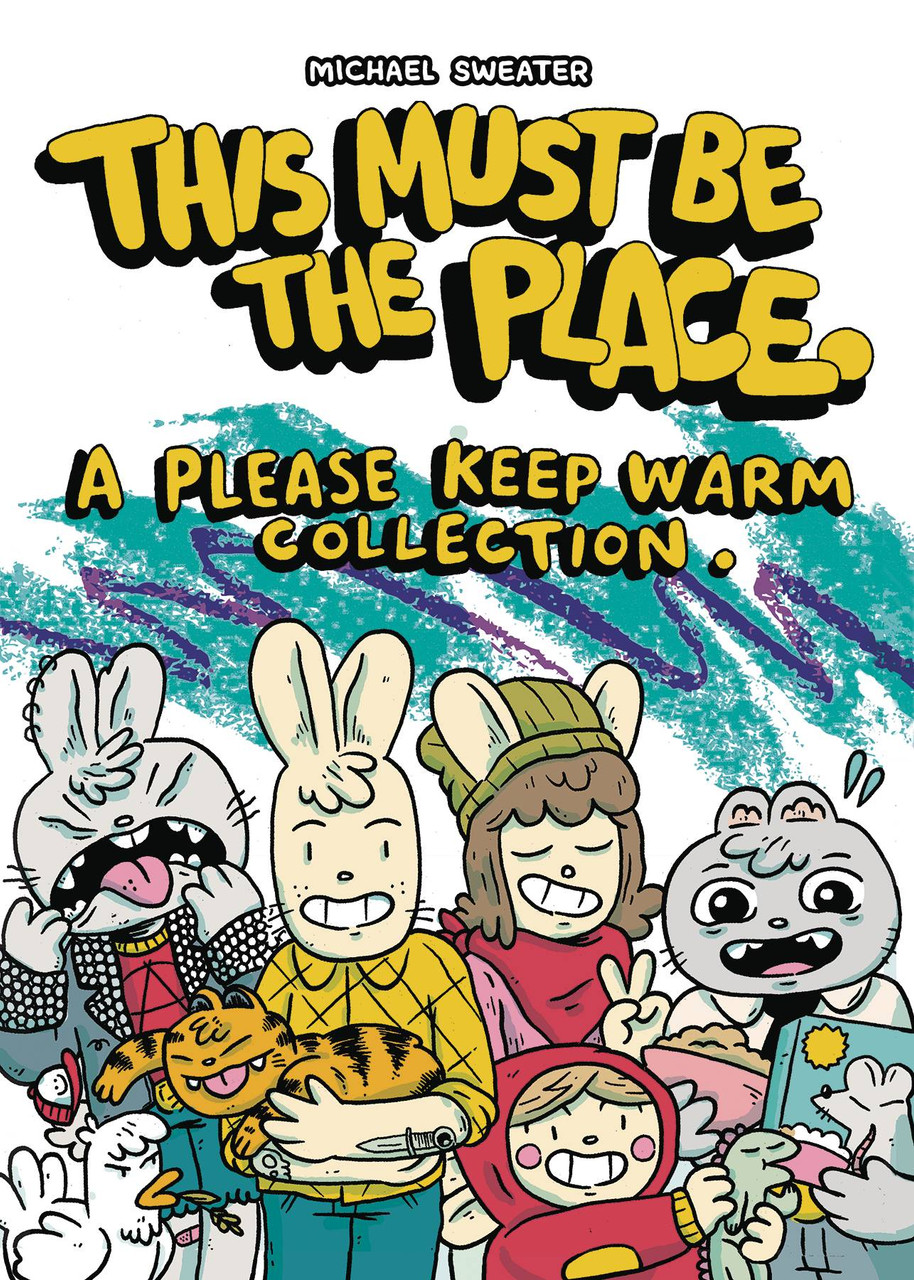
Michael Sweater's comics are often aggressively cute. That cuteness is cut by his funny satires of hipster culture, making what initially looks like YA comics into classic slacker slice-of-life comics. His collection of "Please Keep Warm" comics, This Must Be the Place., has a line-up of quirky and mostly lovable writers, kids, punks, toughs, weirdos, and working people. Using a formula that goes back to Peter Bagge and Hate, and more recently Simon Hanselmann with Meg, Mogg, and Owl, Sweater gently pokes fun at his characters while also clearly displaying a great deal of affection for them.
The comic is a series of vignettes featuring an inquisitive kid named Clover, her Uncle Stan (a writer with perpetual writer's block), an accountant-type named Catman, and a slacker woman named Flower. They're all housemates whose relationships are undefined in the way group houses often are. They're visited by a punk anarchist type named Kevin, a trucker hat-wearing, cigarette-smoking chicken, and have all sorts of adventures. It's all done in an anthropomorphic style that's all about strong expressions and gestures.
Sweater keeps the stories short and snappy, with plenty of humor before eventual punchlines. For example, Clover decides to record a black metal demo and gets a bad review on Pitchfork, prompting Catman to try to cheer her up by regaling her about his goth days in high school. Stan, Clover, and Catman go on a camping trip without inviting Flower, causing her to get depressed. She's cheered by punk rabbit James, who is a marvel of character design with multiple piercings in one of his very long ears. Stan is always trying to write a novel but finds multiple excuses and reasons not to work.
It's all very leisurely paced, which is part of its appeal. No one is in much of a hurry to do anything, inviting the reader to do the same as they stroll through the lives of character archetypes who will be familiar to many. It's Punk Lite in the best sense of what that means, poking gentle fun at the scene and the kind of group houses so familiar to people in their youth. Sweater's character design and storytelling chops are what make it feel so lively and polished.
31 Days Of CCS #40: Aaron Cockle
Aaron Cockle keeps cranking out oblique, bizarre takes on capitalism and culture in the form of a world-exploring video game called Andalusian Dog, and he released four issues of the comic named after the game between February of 2021 and January of 2022. The word "surreal" gets over-used in popular culture to mean "weird" or "uncanny," but the roots of the art movement are deeply involved in an exploration of the unconscious mind and its symbols. How we encounter and process these symbols is not the same as it was a century ago when the movement began, and Cockle's comics are a response to both modern art and technological movements, their intersection, and their being co-opted by industry and capitalism.
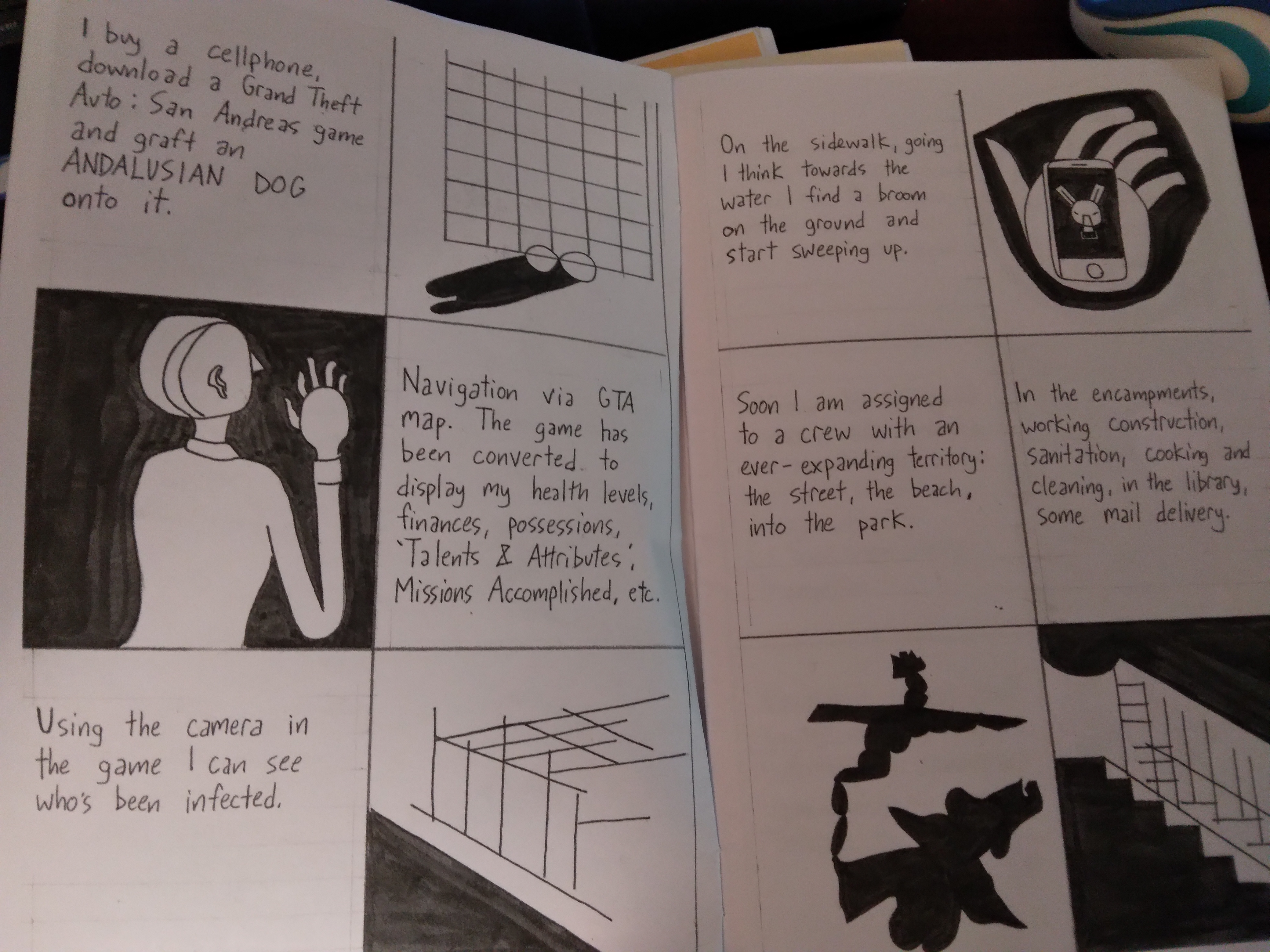
The February 2021 issue of Andalusian Dog is titled "Ladder of Fire," a reference to the Rene Magritte painting of a key, an egg, and a wad of what looks like paper all on fire. Ordinary objects, all in the process of change and possible purification; ordinary objects in the process of being destroyed. In this issue, the paranoia and conspiracy attached to the game take on a different aspect as the narrator is dropped off in Los Angeles with a tent, a sleeping bag, a $100 gift card, and a backpack. His first move is to download Grand Theft Auto: San Andreas and then overlay Andalusian Dog over it. The overlay lists the narrator's own health while providing a map to navigate his environment (since the game was based on Los Angeles). The distance between game and reality becomes nil, and the whole experience is a punishment for various crimes--real and imaginary. There's a desperate sense in this story and the next of secretly and surreptitiously working on borrowed laptops about theories of salvation; in the former story, it's the Ladder. In both stories, there's a sense of total societal abjection for the narrator, of being thrown down and thrown out of society. Yet there's a kind of desperate freedom in that.
The November 2021 issue may be my single favorite issue of the series. Titled, "The Pit," there's once again a press-ganged aspect of the story as the narrator must help build a structure where the pit must be as deep as the tower is high, and the wall must be as long as the height of the tower. It's all for a mysterious Count as Cockle heads straight into Kafka territory, as he talks to his friends and becomes the founding and sole member of the Franz Kafka Fan Fiction Society. Later, he is thrown out of his own organization, of which he is still the sole member. Later still, he and his friends (all labeled X) are sent on a mission to an outpost for for work, Finding the outpost abandoned, part of the group searches for the group that left the outpost, leading to more abandoned outposts, more lost people, and more expeditions. Eventually, it becomes an existential game where one's own identity is in question, a sort of open-world video game where the mission eats itself. Cockle overlays maps and diagrams with less to do with standard cartography and more with game logic.
The December 2021 issue goes back to Chile, a frequent setting in Cockle's comics. The makers and developers of the game find that the game is affecting real life, and real life is affecting game play, and they don't know how this happened. Cockle himself is a character, referring to his own comics and finding reviews of work that he's never published or even conceptualized. Once again, there's a sense of always being on unfamiliar or dubiously claimed ground, squatting in abandoned houses and finding ways to work and even throw parties. All along, the images are nightmarish but clinical; office buildings, cubicles, strange geometry in a Lovecraftian sense. Cockle is deliberately conflating dream logic with virtual reality, trying to find the line between the two--if there even is one.
Finally, the January 2022 issue betrays almost a kind of mania, as huge walls of text appear on each page, overlaid with diagrams, sketches and scribbles that sometimes border on the abstract. It's difficult to even begin to parse, as it's a stream-of-consciousness journal about traveling to Chile once again. The back half of the issue goes in the opposite direction: oblique bursts of text paired with clip-art, diagrams, photos, blotches of ink, maps, and other ephemera. Providing an appendix perhaps only for himself, there are also excerpts from an essay about Kafka and The Decameron. This is the most oblique and self-referential of all of Cockle's comics, seeming lost in its own maze of logic, having long ago abandoned clarity with regard to narrative and plot. It's also barely what I would consider to be a comic.
31 Days Of CCS, #32: Less Than Secret
I enjoy anthologies that are a true team effort. This is something that's one of the major first-year requirements at CCS, as students are split into teams to make an anthology in a particular style, like Golden Age adventure or romance comics or 90s style Shonen Jump manga work. Because most alternative cartoonists are solo acts, forcing this kind of collaboration can be useful and teach a lot of lessons. Less Than Secret is an anthology from several CCS grads and several other cartoonists. Beyond their contributions in terms of the stories they drew, many of the book's cartoonists had other duties related to publishing.
CCS grads Rainer Kannenstine and Ben Wright-Heumann served as its publishers. They were there to make sure the book was on schedule, obtain funding and consider distribution. JD Laclede was the editor, working directly with talent and sequencing the stories. Erienne McCray did the design, while Kelci Crawford acted as the crowdfunding manager. Angela Boyle was an anthology consultant, which makes sense considering her years assembling the Awesome Possum anthology. That collective sense of responsibility on what was clearly a labor of love is present and strengthens the overall anthology.
The theme here is cryptids, or animals that some people claim to exist but whose existence has never been proven. It's fitting that Steve Bissette, the master monster-maker, penned a funny intro explaining his interest in monsters from a young age. Crawford's "A Day In The Life Of Mothman" is played for laughs, as a woman is followed by the legendary creature, whose presence foretells potential disaster. However, she can sense him, and it allows her to prevent a guy from being killed by a car, avoiding a fight at a diner, and preventing her from eating a bad hot dog. Crawford's line is crisp and expressive, with a lot of grayscale shading to add weight to the page.
McCray's comic about the "Fresno Nightcrawler" (essentially a big baseball with legs) is also played for laughs, as this cryptid is more ridiculous than scary. They added a nice touch having the Loch Ness Monsters as its roommate and Bigfoot taunt it. McCray's line is fluid and a nice match for the kind of dynamic silliness that this ridiculous creature (wearing a fedora, even!) demands. Wright-Heumann is a horror guy, and he did a sort of Western/fantasy fusion with a family of Elves fending off a group of chupacabra mysteriously attacking them. The ending is grimly clever. His scratchy line was appropriate for the subject matter, though the extensive use of grayscale was distracting at times. This was a story that cried out for color.
I'm not crazy about comics that insert huge blocks of typewritten text, but Angela Boyle's cartooning is so sharp in her story of the odd little elwetritsch that it wasn't too distracting. Moreover, using that text as the main character's interior monologue actually made this a useful device, commenting on the comic set around it. Boyle manages to sneak an entire murder mystery into this little comic with an unassuming old woman and her strange "pet." Ian Klesch and Andrew Small's story about how a lycanthrope used a dating app to fool a woman into being his prey was funny and grisly. The figure drawing was crude at points in a way that was distracting, and some of that was due to over-drawing in an effort to bolster a shaky line.
Rainer Kannenstine's piece about the Dover Demon went in yet another direction: how messing with weird cryptids is likely to bite you in the ass in horrible ways. It's the story of a bully who attacks the creature in the forest with a ball, then gets his head crushed in revenge. He used some digital effects in interesting ways, including a "syrup brush" for some of the background fills that added to the story's atmosphere. Jess Johnson had perhaps the silliest story in the book, as an emo kid is befriended by his sister's new boyfriend: "JD," or the infamous Jersey Devil. Johnson turned the creature into an actual hockey player and made this a romance/family story where everyone took JD's presence for granted. It's hard not to see Johnson's strong shojo manga influence, giving this a radically different look and feel from the other stories in the anthology. However, it's not a slavish adherence to the style; rather, it's a launching point into Johnson's own style.
There's plenty of backmatter in the anthology, including full biographies and behind-the-scenes stuff that's somewhat interesting, but at 20 pages (compared to 90 pages for the rest of the book) it feels like a lot of padding. That said, the interviews asking each creator why they chose their cryptid, their creative methods, etc. was at least thoughtfully done. Overall, this is a breezy anthology that I wished had been a bit longer.
31 Days Of CCS, #31: Josh Rosen
Josh Rosen has two entries here. The big one is the art job he did for The Good Fight, written by Ted Staunton. It is an unfortunately timely book set in 1933 Toronto, at a time when Nazis were starting to take hold. Toronto is known now as one of the most racially and ethnically diverse cities in the world, but this era showed how fraught that status was, and still is, to an extent. As such, the cast is very Toronto: a Jewish kid named Sid and an Italian kid named Plug, whose families live together, try to hustle their way into helping their families during the Depression.
The essence of this book is a shifting idea of ethical behavior in the face of poverty, systematic white supremacy, and police corruption. Sid and Plug start the book hooking up with Tommy as part of a pickpocketing trio. Tommy is Jewish but pretends he's Irish, because it's better to identity with more traditionally Anglo-Saxon ethnicities than staying true to your own identity--especially as a grifter. His patter, his swagger, and his braggadocio were things that Sid and Plug were dazzled by, even as they slowly started to understand that he would (and later did) sell them out at a moment's notice.
When Sid and Plug were pinched and ended up at the police station, they were quickly wisened up about how the world really worked. The cops couldn't care less about some teen yeggs. What they were after (and had been watching the boys over) was the identities of labor leaders, so they could crush them. They not only couldn't care less about the ethnic minorities who were banding together in order to get better working conditions, they were happy to let the burgeoning Nazi presence in Toronto take care of their job for them.
The book's climax was the real-world Riot at Christie Pits. It putatively started as related to a hotly-contested softball game but led to what was supposed to be a massacre of Jews, Italians, and other minorities as the cops stood by and did nothing. Instead, the marginalized groups fought back and the pro-labor Mayor was able to use this to help get control over the police, and labor gained a number of concessions. In the 21st century, this is all somehow next verse, same as the first, as various forces continue to work against labor and the general voice and betterment of marginalized peoples.
Of course, this is all framed through the eyes of the kids in order to bring it within the purview of YA fiction. This is where Rosen steps in so ably. He has a spare but expressive cartoony style that maximizes the expressions of his characters while keeping a foot in naturalism. The color palette is admirably restrained, emphasizing Rosen's line art instead of dominating it. The characters, especially the antagonists, are on the exaggerated side at times, although Plug, Sid, and Plug's sister Rosie are well-realized. It felt like Rosie was a character Staunton wanted to do more with but couldn't quite figure out how, and her status is somewhere between central character and a side character who adds a bit of color. This amounts to Rosen's PhD in comics in some ways, as it's his first full-length book after doing a lot of minis. His style is no-frills, but it told the story ably and aptly.
Rosen also included Wrestle Club!, a fun zine where he invented an all-women's wrestling federation. He alternated between profiles and short comics involving the wrestlers, and it's a delight. The federation (the All Girls Fight League or AGFL) is a bit like Japanese feds like Stardom where most of the fighters are pretty young (and mostly teenagers), and Rosen really keys in on how each character's gimmick is informed by their personality. This seems like a perfect future YA project; I hope Rosen pursues it.
31 Days Of CCS, #34: Ben Wright-Heuman
Ben Wright-Heuman is a highly versatile cartoonist, writing everything from gag strips about cosplay and comics conventions to horror to suspense thrillers. The Letters Of The Devil II: The Legacy of L is certainly in the latter category, and it's a sequel to his clever original about a cop and a childhood friend engaged in a game of cat-and-mouse. The titular L delivers letters to others giving up incriminating information about someone else, and Wright-Heuman keeps the reader guessing til the end about who the protagonist of the story is--or if there even is one.
For the sequel, Wright-Heuman takes a bit of a page out of the Scream films and adds a distinctly meta element to the proceedings. This time, there is most definitely a protagonist: a first-year Criminology student named Malina who decides to study the case surrounding L, which had become a media sensation. In particular, L's obsession with truth and justice superseding the law resonated for many. She's aided by some inside info: her mother is chief of police, and the corrupt cop at the center of the first book worked under her. When one of her friends commits suicide when she receives a chiding letter from someone who appears to be L, it opens up a brand-new can of worms.
Like any good author of a thriller, Wright-Heuman doesn't cheat with regard to clues; they're all hiding in plain sight, if you're willing to pay attention. One of the clever meta-elements of the book is that serial killer types like L tend to spawn copycats, In this case, it inspired something far beyond that, once again invoking supernatural elements as a tease but certainly using the trappings of cultists. The ending was a bit over-the-top (especially with regard to the cult leader), but then truth is usually stranger than fiction. That's how QAnon became a viral belief system; why not the cult of L?
Heuman is limited as a draftsman, but his storytelling is solid. His use of pacing, gesture, and character interaction was solid, and his characters were highly expressive. The use of red as a contrast color and as L's signature continued to be clever. However, I found the relentlessness of the greyscale shading to be a distraction. Rather than add a sense of weight to a page and filling in dead space, Wright-Heuman drowned the whole narrative in greyscale; it served as a distraction from his storytelling, rather than an enhancement. His storytelling is strong enough that this narrative simply didn't need it. Indeed, this book was a relentless page-turner thanks to his understanding of story structure, motivation, and how to swerve the audience without it feeling cheap. A simple and limited line should be embraced in this situation, because it will provide the easiest access to that first-line/best-line expressiveness that simplicity offers. I'll be intrigued to see how Wright-Heuman continues this particular story and what new directions he can find for it.
31 Days Of CCS, #38: Ian Richardson
Serial killers, as a genre, were played out a long time ago. There are only so many ways one can twist the concept that's not outrageously sexist, racist, and/or homophobic. There's also something lurid and exploitative about these kinds of fictional stories, and they tend to bring out justifications of godhood in these delusional, pathetic killers. Ian Richardson turns serial killer tropes on their head with his very clever On Mondays I Murder. It's told in the form of a first-person day planner, which virtually every panel being a reference either to a classic painting or something in pop culture, only with the likeness of one of the three main characters in the book.
The first couple of chapters are a play on American Psycho-style serial killer narratives. The killer goes into loving detail about his "calling," as just another way of casually flaunting conspicuous wealth. He is above the law because he's white and rich; it's implied that he killed his own rich father in order to fund his lifestyle. When his next target mysteriously disappears, it throws off his rhythm and sense of well-being as though his calendar controlled him, and not the other way around--and to a degree, this is true.
He eventually finds a secret diary written by his target, which reveals her as someone who's every bit as nihilistic as he is. She's constantly being objectified and finds the concept of love to be a joke. Her prey happens to be any man interviewing her for a job; it's a game for her to seduce him. The serial killer deduces that she may have been kidnapped by another serial killer, and he's right.
Rather than shift the narrative to the other killer, it instead shifts to the "victim," as she announces that she's just killed two guys. In the long and intricate process the rich killer undertakes to attack and then convert the second killer to his cause, he never thought for a moment about the victim as anything other as a means to an end. It's the ultimate kind of depersonalization and detachment necessary for killers to operate; not only are their victims othered, every living thing is othered. She uses that against them and winds up replacing them, killing on her own terms.
This comic gets into a highly bleak, nihilistic frame of mind and combines that with pitch-black humor. It's a satire of wealth, it's a satire of having a higher purpose, and at its heart it's a warning against the kind of isolation that a capitalist society frequently engenders. Their cynicism and contempt for others fuels their isolation, to the point where it warps them into only being able to think of others as objects at hand in the most extreme ways possible. In a warped, demented way, killing is the only time they have a glimmer of connection with someone else, and even that is heavily mediated by control rather than freely making themselves vulnerable. In the eyes of each character, even before they started to kill, the world was a binary of causing or receiving pain--and they chose to do the latter. The twist in this book is clever, as is leaving it open-ended isn't any kind of endorsement of her choice; indeed, she's become exactly the same kind of banal monster who thinks she's above it all.