There's no question that Luke Pearson is one of the most talented cartoonists of his generation. The sixth and final (for now) volume of his beloved Hilda series, Hilda And The Mountain King, not only caps off the cliffhanger ending of the previous volume but also ties together a lot of narrative threads from the very beginning. NoBrow very clearly knew what they had in Pearson from the beginning, as these books have always been printed at a size that allows his multi-panel pages to really breathe and flow. Of course, the care that NoBrow takes with their color and production values that mark each of their books has always been a highlight of the Hilda series, but the colors are far more muted and varied than in many NoBrow books. Indeed, Pearson uses a lot of negative space on his pages as a way to highlight individual character moments.
Color tends to dominate many NoBrow books over the quality of the line itself, but that's not the case for Pearson. His beautiful, expressive, and cartoony line takes precedence in every panel. The color simply accents and highlights the line. While his backgrounds and nature drawings are lush and warm, it's his use of gesture and body language in his character designs that truly draw in the eye. Pearson clearly looked at a lot of Chris Ware's work as well as Tove Jansson's, but there's also a lot of Donald Duck in there as well. The only contemporary who depicts panel-to-panel action on the same level is Jeff Smith, but Pearson has a more aesthetically-pleasing style.
The Hilda books center around the title character, a young girl living with her mother. First, they lived out in the woods in a forest filled with strange creatures like invisible elves, mountain-sized giants, and trolls who turn to stone in the daylight. Their existence and motivations sparked the first Hilda book and became a running part of the narrative, although mostly in the background. The key turning point in the series came when her mother moved them into the nearby city of Trolberg, whose whole purpose was to keep the trolls away. Hilda loves her mother but is also extraordinarily strong-willed, and that tension is at the heart of the entire series. Her mother worries about her and starts to feel Hilda pulling away from her, unwilling to share her life with her. That came to a head in the previous volume, Hilda And The Stone Forest, when they were trapped inside the mountain with trolls. All seemed to end well until the end when Hilda woke up as a troll with the troll-mother they had met, and Hilda's mom dealing with the troll-baby they had met.
The new volume picks up from that surprise twist and introduces a number of other plot twists while still conveying the sheer joy that Hilda learns to experience as a troll. She misses her mother and being human, but being a troll conveys a little of the wild experience she wants out of life, one absent of responsibility and expectations. Balancing that wild quality with the safety and comfort she feels at home is at the core of the story, as well as balancing fear with compassion and understanding. The big, epic ending simply recapitulates the series' themes: the relationships between mothers and children (but especially daughters) and the desire from all to have a place to call home. Those themes are writ both large and small throughout the series, though this book makes it big and splashy. The final images display the kind of balance that Hilda and her mother achieved with each other in a joyous fashion.
Showing posts with label luke pearson. Show all posts
Thursday, September 26, 2019
Wednesday, August 15, 2018
NoBrow: Hilda and the Hidden People
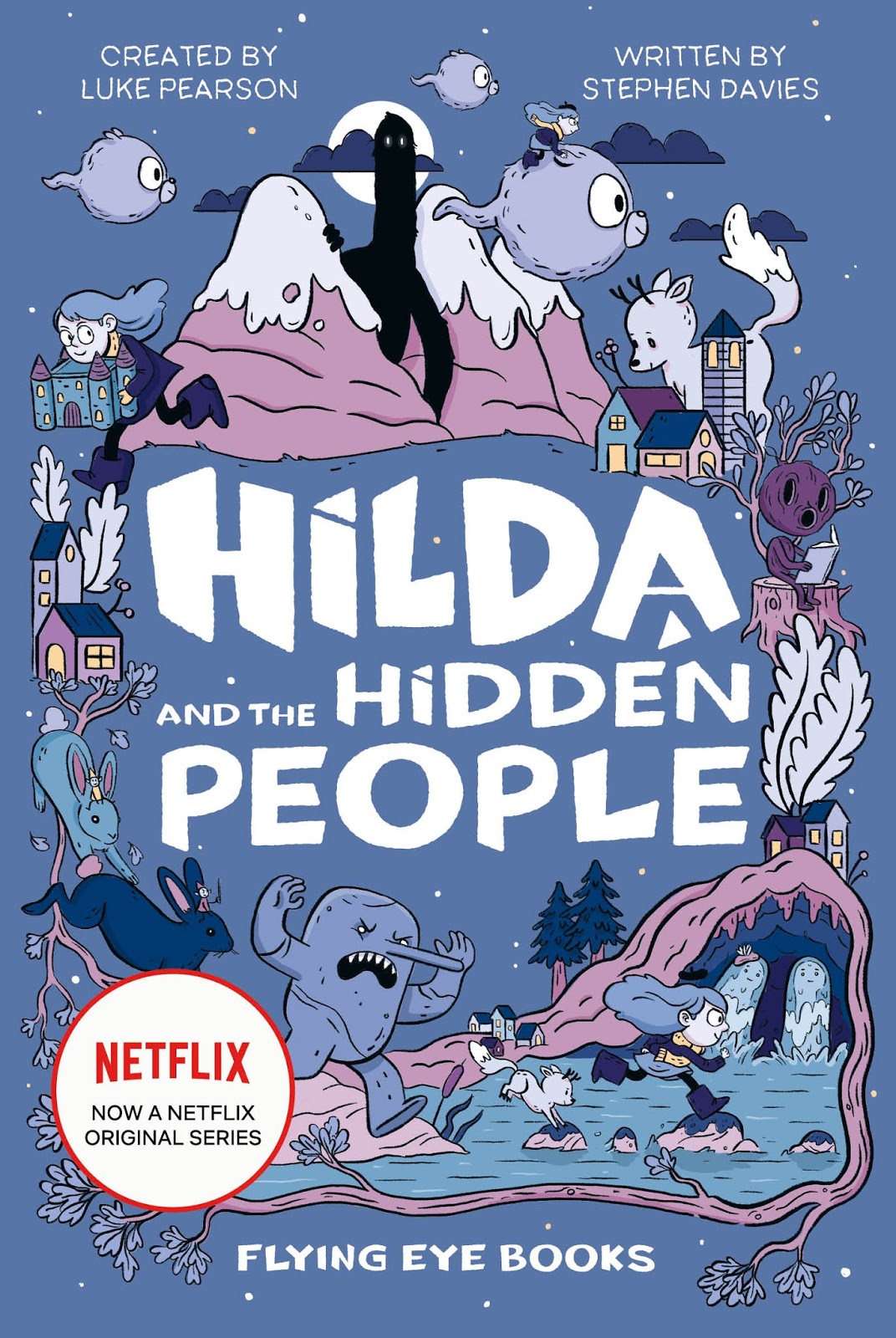
Hilda And The Hidden People is not a new book by series creator Luke Pearson. It is instead an illustrated novelization of the upcoming Netflix series based on his original series. It basically mashes together Hilda and the Troll and Hilda and the Midnight Giant into one bigger story. The adaptation was written by Stephen Davies and illustrated by Seaerra Miller. I know that NoBrow owns the media rights to Hilda, which undoubtedly covered things like novelizations. Pearson was an important part of the cartoon show from what I understand, so I imagine this was just another way for NoBrow to publicize and profit from the original material.
The best way to describe the book is "competent". So much of the Hilda series was dependent on Pearson's vivid visual imagination and long series of silent panels that it was going to be an uphill battle to adapt it as a novel, but Davies did a solid job. It all managed to hang together, and Davies brought some extra humor to characters like the Wood Man with his descriptions. The illustrations are perfunctory and not much else, and they don't have the vivid quality of Pearson's originals.
Happily, I have an on-hand test audience for books like this: my nine-year-old daughter Pen. She was already crazy for the individual Hilda books. In fact, these books are what truly hooked her on reading. She keeps them in her room now and often wakes up in order to read them. She is beyond excited for the upcoming cartoon. So I read a chapter a night to her from the book, and while she certainly enjoyed it, it hasn't quite stuck the way that actual comics have. She hasn't asked me to re-read it in the way she has with certain comics, nor has she looked at it again herself. In other words: this book does its job but no more than that.
The best way to describe the book is "competent". So much of the Hilda series was dependent on Pearson's vivid visual imagination and long series of silent panels that it was going to be an uphill battle to adapt it as a novel, but Davies did a solid job. It all managed to hang together, and Davies brought some extra humor to characters like the Wood Man with his descriptions. The illustrations are perfunctory and not much else, and they don't have the vivid quality of Pearson's originals.
Happily, I have an on-hand test audience for books like this: my nine-year-old daughter Pen. She was already crazy for the individual Hilda books. In fact, these books are what truly hooked her on reading. She keeps them in her room now and often wakes up in order to read them. She is beyond excited for the upcoming cartoon. So I read a chapter a night to her from the book, and while she certainly enjoyed it, it hasn't quite stuck the way that actual comics have. She hasn't asked me to re-read it in the way she has with certain comics, nor has she looked at it again herself. In other words: this book does its job but no more than that.
Friday, September 2, 2016
NoBrow: Luke Pearson
The latest edition of Luke Pearson's Hilda series, Hilda And The Stone Forest, feels like a significant turning point in the series. Each of the first four volumes has expanded the world that Hilda, her mother and her friends live in, but this fifth volume represents a recapitulation of the first four volumes and then expands on that in often harrowing fashion as Hilda and her mom find themselves trapped in a mysterious stone forest. The beginning of the book recapitulates the earlier volumes by depicting highly abridged versions of Hilda's typically rough-and-tumble, hyperkinetic adventures. That began with a long, Carl Barks-inspired sequence where Hilda was chasing after a big clot of dirt with legs that had captured a tiny elven house. Over and under fences, across tracks, through forests and finally at a farmer's house outside of the town's safety wall, the catch here is that Hilda constantly lied to her mother about where she was.
Pearson ramped that up in some remarkably designed pages. There's one page where the action starts at the top of the page in the upper left hand corner, and then the eye is sent to the panel below it, til one gets to the bottom of the page. Splitting the middle of the page into a pair of interlocking trapezoids was an ingenious way of getting the reader to follow the page's action with ease with a repeating pattern in each columns: panel one would be a lie Hilda told to her mom about where she was going, panel two was some crazy adventure and panel three was Hilda lying about where she had been--often covered in dust. While Hilda's mom was trying to keep her safe, Hilda hit a sore spot when she accused her mom of wanting Hilda around because she was lonely.
After a series of misbehavior and some magical mishaps, Hilda and her mother found themselves in a stone forest. Pearson's color schemes shifted from the vibrant, warm and welcoming hues of the city and the forest to the more pale and slightly sickly tones of the forest. There's one two page spread where the "camera" is pulled way back and we the tiny figures of Hilda and her mom walking through the forest and we get a sense of the huge scale of their environment. Each of the three panels on each page is a different color, further contributing to the alien quality of their surroundings. When they discover that they're in fact inside the mountain home of the ferocious Stone Trolls, the narrative shifts once again.
The narrative stops being one of blame and starts being one of survival and escape, as they try to figure out a way to get past the notice of the trolls and get back outside. They learn that there are a variety of trolls, some who are vicious and bullying and others who are kind and group-oriented. They eventually wind up being taken in by a troll and her baby, the latter of whom constructs crude figurines of Hilda and herself. The story seems to resolve in a predictable way: there are more chase scenes, there's a last-minute rescue and everything is cleverly arranged. Pearson never wastes a panel on an extraneous detail and always ties up every plot element, often in unusual ways. There's what appears to be a happy ending where Hilda's learned her lesson and her mother assures her that "I wouldn't change you for the world." That would have been a perfectly fine ending, only Pearson springs a doozy of a cliffhanger that's set up by the mysterious little dolls that the troll baby made. The fact that he smashed reader expectations while still delivering the goods otherwise showed that Hilda's world is getting more complex than she can understand and in this case cope with. Pearson's proven that this isn't a series of books that repeat actions from episode to episode, but rather a coherent serial that's slowly building to something more fantastic, calling back to old characters and details that may not have seemed important when they were introduced.
Of course, Pearson's art has become incredibly self-assured. It's allowed him to become visually bolder in every volume, even as the basics of his character design (especially the flawless stick-arms and stick-legs of Hilda herself and her slightly floating cap) have built a level of familiarity and comfort for the reader. By the time Hilda comes to Netflix as a series in a couple of years, Pearson will no doubt have another volume ready and a lot of material to build on for the show.
Pearson ramped that up in some remarkably designed pages. There's one page where the action starts at the top of the page in the upper left hand corner, and then the eye is sent to the panel below it, til one gets to the bottom of the page. Splitting the middle of the page into a pair of interlocking trapezoids was an ingenious way of getting the reader to follow the page's action with ease with a repeating pattern in each columns: panel one would be a lie Hilda told to her mom about where she was going, panel two was some crazy adventure and panel three was Hilda lying about where she had been--often covered in dust. While Hilda's mom was trying to keep her safe, Hilda hit a sore spot when she accused her mom of wanting Hilda around because she was lonely.
After a series of misbehavior and some magical mishaps, Hilda and her mother found themselves in a stone forest. Pearson's color schemes shifted from the vibrant, warm and welcoming hues of the city and the forest to the more pale and slightly sickly tones of the forest. There's one two page spread where the "camera" is pulled way back and we the tiny figures of Hilda and her mom walking through the forest and we get a sense of the huge scale of their environment. Each of the three panels on each page is a different color, further contributing to the alien quality of their surroundings. When they discover that they're in fact inside the mountain home of the ferocious Stone Trolls, the narrative shifts once again.
The narrative stops being one of blame and starts being one of survival and escape, as they try to figure out a way to get past the notice of the trolls and get back outside. They learn that there are a variety of trolls, some who are vicious and bullying and others who are kind and group-oriented. They eventually wind up being taken in by a troll and her baby, the latter of whom constructs crude figurines of Hilda and herself. The story seems to resolve in a predictable way: there are more chase scenes, there's a last-minute rescue and everything is cleverly arranged. Pearson never wastes a panel on an extraneous detail and always ties up every plot element, often in unusual ways. There's what appears to be a happy ending where Hilda's learned her lesson and her mother assures her that "I wouldn't change you for the world." That would have been a perfectly fine ending, only Pearson springs a doozy of a cliffhanger that's set up by the mysterious little dolls that the troll baby made. The fact that he smashed reader expectations while still delivering the goods otherwise showed that Hilda's world is getting more complex than she can understand and in this case cope with. Pearson's proven that this isn't a series of books that repeat actions from episode to episode, but rather a coherent serial that's slowly building to something more fantastic, calling back to old characters and details that may not have seemed important when they were introduced.
Of course, Pearson's art has become incredibly self-assured. It's allowed him to become visually bolder in every volume, even as the basics of his character design (especially the flawless stick-arms and stick-legs of Hilda herself and her slightly floating cap) have built a level of familiarity and comfort for the reader. By the time Hilda comes to Netflix as a series in a couple of years, Pearson will no doubt have another volume ready and a lot of material to build on for the show.
Thursday, August 14, 2014
Brit Comics: The Hic & Hoc Illustrated Journal of Humour: Volume 2
The Hic & Hoc Illustrated Journal of Humour Volume Two: The United Kingdom, is a follow-up to the publisher's first volume of humorists from the United States. One of the reasons why Hic & Hoc is one of my favorite new publishers is Matt Moses' dedication to printing actual humor comics, something that had gone out of style for many publishers over time. This volume, edited by Lizz Lunney and Joe List, focuses on quick-punch single page stories for the most part. A few key contributors have multiple strips throughout the book, giving it a nice rhythm while varying the style of humor. Some of the pieces are outright gags, while others are more humorous slice-of-life stories. I'm going to go creator by creator and focus on the most interesting strips in the book.
Luke Pearson: The NoBrow star is better known as being whimsical rather than out-and-out funny. In this book, however, he goes to all sorts of extremes. His first strip is a gross-out effort built around the expectation of a different punchline, subverting the comedy of manners that is the explicit punchline. His second strip once again subverts an initial interaction and goes in a far more absurd direction, as a man ends up in a romantic relationship with a robin and winds up falling out of what turns out to be a tree after sex. His third strip borrows from the Michael DeForge playbook, as what appears to be a personal ad written by a cartoonist is in fact written by a horrifying monster that's a DeForgian nightmare. The fourth strip also plays with his style in a different way, looking more like something out of Paper Rad, as a snooping roommate looks at someone's internet cache and finds some rather distressing search histories. Pearson really stretches his cartooning muscles here rather than do what is expected of him, and as a result he shines the brightest here.
Lizz Lunney: Lunney's "Alternative Greeting Cards" are one of the funniest things in the book, with entries like "Congratulations on finding your long lost father/commiserations on finding out he's dead" being one of the darker and funnier bits. She uses a simple line to get across her humor that ranges from the absurd to the morbid.
Joe Decie: The autobio cartoonist consistently delivers the laughs here, whether he's talking about the "untidy Decie DNA" that afflicts three generations of slobs, a gag about his brain needing a system update, burying a remote battery and digging it up a week later to gain the satisfaction of having a working remote again, and (best of all) advising the reader to sell things to door-to-door solicitors as a means of driving them away. That's an especially artfully delivered strip, even with the backfire of having one of the salesmen enjoy the comic that Decie tries to sell to him. As always, Decie's slightly scratchy and naturalistic style and extensive use of greys creates a dreamy, pleasant atmosphere for the reader to latch on to.
Philippa Rice: Her strips about sisters are pleasantly grotesque and knowing about familial relationships; here, two sisters try to trick each other into putting raw eggs into tea and cereal. Rice employs a scribbly, scrawled style here where those scribbles filling in space are meant to be apparent. These are funny drawings meant to be looked at as drawings that nonetheless get across a certain kind of familial emotional truth.
Kristyna Baczynski: Her strips about aliens shopping and fossils arguing about whose eternal view is worse are mildly funny, but they are exceptionally well-drawn. Her funny and exaggerated style sells most of the jokes in both cases.
There are some strange strips that aren't conventionally funny, but they are of interest because of their sheer weirdness. Becky Barnicoat's entry about a bear who tries to make friends with children is lovingly rendered with a level of detail not unlike Anders Nilsen; the poor bear makes bizarre statues of children that partly frighten them but mostly drive the brats to get their parents to drive the bear away. James Downing's story of a demented child's show host who has a woman on to recite Pi is the single weirdest story, as she fails and goes on to hide on a mountain for a hundred years. The exaggerated character design and absurd (and occasionally non sequitur nature of the jokes) remind me a lot of Paper Rad. Donya Todd's story about crash landing on a planet is along the same lines visually, leaning toward more DeForge-style use of tiny, squiggly arms in what turns out to be a romp. Isaac Lenkiewicz has an anthropomorphic walrus attacked by naked children, creating a weird atmosphere where they accuse him of being a pervert. It's a story without a pat resolution that is nonetheless absurd in the most anxiety-provoking sense of the word, aided by his clean, beautiful line.
There are silly and less interesting gags as well, like Fred Blunt's scrawled monkey & elephant story where they take turns hurling things at each other, Jonathan Edwards' nonsensical story about onion curses, and Gary Northfield's extended sci-fi ass joke. The two outstanding slice-of-life bits both revolve around popular internet memes/games. Timothy Winchester turns a moment of appreciating nature into a typically demented game of "Would you rather?", expertly turning a rant of protest into a clever resolution thanks to a well-placed story beat panel. Stephen Collins' strip about a teenage boy trying to get over on a girl with a game of "Zombie Bunker Apocalypse" is funny and knowing, especially since the boy doesn't come close to getting over. The other really notable strip belongs to Gareth Brookes, even if it is a bit meta: he lists any number of stupid suggestions for comics people have given him over the years, with one example being the only two worthwhile topics: Chelsea and Chelsea Under-21s. The rest either don't really have much of a punchline or fall into the absurd or parody categories. The anthology clocks in at a tight seventy pages but easily could have been fifty pages and had more of an impact. It was nonetheless a solid effort that spotlights a number of young British cartoonists.
Labels:
joe decie,
joe list,
lizz lunney,
luke pearson,
philippa rice,
stephen collins
Monday, June 9, 2014
NoBrow Week: Luke Pearson
This week, I'll be taking a look at publications from England's NoBrow from the last couple of years. First, I wanted to note the publication of Luke Pearson's Hilda and the Troll.This is an updated and refurbished version of Hildafolk, his first Hilda book. Some have rightly compared his comics to Miyazaki, but I originally wrote that his comics remind me more of Jordan Crane's children's books. This update is bigger (around 9 x 12") and also has an expansive map of Hilda's mountain environment, as well as an excerpt on the troll book that Hilda reads. and a look at Hilda's desk. Pearson is already one of comics' greatest stylists, and his characterization is pitch-perfect. The book is actually part of Flying Eye, the children's division of NoBrow.
The last couple of Hilda books have moved the story's locale from a rural mountain cottage to the strange little city of Trollberg. What the reader quickly discovers in Hilda and the Bird Parade is that the town is every bit as eccentric and magical as the surrounding countryside. What we learn in these books is that there are rules for living in the city safely that play out metaphorically in terms of magical beings and spaces in-between furniture. Pearson's jamming up to 25 or 26 panels on a single page mirrors the way in which the city itself is packed-in. That becomes especially pronounced after the opening segment where Hilda and her mother argue about Hilda wandering around the city on her own. Seeing the angry face of Hilda's mom take up the entire bottom third of page three is a shocking image for the reader, with the enlarged print of her word balloon doubling up on her anger and fear. When she does allow Hilda to explore with some school chums, the pages suddenly fill up with tiny panels, as Hilda tries (and fails) to get into the sort of malicious mischief they favor. There's one funny page where Hilda is supposed to ring a doorbell and run away, but instead she freezes and tells the elderly woman at the door that she merely wanted to check "that everything's OK".
That leads to a game of hitting birds with stones, something Hilda deliberately messes up at despite peer pressure. When a large and unusual bird is hit by the rock, Hilda rushes to its side. When it turns out he can talk, this spawns an adventure that takes up the rest of the book. Hilda has two distinguishing characteristics: an unerring sense of kindness and a relentlessly insatiable sense of curiosity. The latter prevents the former from ever becoming too treacly, and the former sets her apart from the other kids. The rest of the book sees them try to find her house, then try to find her mother, all while the bird is trying to recover its memories as to an important task it needs to perform. Pearson is careful to resist sentiment, as the warmth he displays in the reunion of Hilda and her mother is immediately broken up by a joke. The central theme of the book--finding one's identity in a new place--is wrapped up nicely and modestly at the end of the book. This volume feels a bit like the first Hilda book, as it's more about exploring character and setting than it is in triggering a more involving plot. Pearson is content to just let his characters wander amiably at times, allowing the reader to simply enjoy the images. His character design is attractive and eye-catching without being too slick. His understanding of body language and gesture is superb, especially when applied to younger characters. Hilda's stick-figure arms and legs and her huge red boots are distinctive enough to always draw in the reader's eye, no matter what else is happening on the page. Pearson keeps the reader slightly off-balance throughout the book by never repeating the same formal set-up twice. Each page has a different grid and panels are never the same size. There are some pages with horizontal grids, vertical panels that jut down to cover a third of the page, splash panels and even some images that flow out of borderless panels.
Hilda and the Black Hound, on the other hand, is more rigid in the way it uses its grids. There's still a good bit of variation on a page-to-page basis, but Pearson abandon's the dizzying approach of Bird Parade, in part because both Hilda and the reader have become better acquainted with Trolberg by this point. This book once again subtly casts a bit of light on the mother-daughter relationship that is so important to the series, as Hilda's mom inadvertently pressures her daughter to get "Sparrow Scout" merit badges. There are three plotlines in the book that wind up intersecting. The first sees Hilda in the Scouts but getting distracted to the point where she's not able to fulfill her duties. The second is about a giant, shadowy black dog that starts popping up in Trolberg, one that starts eating people whole. The third is about Hilda's obsession with a Nisse, a fuzzy humanoid creature that lives in households (in cracks and spaces behind furniture) and occasionally steals minor items. Hilda happens upon one who has been kicked out of its house and feels the urge to help it.
The book then proceeds to pull these three narrative strands together, ramping up the action and suspense in a kinetic and fluid manner. This book is less Tove Jansson (a clear Pearson influence) than it is Carl Barks in terms of the frenetic chase sequences and tight squeezes the characters get into. Regarding influences, Pearson has very quickly cycled through a large variety of influences to find his own style, but one can see traces here and there. Chris Ware's use of color is easy to spot, and there's also a bit of Herge' to be found in terms of the clear line. The brightness of the book is certainly a part of the overall NoBrow aesthetic, which favors strong color schemes above intensive drawing styles. Still, Pearson has carved out his own niche and identity as a cartoonist with a gentle wit and an astonishing amount of patience for all of his own creations. Indeed, there are no real monsters or villains in his stories, just creatures that are more or less misunderstood. Of course, Pearson is able to use the scary design of the Black Hound to generate genuine thrills and excitement, especially during the climax when the Hound is chasing Hilda and the Nisse through house after house. The simple theme of this book is not to judge others too quickly by appearances and allow others to grow and develop at their own pace. Now that Pearson's books are more readily available in the US, there's a good chance that they could become quite popular, and deservedly so.
The last couple of Hilda books have moved the story's locale from a rural mountain cottage to the strange little city of Trollberg. What the reader quickly discovers in Hilda and the Bird Parade is that the town is every bit as eccentric and magical as the surrounding countryside. What we learn in these books is that there are rules for living in the city safely that play out metaphorically in terms of magical beings and spaces in-between furniture. Pearson's jamming up to 25 or 26 panels on a single page mirrors the way in which the city itself is packed-in. That becomes especially pronounced after the opening segment where Hilda and her mother argue about Hilda wandering around the city on her own. Seeing the angry face of Hilda's mom take up the entire bottom third of page three is a shocking image for the reader, with the enlarged print of her word balloon doubling up on her anger and fear. When she does allow Hilda to explore with some school chums, the pages suddenly fill up with tiny panels, as Hilda tries (and fails) to get into the sort of malicious mischief they favor. There's one funny page where Hilda is supposed to ring a doorbell and run away, but instead she freezes and tells the elderly woman at the door that she merely wanted to check "that everything's OK".
That leads to a game of hitting birds with stones, something Hilda deliberately messes up at despite peer pressure. When a large and unusual bird is hit by the rock, Hilda rushes to its side. When it turns out he can talk, this spawns an adventure that takes up the rest of the book. Hilda has two distinguishing characteristics: an unerring sense of kindness and a relentlessly insatiable sense of curiosity. The latter prevents the former from ever becoming too treacly, and the former sets her apart from the other kids. The rest of the book sees them try to find her house, then try to find her mother, all while the bird is trying to recover its memories as to an important task it needs to perform. Pearson is careful to resist sentiment, as the warmth he displays in the reunion of Hilda and her mother is immediately broken up by a joke. The central theme of the book--finding one's identity in a new place--is wrapped up nicely and modestly at the end of the book. This volume feels a bit like the first Hilda book, as it's more about exploring character and setting than it is in triggering a more involving plot. Pearson is content to just let his characters wander amiably at times, allowing the reader to simply enjoy the images. His character design is attractive and eye-catching without being too slick. His understanding of body language and gesture is superb, especially when applied to younger characters. Hilda's stick-figure arms and legs and her huge red boots are distinctive enough to always draw in the reader's eye, no matter what else is happening on the page. Pearson keeps the reader slightly off-balance throughout the book by never repeating the same formal set-up twice. Each page has a different grid and panels are never the same size. There are some pages with horizontal grids, vertical panels that jut down to cover a third of the page, splash panels and even some images that flow out of borderless panels.
Hilda and the Black Hound, on the other hand, is more rigid in the way it uses its grids. There's still a good bit of variation on a page-to-page basis, but Pearson abandon's the dizzying approach of Bird Parade, in part because both Hilda and the reader have become better acquainted with Trolberg by this point. This book once again subtly casts a bit of light on the mother-daughter relationship that is so important to the series, as Hilda's mom inadvertently pressures her daughter to get "Sparrow Scout" merit badges. There are three plotlines in the book that wind up intersecting. The first sees Hilda in the Scouts but getting distracted to the point where she's not able to fulfill her duties. The second is about a giant, shadowy black dog that starts popping up in Trolberg, one that starts eating people whole. The third is about Hilda's obsession with a Nisse, a fuzzy humanoid creature that lives in households (in cracks and spaces behind furniture) and occasionally steals minor items. Hilda happens upon one who has been kicked out of its house and feels the urge to help it.
The book then proceeds to pull these three narrative strands together, ramping up the action and suspense in a kinetic and fluid manner. This book is less Tove Jansson (a clear Pearson influence) than it is Carl Barks in terms of the frenetic chase sequences and tight squeezes the characters get into. Regarding influences, Pearson has very quickly cycled through a large variety of influences to find his own style, but one can see traces here and there. Chris Ware's use of color is easy to spot, and there's also a bit of Herge' to be found in terms of the clear line. The brightness of the book is certainly a part of the overall NoBrow aesthetic, which favors strong color schemes above intensive drawing styles. Still, Pearson has carved out his own niche and identity as a cartoonist with a gentle wit and an astonishing amount of patience for all of his own creations. Indeed, there are no real monsters or villains in his stories, just creatures that are more or less misunderstood. Of course, Pearson is able to use the scary design of the Black Hound to generate genuine thrills and excitement, especially during the climax when the Hound is chasing Hilda and the Nisse through house after house. The simple theme of this book is not to judge others too quickly by appearances and allow others to grow and develop at their own pace. Now that Pearson's books are more readily available in the US, there's a good chance that they could become quite popular, and deservedly so.
Wednesday, October 2, 2013
Fairy Tale Comics
Following up the success of Nursery Rhyme Comics, First Second is aiming another book at younger readers. The formula, once again was to include a mixture of cartoonists and illustrators to adapt classic fairy tales. The results were mixed, and I found that the less successful comics were by the illustrators or cartoonists with whom I was not familiar. While the possibility of being previously biased toward cartoonists whose work I admire is certainly in play, I like to read anthologies precisely because it gives me an opportunity to discover new artists.
Editor Chris Duffy was quite smart about choosing the alt-comics cartoonists for this volume. Nearly all of them had at least some experience with doing all-ages stuff. Both Gilbert and Jaime Hernandez had experienced doing this, especially Gilbert, and it shows in their stories here. Beto's "Hansel and Gretel" is appropriately grisly and weird for a cartoonist who's currently exploring pulp/exploitation comics. Jaime's "Snow White" is appropriate because he's so good at drawing women, though it does inadvertently point out the problem that this story has an astoundingly passive heroine. Stuff just happens to her and she happens to get lucky in the end.
Vanessa Davis' "Puss In Boots" was one of the best stories in the whole book. Her painterly style combined with her strong cartooning fundamentals makes this a perfect hybrid piece for children, as it combines elements of comics and traditional children's illustration. I can't imagine an artist more suited to do an original Toon Book than Davis, and I hope she gets a crack at that in the future. Luke Pearson's "The Boy Who Drew Cats" is done very much in his Hilda style, down to the muted color palette, thin lines and simple but solid character design. It's a story that's at once cute, funny and frightening. "Rabbit Will Not Help" (based on "Bre'r Rabbit") by Joe Lambert is another story perfectly suited for the artist, as he's great at drawing anthropomorphic animals. Using pages packed with as many fifteen panels on them in rows of three, Lambert crams a lot of detail into a small space, establishing a particular kind of rhythm as the story sets up and repeats a certain kind of gag again and again. Breaking that rhythm and establishing the final punchline (slightly altered from the original story but still the same basic idea of saying, "Oh no, please don't make me do something I really want you to do!") allows Lambert to unpack his panels just a bit.
Other highlights include Graham Annable's "Goldilocks", which is told without words and with a deadpan character that heightens its humor, as well as Jillian Tamaki's "Baba Yaga", which eschews the grid entirely to create an open page with two or three images slowly transitioning into each other. Craig Thompson's story about a young king demanding constant storytelling plays to his strengths as an artist who loves to add a lot of detail and decorative elements to his comics. David Mazzucchelli's story about a boy who couldn't shudder was clever but looked a bit on the dull and flat side. Raina Telgemeier's "Rapunzel" was solid as per usual but lacked the distinctive energy and pacing of her own comics. Most of the other stories didn't really make much of an impact on me as a reader one way or another, but Gigi D.G.'s version of "Little Red Riding Hood" was the only story that I thought went out of its way to look twee, like it was trying too hard to look like a story for children. Overall, I thought giving the cartoonists space to really flesh stories out made for a lot of successful results, and even most of the more uneven or forgettable stories were at the very least pleasant. I'll be curious to see if First Second tries to continue to market books to younger readers in the same vein.
Editor Chris Duffy was quite smart about choosing the alt-comics cartoonists for this volume. Nearly all of them had at least some experience with doing all-ages stuff. Both Gilbert and Jaime Hernandez had experienced doing this, especially Gilbert, and it shows in their stories here. Beto's "Hansel and Gretel" is appropriately grisly and weird for a cartoonist who's currently exploring pulp/exploitation comics. Jaime's "Snow White" is appropriate because he's so good at drawing women, though it does inadvertently point out the problem that this story has an astoundingly passive heroine. Stuff just happens to her and she happens to get lucky in the end.
Other highlights include Graham Annable's "Goldilocks", which is told without words and with a deadpan character that heightens its humor, as well as Jillian Tamaki's "Baba Yaga", which eschews the grid entirely to create an open page with two or three images slowly transitioning into each other. Craig Thompson's story about a young king demanding constant storytelling plays to his strengths as an artist who loves to add a lot of detail and decorative elements to his comics. David Mazzucchelli's story about a boy who couldn't shudder was clever but looked a bit on the dull and flat side. Raina Telgemeier's "Rapunzel" was solid as per usual but lacked the distinctive energy and pacing of her own comics. Most of the other stories didn't really make much of an impact on me as a reader one way or another, but Gigi D.G.'s version of "Little Red Riding Hood" was the only story that I thought went out of its way to look twee, like it was trying too hard to look like a story for children. Overall, I thought giving the cartoonists space to really flesh stories out made for a lot of successful results, and even most of the more uneven or forgettable stories were at the very least pleasant. I'll be curious to see if First Second tries to continue to market books to younger readers in the same vein.
Subscribe to:
Posts (Atom)