Showing posts with label juniper kim. Show all posts

Thursday, December 28, 2023

45 Days Of CCS, #28: Juniper Kim

Juniper Kim has shown that they are a serious talent in their time at CCS. Their work here reflects smaller works ideal for zine festivals as they gear up for writing their first true longform comic. Their latest batch of comics includes a dream comic, a collection of sketchbook/diary comics, an illustrated collaboration, and a collection of bizarre humor strips from The Gutter. Individually, none of them are especially exceptional, but taken as a whole, it's an interesting snapshot in time as we see Kim experimenting with different genres, techniques, and ideas. Guisers At The Door! is an illustrated zine they did with writer Grant Cook. The prose is more than a little florid, but Kim's attention to decorative detail is what makes the zine worth looking at. Teeth is a better example of what Kim is capable of. It's a dream comic that makes use of all sorts of interesting materials and techniques. It's printed on a thick, vellum-style paper that allows Kim to use a great deal of erasure and "ghost images" on the page, as the details of a classic teeth-falling-out dream go to some unusual places. It's a fascinating showcase for Kim's mastery of color and pure drawing as well as imaginative cartooning. 


My Room Keeps Talking To Me is a fascinating mixed bag from Kim's sketchbook. Here, Kim struggles with their upbringing, medication, what it means to be an artist, and their place in the world. It's a highlight reel once again for their drawing, their use of color, their willingness to confront difficult thoughts, and so much more. Kim can work in any style, from cartoony to colorful to gritty. There are some interesting narrative threads here that I'd love to see Kim pick up down the road. 


Finally, Kim also has a silly side, as their collection of Funken strips from The Gutter proves. Kim clearly doodles these out fairly quickly, because the line is immediate, warm, and slightly rough. These strips about these strange rabbit-like creatures are an exercise in bending lines and shapes in funny, strange, and frequently horny ways. They give Kim an excuse to draw any weird thing that they want, come up with non sequiturs, and make strips that are either bare-bones or else crammed with decorative detail. Its purpose is not unlike that of a diary strip, only these are much more entertaining and unpredictable. All told, these all feel like warm-up exercises for Kim, keeping their pen moving in between larger projects or their exquisite journal-binding hobby.


Thursday, December 15, 2022

31 Days Of CCS, #15: Rebecca Schuchat and Juniper Kim

Four short comics by Rebecca Schuchat. These are all 4" x 4" minicomics, each of which is a combination of information and polemics. Prop 22 is a comic about a measure passed in California that essentially repudiated a law passed that forced businesses like Uber and Lyft to pay their employees overtime and give them insurance. Not only did the companies spend over $200 in favor of the measure, they forced their employees to carry bags that were in favor of it. Schuchat has a keen understanding of design. Each page almost always obeyed the 2:1 rule, wherein (other things being equal) each panel should contain no more than 1/3 text to 2/3 image. In places where this wasn't true, Schuchat cleverly cut the text in half so as to make the page more readable. 


In OK, Here Is What You Should Know About Bail, Schuchat works with writer Madi Ordway, and the result is a graphic design mess. There are walls of text on each page, the lettering is hard to follow, and the dark purple wash also makes this hard to read. It's important information regarding a corrupt system and the inequity surrounding bail, but it's hard to read. On the other hand, Schuchat's adaptation of the IWW labor song I Dreamed I Saw Joe Hill Last Night uses stark imagery and a bold yellow wash to make the lyrics to this standard truly stand out. The Filibuster may be the best comic in the bunch. The red and blue zip-a-tone effects create a wavy pattern throughout the background of the comic, helping to mitigate the heap of text in the comic. It talks about the toxic history of this procedure in Congress, how it's being used to impede democracy now, and how it could be changed. It's strong political cartooning, although the thoroughness of Schuchat's research is such that she could easily write a book about virtually any subject and make it look interesting. 


Juniper Kim is one of the more intriguing recent CCS students. There is something powerfully raw, ugly, and blunt in the way she discusses trauma, identity, gender, and the mixed feelings surrounding desire. A Girl's Guide To Becoming Asian-American is a howl of anger done using collage. It's an emotional narrative that touches on the sheer pain of assimilation and touches on grief, desire, and images of whiteness while also discussing a debt to ancestors. 


Her Koreans Sing In English got nominated for an Ignatz Award, and for good reason. Using a stacked series of three horizontal panels, Kim weaves three related narratives in and out with each other. One is her own narrative, as she jumps back and forth in time and talks about various events that shaped her relationship to music, both as a player (classical violent) and listener. The middle tier narrative is about her father's time in the DMZ as part of his compulsory military service in South Korea. The bottom tier is about the history of South Korea itself. 

This is all done in watercolors that seep and blur into each other, just as each of the three narratives inevitably blur together. This comic, and much of Kim's work, is the ways in which the cultures and governments of Japan and the United States imposed themselves on Korea. It led to a Westernized Japan imposing similar cultural demands on Korea, like making people study and listen to Japanese military songs composed in a classical Western style. For her father, growing up in the 80s, Western pop music was sought after by young South Koreans as a symbol of Western freedom and economic power. The comic centers around a single event: her father patrolling the DMZ alone, with the South Korean side blasting in western rock and the North Korea side blasting in their own propaganda, and he's surrounded in this no-man's-land by flourishing flora and fauna that exists because people aren't there to endanger them. 

Kim incorporates a particular guitar instrumental he heard with the swirling, bruised colors of the sunset, collapsing her tiered panels into a single splash page. Kim's own recollections about her relationship with music, including the feeling that practicing violin was more important than her father playing his guitar, speaks to the kind of anger that pervades all of her work. There's also a tenderness toward her father and his experiences, and a sense of understanding of her parents' country and why its people do the things they do. That same feeling of feeling betwixt and between as an Asian-American and a country whose last 150 years are all about being colonized at every level (including culturally) and by every ideology are the backbone of this provocative, smart, beautiful, and sad comic.

Tuesday, December 14, 2021

31 Days Of CCS, #14: Juniper Kim

Juniper Kim is a promising first-year student at CCS. She's embraced a wide variety of styles and genres and has shown a great deal of skill in all of them. She submitted a number of short comics for this project.


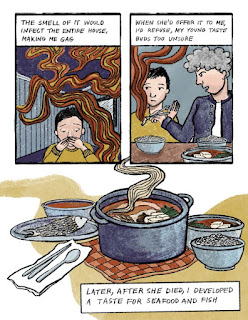
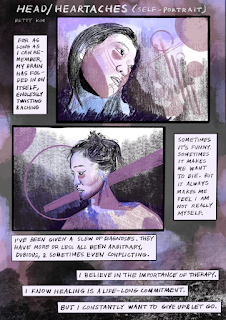
In the category of "narrative comics," Kim started with "Laborers Of Love." I'd say this is as poetic as it is about narrative, and it seems obliquely about pandemic times, as well as imagining a life in a post-capitalist world. It's about human connection and an understanding of how those structures directly impede it, and her use of wavy lines a pink-purple wash doubled down on this emotion. Some of the line art in the panels was obscured by the wash at times, but for the most part, it worked well in intensifying it. "Head/Heartaches" is a bit of autobio where Kim reflects on mental illness and physical pain, and how accepting one's imperfections instead of trying to rid yourself of them is crucial to self-acceptance. Kim's immersive style is highly effective here, as the moody purple and use of shadows effectively conveys this inner conflict. "Every Flavor A Ghost," written by Noah Cho, sees Kim use a different visual technique. It's a more standard grid, as she's relaying Cho's sensory memories and how they connect him to his grandmother. The colors are more balanced and varied while still quite vivid, and Kim successfully adapted a more naturalistic style. 


Kim also submitted three "political cartoons." The first, "Psychiatrist's Office," is actually a pretty good gag. The background features a tearful patient (presumably Kim, but it doesn't matter), while the foreground sees the psychiatrist doodling cubes and fancy logos like a junior high schooler. "All My Flaws And Why They're Not My Fault" is a simple Venn diagram, cleverly inverting the negative stereotypes of being Asian, "womanly," and bisexual to explain her poor driving, tardiness, and impulsivity. When traits are reified by society, why not turn them around? "Making Friends As A Person Of Color In Vermont" has Kim introducing herself and the woman she's being introduced to pouring out a litany of liberal concerns that ignores her actual personhood. The only problem with the gag is that it's mostly textual. 


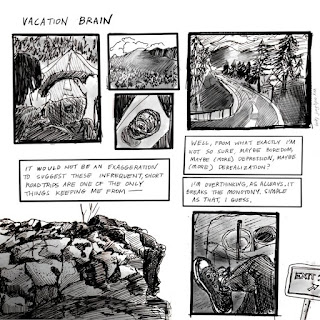
There were also two diary comics, both short (the best kind of diary comic). "I Want To Be A Girlboss But" is in black and white with grayscale shading, and Kim really shows off her line and clever use of a gird here. It's Kim in a shower, thinking about what's important and what's not, and how difficult it is to engage in things like hygiene when depressed. Like all of Kim's work, though, it's less about personal depression and more about existential malaise in general, especially with regard to the expectations of others with regard to "work." "Vacation Brain" may be her best piece; it's about self-reflection and overthinking in the context of how car rides and day trips keep her from going totally over the edge. There's an interesting take on the concept of vacation and how approaching vacation time as something totally great avoids the idea of returning to your regular, terrible life. It's another existentialist thought, akin to the idea of angst in confronting the idea of the void. I thought some of the storytelling was a big cramped; I wished for a bigger page to let some of those early panels breathe and get a real sense of the Vermont countryside. 

Kim submitted three comics-as-poetry pieces. "ACH" is a black and white piece with shifting pencil tones, possibly indicating light and/or wind in a vague environment, spread over a six-panel grid. Kim's command over her pencil makes this piece interesting to look at. "Alienation Triptych" is a collage of various colorful images from daily life and the environment, assembled in a jagged, abstract manner. The text relates to Kim's theme throughout: the thorny issue of mental illness, conformity, and "neat" vs "messy" living. It's ultimately about the desperate urge to connect. "Love Letter" is not a letter to a particular person, but to Love itself. It's about the desire not just to love in the moment, but also to have the sense of a tomorrow that will come where love will also exist. Kim paints it as delusional but necessary, and her blurry use of deep, bruised purples backs up this conflation of love and deep, sleepy darkness. 

Finally, Professor Foxglove's Fungal Fantasia is a mini drawn in the style of a kids' comic, even if the professor in question is exposed to magical, musical mushrooms. This is a trippy, weird bit of fun, but it also displayed Kim's range in proving she's adept at multiple kinds of storytelling. She can pretty much do whatever she wants in comics; she'll just need to figure out what it is she wants to do.