Showing posts with label david yoder. Show all posts

Wednesday, December 21, 2022

31 Days Of CCS, #21: David Yoder & Amy Burns

David Yoder's best comics have always been his humor comics, and he's focused on that in recent years with his strips that react to movies. His Movies That I Watched minicomic is based on comedian Doug Benson's movie-a-day project where he was going to watch a movie a day for an entire year. Yoder one-upped that by attempting to draw a comic reacting to a movie a day for an entire year. Well, he managed to crank out 45 strips from this idea before succumbing to fatigue. While many of these strips are funny, you can see the fatigue start to build up as the art for the later strips gets sketchier and sketchier. Wisely, Yoder stopped and rethought the whole project.


What wound up happening instead was working with writer David Carter as they'd watch a movie together. Yoder would do a strip a week and Carter would write a full review as a sort of package item. In their David And David At The Movies collections, their collaboration works nicely in bunches, thanks to their different tones, styles, and methods of working. It's not just that Yoder tends to be more succinct than Carter because he's a cartoonist, it's also that he synthesizes that knowledge like a comedian--much like Benson. So his reviews aren't beat-by-beat, but rather feature some visual gags, digressions, and fantasy bits, along with actual analysis of the films. Carter thoroughly critiques each film from the point of view of someone who knows a lot about film history, and it shows. However, his reviews are in the same spirit as Yoder's in that they start as a dive into the particulars of the film along with the prior work of the actors, writers, and directors. Along the way, the reader becomes more aware of the overall aesthetic point of view of both Yoder and Carter. I thought their reviews of Hidden Figures were especially on target, with Yoder bringing the laughs and Carter waxing philosophical about the history of biopics. 

Amy Burns has a cute, spare style that lends itself both to absurdist humor and graphic medicine. With regard to the latter, she collaborated with writer Keilani Lime to do a book called No Spoons For You. This is a reference to Christine Miserandino's "Spoon Theory," a metaphor for those with chronic illness and/or disability to use in order to explain that they have a limited and variable amount of energy on any given day, measured in "spoons." When a person runs out of spoons for the day but still has things to do, they can "borrow" spoons from the next day at a high price, or simply be forced to stop, something that can be quite frustrating.

Lime puts this all in fantasy trappings with Burns giving the whole thing a positive sheen with her approachable and fun linework. There are gremlins that cause brain fog, supportive partners, managing medicines, and other struggles. There are funny repeating motifs (like a blanket, hot water bottle, etc being the main character Sunny's "best friend forever and ever"), but there's not so much a narrative so much as there a sense of trying to make readers understand what a struggle a single day can be without using a miserabilist approach. 

Burns' own work tends toward poetic examinations of their own medical issues or absurdist fantasy shenanigans. You'll Never Find The Sun is an effective allegory about ontology, imagining a time not only before one's existence, but before the existence of anything. Then the big bang is compared to one's birth, finding one's parent, finding one's parent...but not finding the sun. It's explained that this comic is a reaction to discovering a diagnosis of lupus, a disease that is associated with sensitivity to sunlight. The problem with the otherwise beautiful presentation is that this expression of grief feels private; the connection to lupus, to being unable to find the sun in the comic feels entirely unconnected. There's nothing wrong with a poetic and private expression of grief, but the explanation afterwards felt tacked-on. 
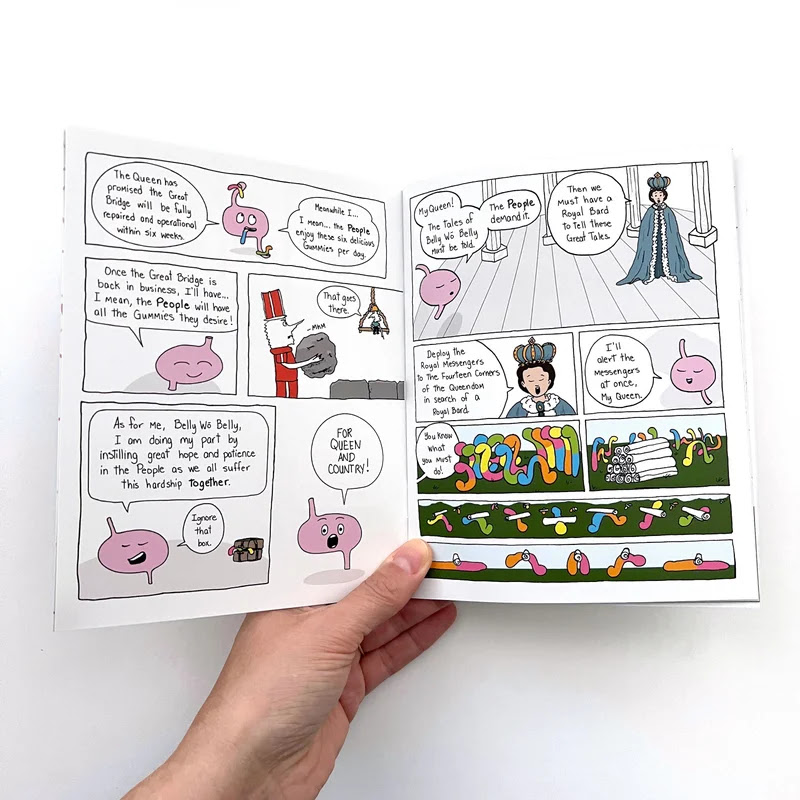


On the other hand, Belly Wō Belly: Bard Search, is absurd at every level. It's about a sentient stomach who is captain of the Queen's Royal Guard, who wears a human body as its armor. He's obsessed with gummies, who are both food and messengers, and his own ego. He begs the Queen to hire a bard to regale the People with tales of his glory, and Belly runs the search. He doesn't find a bard, but he does fill other open positions in the Queen's court, like Director of Waste Management. There are even sillier and delightfully self-indulgent digressions along the way, which only makes sense. If you're going to do a silly comic, you may as well go all the way.

Monday, October 22, 2012

Gag Men of CCS: Lok, Bonesteel, Yoder, Seck

Let's take a look at four CCS grads who are primarily humorists.

Gag Rag #2. by Jeff Lok. Lok is quietly becoming one of my favorite humorists, thanks to his pitch-black comic sensibility. As his figures continue to look more like stacks of shapes and less like actual people, his strips have come into much sharper focus. Earlier in his career, Lok's attempts at a realistic style resulted in some over-rendered images. In this second issue of Gag Rag, he's reached the perfect antithesis of that style, creating figures and forms that are both unsettling and funny to look at. His gags continue to grow darker, meaner and funnier. The main story, about an Antarctic explorer whose heroic mission goes horribly awry, is peppered with absurdities (a man renting only one sled dog because "owning a dog is a lot of responsibility!") and grim, visceral conseqences. Indeed, Lok's can-I-top-this list of abuse heaped on his character goes beyond the cruel and into the ridiculous. Lok intersperses the main narrative with a bizarre visual pun about losing one's appetite and an enigmatic strip about a rooster and his young companion. There's no question that Lok has really found something that works, and I hope he continues to pursue this direction.

A Fan Comic About Community, Mr. Ryland & Mr. Yoder, and Giant Naked Baby, by David Yoder. Yoder is a very funny writer who's trying to figure out the best way of presenting his material visually. It seems pretty clear that drawing is a slog for him, especially since he tries to do much of his work in a naturalistic fashion. My favorite of these three comics was Mr. Ryland and Mr. Yoder, a hastily-drawn story for NaGroNoWriMo (National Graphic Novel Writing Month) that mixes humor and anti-humor in equal doses. It features my favorite drawings of his, most especially his own self-caricature. Along with Colleen Frakes', it's my favorite from the CCS crowd because it's both pleasant and funny to look at. The big glasses, the dot eyes and vaguely vapid smile all add up to funny drawing after funny drawing, which is a nice equation when paired with the punch of his gag work. This mini is one long deconstruction of humor as expressed through two "vaudevillian" characters who wear matching straw hats, bowties and plaid jackets. The way Yoder jumps back and forth through time, ignores conventional narrative and throws in a barrage of jokes both stupid and sophisticated shows how much potential he has as a humorist. The same is true for his Fan Comic About Community,  a TV show that features the same sort of meta-humor at which he excels. The comic is both an expression of his fears of what the show might turn into after its creator was fired and a smart parody of TV tropes, all told within a framework that allows ts "meta" character Abed to function both as a human being and as a comic book character. The crudeness of his line blunts some of the impact of his commentary, but it's still effective. Giant Naked Baby has its funny and absurd moments (after all, it's about the titular baby parking itself outside of someone's house and staying entirely still), but it's really about accepting one's own mortality as well as learning how to let go of loved ones in their dying moments. What the baby turns out to really be is a clever twist that adds an absurd element to the most grave of concepts. Yoder is an artist who just needs to draw a lot more in order to figure out what style will serve him best as an artist, though I could easily see him become a screenwriter as well. I'm hoping he'll continue to stick with comics and even return to previous works and re-draw them.

60/40, Jason and Birds, by G.P. Bonesteel. Bonesteel's comics are very much informed by his pop-culture obsessions, and the quality of the resulting gag generally depends on how cleverly he can spin those obsessions into actual jokes. 60/40 is a silly collection of random gags that are mostly forgettable, with the exception of "Monster Fight". Here, a fight between King Kong and Godzilla is actually a fight about their frayed friendship, bringing the language of slice-of-life comics to bear in a way that both sends them up and plays it completely straight. Bonesteel's skills as a draftsman are not especially highly developed, but he pushes through this thanks to his design and composition choices. For example, Birds is a collection of strips featuring 6-panel variations of the same pose, as two birds on power lines exchange witticisms, dirty observations, insults and deeply personal information. Bonesteel spares the reader's eyes from total visual monotony with some pleasing color schemes, but the real attraction here is the nature of the friendship between the two leads. Jason is by far the best of the comics, as Bonesteel's knack for creating high-concept concepts lands on a doozy: a slice-of-life story featuring Jason, from the Friday The Thirteenth movies. This "side-scroller" of a comic has three panels per page and goes day-by-day with the killer, who does this as a job, even punching a time clock in the morning and hanging out with fellow movie killers like Freddy Krueger and Leatherface. This is a comic about working and the ways it can be a deadening experience, as well as making connections. The ultra-simple, outline style works perfectly in depicting the very 2D world that Jason inhabits and allows Bonesteel to get gory without drawing the reader too far out of the page. This was the first chapter of a longer story, and Bonesteel has something very interesting cooking here.

Life Is Good and Monday Saddies, by Steve Seck. Seck loves depicting the lives of losers, freaks, perverts and all-around degenerate anthropomorphic animals. I've already written about the Pogo meets Hate antics of Life Is Good. However, Seck's art really comes alive when he's not beholden to anything resembling a real narrative, and such is the case in Monday Saddies. The continuing adventures of a homicidal (yet famous) snake, a depraved ranger and a bear looking for inspiration, this comic is agreeably frenetic. It plays into Seck's scratchy, exaggerated style while meshing the increasingly transgressive humor with the cute, anthropomorphic drawings. At the same time, it's a stinging metacommentary on certain kinds of "message" genre stories where Friendship Is The Most Important Thing, ending with the vicious snake going out of his way to stay friends with the ranger, despite the latter's deep desire to be bitten and squeezed by the former. The character of the bear is my favorite, especially when he protests being trapped by the snake's thought balloon and then later winds up haunting a couple that had him stuffed despite just being in a blackout drunk state. The mock-wholesomeness of this comic is what makes it work so well, as the bright orange cover seems to be one beckoning to kids until one comes across the "Not for kids!" warning at the bottom. I'd love to see the whole story done in a four-color process that would mimic Dell-style comics of the 50s and 60s.