Showing posts with label cara bean. Show all posts
Wednesday, October 11, 2017
Minis: S.Lautman, K.Fricas, C.Bean
Blabbermouth 2 and Art Fan, by Katie Fricas. This issue of Blabbermouth has a clever premise: taking a bunch of notes friends wrote to her in 7th grade and creating a narrative of sorts out of them, accompanied by Fricas' distorted and often grotesque figure drawings with garish, non-naturalistic colors. The results, as you might guess, are hilarious. Fricas prints notes that pinball from sheer teenage boredom and discussion of tedious school-related minutia related to tests to wacked-out stories of home, like one kid getting in a screaming match with her mother and then locking herself in the bathroom, calling her a bitch. An anecdote about scoliosis testing gets across the intense feeling of humiliation that went into the exams, especially if one's spine was curved. There's lots of talk about guys and one note where someone was trying to comfort Fricas by saying "You are not as ugly as you think you are" after a guy turned her down. Fricas is never less than intense in depicting all of the awful and yet sweet absurdity of being a 7th grader, in the form of documents that clearly meant enough to her to keep for well over a decade.
Art Fan is a collection of art criticism that Fricas did in the form of comics on the art website Hyperallergic. I could read a full-length book of these pieces, as her ratty line, effective use of grey, expressive use of color and uncanny ability to evoke the spirit of each of the art shows she attended gave me a thorough understanding of what each show as about. The Duke Riley show "Fly By Night", which involved going to the Brooklyn Navy Yard, waiting for sundown, and watching pigeons wearing LED lights being compelled to fly up and to the nearby bridge. That kind of extreme stunt in the service of a simple aesthetic reminds me a bit of the sort of thing Christo does, only it involved "defying their nature, the pigeons refused to surrender to a darkening sky". Pedro Reyes' "Doomocracy" combined the aesthetic of an interactive art installation with that of a haunted house in a critique of capitalism and political corruption that felt harrowing in interesting ways. Fricas seemed drawn to shows that pushed typical understanding and experience of art but wasn't necessarily out-and-out performance art. A strong visual component seemed key to her appreciation of the show, which is one reason Bjarne Melgaard's show bored her, as it was dull to look at and felt more like a fashion shows advertisement disguised as a show than authentic self-expression. Whereas the fashion history show Rei Kawakubo show's presentation had a whimsy and specifically a punk attitude that took the familiar and stretched it, battered it, and bloodied it and still came out looking beautiful. I'd love to see Fricas turn her discerning eye to reviewing comics, as she's an outstanding writer and gets to the heart of works in a clear manner.
Ghost Sex, by Sara Lautman. Lautman's comics are some of the strangest I've ever seen in terms of being in service to their own internal logic and nothing else. They are anti-narratives, like one story about a person anticipating a smell, inhaling the aroma, and then waiting for it to come back around again. The lines are thick, quick and simple. "The Most Popular Thing" is simply someone musing what the most popular thing happens to be, whether it's ice cream, dogs, music or "likes". There's a joke about a hamburger that's the same image on page after page, with only the accompanying text telling us something absurd about the item of food. The titular comic is the most interesting, as Lautman really plays with form here, as two Pac-Man style ghosts go from first base and then all the way home. Lautman is playful with her use of shapes and the way they relate to sex--especially when the two ghosts merge. Lautman's attention to seemingly inconsequential details is a strategy for her overall project of observing the absurd in everyday life.
Snake Pit and Why Draw?, by Cara Bean. Bean is an art teacher and many of her comics are about the experience of teaching and the process of teaching. Why Draw? is more in the vein of the sort of thing that Lynda Barry does, except it takes what Barry regards as a self-evident truth (everyone loves to draw) and delves into it a bit. On page one, she explodes Barry's "Two Questions" ("Is this good?" Does this suck?") that inhibit both creativity and the basic pleasure that making marks on paper brings. She does this by using her self-caricature (an anthropomorphic bean, of course) to say, "You don't have to like your drawings. I will like them." There's power in that statement, as Bean gives the potential student (the reader) and gives them unconditional support in what they draw. They just have to do it. From there, Bean goes into the litany of positive effects that drawing can have on the brain. From there, she does short strips about various artists and their comments about drawing, as well as getting into the right mental space to draw. This feels like a perfect mini to hand out on the first day of a drawing or comics class.
Snake Pit sees Bean use her talent for synthesizing lectures into short comic strips that crystalize certain topics. Here, it's adolescent depression and suicide. The way she illustrated the symptoms of depression, for example, gives them a solidity that simply reading a list of symptoms does not. Without minimizing them, she uses funny drawings to make them even more memorable, like a group of arrows branching off to indicate problems with concentration. Similarly, for more serious symptoms (like suicidal ideations), her drawing a mountain that someone's scaling, wishing they didn't exist, is a powerful visual metaphor. Bean goes on to describe some of the consequences of depression (like learned helplessness) as well as treatments like Cognitive Behaviorial Therapy (CBT). It's a clear, non-judgmental and easy to understand distillation of a lot of information, as the simplicity and fluidity of Bean's clean line carries a lot of complex information.
Wednesday, June 3, 2015
Autobio: Jep, Hayden, Nichols, Bean/Viola
Jep Comix 4, by Jep. The cartoonist draws slice-of-life autobio vignettes featuring a stripped-down self-caricature and frequent anthropomorphic versions of friends. These are comics featuring small but pointed moments, like a memory from high school spent playing a video game, avoiding his father. Another interesting bit was one where the cartoonist has a number of awkward interactions with a man from across the street who weirdly hits on him after he tells him he's getting married. Even a talking head strip featuring him talking to his sister about flooding basements and Moses parting the Red Sea is interesting because of his thick, simple line that's not unlike a Sam Brown figure. These comics are modest, charming and utterly lacking in pretension.
Rushes, by Jennifer Hayden. This is a collection of good ol' four-panel diary comics. They remind me a bit of Jesse Reklaw's strips in that the reader is more or less dropped in media res into Hayden's life and expected to figure things out as she goes along and that it's a process strip. That is, it's Hayden recording her progress finishing a long book about her experience with breast cancer (The Story Of My Tits, out in September from IDW/Top Shelf), as well as a document of everyday family life. This particular volume is also an account of the preparations for as well as an actual trip to London and Paris, so that gives the reader a bit of value-added above simply watching Hayden draw comics or talk on the phone for several panels. Hayden's voice is distinct and powerful, and it's well-matched to her stripped-down but still dense style of cartooning. Her use of negative space in particular is impressive in depicting a busy, cluttered and full life with comics, her family, playing music and a clear identity as the family organizer. Allowing the reader to fill in some lines allows her comics some space to breathe, letting the eye pass quicker from panel to panel without getting bogged down in each panel's details. The personal details are mostly of a quotidian nature, with occasional reminders about her surviving cancer; in these strips, Hayden is more interested in getting down the basics than reflecting too long on what it all means. That immediacy is what makes the strip-to-strip flow so effective.
Heart Farts, by Cara Bean and Rebecca & Jason Viola. This is a two-woman anthology featuring Bean and R.Viola (comics drawn by her husband Jason). The strips are pleasant and lightweight, featuring topics like dreams about Tom Brady and the satisfaction received in creating bento boxes for others' lunches. One of the bigger treats here is a chance to see more of Bean's classroom comics and her bean-shaped self-caricature; one of the strips is about being a teacher and trying to get her students to love what she's teaching as much as she does, getting away from the feeling that she's torturing them. The Violas' bento box strip is about how having an opportunity to make something unique and nourishing for someone else is in itself a nourishing activity. Bean's classroom strip addressed the idea of "flow": how purposeful, creative activity creates positive energy not only for oneself, but for one's associates as well. While Viola's comic doesn't address this explicitly, there's no question that her comic is a demonstration of this idea in action. That synergy of ideas makes the mini greater than the sum of its parts, as it features slightly diverging points of view on the same set of ideas. The versatility of Jason Viola meant that Rebecca could write about anything and the result would inevitably look great.
Flocks 4, by L.Nichols.This is the most powerful chapter yet in Nichols' account of growing up queer and Christian. In this issue, Nichols lays out why simply excoriating her parents and others in their rural Louisiana community for condemning homosexuality isn't so simple. Their parents, teachers and people in their church, who made Nichols' life hellish in some respects, were the same people who encouraged them to excel in school. Being an intellectual of size in school made Nichols an easy target, and that support from adults turned out to be a crucial factor in becoming a success and realizing their dream of attending MIT. In one sense, Flocks is a document about pain: the pain of not fitting in, the pain of knowing that those people you love might not love you for what you truly are.
In another sense, Flocks is about pressure and balance, cleverly represented through mathematical notations. It's about the pressures that all of the various groups of whom we are a member put on us, for good ("you can do it!") and ill ("nerd!", "queer!", etc) and how to balance the negative pressures with the positive support. Nichols describes how they "fit in enough not to be rejected" and "fit in enough to gain support when needed" in hopes that "everything would get better one day". However, this wasn't simply a matter of things getting better by means of escape. Rather, things got better in part because of Nichols' amazing ability to take what nourished them and discard the rest. Even now, the even-handedness regarding faith, family and Nichols' upbringing is remarkable, considering how easy it would to be bitter. As per usual, Nichols' self-caricature as a sort of rag doll remains one of my favorites in autobio comics; it's a figure that's both capable of absorbing a tremendous amount of abuse as well as a tremendous amount of love, often from the same person. Though each issue stood on its own well, the cumulative effect really pays off in this issue in particular, since Nichols so wisely lays out that relationships are far more complicated than they seem on the surface and that the same person can give out support in one way and unwittingly undermine you in another.
Labels:
cara bean,
jason viola,
jennifer hayden,
jep,
l.nichols,
rebecca viola
Monday, September 23, 2013
More Minis From Cara Bean
Let's take a look at some old and new minis from the cartoonist Cara Bean. Bean's been doing minis on and off for a few years now, but she seems to be really concentrating on comics in particular at the moment. As a result, she's rapidly evolving as a cartoonist.
The Gremlins Movie Incident is autobio that recalls her father taking Bean and her rambunctious siblings and cousins to the movie Gremlins. Though rated PG, its grisly (if cartoonish) violence and generally dark themes made it wildly age-inappropriate for little kids, so much so that it led to the PG-13 rating. This is a funny comic, but it's also about the way the film traumatized everyone who saw it in different ways. Bean thought that gremlins would come up out of the toilet to get her and she needed company in there; her sister was afraid they'd come get her at night. In terms of the art, there are three things I especially liked. First, the way Bean draws figures as looking slightly like sausages (or at times, like beans!) is amusing, especially when she gives them big, bulging eyes. Second, her formatting is all over the map in ways that keep the reader guessing: single panel per page images, four-panel grids, pages without panels where images bleed into each other and a hilarious single use of color that was the horrific (and comedic) climax of the story.
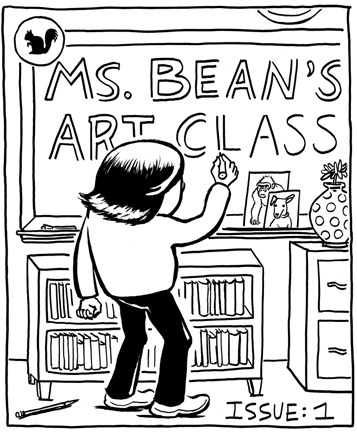
Ms. Bean's Art Class #1, is about Bean's day job as a high school art teacher. Bean's greatest strength as a storyteller is her ability to relate her students' stories on the page. There's a telling early strip called "First Day of School To-Do List" that involves being able to identify potential problem students as well as those students likely to need extra encouragement; her ability to sense what is needed for a situation seems to be a strength for Bean both as an artist and as a teacher. Indeed, this comic is all over the place visually: loosely-drawn stories with varying grid styles; illustrated text and charts; realistically-depicted figures that focus in on the intensity of their feelings; and quick drawings that get across a gag. The secret to Bean's success is her ability to wield authority in her class by way of never taking herself seriously. Every teacher wants their kids to listen, to participate and to be nice to the other kids. Instead of establishing that kind of order through fiat, she uses highly goofy humor and a willingness to be ridiculous. In these stories, it's amazing how well the students often respond to her silly sense of humor, especially because she is absolutely committed to the gag and encourages others to join in. At the same time, she also seeks to make an emotional connection with her students by encouraging their work and simply being nice to them, an approach that can help crack the most distant of students. This is an entertaining comic both because of her choices as an artist as well as her choices as a teacher.
Squeaky Noises is one of Bean's earliest comics. It's an interview between a squirrel and a rescued racing greyhound. Despite that interview format of the squirrel interviewing the dog, it's drawn in a realistic style that does well to understand the ways in which animals move and rest. It's obvious that Bean spent a lot of time drawing animals. What I look most about this comic is the restrained way that Bean attacks the sport of greyhound racing while urging people to consider adopting the animals after their racing days, when so many of them are simply put down. There are other clever storytelling conceits, like several pages of the squirrel approaching the house and jumping in (somewhat nervous about being attacked), then surprising the reader by talking. The final revelation of the squirrel being a security blanket in a very different sense is both funny and touching.
The Gremlins Movie Incident is autobio that recalls her father taking Bean and her rambunctious siblings and cousins to the movie Gremlins. Though rated PG, its grisly (if cartoonish) violence and generally dark themes made it wildly age-inappropriate for little kids, so much so that it led to the PG-13 rating. This is a funny comic, but it's also about the way the film traumatized everyone who saw it in different ways. Bean thought that gremlins would come up out of the toilet to get her and she needed company in there; her sister was afraid they'd come get her at night. In terms of the art, there are three things I especially liked. First, the way Bean draws figures as looking slightly like sausages (or at times, like beans!) is amusing, especially when she gives them big, bulging eyes. Second, her formatting is all over the map in ways that keep the reader guessing: single panel per page images, four-panel grids, pages without panels where images bleed into each other and a hilarious single use of color that was the horrific (and comedic) climax of the story.
Ms. Bean's Art Class #1, is about Bean's day job as a high school art teacher. Bean's greatest strength as a storyteller is her ability to relate her students' stories on the page. There's a telling early strip called "First Day of School To-Do List" that involves being able to identify potential problem students as well as those students likely to need extra encouragement; her ability to sense what is needed for a situation seems to be a strength for Bean both as an artist and as a teacher. Indeed, this comic is all over the place visually: loosely-drawn stories with varying grid styles; illustrated text and charts; realistically-depicted figures that focus in on the intensity of their feelings; and quick drawings that get across a gag. The secret to Bean's success is her ability to wield authority in her class by way of never taking herself seriously. Every teacher wants their kids to listen, to participate and to be nice to the other kids. Instead of establishing that kind of order through fiat, she uses highly goofy humor and a willingness to be ridiculous. In these stories, it's amazing how well the students often respond to her silly sense of humor, especially because she is absolutely committed to the gag and encourages others to join in. At the same time, she also seeks to make an emotional connection with her students by encouraging their work and simply being nice to them, an approach that can help crack the most distant of students. This is an entertaining comic both because of her choices as an artist as well as her choices as a teacher.
Squeaky Noises is one of Bean's earliest comics. It's an interview between a squirrel and a rescued racing greyhound. Despite that interview format of the squirrel interviewing the dog, it's drawn in a realistic style that does well to understand the ways in which animals move and rest. It's obvious that Bean spent a lot of time drawing animals. What I look most about this comic is the restrained way that Bean attacks the sport of greyhound racing while urging people to consider adopting the animals after their racing days, when so many of them are simply put down. There are other clever storytelling conceits, like several pages of the squirrel approaching the house and jumping in (somewhat nervous about being attacked), then surprising the reader by talking. The final revelation of the squirrel being a security blanket in a very different sense is both funny and touching.
Friday, May 17, 2013
Comics-as-Poetry: Rothman, DW, Thomas, Bean
Abzernad, by DW (Hic 'n Hoc). DW's first full-length comic is like a cross between Gary Panter, Will Elder, Jim Woodring and psychedelic art (what he calls "psychedoodles"). Each page is its own puzzling mix of psychedelic wave drawings, scratchily-drawn and slightly amorphous characters, found text impositions, and eye-pops hidden in wave after wave of drawing. There is a kind of narrative carry on from page to page, as the main character is featured interacting with both words and images, but the effect is almost like discovering a series of mysterious cave drawings. Some of the text is random, but much of it obliquely comments on the action on the page, especially the many excerpts for a sort of mask to be worn at night to help with one's skin commenting on the waves of destruction on each page. The comic also has a densely visceral quality, as there are many scenes of cartoonish violence, predation, and other ordeals. At the end, it feels like the main character (and the reader) have survived a harrowing rite of passage that was as much about the psychological makeup of the main character as it was about its physical presence. It's DW's most ambitious work to date, to be sure, and it coheres in a way that's surprising
Dodo Comics #3, by Grant Thomas. This is an all-abstract comics issue, as Thomas carefully uses panel placement and design as a kind of anchor for the abstract images he places into each one. Much like John Hankiewicz, he uses panels and marks to create a kind of visual rhythm, something that's emphasized by titling each piece as a sonnet or "untitled poem". Thomas especially seems to like rising and falling of lines and splotches from panel to panel, "rhyming" them throughout the piece in a complex and intuitive manner. The reading experience is explicitly shaped by the number of panels and tiers he uses on each page. The first "sonnet" has four tiers with 3/2/3/3 panels on each respective tier; the second page goes 3/3/3/3, the third page 4/4/4/4 and the final page has two tiers going 4/2. That rising and falling of each mage allows one to think of the lines as water, wind or anything that flows. That's even more explicit in the other pieces, where a definite sense of motion is implied from panel to panel, even if that motion is ultimately static. I don't get a sense that Thomas is going after provoking an emotional reaction (despite the use of the nomenclature of poetry), but is rather more interested in a more visceral reaction to the way lines on paper react against other lines and the expectation of the reader for a sequential narrative when we see one panel placed after another. These are explicit abstractions, and what they're abstractions of is entirely up to the reader. That's what makes comics like this so interesting to read.
Watching What You Say, by Alexander Rothman. This is a "versequential" book of comics-as-poetry by Rothman, who very carefully tries to balance word and image off of each other in a series of short, snappy works. Rothman spares no expense in this limited run of minis, using full color for every strip. Some of the poems are narratives: I love the phrase "On the last day of the Great Depression"; it reifies an amorphous historical period in a visceral way as a farmer drowns his no longer utilitarian bees. The story/poem "Still, Small" cycles through a group of people sitting in a church pew, "waiting in a field of quiet fires for a glimpse of the flowering fern". The illustrations here are a bit on the nose with relation to the fantastical, metaphorical language of the text, but they nonetheless get across that anxiousness one feels in trying to connect with the divine. On the other hand, the text for "Muses" hilariously acts against the text, introducing the author both as a kind of monkey and someone who draws inspiration from a certain kind of thought. "Praise Poem" uses a nearly static image of a turtle to depict a quick deceleration and a sense of awe as the narrator runs into it. "Processing" takes some sensitive prose and drives it way over the top with the page-stuffing depictions of a chicken getting gutted. It's not that the images themselves were inappropriate, it's that Rothman unnecessarily lays it on a little thick. All told, there's an enormous amount of potential to be had with Rothman's technique. His best works are those where text and image don't repeat each other, but instead reveal different aspects of the same event in interesting ways, like in "Euglossine Bees". In his work, Rothman is trying to reveal something about how we relate to nature, both intentionally and inevitably. That's an ambitious topic to tackle, and this comic is the result of Rothman experimenting with any number of different methods in getting at that elusive relationship. Some succeed more than others, but he's certainly on to something here.
Gorilla Year #1-2, by Cara Bean. This is an amusing stream-of-consciousness series wherein the author gets involved in a series of gorilla-related situations. In the first issue, Bean writes a short auto-bio strip that basically answers the question of "Why Gorillas?" When in art school, she decided to observe gorillas as part of an animal behavior class, an activity she found comforting in the face of anxiety. It wasn't until years later, when she started making comics, that it occurred to her to incorporate these images into a sequential narrative. The results remind me a bit of the surreal storytelling one sees in an Eric Haven comic: there's a slightly sketchy but naturalistic line telling a story where strange events flow into other strange events. The main character watches a movie starring herself turn into a gorilla, which leads that character to witness Mount Rainier erupt and a giant gorilla emerge. Then we see her back in the audience, where her fellow audience members are squirrels, gorillas, cats or dogs. There's a nice fluidity in the story, as Bean's stand-in is always moving forward, leaning at an angle that keeps the reader's eye propelled along the page. She later gets literally swept up by music, boards a bus that says "Finish Art School" and finds herself surrounded by gorillas. I took these images to mean that she surrounded herself with positive and comforting images and events in the face of doubt, fear and even loneliness. Drawing them in a story is almost a way of summoning these comforting feelings and concretizing them in a way that's funny but still very personally meaningful.
The second issue goes into more depth regarding that tumultuous time in a variety of clever ways that still manage to eschew a lot of standard narrative devices. The first story sees Bean walking through an art museum where all the pieces have narrative captions aimed directly at her. Most of the pieces are scenes of nature, but some include drawings of alcohol, food ("secret sadness snacks") and coffee leading the uncomfortable narrative that essentially zeroes in on her every weakness and attempt to mask those weaknesses. The piece segues into her feeling trapped, as though in a cage, which leads back to the narrative of drawing gorillas becoming a therapeutic method of dealing with the tumult in her life and the fact that she is unable to discuss it with anyone. The next story involves gorillas explicating an essay about conceptual art in her fluid but dynamic style, a juxtaposition that I found amusing. The last pieces in the book deal more directly with her art school difficulties, like being forced to live in her school art studio in secret. It's written in a sort of deadpan, matter-of-fact manner in the present tense, even as her being unable to sleep leads her to become unhinged. There's a great scene where Bean shrinks in size at dinner, beds down with a napkin and kisses the fork goodnight as she falls asleep. It's this kind of whimsy and magical realism that makes so many of her stories so memorable.While her comics have more straightforward narrative trappings than the other comics on this list, there's no question that her use of imagery and the way she juxtaposes it against text act to create an entirely different kind of meaning than either one on their own.
Subscribe to:
Posts (Atom)