Thursday, May 2, 2013

Sequart Reprints: Leah Hayes, Josh Simmons, Dupuy

In this column, we'll be looking at three comics that deal with the life of the mind and the delights & terrors within. First up is Phillipe Dupuy's Haunted, a book that's part dream journal and part sketchbook. A loose narrative forms around the trope of our narrator (Dupuy) starting to job in the morning. In each of the "Run Movie" segments, Dupuy encounters an unusual creature that illuminates a particular aspect of his struggle as he's jogging along. In the other stories, we meet a character who is also struggling with something. In his comic, I viewed his running as a metaphor for drawing, and drawing alone in particular. Accustomed as he was to working with a partner (Charles Berberian), I saw this comic as his commentary on working alone, and feeling the urge to scribble down his thoughts as quickly as possible.

There's an almost feverish quality to his work here, as his usual elegant style is jettisoned in favor of quick, expressive sketchwork. The stories all have a grotesquely visceral quality to them, as the struggles portrayed are concrete, physical difficulties. For example, in "The Dog", a dog whose leg is trapped gnaws it off, eats the leg, vomits it and walks until it can't walk anymore. It dies and is frozen in the snow until a bird comes by and plucks an eye out of its corpse. This is the frequent inevitability and futility of life, where even a heroic struggle against all odds winds up for naught. At the same time, it was clear that this story was burning in Dupuy's mind, and he had to draw it as quickly as possible to retain the power of his original thoughts.

One "Run Movie" segment features a dream where Dupuy helplessly watches a number of people in a city square act foolishly until disaster strikes. Not all the dreams are nightmarish--in one "Run Movie" segment, he stumbles upon an empty museum dedicated to his own future works, guarded by a friendly talking dog. After stumbling into a hole, he gets out of trouble with the dog's help by running again. This was the clearest use of the metaphor of running-as-drawing in the book. Later, he meets a talking duck whom he helps out of a funk. The duck's struggle is one of identity crisis--he used travel and the acquisition of material objects as the answer to his existential dread and found that solution lacking. By suggesting giving away the objects as gifts, Dupuy helped him lighten his load.

There's a shaggy dog story about an artist told that he overdraws his portraits trying to figure out how "negative space" works by trying to drink the empty part of a glass of wine, have sex by touching the parts of the body that aren't there, etc. Only by literally having nothing left in his life and having no materials to work with save a piece of paper evicting him from his flat is he able to finally understand how to paint empty space. Another story called "Forest Friends" features more anthropomorphic animals. This group is trying to deal with dog-like friend of theirs who lost an arm (a retelling of the first story in the book, perhaps?). This is a sort of warped companion piece to the slice-of-life stories Dupuy creates with Berberian in their Monsieur Jean stories, only much more visceral and a bit more desperate. Desperation also follows the story of a Mexican wrestler who encounters the one foe he cannot fight and a minotaur who is trapped in a labyrinth and can't die or feel any kind of fulfillment.

The most nightmarish story concerns Dupuy himself. "The Rats" sees him renovating a house and accidentally swallowing a rat. Soon, rats fill up his entire body, unbeknownst to him until one night he vomits the scratchy, black blobs up one by one. Purged, he leaves them behind. This was another story, like "The Dog", that had a frantic quality in its penciling. The idea seemed to have an obsessive quality that he couldn't let go of until it was on the page and out of his system.

Perhaps the key to understanding the whole book is the "Run Movie" segment called "The Old Lady and the Turtle". Meeting a blind woman, she forces him to close his eyes and they drift off to a number of locations. Dupuy obsesses over blindness and losing one's hands in this book, because these are the things that would prevent him from drawing. Ultimately, she advises him to "Learn to lose yourself. You'll stop wondering where you are. And you'll never feel lost again..." This is how Haunted seems to function for Dupuy: as a vehicle for confronting his fears, confronting his nightmares and tackling them head-on where he's at his strongest: on the comics page. He loses himself in these stories, allowing his line to stay loose, lively and scribbly, and winds up, in the last segment, coming to terms with his creations, his fears. This is a bold, remarkable book, especially for an artist who usually creates much more straight-ahead narratives.

Josh Simmons' Jessica Farm is an equally personal narrative project, though it's told very differently. This story is literally Simmons' life's work, as he plans to draw a page a month for 42 years, until he's amassed a 96-page volume every 8 years. The story, about a young woman named Jessica and her sometimes dreamy, sometimes nightmarish series of encounters in her spooky house, feels like both stream-of-consciousness and a coherent narrative. Each page feels like its own entity, as Jessica awakes to a magical Christmas morning only to encounter the looming specter of her sinister father. As she showers, she's serenaded by a miniature band, and then is dragged between the walls of the house to see a number of creatures that she's ignored and who are living in squalor. This book is all about the power--both positive and negative--of imagination and fantasy. Creatures that she dreamed up but stopped thinking about have a life of their own, but a pathetic one.

As the story proceeds, Jessica listens to a concert, goes to the top of a tower with her fantasy friends (where she reveals that she's worried about her father beating her) and breaks the heart of "the captain", a ridiculous sexual fantasy character who starts weeping when she reveals that she doesn't want to be with him all the time. Visually, Simmons excels at depicting both the glee and horror that Jessica experiences. He's a master at crosshatching shadows that loom over a page, and his rubbery penciling style is ideal at depicting the kind of cartoony action featured here.

Simmons keeps the story moving at a dizzying rate--Jessica goes back to her room to see her monkey friend murdered, is attacked by a bizarre creature, winds up in her benevolent grandparents' house, and is charged to go on a quest to "the barn" with a naked stud named Mr Sugarcock. That duo breathlessly manages to dodge her father and get to the barn to deliver a message to the mysterious, wolflike "Smiths". We leave this volume as Jessica prepares to talk to Papa Smith.

Jessica Farm is cartooning in its purest form. It reads like the kind of comics a kid would come up with in the way it flows, but with all the skill and concerns of a mature artist. This is Simmons' kitchen sink of comics, as he manages to throw in all of his storytelling concerns: sex (especially deviant sexuality), adventure, fantasy, horror, terror and absurdity. The fusion of genre and underground sensibilities has always marked Simmons' best work, and Jessica Farm is the ultimate expression of this urge.

Leah Hayes' Funeral of the Heart presents her own darkly comedic vision in this short story collection. This doesn't really function as a comic per se, but is a synthesis of story, lettering and image on the page that combine to create an oppressive atmosphere. It's all done on scratchboard, a medium that is inherently creepy and dark. The illustrations are stark and spare, with Hayes' eccentric lettering style adding as much to the effect as the illustrations. "The Bathroom" is a story about how guilt consumed a couple and manifested itself in the form of a room that they discovered and wound up as their grave. "Whoreson" is both the sweetest and saddest story in the collection, detailing the life of a man covered in fur who goes on to become a famous writer & teacher and later is accidentally killed by his own child. "The Change" is another heart-breaker, about a man who nearly loses his love and the way it hardens him. "The Needle" is about two young women who suspect sinister motives from a nurse who attended her care when she was dying. "The Hair" is the most upbeat story in the book, about two twin girls who were born connected by their hair. One twin decides that she wants to be separated and leaves in the dead of night, a decision that breaks the heart of her sister. How they reconcile is both heartwarming and slightly unnerving.

In general, that's not a bad way to describe Hayes' work. It's not exactly horrific in the way a scratchboard Thomas Ott story would be, but it's disquieting and disturbing. At the same time, it also has a strangely endearing quality. Her features have the feel of bedtime stories for adults, creepy fairy tales where happy endings are a rarity. They are perhaps not as personal as the stories in Haunted or as stream-of-consciousness as Jessica Farm, but they are certainly as revealing in their own way.

Wednesday, May 1, 2013

Telling a Story: Baddeley, Brown, Jackson, Skelly


Silent V #7, by Kyle Baddeley. This trippy sci-fi/fantasy/monster series has been the equivalent of a comics MFA for Baddeley, whose draftsmanship has tightened up and whose storytelling has become much more fluid. From designing pages to understanding how to fill particular panels, Baddeley is a far more assured artist. I'm not going to attempt to connect the finale of his time and space spanning story of robots, monsters, babies, space gods, monks and cults to the rest of the series. Suffice it to say that the hero of the story makes it back to Earth after a pit stop at a space burger, only to ultimately be left out in the cold. Baddeley's crazy imagination makes him one to watch; keep an eye on his new collaboration with Rob Jackson titled LetterBomb.


California #3 and #4, by Rob Jackson. The final two chapters of Jackson's Steinbeck-meets-Lovecraft mash-up are every bit as crazy as the first two installments, yet both are held firmly in check by Jackson's mastery over plotting and fine details. After everyone disappears after his sinister preacher brother's machinations, Billy (the hero of the story) tears out of there to get some help. He's lucky in that his old boss knows some Wise Folk who set him on the path to save his family from their mysterious fate. Things get really weird after that, as a ritual turns Billy into a head floating across the dimensions until he finds his house, and he must rescue everyone while dodging a monster and an evil intelligence. Just when it seems the story has reached its end, Jackson turns the craziness up another ten notches and injects some genuine suspense into the story as Billy desperately tries to find a way to stop the evil intelligence that threatens his town. Jackson really delights in drawing wriggly, disgusting and slightly absurd monsters, and this comic is a special treat as he goes all-out in #4 in depicting the final battle. This may be his most cohesive story yet.


Memorexia, by Box Brown. This is a short, powerful comic about a man going to a clinic in order to recover some especially painful memories from a futuristic machine. All throughout the story, it's emphazed that he can feel the memory but can't actually alter it. The result is a wistful and sweet story with a twist ending that feels earned. The use of techniques like zip-a-tone, diagrams and a rendering style that's simplified with the exception of its character designs make the comic all the more effective, as the reader slowly begins to learn that all the the technological mumbo-jumbo is just a smokescreen for a quietly and effectively portrayed moment between a father and a son. Brown contrasts red and blue throughout the story to add to the sense that one is reading a simple diagram or map of some kind, one of many contrasts found in the story. The difficulty of his relationship with his father is contrasted against the way their relationship ended, so even abusive language by the father is met with a smile. It also points to the way our minds try to create their own narrative, even in the face of memories to the contrary. This is one of many stories by Brown that I've read that have characters with abrasive exteriors that are nonetheless loving and beloved in turn.

Operation: Margarine #1, by Katie Skelly. This is the opening chapter in a stylish caper series about a rich young runaway named Margarine who gets mixed up with a rough and tumble hellraiser named Bon-Bon. After figuring out her strengths and weaknesses as a cartoonist with Nurse Nurse, one can really see Skelly's strengths on full display here. Her characters have a mod, stylish quality to them, lending a pulpy and delightfully affected feel to the adventures and interactions of the main characters. It feels like a movie or a story even as it's being told in a straightforward fashion. Skelly is just great at drawing interesting clothes, styluzed character poses and mannered yet entirely believable character poses. The way she draws huge and expressive eyes is a particular draw, especially because they are never cute. Rather, Bon-Bon's big almond eyes have a vague hint of menace, while Margarine's rounder eyes express a wide variety of emotions, allowing her to act as the in for the reader. The story itself just gets off the ground in this issue with a minimum of fuss: Margarine skips out on a mental institution but gets ratted out by a guy she thought was helping him. When she confronts him and things go south, Bon-Bon steps in and punches him out, leading to the pair escaping on a motorcycle. I'm looking forward to seeing what Skelly does with this sort of runaway set of tropes in terms of characterization; I'm sure it will carry her usual sense of style in terms of the drawings.

Tuesday, April 30, 2013

Sequart Reprints: Windy Corner 2

The following article was originally published at sequart.com in 2007. Austin is now the publisher of Domino Books. Please consider buying one of the many excellent works he's released, especially since he's losing his base of operations (the legendary Cartoon House). Get the first five Domino books for just 26 bucks, with free shipping. All of them are quite good and unlike most comics you've ever seen.
*************************

My favorite kinds of publications about comics, as I have noted in this series, are those that reflect the idiosyncrasies and passions of its editors. Windy Corner Magazine (WCM) is an exemplar of such a publication. I am particularly drawn to WCM because I share some of editor Austin English's more eccentric tastes, and he does little to buffer or prepare the average reader for them. It's a tact that can be a little demanding on a reader not familiar with English's approach to comics and criticism. The focus of WCM is artists writing about and talking to other artists, an approach that makes sense given English's status as an artist and critic.

I like the give-and-take collaborative feel of WCM. Lis Timpone designed a clever table of contents. Molly Goldstrom opened up the magazine with an odd two-page strip where a man prattling on about his love of bricks fails to notice his companion turn into a tree. Juliacks contributed the back cover, a typically dense collage of image, tone and text with a certain wistful quality.

English continues his autobiographical series of comics with a couple of evocative entries. The emphasis of these stories is on his earliest childhood memories, and I love the way he homes in on tactile sensations from memory, like the feel of the chair he sat in, the distress he felt upon hearing the sound and flash of a star "explode", and the soothing sound of the planetarium show's narrator. In "Movie", his memory is as much about the way he interacted with his parents before and after a movie he saw as the movie itself. The former story looks like it was done in colored pencil, and the decorative quality of the colors he uses to balance out his panels is striking. It balances the panels and actually draws the eye in, something lacking in the second story. That sort of pleasantly ramshackle design quality of his works nicely in his second "Life of Francis" episode, which is almost expressionistic in the way it depicts feeling and emotion. Fiona Logusch's "Entangled Relationships" reminds me a bit of Jules Feiffer's work, both in terms of the way she moves her characters around and the rawness of the emotions she portrays.

The feature article on children's book illustrator Lois Lenski was positively inspiring. English is unusual for a critic in that he seems to have an intuitive sense in how to discuss the formal qualities of a work in such a way as to bring it alive for the reader. I knew nothing about Lenski's work going into this article, and English probably would have been well-served to have at least some sort of introduction to her work. That said, I appreciate his enthusiasm about the subject and the way he quickly immerses the reader in the formal and aesthetic qualities of Lenski's art.

The interview in this issue was one of the most enlightening I've ever read with a cartoonist. John Hankiewicz, creator of enigmatic & beautiful comics in minicomics and the collection Asthma, was interviewed by cartoonist Onsmith. Hankiewicz reveals much about his working process, the way he approaches doing comics, why he loves printmaking, the specifics of certain stories and his general aesthetic outlook. Onsmith uses his deep knowledge and appreciation of Hankiewicz's work to take the conversation to some interesting places, but he always allows Hankiewicz room to expand on his thoughts.

The standout feature in an issue filled with great features is Dylan Williams's strip about Alex Toth. It's a series of stand-alone images done in what looks like colored chalk, each accompanied by a caption loosely associated with (almost interpreting) the text. It's a wistful piece dedicated to Toth and the intermittent correspondence that Williams had with him over the years. It's also about relationships and friendships and the way Williams approached them and how his feelings about them changed. It ends with a statement of purpose that connects his feelings about being an artist, about Toth, about comics and about long-distance friendships. I can only imagine this piece running in a magazine like Windy Corner , and that's why Austin English's indulgence in his aesthetic passions winds up as a gift to readers.

Monday, April 29, 2013

Truth and Fiction: Madtown High 1-3

Whit Taylor is a thoughtful, interesting up-and-coming cartoonist who's mostly done autobiographical work. However, I think she's really found her voice with her high school vignettes in Madtown High, most of which are fictionalized accounts of real events. While based on her own experiences as a new kid at a high school, Taylor smooths out these events with a solid narrative structure and cohesive characterizations. She's careful to eschew easy cliches about popular kids and jocks while writing with affection about the group of oddballs she found herself associating with. Giving these life events a narrative structure allows Taylor to shape them into vignettes that flow into and out of other stories, building continuity details like any good series. It also gives her a chance to show off her comedic chops, because many of these stories are very funny. That humor is mined out of the humanity of her characters and the way she provides the kind of small, intimate details that allow a reader to get to know them in a short number of pages.

In particular, Taylor's tales of particular teachers both humanizes them and allows them to be larger than life. Their orchestra professor was obsessed with the violin player from the rock band Kansas and hoped to get him to appear as a guest at their spring concert. When he doesn't show, he's crushed. Taylor gets at the way teachers burn out and often put their hopes on the most trivial of events as a way of breaking through the crushing despair of having to teach so many apathetic children. In another issue, her account of  her AP Biology teacher going through a midlife crisis was fascinating, funny and a little sad, as his own last-ditch attempts at doing something meaningful as a teacher flamed out, leaving him to quit the profession. Yet another teacher proved to be the unlikely recipient of the affection of Taylor's stand-in Wren and several other girls, despite (really, because of) his many, many quirks. Having his photo turned into a cake was a demented master stroke, especially when the recipient kept the bit of frosting with his face on it frozen for months.

Taylor's own stand-in is a little naive and geeky, but not in a stereotypical sense. Wren is great at Science League (an interschool series of contests), develops a crush on her brother's bandmate, is clueless as to why dressing up like a beaver is probably a bad idea, and makes cheesy videos with her friends. Taylor is especially adept at taking a reader inside a world where hanging around a group of strange people (not all of whom are close friends) tends to create inside jokes and highly ritualized behavior of the off-kilter variety. While Taylor's line is crude, something about this setting frees her to draw with a lot of energy and enthusiasm, especially the odder-looking and acting characters. If anything, I'd like to see her art get even more stylized with regard to her characters, rather than try to stay within naturalistic bounds. Taylor really seems to have found her niche with this kind of storytelling, and she produced a book's worth of these strips that hold together quite cohesively while still working at an individual level as a series of discrete vignettes.

Update: Whit was kind enough to send along the fourth and fifth issues of Madtown High. These issues wrap up the series, and it was clear that she really got on a roll as she built up the series' continuity and characters. That bit of world-building added a level of depth and complexity to the series in a manner that I thought was charming. Taylor has a way of addressing typical high school concerns and activities in a way that feels real and lived-in. For example, "Sleepover" is about her female friends coming over and inevitably talking about sex, with some of her friends being more experienced than others. She was then able to turn that into a punchline. Taylor also talks about being both a nerd (competing on a physics team) and a jock (detailing her assorted forays into team and solo sports, with shot put being her best sport). There's also a specificity of time and place: it's late 90s in New Jersey, and the influence of grunge and straight-edge culture were a big deal for her peer group.

The fifth issue sends us into her senior year with cultural touchstones like 9/11 (and the ways in which various adults at her school reacted) and personal touchstones like a senior "lock-in", prom, a trip to the Jersey Shore to get drunk and graduation. Each of them is filtered through her unique sensibilities, with the "lock-in"'s discussion leading her to admit out loud that she felt different and awkward because she was one of the only black kids at a mostly white school. The Shore trip was interesting because these were straight-edge kids who decided to get drunk for the first time as a rite of passage. Taylor doesn't sensationalize or oversentimentalize high school, but she also recognizes that, for her, it was a time that was extremely important and satisfying for her, thanks mostly to her group of friends. I think this story will ring true for many.

Friday, April 26, 2013

Gag Comic Round-Up: Garrison, Stewart, Staveley, Canini/Baxter


Onion Puss #1, by Chris Garrison. The artist behind Jakey The Jerk comes up with another predictable but solid series of jokes surroundingg its bulbous, off-putting titular hero. Garrison's agreeably cartoony style is well-suited for his gags and his onion-faced main character. He's a compendium of socially awkward, offensive tics who is nonetheless a sort of innocent in the face of his abiding crush on a skinny redhead named Priscilla. The short gags featuring OP stalking her in a video store and using offensive language while trying to mirror her evangelism were OK, but the real attraction in this issue is the long story "Ghost of a Chance". It's an extended riff on "Ghost Hunters" type-nonsense, with OP being treated as a sort of loveable scamp who winds up being seduced by a real ghost and saved by a buxom blonde who tries to overlook his many, many faults by saying "We'll have to work on that". When they set up a date at the end and she says something incredibly racist, OP can only say "We'll have to work on that." Garrison is an assured draftsman who uses an exaggerated line to great effect, and the result is a solid, well-crafted joke comic.The premise of the strip and the general nature of the jokes are both silly to the point of fluff, so it's a credit to his skill that he makes this material work as well as it does.

Odd Comics #1-2, by Scott Stewart. Stewart is an accomplished style mimic who pays tribute to a deep roster of cartoonists in this series of gags, homages, puns, eye-pops and other such silliness. Early R.Crumb is his most indelible influence, especially in the series of ridiculous puns in his "Euripedes Pants" stories. Of course, Harvey Kurtzman and Will Elder's MAD is another stated influence in bits like "The Halfway House On Haunted Hill", a very funny story that puts monsters in therapeutic settings. In a more modern context, Stewart reminds me of a slightly less accomplished version of Roger Langridge. His line isn't as clean nor his mimicry as impeccable, but he shares Langridge's sheer relentlessness on the page. Hardly a panel goes by without at least three different jokes, funny drawings or puns in it. He goes deep in his homages and parodies, with "The Moon-Faced Monarch of Matzohville" being a take-off on George Carlson's "Pie-Faced Prince of Old Pretzelburg". It works as homage, but like everything Stewart does, is still very much in his own straightforward, joke-soaked style.

Issue #2 features a long homage to the characters in the comic-book based film from the 1950s, Artists and Models. It includes Stewart's imagining of the ultra-violent character shown in the movie and even includes an Alter-Ego style interview with the artist behind the strip (played in the film by Dean Martin, hence Stewart throws down tons of Martin & Lewis references in the story). While most of the stories center around getting to punchlines (as "Bad Jokes for English Majors" and "Bad Jokes for Philosophy Majors" might indicate), there's also an enigmatic, extended homage to Moebius by way of Shelley. Seeing Stewart strip down his line to a sparse minimum was interesting after seeing him go big and broad for everything else he does. The story seemed to me to be an ode to the poem "Ozymandias", only the explorer in the desert this time has the opportunity to interact with the monument, deeming it wise to simply walk away in the end. Stewart is not an innovator as a humorist; everything here feels like it's directly linked to a vast network of influences. This is not to say that these comics aren't entertaining or well-crafted. Indeed, there's a great deal of pure pleasure to be gained from looking at his drawings and connecting the dots to his many and often obscure references. I'd gladly read another issue of this comic, if only to see what Stewart is keen to mine next.

Anxious Robot Funnies #1-2, Mitt Romney Meets James Brown, by Jotham Staveley. Staveley is a relative newcomer to comics, but I find his energy and approach to be quite appealing, and he shows great promise as an artist whose sense of humor resides between pitch-black and absurd. His shtick is drawing robots and monsters in a crude, slightly over-rendered style and having them discuss issues that range from the banal to the emotional. "Battle To The Death", for example, is a conversation about one guy telling another guy that he's not going to invite him over to Thanksgiving because he and his wife are keeping it low-key. The action, however,  is that of a man battling a sort of shadowy monster in a brutal fistfight. The second issue sees the titular anxious robot putting out a tip jar for his trumpet busking performance, only to be interrupted by a male and female giant monster couple getting into a fight, then wrecking the city, then getting disintegrated by a giant robot. Staveley makes the intensity of his rendering work for him even if it lacks clarity at times, thanks to the sheer ridiculousness of what he's drawing as well as the simplicity of his figures. His Romney/JB comic is very funny, with the Godfather coming back the dead ("I'm just laying low") to slap Romney around and pound some sense into him. Staveley clearly knows his JB mythology and captures his iconic, charismatic presence. These minis are all very short (I believe they were the product of a workshop at the Center for Cartoon Studies), but it's obvious that Staveley already has a voice and style all his own; all he needs from here on out is to refine them. His short, untitled booklet of sketches (with CD!) reveals an artist bursting with ideas.

Drunken Cat Comics Anniversary and Ruffians 1-7, by Brian Canini and Derek Baxter. Canini (with occasional writing partner Baxter) has been drawing for over eleven years, and the Drunken Cat comic collects representative work from this period. Ruffians is a heavily Dave Sim-influenced series about funny animal mob hitmen, with a gorilla framing a short bear that wears boxing gloves. Neither held much interest for me; it all seemed to be material that I've seen better-written and better-drawn elsewhere. The strip about the Devil going to his high school reunion felt like a paint-by-numbers affair, as the jokes were easy to predict from beginning to end. Ruffians is an obvious labor of love whose tone is discordant from the very beginning. Like Sim's Cerebus, only a couple of the characters are anthropomorphic animals, which makes following the action a bit strange because it's almost entirely devoid of humor. Indeed, the mob and prison cliches feel pretty rote, though there are a few interesting twists and turns (like the main character, Scar, getting his Kilgore Trout moment when he meets his creator in a fumetti dream sequence). Canini's storytelling lacks clarity and style and just looks messy. Even his more recent work has a simple, bland quality that serves to move the story along and little else. His work does look better in color on his website, however.

Thursday, April 25, 2013

Sequart Reprints: Solace of the Road: Abandoned Cars

Tim Lane is one of those 20-year overnight successes in comics. He's been doing comics and illustration work for quite some time, but it's only recently that his work has become widely published. In places like Typhon and Hotwire, Lane's spare, stark pulpy stories have stood out. It's to his credit that they work even better as a collection, and Abandoned Cars feels spun from whole cloth rather than carefully stitched together from a number of disparate sources. It's an unusual work because the stories seem so familiar, which is not surprising given the broad array of influences that Lane freely admits to. At the same time, they don't seem to be particularly derivative of a single source, but are rather a fusion of inspirations from comics, film, literature and a hard-lived life. While Lane's goal was to highlight some aspects of what he refers to as "the Great American Mythological Drama" as a broad experience, the way he does it is intensely personal.

In terms of subject matter, his biggest influence is Jack Kerouac. He's drawn to the author's attempt at creating that American myth, especially in terms of wandering about the vast spaces of America. Every one of his characters is restless and unsettled. Some openly take to the road as a kind of temporary relief, while others run from their misery in more metaphorical terms. Unlike Kerouac, Lane isn't interested in building up that myth around himself; even in the autobiographical story about train-hopping titled "Spirit", he openly admits to being in the shadow of his heroes. Lane takes a big cue from Joe Sacco in this regard; not only does his art have a lot of the unfussy, naturalistic characteristics of Sacco's line, but his own self-presentation is decidedly self-deprecatory. Lane becomes one of his own characters: lonely, a little desperate, searching for something and hoping to find it on the road.

There aren't any morals or even real beginnings or endings for most of his characters' stories. There's a touch of the grotesque and the absurd in his stories that lightens and even deflates his narrative style. It's a bit reminiscent of Daniel Clowes in that respect, and I think both artists drew from a lot of the same 1950s illustration influences. Lane goes in a slightly different direction than Clowes in his use of noir stylings. The use of shadow, stark black & white imagery and close-ups recalls the work of Charles Burns, along with his character design. That said, Lane's stories aren't really like Burns' or Clowes'. The more eccentric influence of Clowes is mitigated by the spare, unadorned frankness of Ernest Hemingway.

Many of the stories center around bars and the way that they can act as refuge, crucible, storytelling center or deathtrap. In "Outing", a couple of friends narrowly dodge death in a bar filled with crazy characters, only to meet a grim end on the road. In the book's biggest standout story, "The Aries Cow", the barkeep tries to imagine the life of an old man who comes to her bar to escape his demons, only to give him a tantalizing bit of information that winds up leading him to his end. "Sanctuary" is a classic tale of a man who's done something horribly wrong and knows that he'll be punished for it, having a drink with one of the men who will be meting out that punishment, defiantly delaying his fate just a bit longer. Even Lane's version of "The Story of Stagger Lee" takes place in one of the most disreputable bars in St. Louis. Lane is clearly drawn to the bar as a place whose purpose is not just inebriation, but the possibility of human contact and communication.

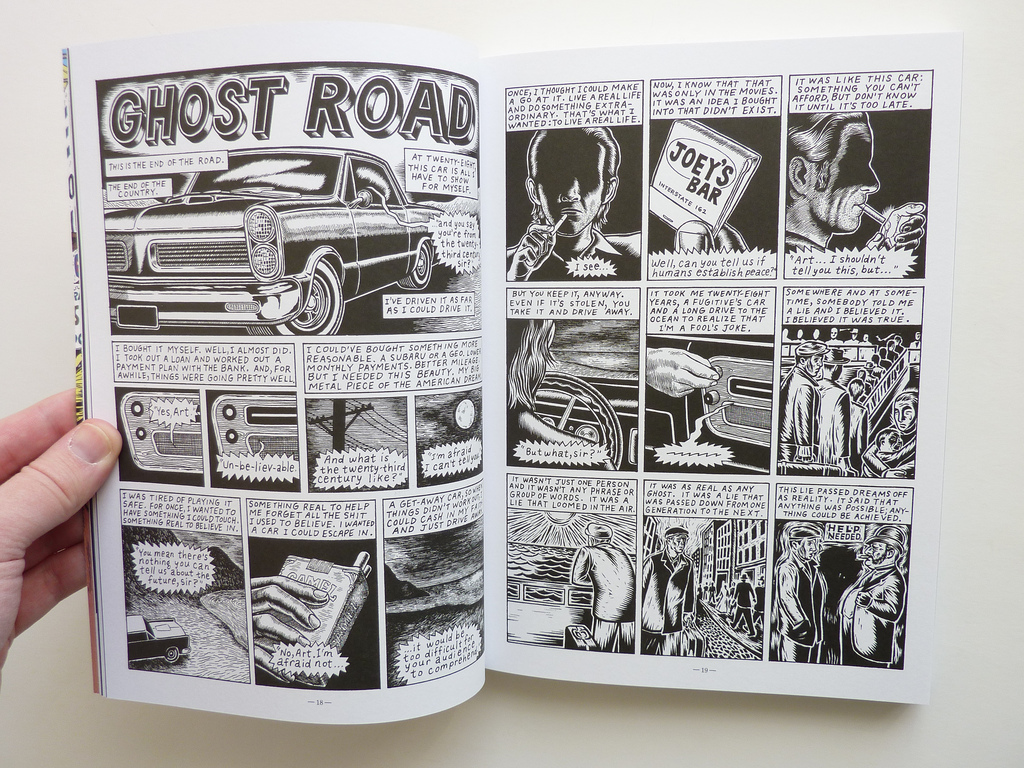
If the bar represents community for Lane, the car represents not just the possibility of escape, but the illusion of solipsism. Cars are tied closely to notions of identity and triumph over one's situation. In "Cleveland", a man at the end of his rope drives to Cleveland to be present at the birth of his best friend's first child, and manages to find a spark of inspiration. "Ghost Road" is about that urge to hit the road only to find that even talking to like-minded individuals doesn't dull pain. "Doo-Wop and Planet Earth" concerns the desperate urge to connect with another as one is ready to leave town, and how that attempt is both an act of cowardice and a leap of faith.

The stationary characters in Lane's world have generally descended into madness. In the book's interstitial pieces, a shut-in is consumed by delusions of grandeur and begins having demented daydreams. In the "The Manic Depressive From Another Planet", another shut-in dares to confront the world despite his near-crippling fear. "Spirit" addresses all of the book's themes: restlessness, the attempt to create meaning out of the randomness of our lives, the way that stories and legends accrue to create our understanding of America, and the need we have to connect our own personal narratives with those overlying American legends. Lane goes a step further in building his notion of American myth with other interstitial features like paper doll cut-outs of American originals like grifters, rockabilly dancers, Chuck Berry, good cops/bad cops, etc. He opens the book with a drawing of young Marlon Brando and ends with a drawing of an older Brando, bookending two views of an actor whose own symbology declined as he aged. Abandoned Cars will appeal to anyone who's ever sought out the comfort of the road, the urge to jump a train, or who looked for answers in the company of fellow patrons at a bar.

Wednesday, April 24, 2013

The Image, Reimagined: Ticket Stub

Published by Rina Ayuyang's new imprint Yam Books, Tim Hensley's Ticket Stub is a dizzying reimagining of still scenes from film, drawn into his sketchbook during slow moments in his job as a closed captioning writer back in the 1990s. The films and TV shows he captioned range from Oscar nominees to the dregs of the B-movie file, but Hensley's poetic interpretations twist both into the hilarious, the ridiculous, and even the poignant, as the frenzied nature of his quickly-captured image burst with life on every page. Originally published serially as minicomics, Ayuyang is yet another publisher going out of her way to rescue classic minicomics series from obscurity, and this collection couldn't be more attractive. The bottom of each page has a small oval slice "punched" out of it as though it were a ticket, a clever detail that adds to the package's overall appeal.

As anyone who read Hensley's classic Wally Gropius knows,  there's a stream-of-consciousness quality to his use of language that's closely tied into surprisingly tight narratives as well as references to pop culture, literature and history. Above all else, Hensley lives to serve his gags, twisting conventional understandings of situations into something still recognizable but quite odd. In other words, it doesn't necessarily make this book any more or less easy to follow if you've seen the movies he references. He turns Love and Basketball from a romance into one of the characters becoming a foul-mouthed coach. He turns b-movie Killer Klowns From Outer Space into a deeply existential crisis of a film ("Need teen groping be such a horror?") He uses a horrible pun involving the name "Ephraim" as part of his account of the biblical film Jeremiah. Wrestlers in cheap fight films are given noble motives, while actors in art films are reduced to parody. Through it all, Hensley's patter weaves between detective novel staccato to cheap advertisement for "Colonel Corn" products to nasty zingers ("In the future, men will live in advanced technological domiciles called 'caves'" for Battlefield Earth and "A bear costume escapes from a zoo..." for Hercules in New York. I most enjoyed the absurd Hensley, like his running motif on the primacy of beards running around Gettysburg.

The last chapter is the greatest, and I can understand why Hensley left it that--there was no way to top it. It's a tour-de-force of repurposed scenes mashed together one after another. It goes from a police procedural to a beach blanket movie to Apollo 13 to even weirder pastures (the panel-to-panel switches between different people on the phone spewing nonsense was astonishing). The slightly relaxed nature of their earlier pages allowed the reader to take in the image from the film, drawn in a style that was realistic yet rendered slightly grotesque and cartoony in Hensley's hands (it's very different from his John Stanley/Dell Comics inspired work in Wally Gropius). In the last chapter, Hensley whips the reader from panel to panel with no time to breathe or think, drowning them in pure, glorious craziness. It climaxes in the Beatles singing a song using baseball play-by-play as lyrics, forcing their fans to weep as they confess their sins. Later, an unseen fans has one of the musicians sign a baseball, saying "Make it out to J.D. Sallinger". It's as fitting an end as any for a cartoonist who was clearly bored out of his mind by his job. I see these strips as a reaction both to that boredom and being forced to watch these films in a very specific way that's guaranteed to squelch any aesthetic enjoyment whatsoever from them. In Hensley's hands, it makes sense that all content was treated the same, because for a captioner, all content was the same. At the same time, it's not all ridiculousness; Hensley captures genuine insight into many of these films, boiling many of them down to their essence or bringing a new (if skewed eye) to the proceedings. The reason why the last chapter works so well as a sort of film mish-mash is because so many films are the same. That said, Ticket Stub shouldn't be read as an explicit form of film critique. Instead, it's a testament to Hensley's unique ability to process culture and images and turn them into something disorienting, hilarious and beautiful.