Showing posts with label sean ford. Show all posts
Thursday, November 6, 2014
Thirty Days of CCS, Day 6: Sean Ford, Amelia Onorato, Andrew Christensen
Burn The Bridges Of Arta, Pt 2, by Amelia Onorato. The cover of the second issue of the series "rhymes" visually with the first. This time, we see the laborer-with-a-secret Orie Foster leaning on a wall with a downcast expression, only we don't get to see his eyes. The protagonist of the series, young Apollonia Ford, appears on the cover of the first issue in precisely the same pose. The first issue followed young Apollonia in her quest to discover what really happened to her sister, who was supposedly on her honeymoon. It's revealed that the powerful architects of the city, as a sort of ritual sacrifice, offer up their own children to bury alive in the cornerstones of all new structures in the beautiful city. Foster did the job with her Apollonia's sister and is constantly haunted by the experience, such that when she follows him home, he obliquely tells her what's going on.
The fantasy elements in this series are light but present nonetheless, especially in terms of the horror of discovering that what seems beautiful and trustworthy is really rotten at the core. Onorato dips a bit into the Dickens well with the colorful neighborhood thieves, but this story is always about two shades darker than one would expect from a fantasy story. The morbid nature of Foster's job, the monstrous hypocrisy of the Architects and the looming nature of Apollonia's future, once revealed, make this an especially grim story. Even in the most Dickensian of scenes, when Apollonia is trying to deal with street urchins, she's rescued temporarily by the neighborhood pervert/pimp. Rather than couching dangers in metaphors, Onorato boldly lays out the bare truth of death and abuse, albeit in a manner that's incredibly restrained. Indeed, her fine line and attractive character design only serve to highlight the feeling of reading a Victorian-era story; the bows in Apollonia's hair, the rosy cheeks of Foster's wife, and most especially the detailed and laborered nature of the buildings are in constant tension with the horror that lies at the heart of the story. Similarly, Onorato mixes moments of humor and kid's-adventure with the truth the audience is now privy to. The class and gender overtones of the story are also unmistakable, but that's been present in all of Onorato's reinterpretation of fantasy tropes. This is a smart, attractively-drawn and simply chilling story.
The Stag #3, by Andrew James Christensen. This simple, understated and highly chilling three issue series concludes with the old man who killed a stag with a disturbingly human face coming face to face with an entire race of these beings. Using a carefully-paced four panel grid on every page, Christensen employs a highly deliberate pace of storytelling to heighten suspense. Making great use of white negative space to portray the desperation of the man's need for food in the midst of winter snows, the use of grey heralds the appearance of menace. Of course, Christensen is careful to show the reader that not all is quite as it seems, and the surprising end of the book highlights this. The use of a model boat as a sort of fantasy escape metaphor only serves to underline the ways in which the man is already psychologically doomed. The economy and overall restraint in the series is a mark of the artist's maturity as a storyteller.
Shadow Hills 2-4, by Sean Ford. This is Ford's follow-up to his Only Skin series, and he hits on a lot of the same beats as the series progresses. There's a weird, menacing presence outside of the town that's affecting the innocent. Someone comes back to town with a great deal of history there in order to settle some kind of family matter. The local police are weird and twitchy. There's a sense that the entire town is hiding some kind of secret. There's a large, sprawling cast which serves to both move plot along as well as provide narrative red herrings. The setting is a small, dusty town in the middle of nowhere. The main difference is that Ford is much more confident and skilled as a draftsman and storyteller this time around.
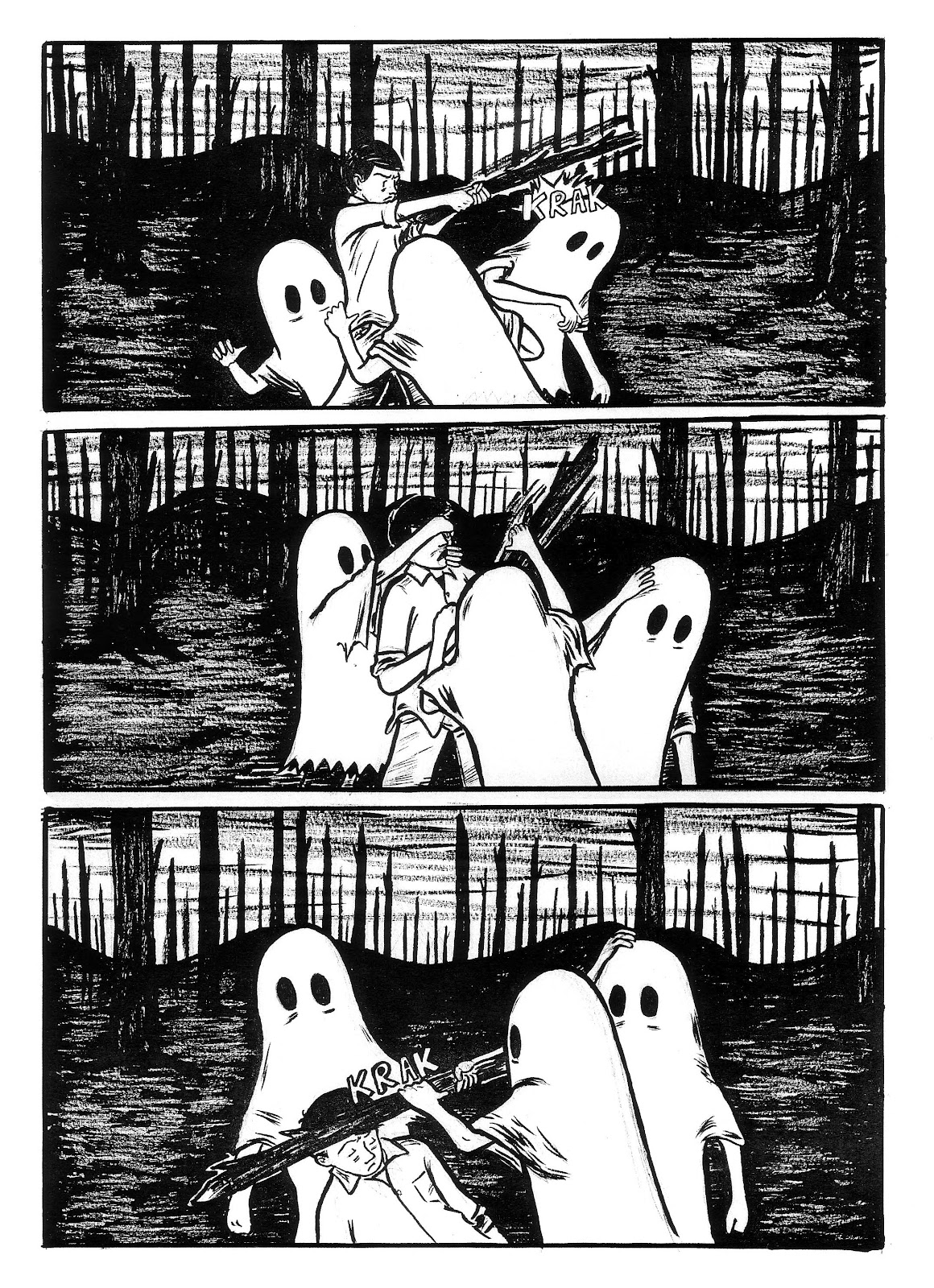
There are two primary supernatural/paranormal phenomena in the series. One is a young man who showed up and is being hidden by a girl in a barn. He seems to have some kind of connection to the earth that feels like a sort of psychedelic superpower. The second is this black-ink ooze that completely covers several characters. It's terrifying, both to the characters in-story, and as a reader, because that ink is the stuff of storytelling itself and here it acts as a highly visceral object of menace. Ford's line is perceptibly but slightly different on the whole; his line is finer and slightly simpler. The occasional over-drawing found in Only Skin has faded as he's become more comfortable. His pages are better composed and balanced, and still get across that sense of desolation and ennui without having to force details on the reader. Ford still has the ability to wow the reader with big splash pages, like a two-page spread of a huge hole that literally opens up underneath what appears to be one of the main characters of the story. Following the shock of that shot up with a two-page shot of a seemingly-benign forest (always a source of danger in his stories) is an incredible transition point in that issue.All of that builds to the introduction of a character mentioned with some air of menace, and his hulking body matches it. I'll be curious to see if the weirdness in this comic is scientific this time around instead of supernatural, but there's a tightness and snap to this comic that shows how much he's learned from his first foray into this kind of storytelling.
Tuesday, November 26, 2013
Thirty Days of CCS #26: Awesome Sound, Can't Lose, Stranger Knights 4
Awesome Sound is an anthology published by Sean Knickerbocker. The low-fi cover belies the beautiful contents within, which look like they were printed on a risograph. DW's endpapers, which forcefully push both text and image to the point of violent distortion, are fitting for a comic that's so visceral and unsettling. Dan Rinylo's "Beast" is told with an Ernie Bushmiller-style simplicity, as the young boy's face here is two big black dots for eyes, a black line for a nose and a mouth that goes from black line to black oval, depending on his emotions. Using a nine-panel grid after an initial splash page that establishes the boy at the edge of a forest, each page is interesting because the central panel is almost always a scene of stillness: we see the boy looking, see him smiling, see him in the middle of walking and then see him running from right to left when wild dogs start chasing him. That sets the story from amusing to frenetic, but the final middle panel is an image of an empty street--right before a wild dog who is chasing the boy is run over by a car. It's both dark and comedic, given the x over the dog's eye and the generally cartoony nature of the story, but the bright red blood on a page that's mostly black and white adds a level of terror to the proceedings.
Knickerbocker's "Do You Still Feel Alone?" begins with a brother and sister in the woods, on the run from something unseen. The way he throws the reader right into a chase scene propels the story right along, heightening its tension from the very beginning. That tension is ramped up when they are assaulted by a nude man, who is stabbed to death by the sister. Knickerbocker pulls back further, revealing that this is an island where a plane has crashed, its inhabitants reduced to life-and-death struggle. It's a brutal, unforgiving little tableau that has no pat ending, and the fact that it's drawn in that cartoony style reminiscent of Chuck Forsman and Sammy Harkham makes it all the more unsettling. Indeed, the later story where a young couple sets themselves on fire in a house (revealing a pentagram on the floor) is a sort of cousin to the sort of thing Forsman did in The End Of The Fucking World. Finally, Juan Fernadez's red ink two-pager is a perfect fit, as his scribbled-out faces go through a progression of consumption. This mini is short but every image packs a punch.
Can't Lose is an old-fashioned fanzine dedicated to the TV show Friday Night Lights. It's everything a fanzine should be: in-jokey, craft-conscious, and gently mocking in a reverent manner. "Coached" by superfan Melissa Mendes, this zine has an interesting sprinkling of well-known cartoonists. Popular topics include the Christian speed-metal band that the character Landry starts ("Crucifictorious"), the comically awful Billy, younger brother of lead character Tim (Henry Eudy does a fine job of pointing out just how weaselly he is while Nomi Kane posits a magical night the two share in the desert), and how doubters often come around to becoming obsessed with the show. Jon Shaw's "Friday Nightlife" speaks to this, as a character who mocks a couple mourning the last episode starts to watch it and eventually enters his own weird world of living out other, self-imagined seasons. Sam Spina actually made me laugh out loud in a strip where he and his wife are asked why South Carolinians are buying Texas beer, and they reply in unison "Texas forever". My favorite strips were Dan Zettwoch's hilarious story about Dillon getting routed because Saracen used photocopies from the playbook to hang up Crucifictorious flyers (lovingly designed and drawn by Zettwoch, of course) and Jeff Lok's tale of escalating terrible behavior being excused "They're good kids". Can't Lose even has a cut-out Tim Riggins paper doll. While bits of it might me mystifying to those in the dark, the premise is laid out clearly enough for the jokes to land.
Stranger Knights 4 was published, as always by Bill Volk. This light-hearted fantasy/sci-fi/superhero anthology has always been on the uneven and amateurish side. This issue is the first to look good from cover-to-cover, and each story is funny to boot. Volk's "Brega and Snurrd" sees him use a cleaned-up, simplified version of his line that emphasizes character expressiveness above all else. The story follows familiar Dungeons & Dragons/fantasy tropes, but it's really about the relationship between a mother and her teenaged daughter. Of course, the mother here is a bearded dwarf and her daughter is trying to pass as human at her wizarding school. When the mother demands the presence of her daughter for an adventure (ie, bonding session), tension arises in an amusing manner. This is a crisply-paced story that actually gets across real feelings in its fantasy context. I'd love to see more from these characters and their world. The Volk-written "Thousand Year Grudge" (drawn by Bryan Stone) is a denser, grittier story involving anthropomorphic animals, thievery, romances gone bad and multiple double-crosses. The thickness of Stone's line is coupled with cross-hatching, lots of spotted blacks and other noir visual effects to counter the funny animals and the wonderfully ludicrous character of Maggie, the young bird who decides to be a thief. Ann Lewis' "Headless" is a bit on the cruder side in terms of rendering, but her use of humorous body language in telling a story about an empty but animated suit of armor sells it effectively. Finally, the Volk-Mary Soper continuing collaboration "Incantrix X" continues to be a reliably amusing story with idiosyncratic character design and odd design choices.
Saturday, November 9, 2013
Thirty Days of CCS #9: Ford, Forsman, Coovert, Kim, Martin, Gaskin
Let's take a look at some short comics from the remarkable graduating class of 2008 from CCS, many of whom spent time editing the Sundays anthology.
Simple Routines #18, by J.P. Coovert. Coovert's been honing his craft as an autobio cartoonist for some time now, and his most recent results have been increasingly poignant and poetic. That includes his line, which he has simplified thanks to the choice of using a thin weight (exactly the same as the weight he uses for his lettering), which gives each panel a sense of compositional unity. Considering that he uses a narrative caption for most of his panels, this is the biggest key to their success. His figures are simple and iconic without sacrificing clarity or expressiveness, which is important because Coovert explores the emotions he feels for his wife, friends and parents in many of the anecdotes described here. The final story, where he remembers playing with a sick kid as a child as a formative moment for how he views life, is poignant without being maudlin or too self-important. Through sheer hard work and repetition, Coovert has made the daily diary strip more than just an artist's exercise.
Teen Creeps #1 and Working On The End Of The Fucking World, by Chuck Forsman. Forsman is one of the smartest and most thoughtful cartoonists working today, with an intellectual curiosity about process and themes that reflects his status as cartoonist, editor and publisher. That curiosity has led to Forsman publishing several interview zines through his Oily Comics concern, as well as the Working On... zine that's comprised of commentary, an interview, sketches and thumbnails from his most well-known comic that began as a series of eight-page minis. Forsman notes that it's mainly an excuse to "play with 2 color printing", and he sounds a bit anxious about being pretentious in the interview, but it's clear that this is something he takes seriously, and rightly so. Documenting that process in a manner that's visually interesting and challenging was obviously a puzzle of its own for him. Teen Creeps is his new series of short stories involving "loosely connected" characters over time. The first issue starts a story featuring Hilary and her bad-ass friend Dawn. Hilary is slut-shamed by a jock at a high school when she won't put out after he goes down on her. When Dawn catches wind of this, she kicks the kid spreading a rumor about Hilary in the groin, ignoring the inevitable lecture from school officials. Forsman's specialty is teenage characters, and this comic features him tackling the subject from a different perspective. It's not just that the lead characters are girls (a rarity for Forsman), it's that he's examining a different set of character dynamics than usual. This set of Teen Creeps story seems like it's going to focus in on the friendship between Dawn and Hilary, and the ways in which that friendship blurs and strains. As always, Forsman's character design is cartoony and grotesque in a manner that feels real, from Hilary's pointy nose and long, stringy hair to a kid's flat-top, spiky haircut.
Shadow Hills #1, by Sean Ford. It's a brand new series for Ford after working on Only Skin for several years. This time around, the focus seems to be on a couple of children: a mute boy who collapses near a small forest town, and a girl who fancies herself a would-be detective who discovers him. Told in retrospect by the girl, it hints at ominous, strange events that seem to indicate that the boy was far from ordinary. Ford seems to have varied his line weight a bit here, giving his line a more fragile, tremulous quality. Ford also sets up the stakes of this story more rapidly than in Only Skin, with its narrative structure immediately instilling a sense of menace and foreboding from the very beginning. It was a bit strange to see Ford work this small, after seeing the wide-open vistas of his last book, but he may be going for something more claustrophobic here.
Timber Run 1 and Dumpling King 1, 2 by Alex Kim. If you were to ask me about a particularly underrated cartoonist, Kim would be one of the first names I'd consider. His idiosyncratic and piercingly angular character design, his lush use of backgrounds, and his quirky sense of humor all punctuate his status as an outstanding writer of suspense and horror comics. Dumpling King, published by Oily Comics, promises to be a creepily-paced breakout work that brings him deserved attention. It's remarkable how quickly he's able to establish the premise and setting of this comic, as a prospective dumpling making decides to abandon his tutelage in favor of being the store's delivery man after the former holder of that spot kills himself. He wants to investigate for himself the mysterious Grace Chang and her sinister family despite the protestations of his mentor. Kim quickly sets up steam and fog as recurring visual motifs, painstakingly rendered in a stippled line that gives the vapor a density that looks dangerous. The changing covers are also carefully considered, as we switch from character to character in each issue and the moon slowly sets. This is beautiful and meticulous cartooning that's in total service to the demands of the immediately engrossing story. Kim draws the reader into his world with pointy noses and wrinkled faces. Timber Run is the first part of a horror comic that features one of Kim's favorite motifs: the cabin in the woods. The reader is slowly drawn into a family drama, an abandoned relative and his sister's family attempts to find him. If the horror here is perhaps more conventional, Kim plays around with expectations by putting the family's drama out front until the monster is revealed in gloriously over-the-top style. Kim leaves the reader on a nasty cliffhanger, making it clear that a happy ending is not guaranteed.
Gnomes, by Sam Gaskin. This is a bit of smudgy silliness from a cartoonist who has always used fantasy and pop-culture tropes and images to fuel his humor. The strips here range between quotidian activities to out-and-out gags, like a gnome tricking a troll into falling into a hole and then pissing on him. Many of them are more like "tickle fight", which involves two gnomes tickling each other with the tagline "everybody wins!" This is a deliberately lo-fi, bawdy version of the famous 1977 book of illustrations that set off the gnome craze, one where plot and character are less relevant than world-building. Of course, the world-building here mostly involves gnomes getting drunk on mead and eating pumpkin bread. It's an amusing concept that's as sloppily drawn as the original book was fastidious.
Gagger 1, by Dane Martin. Martin has long been a cartoonist who's mashed together influences from the golden age of cartooning like EZ Segar with more modern influences like Tony Millionaire and Mark Beyer. Martin's comics have a feverish, nightmarish quality, even as they follow the adventures of cartoon birds who happen to be artists, animators and gagsmiths. There's a mix between characters that have a deliberate, energetic crudeness in terms of their rendering and a carefully-crafted set of backgrounds that feature intricate patterns and furiously-dashed marks. The eye doesn't rest on a Dane Martin page; instead, it dashes anxiously from image to image, never being allowed to relax or find comfort in any of the drawings. It's an anxiousness that's not unlike what Michael DeForge does on his pages, only cranked up to a more uncomfortable level. The main character here is a gag writer for "Uncle Saul" who's out of inspiration and ideas who takes a walk, only to reveal how useless and impotent he is a sentient creature, one completely unable and unwilling to help others. Of course, the character is ridden by guilt, because all of his emotions must center around his own negative conception of self no matter what. It's a powerful, bracing little comic that promises some fascinating insights into human interaction.
Simple Routines #18, by J.P. Coovert. Coovert's been honing his craft as an autobio cartoonist for some time now, and his most recent results have been increasingly poignant and poetic. That includes his line, which he has simplified thanks to the choice of using a thin weight (exactly the same as the weight he uses for his lettering), which gives each panel a sense of compositional unity. Considering that he uses a narrative caption for most of his panels, this is the biggest key to their success. His figures are simple and iconic without sacrificing clarity or expressiveness, which is important because Coovert explores the emotions he feels for his wife, friends and parents in many of the anecdotes described here. The final story, where he remembers playing with a sick kid as a child as a formative moment for how he views life, is poignant without being maudlin or too self-important. Through sheer hard work and repetition, Coovert has made the daily diary strip more than just an artist's exercise.
Teen Creeps #1 and Working On The End Of The Fucking World, by Chuck Forsman. Forsman is one of the smartest and most thoughtful cartoonists working today, with an intellectual curiosity about process and themes that reflects his status as cartoonist, editor and publisher. That curiosity has led to Forsman publishing several interview zines through his Oily Comics concern, as well as the Working On... zine that's comprised of commentary, an interview, sketches and thumbnails from his most well-known comic that began as a series of eight-page minis. Forsman notes that it's mainly an excuse to "play with 2 color printing", and he sounds a bit anxious about being pretentious in the interview, but it's clear that this is something he takes seriously, and rightly so. Documenting that process in a manner that's visually interesting and challenging was obviously a puzzle of its own for him. Teen Creeps is his new series of short stories involving "loosely connected" characters over time. The first issue starts a story featuring Hilary and her bad-ass friend Dawn. Hilary is slut-shamed by a jock at a high school when she won't put out after he goes down on her. When Dawn catches wind of this, she kicks the kid spreading a rumor about Hilary in the groin, ignoring the inevitable lecture from school officials. Forsman's specialty is teenage characters, and this comic features him tackling the subject from a different perspective. It's not just that the lead characters are girls (a rarity for Forsman), it's that he's examining a different set of character dynamics than usual. This set of Teen Creeps story seems like it's going to focus in on the friendship between Dawn and Hilary, and the ways in which that friendship blurs and strains. As always, Forsman's character design is cartoony and grotesque in a manner that feels real, from Hilary's pointy nose and long, stringy hair to a kid's flat-top, spiky haircut.
Shadow Hills #1, by Sean Ford. It's a brand new series for Ford after working on Only Skin for several years. This time around, the focus seems to be on a couple of children: a mute boy who collapses near a small forest town, and a girl who fancies herself a would-be detective who discovers him. Told in retrospect by the girl, it hints at ominous, strange events that seem to indicate that the boy was far from ordinary. Ford seems to have varied his line weight a bit here, giving his line a more fragile, tremulous quality. Ford also sets up the stakes of this story more rapidly than in Only Skin, with its narrative structure immediately instilling a sense of menace and foreboding from the very beginning. It was a bit strange to see Ford work this small, after seeing the wide-open vistas of his last book, but he may be going for something more claustrophobic here.
Timber Run 1 and Dumpling King 1, 2 by Alex Kim. If you were to ask me about a particularly underrated cartoonist, Kim would be one of the first names I'd consider. His idiosyncratic and piercingly angular character design, his lush use of backgrounds, and his quirky sense of humor all punctuate his status as an outstanding writer of suspense and horror comics. Dumpling King, published by Oily Comics, promises to be a creepily-paced breakout work that brings him deserved attention. It's remarkable how quickly he's able to establish the premise and setting of this comic, as a prospective dumpling making decides to abandon his tutelage in favor of being the store's delivery man after the former holder of that spot kills himself. He wants to investigate for himself the mysterious Grace Chang and her sinister family despite the protestations of his mentor. Kim quickly sets up steam and fog as recurring visual motifs, painstakingly rendered in a stippled line that gives the vapor a density that looks dangerous. The changing covers are also carefully considered, as we switch from character to character in each issue and the moon slowly sets. This is beautiful and meticulous cartooning that's in total service to the demands of the immediately engrossing story. Kim draws the reader into his world with pointy noses and wrinkled faces. Timber Run is the first part of a horror comic that features one of Kim's favorite motifs: the cabin in the woods. The reader is slowly drawn into a family drama, an abandoned relative and his sister's family attempts to find him. If the horror here is perhaps more conventional, Kim plays around with expectations by putting the family's drama out front until the monster is revealed in gloriously over-the-top style. Kim leaves the reader on a nasty cliffhanger, making it clear that a happy ending is not guaranteed.
Gnomes, by Sam Gaskin. This is a bit of smudgy silliness from a cartoonist who has always used fantasy and pop-culture tropes and images to fuel his humor. The strips here range between quotidian activities to out-and-out gags, like a gnome tricking a troll into falling into a hole and then pissing on him. Many of them are more like "tickle fight", which involves two gnomes tickling each other with the tagline "everybody wins!" This is a deliberately lo-fi, bawdy version of the famous 1977 book of illustrations that set off the gnome craze, one where plot and character are less relevant than world-building. Of course, the world-building here mostly involves gnomes getting drunk on mead and eating pumpkin bread. It's an amusing concept that's as sloppily drawn as the original book was fastidious.
Gagger 1, by Dane Martin. Martin has long been a cartoonist who's mashed together influences from the golden age of cartooning like EZ Segar with more modern influences like Tony Millionaire and Mark Beyer. Martin's comics have a feverish, nightmarish quality, even as they follow the adventures of cartoon birds who happen to be artists, animators and gagsmiths. There's a mix between characters that have a deliberate, energetic crudeness in terms of their rendering and a carefully-crafted set of backgrounds that feature intricate patterns and furiously-dashed marks. The eye doesn't rest on a Dane Martin page; instead, it dashes anxiously from image to image, never being allowed to relax or find comfort in any of the drawings. It's an anxiousness that's not unlike what Michael DeForge does on his pages, only cranked up to a more uncomfortable level. The main character here is a gag writer for "Uncle Saul" who's out of inspiration and ideas who takes a walk, only to reveal how useless and impotent he is a sentient creature, one completely unable and unwilling to help others. Of course, the character is ridden by guilt, because all of his emotions must center around his own negative conception of self no matter what. It's a powerful, bracing little comic that promises some fascinating insights into human interaction.
Labels:
alex kim,
chuck forsman,
dane martin,
jp coovert,
sam gaskin,
sean ford
Wednesday, July 17, 2013
CCS-Powered Anthologies: Irene 2 and Sundays 5
Irene #2, edited by Andy Warner, dw and Dakota McFadzean. This is another strong entry from this mostly-group of grads from the Center for Cartoon Studies. I like the push-and-pull in its sensibilities with Warner (a naturalistic storyteller), McFadzean (an artist with a delicate but cartoony line) and dw (who specializes in abstractions, patterns and text appropriations), leading to a book that has a bleakly humorous streak. Take McFadzean's "Standing Water", for example. This one features a young boy making his way around his neighborhood wearing a mask, only the entire area is under water. Friends, family and pets float limply in the water, and his attempts at interacting with the world reveal a hidden well of meanings that have lost all their significance in the wake of what is essentially the end of the world. What seem to be acts of revenge or cruelty lose their meaning, leading him to a sense of sad resignation in a totally absurd situation.
Both sets of "Drawings" from dw serve to accent and set off the more conventional narratives, sounding a discordant and occasionally confrontational note in the way they use text and challenge the eye with their psychedelic patterns. After his first set of drawings come three dark stories in a row: Beth Hetland's "1838g", Warner's "Champions" and Sean K's "Ghosts". The first story is about the steady drumbeat of a nightmare that stops and starts. Is the woman in this story pregnant and afraid, imagining her baby to be a hideous parasite? Is she giving birth in the end or having an abortion? Warner's story is from the point of view of a young teen living in the rebellious glow of his older brother, following him as he storms away from his step-father and gets into a drunken snowmobile race that can only have tragic consequences. That Warner has the young narrator filled with nothing but hope makes its subtext all the more sad. "Ghosts" is shockingly straightforward: a young couple enters their house, douse themselves with gasoline and set themselves on fire. The causes of their despair are never mentioned; the drawing of a pentagram on the floor simply indicates that they had run out of options.
I was unfamiliar with Omar Khouri's work before seeing it in Irene, but his smudged, brushy story about a young man in Lebanon refusing to accept his father's legacy as a political strongman was funny and fascinating. The story is filled with scathing political satire that reflects both the sense of hope and cynicism inherent in the "Arab Spring" of the past few years, getting across the sense that the reins of power are loose enough for protest to make a difference but leaving a lingering sense of doubt that any change could be lasting or real. The back half of the comic is slightly less bleak, as Sophie Yanow's account of being escorted by a kind African cabbie in Paris consists entirely of the view from the cab, with no human figures present at all. Marc Bell's rubbery drawings and comic eye-pops make for a nice contrast to dw's drawings. Jonah McFadzean's "Monster Soup" actually works to reduce a sense of active dread with a child's logic and problem-solving. Finally, Bailey Sharp's story about being a poor cartoonist working in an art gallery and being confronted by a high-rolling elite asshole ends the book on a much-needed laugh. Her grotesque approach and willingness to take the piss out of everyone (artists, punks, the rich) leads to a number of very funny plot and character twists, and her critiques of the art world are as dead-on as her self-critiques. The book is well-edited and nicely designed, and it has the potential to be an impressive series if the editors decide to do future volumes.
Sundays #5, edited by Chuck Forsman, Sean Ford, Alex Kim, Joseph Lambert and Melissa Mendes. The Sundays anthology debuted years ago at the MOCCA festival and caused a big stir, thanks to its production values, ambitiousness and unusual format. This was especially the case because it came from a group of total unknowns, and it acted as a shot across the bow from CCS that its cartoonists were worthy of attention. The third and fourth volumes were absolutely outstanding, with the third coming in an innovative three minis in way package and the fourth simply loaded with cutting-edge cartoonists. The fifth volume, released a year ago, is filled with strong work but doesn't hold together like past volumes. Simply put, I'm not sure every participating artist had the same commitment to publish their best work here as they had in the past.
For example, editor Chuck Forsman didn't even contribute a comic--just a two page illustration. Max de Radigues seemed to have contributed a few pages from his Moose comic. The first four pieces in the book took up a lot of room but looked ill-suited for a black & white anthology. The lack of a clear link or theme also made these stories a slog; I eventually gathered that a loose theme may have been "life and death" or more specifically the line between the two. Damien Jay's "leaf writing" comic was fascinating as an experiment in immersive comics making, but once again it seemed to cry out for color to add greater clarity. Some of its pages were very difficult to read.
Things picked up in a stretch that included a grim but hopeful story by Melissa Mendes and a James Hindle story that popped off the page thanks to its cartoony clarity. Joseph Lambert stepped up with one of his best-ever short stories about a fight between two best friends. No one expresses sheer rage quite like Lambert does, and though its protagonist winds up in hell, she makes things very unpleasant for the Devil. Michael DeForge contributes just a couple of pages, but he manages to cram in a lot of story, as a hunter brings back a stray animal from the forest for his family to eat. It's just that the animal is a human child, eaten entirely with nonchalance. Alex Kim's young girl bringing animal heads to her "papa" in the forest is chilling and enigmatic; even if this is just an excerpt.
John Brodowski's "Wolf Eyes" is a typically hilarious piece that follows his exceptionally-rendered heavy metal fantasies out into the desert, as a sax player's furious solo and the cries of a wolf become one. The final image, of his sports car driving off into a sunrise that features the image of a woman's legs and ass boldly astride mountains, is typical of the wonderful ridiculousness of his comics. The highlights of the final third of the book include Warren Craghead's fascinating drawings of what seems to be a tidal pool over the span of a few hours, his drawings directing the reader's eye by numbering lines as he tries to depict simultaneity; his comics are as much about time in a single image as they are about place or object. Jeff Lok's chicken comics are typically alarming in their comedic structure, as his use of static images clashes in an interesting manner with the cartoony nature of his stories. Colleen Frakes' story about a woman getting food from the ocean was later expanded upon in her own mini, but it fits snugly here. Finally, Alexis Frederick-Frost's short about balloonists encountering a giant bird was typically elegant, horrifying, funny and delightfully-rendered. Sundays 5 is not a bad anthology. At least 2/3 of the work is good-to-excellent. It's just not quite as groundbreaking or sharp as its most recent predecessors, which to be fair is a tough standard to live up to. Given that its editors are busier than ever with their own projects, I'll be curious to see if they continue to publish the anthology.
Thursday, May 30, 2013
Sequart Reprints: Minis from Forsman, Ford, Glidden, Smith, Mardou, Overby, Latta
Time to check in on the world of mini-comics.
Snake Oil 1-2, by Chuck Forsman. This is a really excellent, unusual mini that combines slice-of-life slacker life with a truly demented fantasy narrative. It's told in a series of vignettes as a garbageman named Tim is kidnapped from a diner by several mysterious figures using some kind of magical powers. His best friend Bob and fellow garbageman tries to pursue them but is outfoxed. The lead sinister figure stops him by asking him his name, and then says, "Bob, quit doggin' me" and then laughs maniacally down an alley and disappears. Meanwhile, Bob's son Darryl is getting high with his friend Kim, who smokes what's in a mysterious pipe. She suddenly goes catatonic for no apparent reason. Tim finds himself in a mysterious land populated by nudists, while the bull-headed men who are driving him away in a van freak out on pills. In the back-up story, "Mickey The Man", a man goes from a state of being a human and then being an anthropomorphic duck and finds that his baby is stolen from him by unidentified, sinister forces.
It looks like Forsman is cycling through his influences in this mini, spinning them through his own unique point of view. I can sense early Chester Brown as an influence in the first story and his character design is very similar to Sammy Harkham's in the second. The way he mixes humor, fantasy elements, a gnawing sense of dread and everyday ennui as components in his story make it quite memorable. I like his character design and composition, though his line isn't quite assured enough to pull off every trick he attempts in this book. His ambition is impressive, as is his restraint in not overrendering his characters. Forsman is an student at the Center For Cartoon Studies, and it's obvious that he's developing rapidly as an artist. He's definitely one to watch.
Only Skin #3, by Sean Ford. This series reminds me a little of Gilbert Hernandez' work in some respects. The ensemble cast, the wide-open spaces, the eccentric character design, and the looming but enigmatic sense of menace that pervades the book are all reminiscent of a lot of Hernandez' recent work in particular. This issue starts to fill in some of the blanks regarding some of the key character's (Cassie) backstory, as we learn why she left the tiny, dusty town. She's confronted by a person who was the catalyst for her departure, who may play a significant role in the mysterious and brutal disappearances that are occuring in town. We also see more of my favorite character, the Pac-Man looking ghost that follows around Cassie's younger brother and nearly gets him killed. Some of the series' themes are also beginning to coalesce, especially mortality and the nature of human connection. I'm not sure how long this series is slated to run, but it quickly has become a favorite. Like Forsman, Ford has an excellent sense of composition and design but is still mastering the quality of his line. It's not always entirely assured, as though rendering certain scenes seemed to take an enormous amount of effort (especially character-to-character interactions). But also like Forsman, Ford avoids the pitfalls of overrendering.
How To Understand Israel In 60 Days Or Less, Chapters 1 & 2, by Sarah Glidden. Glidden is best known for her journal comics, and in these comics she takes her wry perspective to describe her journey to Israel on a "birthright tour". She took advantage of the Israeli government (combined with private donors) funding a program that brings young Jews to Israel from around the world. Glidden took the trip from a quite skeptical point of view, as a non-religious Jew whose feelings about Israel were ambivalent, to say the least. She was curious as to what kind of people she'd meet on the tour, if those running the tour would truly engage the tough questions regarding the Palestinian conflict, and how much of the trip would simply be an exercise in propaganda.
The best thing about these comics is Glidden's forceful and unapologetic presence as a biased narrator. She is not Joe Sacco in Palestine, submerging his own ego in order to get the stories of others. These comics are about Glidden's feelings and point of view about this experience. Despite her strong opinions going into it, one can sense that the mixed emotions she feels about being in Israel cause her to really think over everything she sees and hears. There's a liveliness in how she depicts characterization that allows the reader to fly through the story, and one can't help but wonder how Sarah will react to what she encounters next. Her position as someone who leans to the left who has enormous sympathy for the Palestinian cause can't help but be tempered by the complex realities of everyday life. Glidden also livens up the proceedings by depicting the wanderings of her imagination: as she confesses that she doesn't know how the Six Day War was fought, she starts to imagine soldiers mounted on dinosaurs attacking each other. Another sequence finds her experiences "on trial" in her mind, as the prosecution attacks what she sees as propaganda while the defense notes how open-minded the guides are, halting when the judge declares a recess for a bathroom break at the next gas station.
Glidden's line is on the primitive side, more concerned with capturing gesture and expression than a meticulously crafted stylization. For the purposes of a story that is entirely about the emotions and expressions of her characters, her art is more than up to this task. She sticks to a rigid 9-panel grid on every page, which serves to keep the story flowing but cramps things a bit. That mostly plays out in her lettering, which is a bit too small on the page and seems rushed at times. It's the only thing that interrupts the otherwise seamless flow of the comic; one rarely notices lettering unless it's a distraction. One could actually see the lettering becoming much clearer at the end of chapter 2, and her pages in general opened up a bit and started to breathe a bit more. I admire Glidden's ambition in tackling this project and think that her combination of wit, outrage and skepticism will make for a fascinating personal account of one of the world's most controversial areas. One can already see that the challenges inherent in telling this story are making her a better artist.
Small Bible, by Shannon Smith. This is a clever mini that's about points of view and description. Taking key portions of the Old Testament, Smith quotes extensively from Stephen's Defense in the Book of Acts, then quotes the original scripture, then provides an illustration--all in just 9 pages. It's a clever comic that's both a straightforward depiction of an event, and a commentary as an interpretation of an interpretation of an event that may or may not have happened--but has enormous importance. Joann Sfar's Rabbi character in THE RABBI'S CAT described Judaism as different from Western (Hegelian) thought, which is thesis, antithesis, synthesis. The history of Jewish thought, he explained, is thesis, antithesis, antithesis, antithesis, and so on. This mini is another step in the argument, providing a visual interpretation of the events that is action-oriented on nearly every page. An angel dramatically swoops in to prevent Abraham from sacrificing Isaac; Moses gets a magic glowing staff from god that cures snake bites; various epic battles are fought. Smith gets across the quite visceral experience of reading the Old Testament, a tact that is quite different from the purposes of either Stephen or the original Torah. It's quite a clever little project.
Washing Machine, by Mardou. I really enjoyed this slice-of-life mini because it subverted expectations at every turn. A story about a 20-something woman who breaks off an affair she's having with an older married man, Mardou sets up a situation where her protagonist Rachel seems to be on the way to finding an exciting new boyfriend. Instead, Rachel's night ends in disaster as the wife of her ex-flame confronts her, her potential new boyfriend drives the hysterical woman home, and her dumpy roommate actually finds a potential love interest. Mardou's character design and dialogue are clever and serve well in drawing in the reader's interest. The ending of the story serves to offer up a bit of justice to a character that is actually a bit vain, shallow and conceited, and the way Mardou brings these threads together in one explosive ending was quite satisfying.
Jessica, by Jason Overby. This is an unusual mini printed with a thick cardstock cover and heavy paper. While this is essentially an anecdote about a missed connection with a woman, what makes it unusual is Overby's visual approach. He alternates between a Paper Rad-style primitivism, pure iconic abstraction, and Frank Stack-style scribbly expressionism. The story drifts in and out of the anecdote, as Overby sometimes digresses to past memories and experiences. This mini is stream-of-consciousness and attempts to get across the experience of one's own consciousness visually. I especially liked the iconic abstraction that represented himself; ironically, his most abstract representation is the most straightforward in relating the narrative. This was certainly an interesting amalgamation of ideas and techniques, presented without compromise to conventional narrative concerns, and it'll be interesting to see how Overby develops his talent.
Rashy Rabbit #4, by Josh Latta. This is an outsized slice-of-life comic told in classic funny animal fashion. Indeed, Latta's skill in rendering his characters in that classic style is so considerable that the first page of this comic, featuring a sex scene, caught me totally off guard. The title character is a familiar 20-something loser, constantly (but often unsuccessfully) on the make and getting high. That opening sequence, featuring a sex scene and a stunning death, was quite a darkly hilarious introduction to this issue. Rashy as a character is a sad sack, without much ambition of his own and is thus easily manipulated by others. While the dialogue has a sort of sleazy verisimilitude that's amusing (especially Rashy's dirtbag stoner cousin), Latta takes a risk in having a protagonist that's so passive in this issue. Not having read the first three issues of the series, I'd be interested in seeing how Rashy interacted with other characters, and how that influenced the narrative.
Snake Oil 1-2, by Chuck Forsman. This is a really excellent, unusual mini that combines slice-of-life slacker life with a truly demented fantasy narrative. It's told in a series of vignettes as a garbageman named Tim is kidnapped from a diner by several mysterious figures using some kind of magical powers. His best friend Bob and fellow garbageman tries to pursue them but is outfoxed. The lead sinister figure stops him by asking him his name, and then says, "Bob, quit doggin' me" and then laughs maniacally down an alley and disappears. Meanwhile, Bob's son Darryl is getting high with his friend Kim, who smokes what's in a mysterious pipe. She suddenly goes catatonic for no apparent reason. Tim finds himself in a mysterious land populated by nudists, while the bull-headed men who are driving him away in a van freak out on pills. In the back-up story, "Mickey The Man", a man goes from a state of being a human and then being an anthropomorphic duck and finds that his baby is stolen from him by unidentified, sinister forces.
It looks like Forsman is cycling through his influences in this mini, spinning them through his own unique point of view. I can sense early Chester Brown as an influence in the first story and his character design is very similar to Sammy Harkham's in the second. The way he mixes humor, fantasy elements, a gnawing sense of dread and everyday ennui as components in his story make it quite memorable. I like his character design and composition, though his line isn't quite assured enough to pull off every trick he attempts in this book. His ambition is impressive, as is his restraint in not overrendering his characters. Forsman is an student at the Center For Cartoon Studies, and it's obvious that he's developing rapidly as an artist. He's definitely one to watch.
Only Skin #3, by Sean Ford. This series reminds me a little of Gilbert Hernandez' work in some respects. The ensemble cast, the wide-open spaces, the eccentric character design, and the looming but enigmatic sense of menace that pervades the book are all reminiscent of a lot of Hernandez' recent work in particular. This issue starts to fill in some of the blanks regarding some of the key character's (Cassie) backstory, as we learn why she left the tiny, dusty town. She's confronted by a person who was the catalyst for her departure, who may play a significant role in the mysterious and brutal disappearances that are occuring in town. We also see more of my favorite character, the Pac-Man looking ghost that follows around Cassie's younger brother and nearly gets him killed. Some of the series' themes are also beginning to coalesce, especially mortality and the nature of human connection. I'm not sure how long this series is slated to run, but it quickly has become a favorite. Like Forsman, Ford has an excellent sense of composition and design but is still mastering the quality of his line. It's not always entirely assured, as though rendering certain scenes seemed to take an enormous amount of effort (especially character-to-character interactions). But also like Forsman, Ford avoids the pitfalls of overrendering.
How To Understand Israel In 60 Days Or Less, Chapters 1 & 2, by Sarah Glidden. Glidden is best known for her journal comics, and in these comics she takes her wry perspective to describe her journey to Israel on a "birthright tour". She took advantage of the Israeli government (combined with private donors) funding a program that brings young Jews to Israel from around the world. Glidden took the trip from a quite skeptical point of view, as a non-religious Jew whose feelings about Israel were ambivalent, to say the least. She was curious as to what kind of people she'd meet on the tour, if those running the tour would truly engage the tough questions regarding the Palestinian conflict, and how much of the trip would simply be an exercise in propaganda.
The best thing about these comics is Glidden's forceful and unapologetic presence as a biased narrator. She is not Joe Sacco in Palestine, submerging his own ego in order to get the stories of others. These comics are about Glidden's feelings and point of view about this experience. Despite her strong opinions going into it, one can sense that the mixed emotions she feels about being in Israel cause her to really think over everything she sees and hears. There's a liveliness in how she depicts characterization that allows the reader to fly through the story, and one can't help but wonder how Sarah will react to what she encounters next. Her position as someone who leans to the left who has enormous sympathy for the Palestinian cause can't help but be tempered by the complex realities of everyday life. Glidden also livens up the proceedings by depicting the wanderings of her imagination: as she confesses that she doesn't know how the Six Day War was fought, she starts to imagine soldiers mounted on dinosaurs attacking each other. Another sequence finds her experiences "on trial" in her mind, as the prosecution attacks what she sees as propaganda while the defense notes how open-minded the guides are, halting when the judge declares a recess for a bathroom break at the next gas station.
Glidden's line is on the primitive side, more concerned with capturing gesture and expression than a meticulously crafted stylization. For the purposes of a story that is entirely about the emotions and expressions of her characters, her art is more than up to this task. She sticks to a rigid 9-panel grid on every page, which serves to keep the story flowing but cramps things a bit. That mostly plays out in her lettering, which is a bit too small on the page and seems rushed at times. It's the only thing that interrupts the otherwise seamless flow of the comic; one rarely notices lettering unless it's a distraction. One could actually see the lettering becoming much clearer at the end of chapter 2, and her pages in general opened up a bit and started to breathe a bit more. I admire Glidden's ambition in tackling this project and think that her combination of wit, outrage and skepticism will make for a fascinating personal account of one of the world's most controversial areas. One can already see that the challenges inherent in telling this story are making her a better artist.
Small Bible, by Shannon Smith. This is a clever mini that's about points of view and description. Taking key portions of the Old Testament, Smith quotes extensively from Stephen's Defense in the Book of Acts, then quotes the original scripture, then provides an illustration--all in just 9 pages. It's a clever comic that's both a straightforward depiction of an event, and a commentary as an interpretation of an interpretation of an event that may or may not have happened--but has enormous importance. Joann Sfar's Rabbi character in THE RABBI'S CAT described Judaism as different from Western (Hegelian) thought, which is thesis, antithesis, synthesis. The history of Jewish thought, he explained, is thesis, antithesis, antithesis, antithesis, and so on. This mini is another step in the argument, providing a visual interpretation of the events that is action-oriented on nearly every page. An angel dramatically swoops in to prevent Abraham from sacrificing Isaac; Moses gets a magic glowing staff from god that cures snake bites; various epic battles are fought. Smith gets across the quite visceral experience of reading the Old Testament, a tact that is quite different from the purposes of either Stephen or the original Torah. It's quite a clever little project.
Washing Machine, by Mardou. I really enjoyed this slice-of-life mini because it subverted expectations at every turn. A story about a 20-something woman who breaks off an affair she's having with an older married man, Mardou sets up a situation where her protagonist Rachel seems to be on the way to finding an exciting new boyfriend. Instead, Rachel's night ends in disaster as the wife of her ex-flame confronts her, her potential new boyfriend drives the hysterical woman home, and her dumpy roommate actually finds a potential love interest. Mardou's character design and dialogue are clever and serve well in drawing in the reader's interest. The ending of the story serves to offer up a bit of justice to a character that is actually a bit vain, shallow and conceited, and the way Mardou brings these threads together in one explosive ending was quite satisfying.
Jessica, by Jason Overby. This is an unusual mini printed with a thick cardstock cover and heavy paper. While this is essentially an anecdote about a missed connection with a woman, what makes it unusual is Overby's visual approach. He alternates between a Paper Rad-style primitivism, pure iconic abstraction, and Frank Stack-style scribbly expressionism. The story drifts in and out of the anecdote, as Overby sometimes digresses to past memories and experiences. This mini is stream-of-consciousness and attempts to get across the experience of one's own consciousness visually. I especially liked the iconic abstraction that represented himself; ironically, his most abstract representation is the most straightforward in relating the narrative. This was certainly an interesting amalgamation of ideas and techniques, presented without compromise to conventional narrative concerns, and it'll be interesting to see how Overby develops his talent.
Rashy Rabbit #4, by Josh Latta. This is an outsized slice-of-life comic told in classic funny animal fashion. Indeed, Latta's skill in rendering his characters in that classic style is so considerable that the first page of this comic, featuring a sex scene, caught me totally off guard. The title character is a familiar 20-something loser, constantly (but often unsuccessfully) on the make and getting high. That opening sequence, featuring a sex scene and a stunning death, was quite a darkly hilarious introduction to this issue. Rashy as a character is a sad sack, without much ambition of his own and is thus easily manipulated by others. While the dialogue has a sort of sleazy verisimilitude that's amusing (especially Rashy's dirtbag stoner cousin), Latta takes a risk in having a protagonist that's so passive in this issue. Not having read the first three issues of the series, I'd be interested in seeing how Rashy interacted with other characters, and how that influenced the narrative.
Labels:
chuck forsman,
jason overby,
josh latta,
mardou,
sarah glidden,
sean ford,
shannon smith
Friday, September 21, 2012
Children Are The Future: Only Skin
The subtitle of Sean Ford's debut book (with Secret Acres) is "New Tales of the Slow Apocalypse". What appears to be a slow-moving mystery story does indeed turn into something that approaches the apocalypse, at least what what one would call the apocalypse in its small desert town setting. The key to the book's success is that Ford works big--the book is 8 x 11", which allows Ford the room to show the reader the desolate and beautiful vistas of the desert as well as the majesty and danger of the nearby forest. This also allows him to get expressionistic at times, rendering a fire and burned-out trees in the forest with a sort of charcoal smear. His character work is simple, mostly using small circles, vertical dashes or dots for eyes. The eccentricities in his character design make up for his weaknesses in rendering the human form and having a firm grasp on the ways in which people move in space and relate to each other. This is less pronounced in the action scenes (where forward momentum carries the figures and story forward) than in the book's many quiet moments, though the increasingly bizarre nature of the book as it proceeds mitigates that a bit.
Only Skin is about a young woman and her pre-teen brother who return to this small town in order to search for her missing father, who ran a gas station. The book feels like a cross between a David Lynch film and a Gilbert Hernandez story. Like in the former, there's an interest in small town living, the occasional surreality of daily life, the darkness beneath the surface of reality, the nature of evil and the feeling of being in the hands of forces beyond one's control. Like the latter, there's an interest in human relationships, the ways in which people can hurt each other, betrayals, eccentric character portrayals, wide-open spaces, and the enigmatic and evasive but always looming sense of menace that pervades every page. Ford's aim is to keep the reader off-balance as to what's really going on in this story. Is it a conspiracy story? A horror story, complete with don't-go-in-the-woods tropes? A conventional murder mystery story? A story about disaffected teenagers? Without revealing the specifics of the plot, Only Skin turns out to be a highly conventional story in terms of exactly what happens, when and why, but that conventionality proves to be highly disturbing. More disturbing, I'd say, than if it was a purely supernatural horror story.
Like both Hernadez and Lynch, Ford spends a lot of time developing the book's extensive cast of characters. The plot unfolds through their interactions, rather than the characters existing solely for the sake of the plot. The reader is forced to determine which of these characters will prove to be important (if any of them) and why. Will it be the conspiracy-obsessed bearded man with a blog? Will it be the meek newspaper man who may be doomed to the same medical fate as his father? What role does the young woman who bursts, half-dead, into a diner and then collapse play? Is the weirdo who helped run the gas station who professes to rarely sleep a part of this? What about the jilted ex-wife of the forest developer who disappeared into the forest, or her slightly creepy son? By focusing on their conversations, conflicts and history in progress, Ford continues to keep the reader both off-balanced and intrigued, as those glimpses may or may not contain important information. What they really do is expand the world of the story and flesh out every character in small but significant ways, making the final fates of most every character something that's important.
Though Ford tosses out a lot of red herrings that prove to be narrative dead ends (both for the reader and the characters in the story who are trying to unravel its mysteries), those red herrings wind up having narrative and thematic resonance down the line. Indeed, the most obvious red herring (that the disappearances are part of a police/developer scheme to raze the forest for timber sales) is the sort of hypocrisy that winds up being the flashpoint for the real perpetrators of the disappearances and murders. Ford doesn't go so far as to suggest that the killings are justified, putting the town's resident conspiracy theorist in jeopardy when he starts sympathizing with the killers. Ford also distracts the reader with a giant piece of magical realism: a ghost that looks like a Pac-Man character who lures the younger brother of the protagonist into the forest. That ghost character is equal parts hilarious, ominous and menacing, and its real identity winds up being a key to the resolution of the story.
Speaking of that resolution, while there's an ending to this story, it's not exactly a happy one. Indeed, things feel more like the protagonists are happy to escape with their lives instead of triumphing over evil. Certainly, given the source of the mystery, no one in the story can feel great about the way things play out. Not every character makes it out of the forest, either, and who lives and who doesn't winds up being suspenseful until the bitter end. The final scene, involving the boy and his ghost, is both strangely touching, deeply weird and a bit disturbing. With his debut book, Sean Ford brings a world to life that's both mundane and horrific, crushingly dull and frighteningly beautiful, and full of relationships both broken and healing. His sense of sweep and understanding of how to portray shocking, stunning images carries the book. As he matures as an artist, he'll become more adept at giving his lower-stakes, lower-key character scenes the same kind of impact.
Only Skin is about a young woman and her pre-teen brother who return to this small town in order to search for her missing father, who ran a gas station. The book feels like a cross between a David Lynch film and a Gilbert Hernandez story. Like in the former, there's an interest in small town living, the occasional surreality of daily life, the darkness beneath the surface of reality, the nature of evil and the feeling of being in the hands of forces beyond one's control. Like the latter, there's an interest in human relationships, the ways in which people can hurt each other, betrayals, eccentric character portrayals, wide-open spaces, and the enigmatic and evasive but always looming sense of menace that pervades every page. Ford's aim is to keep the reader off-balance as to what's really going on in this story. Is it a conspiracy story? A horror story, complete with don't-go-in-the-woods tropes? A conventional murder mystery story? A story about disaffected teenagers? Without revealing the specifics of the plot, Only Skin turns out to be a highly conventional story in terms of exactly what happens, when and why, but that conventionality proves to be highly disturbing. More disturbing, I'd say, than if it was a purely supernatural horror story.
Like both Hernadez and Lynch, Ford spends a lot of time developing the book's extensive cast of characters. The plot unfolds through their interactions, rather than the characters existing solely for the sake of the plot. The reader is forced to determine which of these characters will prove to be important (if any of them) and why. Will it be the conspiracy-obsessed bearded man with a blog? Will it be the meek newspaper man who may be doomed to the same medical fate as his father? What role does the young woman who bursts, half-dead, into a diner and then collapse play? Is the weirdo who helped run the gas station who professes to rarely sleep a part of this? What about the jilted ex-wife of the forest developer who disappeared into the forest, or her slightly creepy son? By focusing on their conversations, conflicts and history in progress, Ford continues to keep the reader both off-balanced and intrigued, as those glimpses may or may not contain important information. What they really do is expand the world of the story and flesh out every character in small but significant ways, making the final fates of most every character something that's important.
Though Ford tosses out a lot of red herrings that prove to be narrative dead ends (both for the reader and the characters in the story who are trying to unravel its mysteries), those red herrings wind up having narrative and thematic resonance down the line. Indeed, the most obvious red herring (that the disappearances are part of a police/developer scheme to raze the forest for timber sales) is the sort of hypocrisy that winds up being the flashpoint for the real perpetrators of the disappearances and murders. Ford doesn't go so far as to suggest that the killings are justified, putting the town's resident conspiracy theorist in jeopardy when he starts sympathizing with the killers. Ford also distracts the reader with a giant piece of magical realism: a ghost that looks like a Pac-Man character who lures the younger brother of the protagonist into the forest. That ghost character is equal parts hilarious, ominous and menacing, and its real identity winds up being a key to the resolution of the story.
Speaking of that resolution, while there's an ending to this story, it's not exactly a happy one. Indeed, things feel more like the protagonists are happy to escape with their lives instead of triumphing over evil. Certainly, given the source of the mystery, no one in the story can feel great about the way things play out. Not every character makes it out of the forest, either, and who lives and who doesn't winds up being suspenseful until the bitter end. The final scene, involving the boy and his ghost, is both strangely touching, deeply weird and a bit disturbing. With his debut book, Sean Ford brings a world to life that's both mundane and horrific, crushingly dull and frighteningly beautiful, and full of relationships both broken and healing. His sense of sweep and understanding of how to portray shocking, stunning images carries the book. As he matures as an artist, he'll become more adept at giving his lower-stakes, lower-key character scenes the same kind of impact.
Tuesday, May 3, 2011
New Post: Minis from Laura Terry, Ross Wood Studlar, Bill Volk & Sean Ford
Here are some recent minicomics by alumni from the Center for Cartoon Studies.


Stranger Knights, by Bill Volk, Mary Soper & Casey Bohn. This is a slight but amusing anthology edited by Volk, an artist who seems drawn to a grungy and unglamorous version of folklore and myth-making. All three feature smart-ass and off-kilter superhero stories. Volk uses a clear and clean line in depicting the adventures of Shamash, the Mesopotamian god of justice. Midway through, the story takes a left turn as he must go home to ask a favor of his grandfather, Enlil, who insists that he try some potato chips. Despite the story's whimsical trappings, it has the tight plot of a Silver Age Marvel story, right down to the interpersonal squabbling of Shamash's superhero teammates in the "Stranger Knights". That light touch, combined with just a touch of angst, continues in the Volk-written, Soper-drawn story of Incantrix X. This is a sci-fi superhero story about a character who uses her mind-clouding abilities to defeat alien dinosaur men but is given a prophecy about turning evil in the future. Soper's line is expressive and exceedingly fine, which gives the whole story a breezy feel. Bohn's work is similarly quirky, as he depicts the adventures of a superhero who uses an electric guitar to fight evil. His art is crude, not unlike a Golden Age cartoonist who had a week to crank out a nine page story, but it has a primitive energy and stays remarkably clear. I wouldn't say that Stranger Knights is a remarkable comic, given the scores of fusion-light superhero comics that have emerged from the alt-comics scene in recent years. I will say that it's one of the more enjoyable comics of its kind that I've encountered, especially in the way that it kept its mood light while being entirely aware of the sort of story it was telling. This looks like it will be the first issue in a series, and I'd like to see what Volk can do in future issues.

Only Skin #7, by Sean Ford. This is the final issue of this storyline, one that will be collected by Secret Acres in 2012. That publisher has released minicomics collections from several CCS cartoonists, including Sam Gaskin, Joseph Lambert and (tangentially) Ken Dahl. Ford says in this issue's notes that the series will continue with a new story. I won't say much about the actual story given that this is the last chapter, but this is very much a denouement to the explosive events of the previous issue. It's a line-dividing issue that very much has the feel of a monster or zombie film where the heroes didn't quite win and are lucky to get out alive. What's interesting is that ultimately the most destructive, (literally) society-obliterating elements of the story turn out to be human ones. Ford makes this issue a mirror of the first one, where there was page after page of bleak, full-page shots of the desolate setting. In this issue, we see that environment burned down in page after page, with Ford's distinctive smeared pencils creating an eerie, shifting environment. This series has been quite an opening salvo in Ford's young career, one that has seen him refine his line while creating beautifully composed and balanced pages.

Morning Song and b.f.f by Laura Terry. Terry has always been a strong storyteller with a distinctive voice, but these two minis demonstrate a newfound devotion to craft and detail. They're both what I refer to as "convention minis"; that is, minicomics that are art objects as well as comics. They generally tend to be slightly flashier and more gimmicky than a standard mini. What makes these minis by Terry stand out is the way she manages to fold in function along with form. The gimmick of each mini serves the actual story (slight as it is) well, and the story would not be able to function well if it didn't appear in this particular form. Morning Song, for example, is an eight-panel comic. It's about a young man whose fiddle playing gently nuzzles the wildlife from sleep to wakefulness. It's tucked into a cute cardboard rodent head. When you pull the comic out, we then read the first two pages, as we see the song bringing dawn. The reader then unfold the comic up to reveal the next four panels, as we meet the musician. Finally, we unfold the comic one more time to its full 11 x 17" length to see the final scene. Reading this wordless comic takes less then thirty seconds, but the physical experience of folding and unfolding it is a clever way of making the reader understand the passage of time.

Only Skin #7, by Sean Ford. This is the final issue of this storyline, one that will be collected by Secret Acres in 2012. That publisher has released minicomics collections from several CCS cartoonists, including Sam Gaskin, Joseph Lambert and (tangentially) Ken Dahl. Ford says in this issue's notes that the series will continue with a new story. I won't say much about the actual story given that this is the last chapter, but this is very much a denouement to the explosive events of the previous issue. It's a line-dividing issue that very much has the feel of a monster or zombie film where the heroes didn't quite win and are lucky to get out alive. What's interesting is that ultimately the most destructive, (literally) society-obliterating elements of the story turn out to be human ones. Ford makes this issue a mirror of the first one, where there was page after page of bleak, full-page shots of the desolate setting. In this issue, we see that environment burned down in page after page, with Ford's distinctive smeared pencils creating an eerie, shifting environment. This series has been quite an opening salvo in Ford's young career, one that has seen him refine his line while creating beautifully composed and balanced pages.

Morning Song and b.f.f by Laura Terry. Terry has always been a strong storyteller with a distinctive voice, but these two minis demonstrate a newfound devotion to craft and detail. They're both what I refer to as "convention minis"; that is, minicomics that are art objects as well as comics. They generally tend to be slightly flashier and more gimmicky than a standard mini. What makes these minis by Terry stand out is the way she manages to fold in function along with form. The gimmick of each mini serves the actual story (slight as it is) well, and the story would not be able to function well if it didn't appear in this particular form. Morning Song, for example, is an eight-panel comic. It's about a young man whose fiddle playing gently nuzzles the wildlife from sleep to wakefulness. It's tucked into a cute cardboard rodent head. When you pull the comic out, we then read the first two pages, as we see the song bringing dawn. The reader then unfold the comic up to reveal the next four panels, as we meet the musician. Finally, we unfold the comic one more time to its full 11 x 17" length to see the final scene. Reading this wordless comic takes less then thirty seconds, but the physical experience of folding and unfolding it is a clever way of making the reader understand the passage of time.

b.f.f. has a clever wrap-around cardstock cover featuring two girls in a tree; opening up the right front flap changes the picture so that only the girl on the left is present. This story reveals just how much Terry's overall chops have improved. Her line is thinner and more confident at the same time. One of Terry's strengths has always been the depiction of movement, and this mini sees her using some interesting techniques to depict movement by moving the reader's eye across the page in a zig-zag fashion. The story is semi-auto-bio, based on a childhood experience where she had her heart broken by a girl. What I liked best about it is the way it resolves; rather than end on a self-pitying note or a cheer-up platitude, it instead unites "Laura" and her anthropomorphic heart by having them engage in "petty revenge". Terry seems ready for a next-level jump, and so I will be quite interested in seeing her tackle a long form work or short story collection.

Avian Tales From Crater Lake, by Ross Wood Studlar. Studlar is a park ranger who also happened to attend "cartoon school". Unsurprisingly, his subject tends to be nature. In terms of his drawing, this comic is a step forward from the previous comic I reviewed of his, The Raven And The Crayfish. His line is no longer quite as labored; drawing directly from nature is a nice match for the looseness of his line. This eight-page comic is a collection of small observations of birds at Crater Lake, from young eagles' leaps out of their aerie to the way diving ducks plowed several dozen feet into the crystal-clear lake in order to devour fish. Studlar also has a prose piece connecting mythology and folklore to the unpredictable and threatening nature of storms on the lake. This is a slight comic at best, one that hints at many more interesting anecdotes and observations to come. Studlar is clearly still trying to figure out just what it is he wants to do as a cartoonist, and his eye and interests are so different from that of the average cartoonist that he has the potential to do some interesting work. A book full of these stories and observations, linked together with prudent editing, could produce a unique comics artifact. As long as he continues to use a more restrained line for both his true life and mythological interests, that book could be a compelling read.

Avian Tales From Crater Lake, by Ross Wood Studlar. Studlar is a park ranger who also happened to attend "cartoon school". Unsurprisingly, his subject tends to be nature. In terms of his drawing, this comic is a step forward from the previous comic I reviewed of his, The Raven And The Crayfish. His line is no longer quite as labored; drawing directly from nature is a nice match for the looseness of his line. This eight-page comic is a collection of small observations of birds at Crater Lake, from young eagles' leaps out of their aerie to the way diving ducks plowed several dozen feet into the crystal-clear lake in order to devour fish. Studlar also has a prose piece connecting mythology and folklore to the unpredictable and threatening nature of storms on the lake. This is a slight comic at best, one that hints at many more interesting anecdotes and observations to come. Studlar is clearly still trying to figure out just what it is he wants to do as a cartoonist, and his eye and interests are so different from that of the average cartoonist that he has the potential to do some interesting work. A book full of these stories and observations, linked together with prudent editing, could produce a unique comics artifact. As long as he continues to use a more restrained line for both his true life and mythological interests, that book could be a compelling read.
Labels:
bill volk,
casey bohn,
laura terry,
ross wood studlar,
sean ford
Wednesday, December 23, 2009
TCJ Post #10: Only Skin #4 and One Thousand Lies
Rob reviews two new minicomics from CCS folks: Sean Ford's ONLY SKIN #4 and Laura Terry's ONE THOUSAND LIES.
Friday, April 17, 2009
Mini-Comics Round-Up: Sayers, Dinski, M.Hogan, R.Hogan, Trivial, Carcieri
Rob reviews another batch of interesting minicomics. Included are JUST SO YOU KNOW #1 by Joey Sayers; TRIVIAL, an anthology by Sean Ford, Alex Kim, Andrew Arnold & Alexis Frederick-Frost; MIND-MAPPING by Will Dinski; BEARD-GROWING CONTEST by Raighne Hogan; MANNY & BIGFOOT by Meghan Hogan; and PORTALS #1 & DREAM #1 by Nic Carcieri & Eric Dotson.

JUST SO YOU KNOW, by Joey Sayers. This mini is certainly a change of pace for the artist behind the "Thingpart" gag strips. Sayers generally employs a minimalist but nicely composed style for absurdist gags that skillfully subvert reader expectations. Her comics remind me a bit of Matt Feazell (in terms of the minimalist style) and Michael Kupperman (in terms of the quality of the absurd gagsmithing). JUST SO YOU KNOW is an autobiographical comic featuring anecdotes about Sayers' transition from male to female. I've actually read a surprising number of autobiographical comics about this subject, but Sayers' strips here are unusual because she takes great pains to provide every anecdote with a punchline. No matter how personal or serious a direction she takes the reader, Sayers always leavens the seriousness with a joke. The joke is frequently at her own expense. One gets the sense that Sayers was worried about being boring or preachy in a comic that was already (by definition) entirely self-centered. Pricking her own ego from time to time acts as preventative medicine for the reader who might think that Sayers takes herself way too seriously.
The impression one walks away with after reading this comic is that it's only because of the greater ease she feels in the world and with herself that she was not only able to write about this subject, but make fun of it. The first strip, "Freaking Out The Parents" starts off with some stiff medicine, as she tells her parents (and the audience) about the way she's struggled trying to live as a man, her depression and how she felt the need to turn to drugs. She kept going on like this for several panels, noting that she just wanted to be happy, until we are hit with her father saying, "Wait, you did drugs?" Sayers once again sets the reader up with one expectation and then pulls the rug out, establishing the formula for the rest of the comic.

Sayers gives us certain bits of the process of transition and the anxiety a transgendered person can feel, but isn't interested in presenting us with all the details. This comic is really about her own thoughts about transition, both funny and otherwise, as opposed to making a larger statement about it. There are vignettes about how hormones affect her emotional state (which create more than a little unease with both her and her girlfriend), being excited about growing breasts and getting a state ID confirming her new identity, and wondering if she's a bitch now in various circumstances. She closes things out by focusing on the relationship with her long-time and supportive girlfriend, as Sayers went from cross-dresser to transsexual. All told, this is a clear early front-runner for minicomic of the year for 2009, and I'm eager to see Sayers do more stories in this mold. She has a gift for relating personal details without being insufferable and of mining humor without forcing punchlines.

TRIVIAL, by Alexis Frederick-Frost, Alex Kim, Andrew Arnold and Sean Ford. The third of the Center for Cartoon Studies' "Four Square" anthologies is the strongest overall. Every quartet of artists in each issue works around a central theme, with this issue's being "trivial". That's a rather open-ended concept, which leads to four very different sorts of stories. Frederick-Frost's bold brush strokes and heavy use of blacks are a perfect way to open the book, drawing in the reader's eye with the starkness of his style. It's a style that fits the story well, being about the harsh beauty of Antarctica and a Shackleton expedition there. As he and his men trudge across the unforgiving landscape, the only way they could keep their sanity was by discussing the most inane of topics: conceptualizing new dishes and then debating their merits and originality. During a heated debate about the jam roll, Frederick-Frost underscores the nature of their struggle by printing the rather restrained text of Shackelton's account of the debate but showing a life-or-death struggle in the ice. It's a clever idea, well-executed.

Alex Kim and his weird, wavy line really go to town on a trivial conversation that turns into a graphic description of a weird nightmare. Kim throws us straight into a talking head with no explanation (not unusual in his comics), as the character is talking to someone we never see (one can surmise that the reader is really his conversational partner). The character talks about his obsession with hands and then relates a dream where he discovers his hands have become gigantic, sentient and murderous--eventually killing him, even as they were still attached to his body. What makes the story work is the way Kim uses panel-to-panel transitions, slowly panning down and around to up the horror content of the story. The effect is deliberately disjointed, creating an intense dream logic that continues until we slowly, creepily pan back to the character in real time. This is less a story than an image that Kim expanded and fleshed out, and it's the strength of that image that makes this chapter memorable.
Andrew L Arnold has an entry about a retired god/superhero who lives on a cloud. His day starts off reading a book, and he is then presented with a problem that is seemingly trivial at first but grows ever more problematic: a meteor heading toward a city that his explosive arrows just won't blow up. In the end, his luck (and aim) run just a little bit awry. This is a nicely designed chapter with a funny punchline that is deliberately stretched out like a shaggy dog story. It's a bit more conventional than the other stories in this anthology and less interesting to simply look at, but it's solidly crafted.

Sean Ford checks in with a couple of vignettes related to his ONLY SKIN series, featuring the odd ghost and new kid Clay. In the series, the ghost is mischievous at best and malevolent at worst, but he's more the former in these stories. In the first vignette, Clay and the ghost are mushrooming and the ghost urges him to give a poisonous mushroom to a nearby girl. When Clay refuses, the ghost mocks him like a grade schooler. In the second story, the ghost longs for nostalgic memories that are not really his, like drinking vodka and smoking cigarettes in a cemetery. The punchline comes when Clay actually does it for him and it's not exactly as exciting as he hoped. Ford's biggest strengths are character design and page composition. He solves the problem of what are essentially two talking head stories by varying his panel design, having the characters engage in visually interesting actitivies while they talk and dropping characters into shadow as a way of adding variety. All of that would be pointless if Ford weren't so adept at crafting dialogue. Clay acts as a nice straight man of sorts for the ghost, whose enigmatic nature lends itself to all sorts of possibilities. It's not surprising that a good chunk of the crew behind the SUNDAYS anthology would produce such a visually distinctive book with great production values, and it's clear that they all approached their contributions to this book very seriously.

MIND-MAPPING, by Will Dinski. Another winner from Will Dinksi, who always engages the form of his delivery system in new and exciting ways. This comic is about memory as it relates to pain, and the ways in which the things we recall tend to be very much by choice. It's about a map specialty store owner with a photographic memory, who laments that he is haunted by the specters of his memories, recalling them more sharply than most. He relates in excrutiating detail various incidents burned into his brain. Upon discovering that his store has been robbed, including of his laptop, he realizes that perhaps a lifetime spent dwelling on the mental recreation of trauma has left him more than a little unobservant. That realization perhaps let him realize that the ghosts he was haunted by were of his own making.

The comic unfolds like a typical Dinski work: crisply stylized characters, word balloons that act as individual captions and a certain economy of line and storytelling. The comic folds out like a map, which not only refers back to the main character but also the way he thought of memory as a series of grids that one could access. When one has finished the comic, Dinski gives us a little surprise: turn out the lights and then look at the glow-in-the-dark images that pop up. It's a clever flourish for a story that had a lot of punch and wasted no time to get there. Dinski's been on a real roll the past couple of years, and this mini certainly continues his hot streak. I like how he goes out of his way to create comics that are difficult to reprint in standard format, fully embracing the freedom and difficulties that creating minicomics provide.

BEARD GROWING CONTEST by Raighne Hogan and MANNY & BIGFOOT by Meghan Hogan. This is a pair of tiny minis from the husband-wife duo behind the excellent GOOD MINNESOTAN anthology. Both of these minis are beautiful, weird art objects; they're less stories than quick impressions. R.Hogan's BEARD GROWING CONTEST is a brief little vignette about a little kid straining to grow a beard and unleashing a fart instead, with the real punchline being what happens in his dreams later on. The full-color MANNY & BIGFOOT feels like a story fragment, as a man and his pet rabbit are threatened by a mysterious kidnapping note, while his sweater-stretching roommate Bigfoot messes with him. The soft pastels grab the eye and create an almost blurry softness for the visuals. The production values of both minis are top notch, even if the comics themselves are the very definition of "slight". Still, it's clear that that's what both cartoonists were going for: a slight, fun comic that served as a useful test for some eye-catching techniques.

DREAMER #1 and PORTALS #1 by Nic Carcieri, Rantz, Jason Flowers, Joel Cotejar, and Eric Dotson. There's something comforting about a writer who is so devoted to creating genre comics that he puts them out bit by bit in minicomics form. There's no pretense to being rich or famous, but rather an intense need to tell one's stories. As part of United Fanzine Organization, these comics have the appearance of work by enthusiastic amateurs rather than polished pros, but this is honestly what is most appealing about them. With both DREAMER and PORTALS, we get a tiny snapshot of a larger idea, the effect being watching the first five-minute segment of a 25-part movie serial from the 1930s. DREAMER'S about a guy who receives a weird artifact of his father's that has something to do with some kind of ancient struggle. I like the unfussy line of artist Eric Dotson here, even if it is a bit stiff in places. Every story in PORTALS is a bit of high concept: both "Kylie West" and "Hot Wings" involve big-boobed heroines engaging in adventure; the former's about an astronaut who winds up on a weird planet, and the latter is about warrior angels. The stylizations of artist Rantz veer between sloppy and fetishistic, drawing equally from manga and Image-style art. As such, it feels more like pin-up art than something that really tells a story. Jason Flowers' work in "Are We Dead Yet?" (about an immortal detective) tries for noir but winds up being muddy (including the lettering). "The London Fog" is the most ridiculous concept in the book (a magical Victorian-era vigilante preying on killers in the form of fog) yet Joel Cotejar's linework makes the idea come alive. I like the enthusastic fan ambition of Carcieri in that he's writing five epics at once (if in dribs and drabs), almost as if he's finding out what will stick best. It's that purity of enthusiasm that shows through, even if some of the stories feel like well-trod genre ground. Other than the loopy-but-serious "London Fog", I can't say that I'd be eager to read further installments of any of these series, but I'm glad that they exist.

JUST SO YOU KNOW, by Joey Sayers. This mini is certainly a change of pace for the artist behind the "Thingpart" gag strips. Sayers generally employs a minimalist but nicely composed style for absurdist gags that skillfully subvert reader expectations. Her comics remind me a bit of Matt Feazell (in terms of the minimalist style) and Michael Kupperman (in terms of the quality of the absurd gagsmithing). JUST SO YOU KNOW is an autobiographical comic featuring anecdotes about Sayers' transition from male to female. I've actually read a surprising number of autobiographical comics about this subject, but Sayers' strips here are unusual because she takes great pains to provide every anecdote with a punchline. No matter how personal or serious a direction she takes the reader, Sayers always leavens the seriousness with a joke. The joke is frequently at her own expense. One gets the sense that Sayers was worried about being boring or preachy in a comic that was already (by definition) entirely self-centered. Pricking her own ego from time to time acts as preventative medicine for the reader who might think that Sayers takes herself way too seriously.
The impression one walks away with after reading this comic is that it's only because of the greater ease she feels in the world and with herself that she was not only able to write about this subject, but make fun of it. The first strip, "Freaking Out The Parents" starts off with some stiff medicine, as she tells her parents (and the audience) about the way she's struggled trying to live as a man, her depression and how she felt the need to turn to drugs. She kept going on like this for several panels, noting that she just wanted to be happy, until we are hit with her father saying, "Wait, you did drugs?" Sayers once again sets the reader up with one expectation and then pulls the rug out, establishing the formula for the rest of the comic.

Sayers gives us certain bits of the process of transition and the anxiety a transgendered person can feel, but isn't interested in presenting us with all the details. This comic is really about her own thoughts about transition, both funny and otherwise, as opposed to making a larger statement about it. There are vignettes about how hormones affect her emotional state (which create more than a little unease with both her and her girlfriend), being excited about growing breasts and getting a state ID confirming her new identity, and wondering if she's a bitch now in various circumstances. She closes things out by focusing on the relationship with her long-time and supportive girlfriend, as Sayers went from cross-dresser to transsexual. All told, this is a clear early front-runner for minicomic of the year for 2009, and I'm eager to see Sayers do more stories in this mold. She has a gift for relating personal details without being insufferable and of mining humor without forcing punchlines.

TRIVIAL, by Alexis Frederick-Frost, Alex Kim, Andrew Arnold and Sean Ford. The third of the Center for Cartoon Studies' "Four Square" anthologies is the strongest overall. Every quartet of artists in each issue works around a central theme, with this issue's being "trivial". That's a rather open-ended concept, which leads to four very different sorts of stories. Frederick-Frost's bold brush strokes and heavy use of blacks are a perfect way to open the book, drawing in the reader's eye with the starkness of his style. It's a style that fits the story well, being about the harsh beauty of Antarctica and a Shackleton expedition there. As he and his men trudge across the unforgiving landscape, the only way they could keep their sanity was by discussing the most inane of topics: conceptualizing new dishes and then debating their merits and originality. During a heated debate about the jam roll, Frederick-Frost underscores the nature of their struggle by printing the rather restrained text of Shackelton's account of the debate but showing a life-or-death struggle in the ice. It's a clever idea, well-executed.

Alex Kim and his weird, wavy line really go to town on a trivial conversation that turns into a graphic description of a weird nightmare. Kim throws us straight into a talking head with no explanation (not unusual in his comics), as the character is talking to someone we never see (one can surmise that the reader is really his conversational partner). The character talks about his obsession with hands and then relates a dream where he discovers his hands have become gigantic, sentient and murderous--eventually killing him, even as they were still attached to his body. What makes the story work is the way Kim uses panel-to-panel transitions, slowly panning down and around to up the horror content of the story. The effect is deliberately disjointed, creating an intense dream logic that continues until we slowly, creepily pan back to the character in real time. This is less a story than an image that Kim expanded and fleshed out, and it's the strength of that image that makes this chapter memorable.
Andrew L Arnold has an entry about a retired god/superhero who lives on a cloud. His day starts off reading a book, and he is then presented with a problem that is seemingly trivial at first but grows ever more problematic: a meteor heading toward a city that his explosive arrows just won't blow up. In the end, his luck (and aim) run just a little bit awry. This is a nicely designed chapter with a funny punchline that is deliberately stretched out like a shaggy dog story. It's a bit more conventional than the other stories in this anthology and less interesting to simply look at, but it's solidly crafted.

Sean Ford checks in with a couple of vignettes related to his ONLY SKIN series, featuring the odd ghost and new kid Clay. In the series, the ghost is mischievous at best and malevolent at worst, but he's more the former in these stories. In the first vignette, Clay and the ghost are mushrooming and the ghost urges him to give a poisonous mushroom to a nearby girl. When Clay refuses, the ghost mocks him like a grade schooler. In the second story, the ghost longs for nostalgic memories that are not really his, like drinking vodka and smoking cigarettes in a cemetery. The punchline comes when Clay actually does it for him and it's not exactly as exciting as he hoped. Ford's biggest strengths are character design and page composition. He solves the problem of what are essentially two talking head stories by varying his panel design, having the characters engage in visually interesting actitivies while they talk and dropping characters into shadow as a way of adding variety. All of that would be pointless if Ford weren't so adept at crafting dialogue. Clay acts as a nice straight man of sorts for the ghost, whose enigmatic nature lends itself to all sorts of possibilities. It's not surprising that a good chunk of the crew behind the SUNDAYS anthology would produce such a visually distinctive book with great production values, and it's clear that they all approached their contributions to this book very seriously.
MIND-MAPPING, by Will Dinski. Another winner from Will Dinksi, who always engages the form of his delivery system in new and exciting ways. This comic is about memory as it relates to pain, and the ways in which the things we recall tend to be very much by choice. It's about a map specialty store owner with a photographic memory, who laments that he is haunted by the specters of his memories, recalling them more sharply than most. He relates in excrutiating detail various incidents burned into his brain. Upon discovering that his store has been robbed, including of his laptop, he realizes that perhaps a lifetime spent dwelling on the mental recreation of trauma has left him more than a little unobservant. That realization perhaps let him realize that the ghosts he was haunted by were of his own making.

The comic unfolds like a typical Dinski work: crisply stylized characters, word balloons that act as individual captions and a certain economy of line and storytelling. The comic folds out like a map, which not only refers back to the main character but also the way he thought of memory as a series of grids that one could access. When one has finished the comic, Dinski gives us a little surprise: turn out the lights and then look at the glow-in-the-dark images that pop up. It's a clever flourish for a story that had a lot of punch and wasted no time to get there. Dinski's been on a real roll the past couple of years, and this mini certainly continues his hot streak. I like how he goes out of his way to create comics that are difficult to reprint in standard format, fully embracing the freedom and difficulties that creating minicomics provide.

BEARD GROWING CONTEST by Raighne Hogan and MANNY & BIGFOOT by Meghan Hogan. This is a pair of tiny minis from the husband-wife duo behind the excellent GOOD MINNESOTAN anthology. Both of these minis are beautiful, weird art objects; they're less stories than quick impressions. R.Hogan's BEARD GROWING CONTEST is a brief little vignette about a little kid straining to grow a beard and unleashing a fart instead, with the real punchline being what happens in his dreams later on. The full-color MANNY & BIGFOOT feels like a story fragment, as a man and his pet rabbit are threatened by a mysterious kidnapping note, while his sweater-stretching roommate Bigfoot messes with him. The soft pastels grab the eye and create an almost blurry softness for the visuals. The production values of both minis are top notch, even if the comics themselves are the very definition of "slight". Still, it's clear that that's what both cartoonists were going for: a slight, fun comic that served as a useful test for some eye-catching techniques.

DREAMER #1 and PORTALS #1 by Nic Carcieri, Rantz, Jason Flowers, Joel Cotejar, and Eric Dotson. There's something comforting about a writer who is so devoted to creating genre comics that he puts them out bit by bit in minicomics form. There's no pretense to being rich or famous, but rather an intense need to tell one's stories. As part of United Fanzine Organization, these comics have the appearance of work by enthusiastic amateurs rather than polished pros, but this is honestly what is most appealing about them. With both DREAMER and PORTALS, we get a tiny snapshot of a larger idea, the effect being watching the first five-minute segment of a 25-part movie serial from the 1930s. DREAMER'S about a guy who receives a weird artifact of his father's that has something to do with some kind of ancient struggle. I like the unfussy line of artist Eric Dotson here, even if it is a bit stiff in places. Every story in PORTALS is a bit of high concept: both "Kylie West" and "Hot Wings" involve big-boobed heroines engaging in adventure; the former's about an astronaut who winds up on a weird planet, and the latter is about warrior angels. The stylizations of artist Rantz veer between sloppy and fetishistic, drawing equally from manga and Image-style art. As such, it feels more like pin-up art than something that really tells a story. Jason Flowers' work in "Are We Dead Yet?" (about an immortal detective) tries for noir but winds up being muddy (including the lettering). "The London Fog" is the most ridiculous concept in the book (a magical Victorian-era vigilante preying on killers in the form of fog) yet Joel Cotejar's linework makes the idea come alive. I like the enthusastic fan ambition of Carcieri in that he's writing five epics at once (if in dribs and drabs), almost as if he's finding out what will stick best. It's that purity of enthusiasm that shows through, even if some of the stories feel like well-trod genre ground. Other than the loopy-but-serious "London Fog", I can't say that I'd be eager to read further installments of any of these series, but I'm glad that they exist.
Labels:
alex kim,
alexis frederick-frost,
andrew arnold,
ccs,
joey sayers,
minicomics,
sean ford,
will dinski
Subscribe to:
Posts (Atom)