Showing posts with label mercedes campos lopez. Show all posts

Wednesday, February 11, 2026

31 Days Of CCS, #11: Short Comics from Faith Cox, Ashley Jablonski, August Driussi, Michael Albrecht, Coco Fox, Mercedes Campos Lopez

Some short CCS reviews for some short CCS comics: 

a berry silly Love Letter, by Coco Fox. Fox is really good at cute, pun-based comics, and this tiny comic sealed in a tiny envelope (sealed with wax!) is no exception. The puns here are based on food, and it's reflelctive of the kind of kids' comics that she's best known for, as well as her penchant for art and craft projects. 


Life Is A Hiiighway, by A. Driussi. This is a hilarious mini about how doing a Lightning McQueen drag king act changed his gender identity. Hilariously, it caused him to want to be a car, but he settled on being a man instead. The drawing of Driussi in that drag is completely ridiculous, and the whole thing is a very lighthearted (yet true-to-life) account of deciding to transition. The almost lurid color scheme is what makes it work.


The Long Game, by Mercedes Campos Lopez. The thing I immediately noticed about this short bit of autobio is how much smoother her line has become. This is a story about growing up with two brothers and how they were all obsessed with the game pieces of a Pokemon-themed Monopoly game. Campos Lopez detailed sneakily pillfering them from her brothers until they were missed. The segue into adulthood, where her brothers wondered whatever happened to the pieces, led to a very funny wink by the author at the end. 

Laundry & Marginalia, by Michael Albrecht. Albrecht is another CCSer with enormous promise; all of his longer form comics thus far have been very interesting. These short minis show off his cartooning in different ways. Laundry is about a ghost who goes to a laundromat, washing itself in a machine and then coming home dripping wet, hanging itself on a line to dry. Albrecht's pencil work here is just lovely, all in service of a gag. Marginalia is just that: doodles, scribbles, half-formed ideas, exhortations, and moments of despair. 


Life As An Elementary Ghost #4 & #5, by Ashley Jablonski. I love the genre of teachers writing comics about the ridiculous things their kids say in class, and Jablonski's twist on it is drawing everyone as ghosts. It's a clever idea because it conveys the spirit of the idea with simple, stylized drawings without adding too much identifying detail. 

How to be: Mysterious, by Faith Cox. Cox is another big-time talent, and this purports to be the latest volume of a larger How To Be series. Using a delightful rabbit character (doing this like posing in front of a mirror while saying "I am a sexy enigma"), the illustrations belie the dubious instructions of the "manual" in amusing ways. For a quick one-off gag, this was executed with considerable care. 

Monday, December 25, 2023

45 Days Of CCS, #25: Iris Yan and Mercedes Campos López

Iris Yan is one of the funniest of all the CCS grads. Though she works exclusively in memoir, she injects humor into most of her work, and it's both bone-dry and frequently dry. There's a total absence of sentimentality in her comics, which is what allows her to be so matter-of-fact regarding any number of upsetting things. In one mini, (originally published in the My Pace 02 anthology), she considers the death and then subsequent funeral service for her mother. While there are genuinely touching moments in the comic, Yan also spends time wondering if her mother was on a secret hockey team after receiving a wreath from "the team." Another short comic was Teaching English In Taiwan, which is exactly what it sounds like. Yan's tone is so funny because of the way it shifts; there are times when she's unbelievably (and hilariously) harsh in talking about her Taiwanese students, but she also tenderly discusses how much they look up to her and are grateful for the class. As always, Yan is intensely curious about local customs and culture, which is another key aspect of this mini. 


As always, Yan's line is consistently wobbly, but it never detracts from the expressiveness of her anthropomorphic figures. Yan depicts herself as a pig, and she draws herself as a pig on two feet rather than a pig with more human figures. This is true of all her figures, which is part of the humor of her comics. For example, in the unrelentingly hilarious Pigs In Heat, Yan tells four different stories about going to a "swing house" in her native Brazil. It's a house for swingers to have sex in, with an entry fee. Never have I read a more sex-soaked comic that was less erotic than this one, thanks to Yan's unshakeable character design. Birds fuck bears, monkeys fuck turtles, etc. It's a smart choice, because Yan also emphasizes the total absurdity of this situation; it's enough to make one question one's own desire. Yan is also interested in logistics while maintaining her trademark bluntness about everything. 


It's no surprise that My Brief Colon Cancer Story is one of the better cancer narratives I've ever read. As a former cancer professional, I despise narratives that valorize the treatment process in any way. That was never a concern with Yan, who opens the book detailing the cancer-related deaths of her own parents and her blunt unwillingness to engage with the obvious symptomatology she faced. Yan details, in chronological order, exactly what she experienced as she was tested for cancer, got surgery, and then later got chemotherapy. Details about the friends and family who came with her, the amenities of the hospital, the personalities of her caregivers, and her generally sharp tongue make this as funny as it is a highly informative work of graphic medicine. Yan's line may be shaky, but there's no doubt that she's an effective cartoonist whose art makes her stories even funnier.


Mercedes Campos López's background in biology is in full effect in her comic Virus. It is a highly effective primer on COVID, cleverly and thoroughly explaining what exactly a virus is, how they spread, how they mutate, and how this relates to the global pandemic. With clear, colorful cartooning and a firmly authoritative but welcoming voice, Campos López sticks to the facts and the science with regard to what is understood about how viruses work as well as how they were addressed during the pandemic. While acknowledging that conspiracy theories, politics, and cultural differences have a way of obstructing science, Campos López aims to educate, not engage in debate with bad faith points of view. While an intelligent child can follow along, the science explored in this comic is certainly at a high school/adult level, with visual breakdowns of fairly complex principles of organic chemistry and biology. The comic is designed to follow a series of bite-size question-and-answer sequences, starting with the big question regarding COVID, backing up to explain viruses in general terms, and then circling back around to the central idea. The one problem with this ambitious example of applied cartooning is that it badly needed line edits, as there are multiple typos and errors throughout. I imagine this will be corrected for future editions. 

Sunday, December 11, 2022

31 Days Of CCS, #11: Ivy Lynn Allie, Mercedes Campos Lopez, Meg Selkey


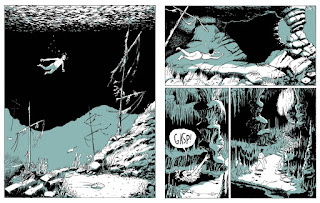
Dunk, by Meg Selkey. This short comic is heavy on color and production values, but it pays off because of its emotional heft. Two girls are playing in a pool when one suggests a game of "dunk": one cradles the other, who must guess what color the other girl is thinking. If she gets it wrong, then she gets submerged (dunked!) in the water. The panels where the girl is underwater, gazing upward through her goggles and experiencing the sheer, visceral quality of light through water while holding her breath, is at once thrilling and frightening. This was the desired effect, and the comic ends with her hooked, asking for another color. 
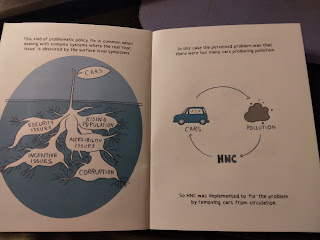

Hoy No Circula, by Mercedes Campos Lopez. Campos usually writes YA mystery stories, but she's quite adept at writing journalistic comics as well. This is a clear and even-handed explanation of a particular problem (air pollution in Mexico City), a seemingly sensible policy (restricting the number of cars on the street on a given day), and how that policy actually makes things worse. Campos notes that this was a surface-level solution to a much more complex problem whose roots include government and police corruption. (For example, plenty of cops were happy to take bribes from those driving on forbidden days rather than impound their vehicles, which would actually help the problem.) From the standpoint of graphic design alone, this is a really attractively-assembled minicomic; with an image per page and attractive lettering, it draws the reader into getting a lot of information without it feeling like medicine. Campos writes it much like one of her mystery stories: there's a dangling bit of information that the reader can't help but be curious about. Campos is clearly passionate about the subject but never stoops to polemic, adding just enough distance to let the reader sift through the evidence on their own. This reminds me a lot of how Dan Nott approaches this sort of thing in an almost Socratic fashion. 

Mirror Neuron No. 2, by Ivy Lynn Allie. Allie's harsh, funny slice-of-life stories have quickly vaulted her into the upper tier of CCS grads, especially as her confidence in her line has grown. She's staking out her own territory, to be sure, but it's the kind of thing that Sean Knickerbocker, Tillie Walden, and especially Dakota McFadzean do so well. Allie conjures up sad, ugly, and desperate lives where rewards are few and justice isn't always fair. Her adaptation of Hans Christian Anderson's "The Tinderbox" is somehow even more fucked-up than the original. The original concerns a soldier who retrieves a tinderbox for a witch and gets fortunes from three magical dogs. He then decides to kill the witch and take the tinderbox. He becomes nouveau riche until he spends all his money, then strikes the tinderbox, summoning one of the dogs to do his bidding. He has them get more money from their magical tree. Eventually, he's smitten with a princess and has the dog take them on a magical nighttime journey. The princess' family tracks him down and he's sentenced to death, but manages to get his hands on the tinderbox before he's hung. He's rescued, gets the princess, and kills everyone else. 

Allie seizes on the one obvious aspect of this story without any kind of moral: it's a young man's revenge fantasy. So she alters certain details to remove any doubt that its protagonist has no redeeming qualities at all; indeed, he's the personification of self-gratification, narcissism, misogyny, greed, and cruelty. He's a fisherman asked by a kind woman to retrieve the tinderbox. She says it's sentimental and he doesn't believe her, so he kills her. When he summons the dog for the first time, it gets him money by robbing and setting the local bank on fire. The dog's very presence causes a trail of plague. He has a memorable dream night with the wealthy young woman, but when she rejects him in the light of day, he has the dog kill her and her fiance. When the authorities close in, he simply has the dog kill them and he becomes governor. He is never punished for his actions; why should he be? He is the personification of the patriarchy, skating by and never seeing the consequences of his own actions. All except one: he leads a love impoverished of love and friendship, of having relationships not mediated by power or money. Allie's cartooning is extremely confident here for a number of spectacular and violent setpieces that add the power necessary to really make this story land. 

The "Intermission" section points to the versatility of this one-woman anthology format for Allie, as she's able to do some sillier stories like "The Thin Orange Line," about a maverick public works guy who's fired for fixing potholes out of his jurisdiction; his response, of course, is to become a pothole vigilante. There's also some amusing out-of-context overheard bits of weirdness that speak to Allie's overall versatility. The framing device of a desolate rest-stop is an apt metaphor for these betwixt-and-between pieces. 
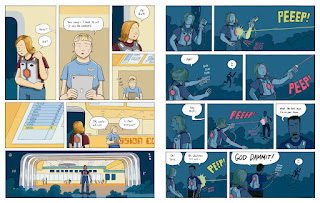

"I'll think about it" is the flipside to the "Tinderbox" story in terms of theme. If the latter is about revenge for a masculine sense of being aggrieved, then this story reflects the sad reality of a lack of imagination. Offered a chance to go with his girlfriend on an adventure and a new life in England, the protagonist instead clings to the sad fantasy of success at a floundering video game company. This is pounded home by a pathetic laser tag company team-building event. Even this bit of potential testosterone-boosting, gun-toting fun is subverted at every turn by confusion, a lack of enthusiasm by some, and irrational enthusiasm by others. The scene where the desperate boss, proud of providing pizza for his employees, is turned down by the protagonist because he already ate, is everything the reader needs to know about this situation. The defeatist ending, where the protagonist simply goes home early, points to an interesting structural decision on Allie's part: the real climax of the story is when after his girlfriend says that there are game studios in London, he replies, "I'll think about it." He's already made his decision, he regrets it, but there's a sense in which there's no going back. He's bought into his own bullshit too much at this point, even as he gets a dose of reality in the hilariously awful team-building exercise. It's a wrecking ball every bit as devastating as the events of "The Tinderbox," told with restraint and a dark, acidic wit. This wit is at the essence of all of Allie's work. 

Saturday, December 4, 2021

31 Days Of CCS, #4: Mercedes Campos López

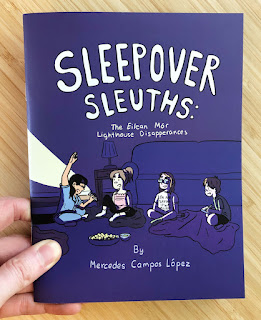
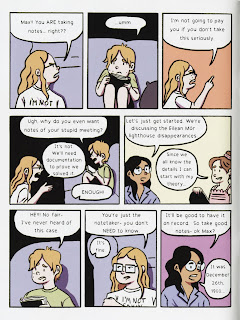
Mercedes Campos López is a cartoonist whose work is ideally suited for YA and middle-grade success. Her latest, Sleepover Sleuths: The Eileen Mór Lighthouse Disappearances, has an irresistible hook: three teenage girls (and an annoying but engaged younger brother) have a sleepover in order to discuss their personal theories behind real-life mysteries. In this case, it's about a Lighthouse where the three keepers mysteriously disappeared without a trace, leaving behind a plate with food and beds that were made up. It's a great enigma that's stood the test of time, given a lack of evidence to support one theory over another.


That made it perfect fodder for a story like this. In a comic that mixes the feel of sleepover and sibling dynamics with that of a fun true-crime podcast, López crafts three different narratives for the case, one for each of the three girls. One postulated a murder and tried to back it up with (discredited) logs from the youngest member of the crew. Another suggested the island was cursed and they were sucked into a dimensional rift, while a third suggested the boring but plausible theory of extremely high waves sweeping them away. López deftly added some nice narrative structure when the dad of one of the girls breaks up the party in terrifying fashion. 

The storytelling is solid throughout, However, López's line is shaky at times. She covered some of that up with her use of color, but the color saturation pushed her to use a thicker line, which was not to her advantage as an artist. This is also a case where computer coloring got a little out of hand on some pages, distracting the eye away from the line and character expressions. It seems like López's strengths are as a "first line, best line" cartoonist who is all about using a sketchy style that displays emotion and character relationships as they relate in space; the use of color and excessive embellishment disguises that. I suspect that this is something that will work itself out in time. The comic feels like an attempt at doing a polished YA work but not quite yet having the chops to do so. In terms of storytelling and characterization, López is right there. The devil will just be in the details and continuing to refine her process. 

Thursday, December 3, 2020

31 Days Of CCS, #3: Mercedes Campos Lopez

Mercedes Campos Lopez's entry is a good old-fashioned, 28-page comic book titled Professor Ghost. It's an absolute delight. Lopez's aesthetic sense is fully-formed, as she keeps her line simple and relies on color and her clever layouts to tell her story. The comic has a Dell or Gold Key flavor to it, as a college student named Emily tries to find out more about her mysterious English professor: Professor Ghost. He's an actual ghost in a suit of armor who needs a TA to do things like set out books and turn the pages of things he wants to read or grade. 

The story is a sweet one, as the ghost is reluctant to discuss how he died, yet betrays a tremendous sense of loneliness. Emily can't leave well enough alone but winds up helping him connect to someone in the end. The mystery angle is a funny one with an unexpected twist that makes this a relatable, human story. Lopez pulls out a lot of stops in telling the story, embracing clarity and simplicity above all else. Her line is emotionally expressive despite its simplicity, especially with a character like Professor Ghost whose face remains hidden throughout the comic. The use of body language and gesture allows Lopez to create the book's emotional narrative, which is the whole crux of the story. Lopez's color fills sometimes felt jarring, however, like a dark green on some pages that sucked up the line. The computer colors often felt artificial and even detracted from the story on occasion, as they took me out of the narrative. A bit more detail with regard to the line art to add more weight to each pane might have allowed her to back off on trying to make the colors do much of the heavy lifting narrative as well as provide backgrounds. Her line is definitely strong enough to take a more prominent role in her work. Lopez has a future doing YA comics, if she wants to go that route.