Showing posts with label ivy allie. Show all posts

Sunday, January 12, 2025

45 Days Of CCS, #43: Rust Belt Review 6


Sean Knickerbocker is always willing to take a lot of chances when putting together an issue of Rust Belt Review. Some of them don't pay off, but some of the anthology's best entries are often among the best comics of the year. In this issue, that's certainly true of Ivy Lynn Allie's story, "The Kingdom." Allie tells what's sort of an anti-coming-of-age story about two pre-teen girls, Nico and Chrissy. Nico is the narrator, and she talks about playing during the summer with a clearly surly Chrissy, who is a horrible friend and a borderline bully. There are a series of events and characters--a sleazy handyman, an overbearing mother, minor crimes--that would seem to indicate a major trauma. Except none of that happened, and things went back to normal. It's a story that is defiantly anecdotal, yet there are aspects of it that hint at lingering personal issues for Nico. As always, Allie's cartooning is expressive and cartoony, with just enough of a fine control on line to contain Allie's flourishes. 


Knickerbocker's own "Best Of Three" serial reaches its penultimate chapter, and the exceedingly seedy quality of the narrative is matched only by the pathetic and self-delusional quality of its cast. It's Knickerbocker's best-realized long narrative, and I'm excited for the final chapter. Knickerbocker's swerves and desperate characters remind me of the film work of the Coen Brothers. 


There are several other very good stories in the anthology. Valerie Light's "How To Walk" is an exceptionally well-drawn and cartooned takedown of the femininity industrial complex, especially with regard to how young women and girls are taught certain "standards" of how to walk, dress, act, etc so that they can successfully marry. Maggie Umber's "Those Fucking Eyes" is another triumph for her, with a series of splash page drawings that tell a loose narrative about desire and being desired. Andrew Greenstone's "Lemurman 2" is a successful bit of horror pastiche that's notable for his grotesque, exaggerated cartooning. Ana Pando's interstitials are all intriguing and enigmatic, especially the piece about finding a double of herself and getting no explanations. 

The rest of the stories are less memorable like Matt MacFarland's unfortunate entry in the "dudes gettin' laid" genre; slight pieces from John Sammis and David Caldwell, a horror parody piece by Brian Canini that felt repetitive in comparison to Greenstone; and a gritty piece by Alex Nall that felt a bit too much like Knickerbocker's piece. There are more misses in this volume than in most of the other issues, but the best pieces are truly outstanding. 

Friday, December 29, 2023

45 Days Of CCS, #29: Comox and Ionosphere

Comox is an odd little video game-themed anthology with an interesting gimmick: it's a flip book were two artists do the "flip-side" of the other story. Filipa Estrela and Kevin Fitzpatrick are both in it, and both of their stories are very amusing. Each chapter is two pages and focuses on a type of game: horror, RPG, fighter, etc. Estrela gets "simulation," and she approaches an Animal Crossing type of game with the concept of, "what if the farmer was actually kind of a lunatic?" The frenzy of activity following the farmer (including underground rock-breaking) is perfect for Estrela's cute character design, and the fluidity of motion (even on pages crammed with panels) allows the reader to fly right through. Their partner, Emily Wigglesworth, tells the story from the point of view of everyone else in the village who is slightly alarmed by the farmer. 

Fitzpatrick's story is a fantasy RPG, something he's quite adept at in his usual comics. While maintaining some trappings of the game environment (like a health meter), Fitzpatrick wisely steers away from the clutter of a typical video game screen (something that hurt several other stories) and sticks to the layout of a typical adventure. The story follows a hero looking for their young companion in a cave, fighting a monster, and being saved by their friend at the last second. Fitzpatrick is so clever in composing his pages, seamlessly fitting together 14 panels on one page at odd angles in a way that felt both fluid and exciting. The flip story, by Mica Liesenfeld, is told from the point of view of the younger companion. The non-CCS highlight of the anthology was Shoona Browning's first-person shooter story where the bored protagonist, after saving humanity from the zombie horde, restarts the game--much to the chagrin of their companion. 

Speaking of anthologies, Masha Zhdanova edited a very good science-fiction anthology called Ionosphere. It's not a surprise that the best pieces were by her and standout CCS alum Ivy Lynn Allie, but there were a couple of other good pieces as well. Zhdanova's story "This World Still Locked Within A Dream" is a variant take on time loop stories such as Groundhog Day. The story follows a young woman named Perilla who one day realizes she is in a time loop, but her life is so boring and routine that she only realizes it when she notices that the event banner on a phone game hasn't changed. A glamorous character from the game named Gigi Galore tells her she was selected as a time loop beta tester, and for a fee, she would be sent back to her normal life. When Perilla refuses, that creates a long series of loops with some surprising emotional connections, a long meditation on depression and loneliness, and just how hard it is to break out of routines. Zhdanova effectively combines the sparkly video game character with an extremely mundane environment. The story is also available as a stand-alone minicomic. 

Allie's story, "Playthings," is a fascinating account of how adult concerns and the concerns of children are often at such odds that there is a vast disconnection of how reality is perceived. The story takes place on another world, as a girl named Rissy tramps around while her parents feverishly work on a project that will flood a local create in order to grow oxygen-creating algae. Unbeknownst to them, Rissy has discovered a race of tiny aliens that she refers to as fairies, and her parents don't realize that in trying to reassure her about what they think are imaginary friends, they have missed out entirely on the ramifications of what they're about to do. Allie adds greater complexity when she completely misinterprets the actions of the aliens, thinking they've destroyed her robot chicken friend, and she lashes out at them in violence and anger. Allie's pages are so smooth and orderly, built around lurking misery and the creeping feeling that something bad is always about to happen. 

The other notable entries in the anthology are from Akira B. and Zab R., who spin a beautiful-looking story about a space explorer letting in a highly unwelcome visitor to his ship by accident; and Torc, whose story about the ramifications of asking a freed creature for help is emotionally resonant and highly disturbing because of the emotional connection between the characters.  

Sunday, December 11, 2022

31 Days Of CCS, #11: Ivy Lynn Allie, Mercedes Campos Lopez, Meg Selkey


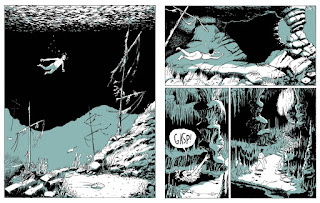
Dunk, by Meg Selkey. This short comic is heavy on color and production values, but it pays off because of its emotional heft. Two girls are playing in a pool when one suggests a game of "dunk": one cradles the other, who must guess what color the other girl is thinking. If she gets it wrong, then she gets submerged (dunked!) in the water. The panels where the girl is underwater, gazing upward through her goggles and experiencing the sheer, visceral quality of light through water while holding her breath, is at once thrilling and frightening. This was the desired effect, and the comic ends with her hooked, asking for another color. 
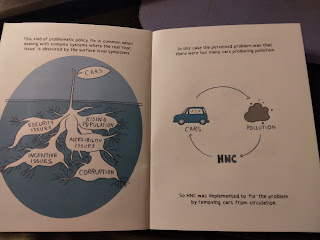

Hoy No Circula, by Mercedes Campos Lopez. Campos usually writes YA mystery stories, but she's quite adept at writing journalistic comics as well. This is a clear and even-handed explanation of a particular problem (air pollution in Mexico City), a seemingly sensible policy (restricting the number of cars on the street on a given day), and how that policy actually makes things worse. Campos notes that this was a surface-level solution to a much more complex problem whose roots include government and police corruption. (For example, plenty of cops were happy to take bribes from those driving on forbidden days rather than impound their vehicles, which would actually help the problem.) From the standpoint of graphic design alone, this is a really attractively-assembled minicomic; with an image per page and attractive lettering, it draws the reader into getting a lot of information without it feeling like medicine. Campos writes it much like one of her mystery stories: there's a dangling bit of information that the reader can't help but be curious about. Campos is clearly passionate about the subject but never stoops to polemic, adding just enough distance to let the reader sift through the evidence on their own. This reminds me a lot of how Dan Nott approaches this sort of thing in an almost Socratic fashion. 

Mirror Neuron No. 2, by Ivy Lynn Allie. Allie's harsh, funny slice-of-life stories have quickly vaulted her into the upper tier of CCS grads, especially as her confidence in her line has grown. She's staking out her own territory, to be sure, but it's the kind of thing that Sean Knickerbocker, Tillie Walden, and especially Dakota McFadzean do so well. Allie conjures up sad, ugly, and desperate lives where rewards are few and justice isn't always fair. Her adaptation of Hans Christian Anderson's "The Tinderbox" is somehow even more fucked-up than the original. The original concerns a soldier who retrieves a tinderbox for a witch and gets fortunes from three magical dogs. He then decides to kill the witch and take the tinderbox. He becomes nouveau riche until he spends all his money, then strikes the tinderbox, summoning one of the dogs to do his bidding. He has them get more money from their magical tree. Eventually, he's smitten with a princess and has the dog take them on a magical nighttime journey. The princess' family tracks him down and he's sentenced to death, but manages to get his hands on the tinderbox before he's hung. He's rescued, gets the princess, and kills everyone else. 

Allie seizes on the one obvious aspect of this story without any kind of moral: it's a young man's revenge fantasy. So she alters certain details to remove any doubt that its protagonist has no redeeming qualities at all; indeed, he's the personification of self-gratification, narcissism, misogyny, greed, and cruelty. He's a fisherman asked by a kind woman to retrieve the tinderbox. She says it's sentimental and he doesn't believe her, so he kills her. When he summons the dog for the first time, it gets him money by robbing and setting the local bank on fire. The dog's very presence causes a trail of plague. He has a memorable dream night with the wealthy young woman, but when she rejects him in the light of day, he has the dog kill her and her fiance. When the authorities close in, he simply has the dog kill them and he becomes governor. He is never punished for his actions; why should he be? He is the personification of the patriarchy, skating by and never seeing the consequences of his own actions. All except one: he leads a love impoverished of love and friendship, of having relationships not mediated by power or money. Allie's cartooning is extremely confident here for a number of spectacular and violent setpieces that add the power necessary to really make this story land. 

The "Intermission" section points to the versatility of this one-woman anthology format for Allie, as she's able to do some sillier stories like "The Thin Orange Line," about a maverick public works guy who's fired for fixing potholes out of his jurisdiction; his response, of course, is to become a pothole vigilante. There's also some amusing out-of-context overheard bits of weirdness that speak to Allie's overall versatility. The framing device of a desolate rest-stop is an apt metaphor for these betwixt-and-between pieces. 
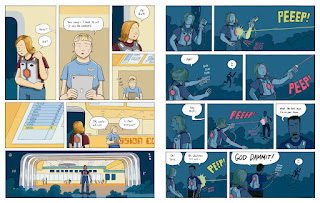

"I'll think about it" is the flipside to the "Tinderbox" story in terms of theme. If the latter is about revenge for a masculine sense of being aggrieved, then this story reflects the sad reality of a lack of imagination. Offered a chance to go with his girlfriend on an adventure and a new life in England, the protagonist instead clings to the sad fantasy of success at a floundering video game company. This is pounded home by a pathetic laser tag company team-building event. Even this bit of potential testosterone-boosting, gun-toting fun is subverted at every turn by confusion, a lack of enthusiasm by some, and irrational enthusiasm by others. The scene where the desperate boss, proud of providing pizza for his employees, is turned down by the protagonist because he already ate, is everything the reader needs to know about this situation. The defeatist ending, where the protagonist simply goes home early, points to an interesting structural decision on Allie's part: the real climax of the story is when after his girlfriend says that there are game studios in London, he replies, "I'll think about it." He's already made his decision, he regrets it, but there's a sense in which there's no going back. He's bought into his own bullshit too much at this point, even as he gets a dose of reality in the hilariously awful team-building exercise. It's a wrecking ball every bit as devastating as the events of "The Tinderbox," told with restraint and a dark, acidic wit. This wit is at the essence of all of Allie's work. 

Monday, December 21, 2020

31 Days Of CCS, #21: Ivy Lynn Allie

Ivy Lynn Allie's most recent minicomics show an artist who's come into her own stylistically and as a writer. Her short fiction is exceptionally clever, subtle, and unsettling, and her ability to effortlessly cross genres mark her as someone who can go in any direction as a cartoonist and do well.


Last Stop, for example, mixes two genres. There's a heaviness to this story as she quickly establishes her nameless protagonist as a man who's reached the end of his rope. He's broke, he doesn't have a job, and he's completely isolated himself from his family and his therapist. Allie gets this across with one succinct panel. This is a character psychodrama. The story begins when he falls asleep on the subway, only to awaken at a stop where a talking raccoon in a cop's uniform rousts him and throws him off the train, and he finds himself in a part of the city where anthropomorphic animals are dominant. That minor-key tone of his depression mixed with the weird absurdity of the world he finds himself trapped in are a potent high-concept, and him finding another human and glomming on to him provide the spark for the beginning of a potentially longer story. As it stands, the combination of despair and lunacy resonates. One can see Allie's drawing tighten up and sharpen as the issue unfolds, with the black gutter space emphasizing the comic's sense of gloom. The character design, especially for the animals, is expressive; it's silly but also gritty and realistic at the same time.

My Friend Meredith is a brutal take on how childhood friendships can be every bit as abusive as other relationships. A girl named Terri and her family visit their friends, and a loving, open Terri is happy to see her same-age friend, Meredith. Allie is not subtle in waving the red flags regarding Meredith from the beginning: she wants Terri to watch a scary movie at her, and then screams at Terri and hits her with a pine cone when Terri beats her in a foot race. The point of the story is not that it establishes Meredith as a sociopath (and Allie does pile it on), it's that Terri is willing to take it, because she thinks of her as a friend, no matter what. What's left unsaid are the social forces that pushed Terri to think this was so, and how her faith in them clearly wavered in the comics' final, silent panels. 

Sanity Check was not only the most fully-realized of these three comics, it was one of the better minicomics I read in 2020. It's a collection of her shorter comics in the tradition of series like Eightball, and the small aesthetic touches and interstitial pieces in the comic make it greater than the sum of its parts. It's a satisfying read from beginning to end, starting with "Of Course, No One Knew." Allie begins the piece in media res, as she at first leads the reader to believe that this is a flashback comic of some kind with invisible narrators talking about a film they had made together. Allie deliberately confuses the reader as to the point of view in this story while relishing the opportunity to talk about the making of a small-budget horror flick. The swerve she introduces has a huge payoff that makes everything make sense while revealing how different projects can be hugely meaningful to people, especially young people. 

"I Made A Friend," with pink as its spot color, is a horribly tragic and tender account of the magic spark of creativity and how cruelly and quickly it can be snuffed out. "The Situation" is about a woman whose job it is to remove poisonous toads, but who didn't want to kill them. The decisions she's forced to make are heartbreaking, but it's even more heartbreaking when it's clear this experience hardened her emotionally. The pea soup-green in this comic is crucial in establishing its atmosphere. Allie's restraint as a storyteller and willingness to explore emotionally complex characters and situations signals that she's ready to sink her teeth into a longform comic or continue to build this body of short story work. 

Sunday, December 15, 2019

31 Days Of CCS #15: Betsey Swardlick, Ivy Allie

Ivy Allie is a first-year CCS student who's demonstrated some sharp comedic instincts in her work to date. Funny Fables is her take on the CCS Aesop project, and she did a meta version of "The Fox And The Crow" that was hilarious. She took the original story, where the fox flattered the crow into dropping a desired pie, and then turned it into a Tom & Jerry routine where each animal sought revenge and the pie. All the while, the narrator kept going, alarmed at what was going on, and coming up with new morals for each story after the latest turn of events. The narrator even winds up playing a part in the narrative itself, as the animals could hear them. Allie's cartooning is fluid and appropriately cartoony.

The Castle Caper reminds me a bit of Mathew New's comics in that there's an unlikely duo going on Indiana Jones-style adventures. In this comic, it's a mummy and a professor's assistant who go on a treasure hunt. The mummy (nicknamed "Monty") had his tomb robbed hours after his death, and being trapped for 4,000 years wasn't going to make finding it easy. This is another breezy, silly, and funny comic whose action is fluid and clear. Allie's use of color brightens up the empty spaces in her panel and even heightens the action at crucial junctures. Allie's character design is a bit fussy in some spots, like the scribbly character of hair for some of the characters. It distracts from the clean aesthetic of the comic and wasn't really needed, given that strong use of color. It's really the only element of her work that isn't simple and fluid. Other than that, it's clear that she's ready to tackle longer work.

I've long enjoyed Betsey Swardlick's punk rock monster-comedy comics for years, from Failwolves to her collaboration on Glamera. She's currently doing a one-woman anthology called Spaghetti Punch, where she's throwing out different ideas in an effort to see what sticks. The first issue features a story about a witch-powered ice cream stand with unusual flavors, whose price is a brief blood-letting. The exasperation felt when half of the clientele want something without dairy or gluten is hilarious. There's also a "debate" between two wrestlers about going shirtless or not and the understanding that disassociating while driving is not a good thing.

Spaghetti Punch #2 finds Swardlick hitting on her next great idea: "Party People." The concept is a world where vampires hold parties where the caterers/waiters are expected not only to serve them drinks but also to be available for blood-sucking. This is an absolutely brutal satire of the idle rich, but it's also a fascinating account of a particular young woman who really got into the experience of having her blood sucked. It's a kind of horror version of Upstairs, Downstairs, looking at both the vapid aristocracy and the foibles of the workers. Finally, Swardlick was the key mover in Ratburn, a comic about a band of anthropomorphic rats. This is mostly fragmentary, but it bounces between the band in its decadent punk rock heyday and years later, when the lead singer is a teacher but still invested in the dream. There's also a rat couple that Laurel Lynn Leake and Amelia Onorato do pin-ups for. This is an interesting set of ideas that bear further fleshing out.