Showing posts with label josh bayer. Show all posts

Saturday, October 26, 2024

Josh, by Bayer, Simmons, Cotter, and Stephens

The Josh anthology is a gimmick in the most fun sense of the word. It features cartoonists Josh Bayer, Josh Cotter, Josh Simmons, and Josh Stephens, all doing their version of horror. I wasn't familiar with Stephens going into this comic, but it's clear by his contributions that he was quite comfortable with the genre. Of course, this is Simmons' wheelhouse, and he doesn't disappoint with his casually deranged contribution. For Cotter and Bayer, both of their work is strange and dense, but they found ways to stay true to their styles while dialing up the tension. 


The image of this collective as a scuzzy Rat King scribbling out assorted perversions is one that's repeated on the title page and end page, and it's a fitting one. The quartet makes a point of repeating the name "Josh" past the point of meaning, and Cotter zeroes in on it for his "Keep On Joshin'." Starting out as a kind of Crumb pastiche and a faux slice-of-life story about a guy hosting some friends at a party, it veers into inexplicable body horror when the friends see the Josh he has in the living and suddenly sprout horrific parasites. The sickly pink shade of the tiny, cartoony "Josh" parasites is genuinely unnerving in the way so much of Cotter's work tends to be. 


Bayer doesn't really do horror per se, but his "Horror Skies" is a typical mix of memoir, fantasy, comics history, urban geography, and lumpy, disturbing body shapes. Bayer's comics on the surface seem to be a swirling mass of crude drawings and scrawled lettering, but these design choices are quite deliberate. A closer look reveals a locked-in 12-panel grid that starts with the premise of Bayer trying to think of an idea for the anthology and quickly shifts his initial idea of recording the lives of the homeless in Penn Station to an investigation of the "murder" of 80s/90s cartoonists like Gerry Shamray, Ted Stearn, and Michael Dougan. Bayer incorporates his girlfriend (the cartoonist Hyena Hell) into it, as she asks him about the "murder" of Harvey Pekar as well. When Bayer is followed by Stearn's creation Pluck (an anthropomorphic chicken), it's all part of the shadowy, strange horror that follows him. Bayer mixes absurd humor with his genuine interest in these artists, along with his typical punk sensibilities and desire to depict the grimy, dirty, and forgotten aspects and people of the city. 


Stephens' "The One And Only" is a slightly more drawn-out version of the story that both Cotter and Simmons did. That is, a figure named Josh proves to be a terrifying force for destructive, absurd evil. In this case, the Josh is a tech-bro cult leader whose bid for world domination through his literal force of personality goes horribly awry. The final, visceral image is a showstopper, as Stephens had mostly avoided horrific violence up until that point. 


Simmons' "To Be Joshed," unsurprisingly takes the cake for absolutely absurd, senseless violence. At a girls' soccer game, an alpha male type named Josh magically appears, hits on soccer moms, and responds with an "I'm just Joshing you" when they express concern. Of course, he soon goes on a rampage and the violence escalates to an immediate, crazed degree and ends with him threatening the reader with a Joshing as he breaks the fourth wall. Simmons' work is notable for his total commitment to gleeful and unhinged nihilism. As a reader, it's a rare example of someone tapping into their id that is actually interesting, as most of those sort of comics tend to be puerile. His undeniable skill as a cartoonist is a big reason why it works. 

It's why the collection works as a whole; one might ask, "What was the point of all this?", and the answer is "No point at all." Only Bayer wrestles with meaning here, because even his most violent and absurd comics wrestle with morality and authenticity. The irony is that while his work looks the most grimy and depraved on the surface, it's the cleaner art of the other three artists that zeroes in on making the self-referential conceptual gag so gleefully, pointlessly, and gloriously unsettling. 

Saturday, October 1, 2022

Minis: Jonathan Baylis And Friends Return For So Buttons #12

Jonathan Baylis continues his series of mostly affable and funny autobiographical stories with an all-star cast of cartoonists as his collaborators in So Buttons. Working in the tradition of Harvey Pekar, Baylis has refined his storytelling and matched his ideas to his illustrators with an intuitive editorial sense that rarely goes astray. Anyone who's met him in person knows that his upbeat and ebullient personality perfectly matches the mensch he writes about on the page. He's less concerned about narrative than he is in precisely nailing an anecdote, often to set up a particular punchline. 


Every new issue features upgraded production values; the cover stock and the paper for it are both top-notch. Baylis has been at this awhile now, and he continues to add new features even as his stories begin to shift from childhood and young adulthood to more stories about his wife and son. In one story, drawn by Lance Ward, Baylis ponders his own place in the comics world. This is a perilous question that can usually only end badly, but this story is less about worry about one's accolades and more about connecting with people in the community. As a side note, this thirst for community was a big theme at SPX this year, as the artists were giddy to be back out with their peers and fans. The story is set at an earlier SPX, where Baylis sat with the late Tom Spurgeon (one of the great writers about comics) and Carol Tyler (one of the greatest cartoonists of all time) and made them laugh. This anecdote led into Baylis learning that Tyler had many pages of unpublished art; he not only printed one in this issue, but he made prints of this to sell in order to help fund her late husband Justin Green's memorial. 


Another fun thing was seeing a comic from his young son, Lucas. While every parent obviously loves seeing their children's art, the deep love that Baylis has for the medium has clearly been communicated and shared with his son--another example of this theme of community that marks this issue. 


Like Pekar, Baylis has turned himself into a cartoon character, with his cap and facial hair being iconic elements he directs his artists to use. He plays on this in a strip about his facial hair, noting that his wife liked it on their first date, so he's kept it that way. That look is a bit like the actor Ethan Hawke, who he happens to work with later in life. Here, Baylis lets slip something that otherwise has nothing to do with the rest of the story (he was bullied in childhood), but the strip ends with a punchline about he and Hawke both wearing the same sneakers. 

Baylis has worked in television and also the Make-A-Wish foundation, and his wife is a stand-up comedian who had a show on NPR for a long time. As a result, he's met a lot of famous people, and they often provide fodder for his stories. One such story involved meeting punk legend Ian MacKaye in a green room, and he told him about being on Saturday Night Live as part of a mosh pit for the band Fear. Drawn by J.T. Yost, it's both naturalistic and slightly on the grotesque side, befitting the subject matter. Baylis pokes fun at himself for dropping names in a story drawn by frequent collaborator Noah Van Sciver, but it's genuinely interesting to see Baylis draw lines between meeting Chris Claremont, Jay Lynch, and the director Mike Dougherty. Creative circles can be pretty tight. 


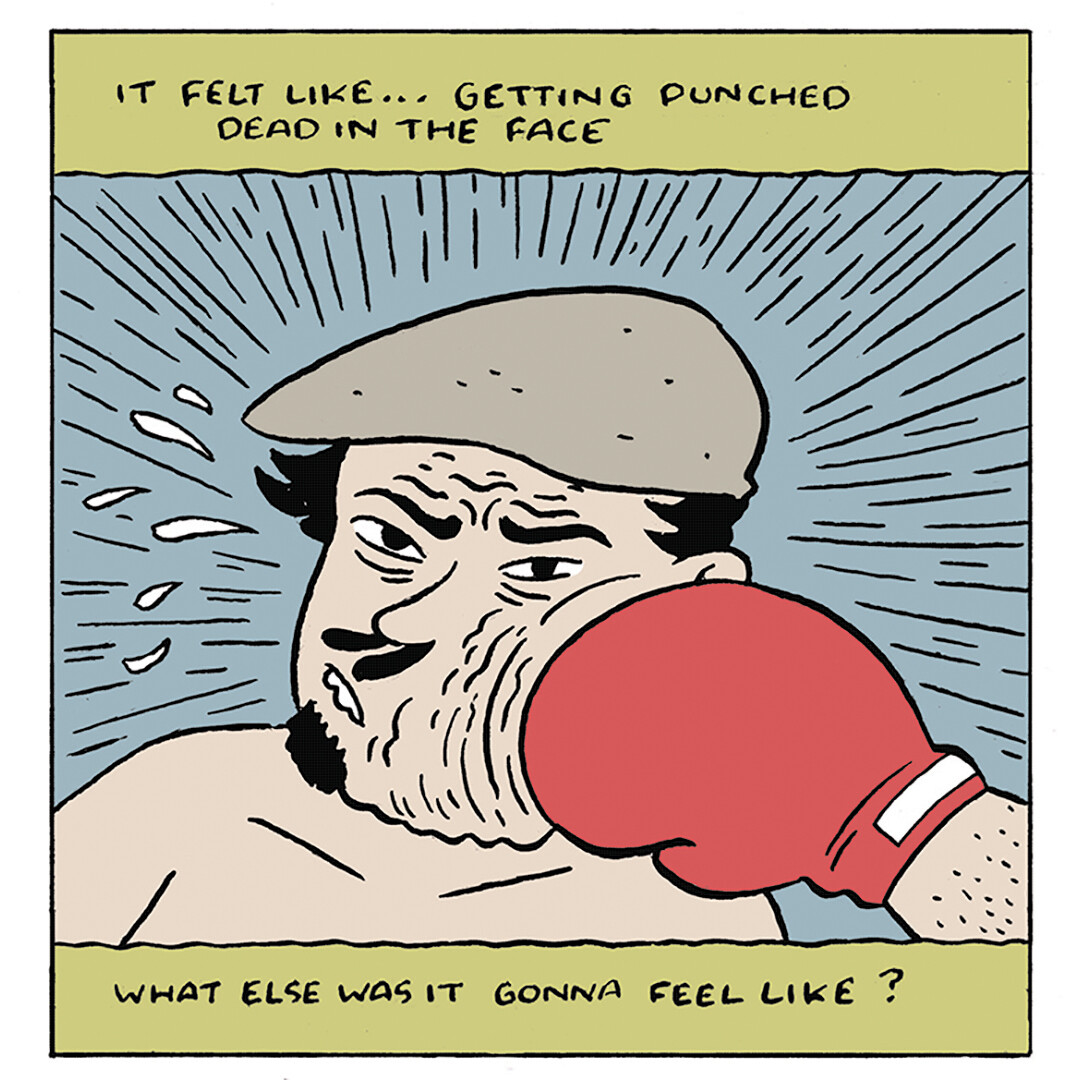
To be sure, Baylis has written about personal things before, especially with regard to his relatives. This issue feels a little different, though. In one story, he goes into greater detail about being bullied and talks about learning how to spar in a boxing gym. With Josh Pettinger giving the story just enough cartoony distance to soften the subject matter, Baylis talks about how literally learning how to take a punch in a boxing ring. In a series of increasingly-visceral panels where Baylis' face swells up with each blow received, he unleashes a torrent of grief: disease, death, job loss, and family crises over a relatively short span of time. A more naturalsitic approach would have been unbearable, but Pettinger nails this litany of blows landed, just as Baylis lays it out plainly. There's not a happy ending per se, but he ties it back into boxing by learning how to take a shot and keep moving. 

On a lighter night, strips about his son reading his comics and being absolutely delighted to see the word "shit," much to Baylis' consternation, is fun at his own expense, but he also clearly enjoys this dynamic. A strip where he helps a pregnant woman get to a hospital is given some soulful emotion when he realizes it's the place where his wife gave birth. The montage of images from the husband-wife duo of Kevin Colden and Miss Lasko-Gross is especially effective in portraying the profound gratitude he has for this place and that time. As with many of Baylis' comics, the whole tends to be greater than the sum of its parts, which is a testament to his editing and sequencing of his pieces. 

Tuesday, May 22, 2018

Fantagraphics: Bayer & Marra's Crime Destroyer #2

Josh Bayer's All-Time Comics line published by Fantagraphics has had its ups and downs. It's walked the narrow line between satire of hyper-violent, sexist comics and a celebration of same. Crime Destroyer #2 is mostly a Benjamin Marra production, with co-scripting by Bayer. It has the usual Marra beats, only some of the inherent ridiculousness of the character (like two Black Power fists acting as epaulets on his uniform) pulls away from Marra's usual deadpan delivery. It eventually answers the question: what if Ben Marra wrote Batman?

The issue begins with the titular character barging in on a villain named P.S.Y.C.H.O., a crazy nihilist type not unlike the Joker. The story explores the way vigilantism might actually play out, as he prevents the execution of judges by shooting the villain. They are outraged that he took the law into his own hands, before he reassured them that he used rubber bullets to stun him. When Crime Destroyer takes the villain to police headquarters, the by-the-book commissioner orders the villain to be freed and CD to be arrested, saying, "The law demands not justice--but order..." Marra hits on a sensitive political topic in a blunt manner, as the "Blue Lives Matter" mantra and the unwillingness of good cops to hold bad cops accountable for their actions is precisely about order over justice. It's also the polar opposite of what usually happens to super-heroes in these kinds of stories, as they become sort of unofficial members of the police department.

Marra and Bayer go straight for the throat again and again. The P.S.Y.C.H.O. kidnaps the commissioner's adult daughter after he's freed, prompting Crime Destroyer's only ally left to call him to help rescue her. He finds the villain, dispatches his muscle and then shoots him in the back with a real bullet as he runs away. CD then finishes the job by throwing him over a ledge--or does he? There's a villainous intervention by the Big Bad of the ATC line, Raingod, leading to an ending out of an old Steranko issue of Captain America. The comic's satirical elements are in many ways in conflict with its campier aspects, a frequent problem with superhero comics in general. Marra's stiff, 80s-emulating art really does make it look like a relic from another era, especially since veteran letterer Rick Parker contributed to this issue. The overall effect is somewhere betwixt and between. It doesn't work as light entertainment, but the characters are too thin to really work on a more sophisticated satirical level. There's a lot that's interesting about this comic, but its dissonant tone makes it disposable.

Tuesday, March 20, 2018

All-Time Comics: Blind Justice #2

In some respects, Josh Bayer getting Fantagraphics to publish his line of 80s throwback superhero comics may have been a bad thing for the project. It put a sheen of respectability on a project that was inherently bizarre and trashy. Indeed, it's odd that these are now Bayer's best-known comics, considering how much better his Raw Power and Theth series are. They also trade in on superhero tropes but from a completely different perspective, incorporating the juvenile aspects of reading them as part of the experience and warping them through Bayer's "cover versions" of obscure comics. Bayer's idea to mix alternative cartoonists with older mainstream cartoonists was an interesting one in theory, but there have been a lot of hiccups along the way. Indeed, the first issue of Blind Justice, to be penciled by Rich Buckler and his son, is one of the most incoherent comics I've ever read.

The over-the-top violence and misogynistic elements of the other All-Time comics, combined with the fact that the entire first wave was done by men, made them an easy target for criticism. Bayer's attempt to combine frequently nihilistic and raw 80s comics with the dumb ultraviolence of 80s cinema as a kind of goof removed both Bayer's own satirical viewpoint as well as artists like Ben Marra, whose work walks a fine line between satire and sexism. The character Justice is in the tradition of inexorable, intelligent, vengeance-seeking crusaders. The twist is that his secret identity is that of a unresponsive cranial injury victim living in a ward. When he hears about crime, he builds himself armor out of things like old newspapers and phone books, cobbles together a club, and looks like a bulky, bandaged figure in a suit. Having a hero literally built out of decay and newsprint is a fun metaphor, especially one as single-minded as an avenging Steve Ditko character.

The second issue follows a psychopathic killer who enters a home and asks "Hey buddies...who wants to lay down and make this easier for me? Who wants to lay down on my altar?" The killer, named Miller, is a kind of goof on Bayer's version of G. Gordon Liddy, ranting about raw power and viewing killing as a part of nature, that he exists to eliminate weaker species. Of course, he's gone rogue from a typically evil corporation. The first big action piece is Justice infiltrating the company to get information and escaping from a small army of guards. The clever thing about the storytelling here is Justice essentially bullshitting his way through his enemies with a combination of trickery and outrageous confidence, as he proceeds as though he's invincible even though he has no powers. The same was true for his showdown with Miller, except this time the villain saw through the disguise but underestimated Justice's cleverness and relentlessness.

The story, while violent, actually tracks quite nicely. Part of this is due to the unlikely but highly efficient art team of Noah Van Sciver and Al Milgrom as penciler and inker, respectively. Van Sciver goes to town with all sorts of weird page grids and formal oddities, like the bottom of a panel "giving out" underneath a punk's foot. Milgrom's inks essentially smooth Van Sciver out a bit, adding a bit of fluidity to fight scenes, while retaining the essential character of Van Sciver's work. Milgrom was the essence of the meat-and-potatoes Marvel inker and penciler who could work super fast and tell a story, even if the art itself wasn't flashy or attractive. The eccentric coloring job by Paul Lyons and Jason T. Miles (whose work is about as far away from this as one can imagine) only increased the weirdness of the book, as Miller was purple, Justice's shirt was yellow, and the sky during the showdown ranged between yellow, orange and red. The use of color was so deliberate, yet they kept it the same four-color flat colors of early 80s comics in order to duplicate that atmosphere, only the sheer wonkiness of it served to remind the reader of the comic book essence of the proceedings. It was meant to be anything but realistic and a little bit ugly and weird as well. It feels like Bayer also really nailed the tone of this comic in a way he hadn't in other All-Time issues. I have a feeling that the second run of All Time Comics will wind up being much more interesting in the first, especially with comics drawn by Gabrielle Bell and Julia Grfoerer.

Wednesday, November 30, 2016

Minis: The Yeah Dude Comics Box

Philadelphia's Pat Aulisio has been steadily publishing his own work as well as the work of others for quite a while. The beautifully constructed cardboard box that houses the Yeah Dude Comics mini-sampler is quite the attention-getter for a variety of comics. Aulisio essentially constructed a portable mini-library for these comics.

Most of them are very short and raw. Going in order of the table of contents, Josh Bayer leads off with Hot Desert Fever. It's one of his riffs on Sylvester Stallone and Stan Lee, as he imagines Stallone desperately wanting to write comic books like Lee. The resulting Human Torch story is a classic Bayer parody: altered character design (the Torch wears a helmet and carries a gas can), scatological humor, and visceral violence. Bayer's ability to fully inhabit the minds of these hyper-masculine, ridiculous characters and somehow make them come alive on the page is one of his greatest talents. Even in a story as absurd as this one, where Stallone has a butler that he names as Jarvis or Alfred, depending on the panel, and where he grows a tiny version of himself as Rocky to give him advice and encouragement, Bayer's always working within an internal set of logical rules.

Ian Harker's Face Force is a parody of 90s era Image Comics, with Rob Liefeld in particular being a touchstone. Nothing much actually happens in this comic, which makes it a particularly apt satire. McDonald's National Cemetary (sic), by Michael Gerkovich, is a series of strange images and clip art surrounding the idea of McDonald's going back to ancient Egypt, and to imagine what one would find if a site was excavated. Some of them riff off McDonald's iconography, like a Hamburglar looking through a telescope or a pharaoh having Ronald McDonald makeup on. The actual images match the meaningless absurdity of the concept itself, and Gerkovich gleefully runs with it. Josh Burggraf's International Geographic cleverly takes the you-are-there anthropological premise of the source material it's parodying with similar shots of nature, candid shots of "native" life, and the rituals from an alien world that are as baffling to the reader here as indigenous societies are to western societies. Burggraf's skill as an illustrator sells the joke, which is short enough to not outstay its welcome.        
         
Aulisio's Diabolik! is a parody of the Italian anti-hero, and he nails the way the narrative in the comic spells everything out. Getting pushed aside by his girlfriend Eva was also amusing in the way he puts everything in annoyingly modern speech patterns. The use of shadows and effects like zip-a-tone also made it reminiscent of its source material. Tara Booth's Daily Routine reminded me a lot of Jerry Smith's Rattletrap: extremely crudely-drawn comics, printed at tiny size, that hilariously and disgustingly address quotidian issues. Booth holds absolutely nothing back, like an early strip where she's over at a friends' place, falls asleep on her couch and accidentally urinates on it while asleep. When she wakes up, she leaves as fast as possible, as the caption "Run away from pee couch" indicated with a combination of shame and glee. Booth isn't afraid to get absurd or exaggerated, like in her strip where her face resembles two eggs and bacon, another where her dog licked her face off, and a truly disgusting entry where she gives birth to a "food baby". The cheery wave the food baby gives is what puts the strip over the top. There's an essential sweetness to these strips despite the frequently disgusting and scatological subject matter, and that sweetness ties in to her willingness to confront issues that normally are couched in terms of shame. She forgives herself and allows herself to be human, and that shines on every scrawled page.

Issue one of Box Brown's Softcore is something I have reviewed elsewhere, Skuds McKinley's Korgok is straight-up, visceral sword-and-sorcery. After an epic-establishing introduction, the actual comic is all highly-detailed violence. Keenan Marshall Keller's The Goiter #1 is another standout in this collection. Keller's work is not unlike Ben Marra's in that he uses hyperviolent and exaggerated situations for humorous intent, only that humor is bone-dry and at times indistinguishable from the actual genre comics and movies that he is paying homage to. In this case, Keller starts out doing a story about stoners and transforms it into a supernatural/horror story, as a young man who's working for an elderly woman hears a voice coming from the enormous tumor on her head. Keller leaves open the possibility that the young man is insane & hallucinating, which makes the scene where he "frees" the tumor by cutting it off, leaving her body spurting blood, all the more disturbing (and yet hilarious because of its ridiculous nature). Keller goes over the top in his figure work, deliberately overdrawing and cluttering up his page in an effort to keep the reader off-balance.

Finally, Erika Davidson's enigmatic Hadaka is a dreamy, surreal version of the Japanese festival where a minimal amount of clothing is worn. All the figures here are women, as they walk into rooms filled with or filled up by various women's erogenous zones. It's a brief mini whose mission seems to have been getting down those images on paper, of putting something that came from dream logic and fantasy and making it partially tangible. Thomas Toye's Entering A Room Full Of People is another visceral horror story, this time involving a frightening, serpentine home intruder who encounters a voracious plant that has killed the family living in the home. This almost entirely silent comic is typical of the works found in this box: rough, visceral, iconoclastic, visually distinctive, uncompromising and entertaining. The actual quality of each comic varies, as does its ability to sustain interest after a single read, but this was a great sample of a particular kind of comics aesthetic that a number of artists are currently pursuing.

Tuesday, May 17, 2016

Josh Bayer Week: Anthologies and Collaborations

Bayer is a comics educator at Parsons in addition to being a prolific cartoonist. Apart from being a teacher, he's been a long-time believer in collaborating on comics. His most frequent collaborator is Pat Aulisio, and while their comics often tend to wind up being visceral and scatological, there are occasions where something more interesting emerges.

An example of that is The Greater Good, which is a cousin to Birth Of Horror and Bayer's other comics examining the corporate and cultural history of mainstream comics. This one's all about the iconoclastic Steve Ditko, hard at work in his tiny New York apartment on his own strange comics, refusing to have anything to do with his old work. (This is all of course 100% true.) This story takes the idea of Stan Lee being a demonic creature a step further, making him one of the Lizard People who secretly rule the earth. The mix of outright fiction with truth that is stranger than fiction makes these stories so potent, as Ditko recounts being asked to work with Lee again on the hilarious ill-fated Ravage 2099 project. Aulisio and Bayer once again absolutely nail Lee's carney patter, while capturing Ditko's grim monotone in a figure with its few hairs sticking straight up. Things get worse when Mickey Mouse and Marvel track down Ditko, explaining to him that Marvel owns everything he's ever created, now and after his death, Steve Gerber's Destroyer Duck character (created to help Jack Kirby in his lawsuit against Marvel) comes on and explains how Ditko is now part of the machine again and how he'll continue to do so even after he's dead. Mickey is a steroidal, tattooed bully, carrying around Spider-Man on a chain. This is a nightmarish but hilarious comic that spoofs Ditko's Objectivist tendencies as well as Marvel's utter ruthlessness as a corporate entity.

Along the same lines is Marvel Comics Presents #6, from Drippy Bone Books. Working in a multi-color wash, Bayer contributes yet another story about characters and their creators. The anthology was formatted to mimic a Marvel anthology from the late 1980s and early 1990s, one where minor characters sometimes got spotlights. Bayer begins this story of a team-up of Moondragon, Howard the Duck, Deathlok the Demolisher, Rom, Mastodon, US Agent and the Living Zombie with a modified version of a Marvel classic: the team hanging out and relaxing, trading quips. Of course, Bayer puts that scenario in a strip club and adds a number of scatological jokes centered on Howard. Plastic Man comes from the great beyond to warn each of the characters of their fates, telling them that their creators died unexpectedly and young, were forced out of work, or otherwise driven to madness. Bayer then offers up a hilarious bit of self-critique at the end, as the strippers who were in the story complained about their roles and lack of dialog. Bayer faced some criticism over a strip where two female characters were beaten up because they were cartoonists (the "Stop Cartoonists" thing he did with Pat Aulisio), and I think paused for a moment to acknowledge that his work isn't exactly bristling with female characters.

Keenan Marshall Keller's story about Adam Warlock on acid was almost gilding the lily in terms of how trippy the character would become when it fell into Jim Starlin's hands, but it was still fun. Even funnier was Michael Hawkins story featuring the obscure character D-Man, as he experiences a weird and transcendent day and night with the emotion-manipulating Starfox. I also enjoyed the Bullpen Bulletins parody at the end of the book; these have been done before, but the sheer viciousness of this one made it notable.

Suspect Device is clearly one of Bayer's favorite projects. He sends an invitation to an artist he likes to take clipped-out panels from a classic comic strip, comic book or other art source. He then asks them to draw a strip that theoretically should start with a borrowed panel and end with one as well, with their own work in-between. At 120 pages, SD #2 was a slog to get through. The lack of variation from strip to strip (especially when Nancy and Garfield were the primary inspirations) made the book difficult to get through, though of course there were plenty of gems. There were even a few cartoonists who didn't go after obvious gross-out gags, like Dunja Jankovic. She used her trippy style to have Nancy look at a series of psychedelic patterns on a TV screen. One of the problems with the anthology is that many contributors took the assignment and created something quick and (usually) dirty. The better stories were by artists who took their time to create a coherent (if demented) storyline. like Mykl Sivak's disgusting but beautifully-drawn strip that even includes multiple panels from the original for comedic effect. Noah Van Sciver and Pat Moriarity contributed some of the funnier and clearer entries, while Elizabeth Bethea's gross-out strips were by far the most visceral yet intelligent. Bayer's own strips captured the energy and immediacy of the project in a way that most contributors couldn't match.

SD #3 was trimmed back to a more manageable 70 pages, though that was still about 20 to 30 pages too many. Derf's political background was brought to bear in a 2013 shot at Donald Trump, while James T Stanton's smoothly-drawn strip involving Wimpy and Popeye was puerile but utterly hilarious, thanks to the execution and commitment to the concept of Wimpy fellating a hamburger. Sasha Steinberg brought in his interest in drag in a perfect mimicry of Harold Gray to portray a trans person in combat with Orphan Annie. Steinberg's mastery of Gray's dialog and modern shade-throwing made this a top-notch entry. Sophie Goldstein's ability to use Gray's hatching style made her strip about the ontological underpinnings of the universe ("it's Popeyes all the way down!") was another strong laugh. Adrian Pijoan's "Death shroud" strip made perfect use of the idea of Annie as a sort of "forbidden fruit". Overall, this was a tighter issue that the artists seemed to take more seriously.

Finally, SD #4 opened things up with more Annie, Alley Oop, the Phantom and these amazing Russian tattoo drawings. Mixing a greater variety of characters made the results more varied, with Jason Little's full-color opener blending the three in a sort of bizarre Tijuana Bible. Ben Marra ran with that idea, with the Phantom finding his girlfriend with the demons from the tattoo drawings in a compromising position. Marra's ability to mimic the original look and feel of the strip was once again key to the success. Bethea's strip about the Phantom being a schoolteacher for Annie had the resonance of a Gerald Jablonski strip in its absurdity, while the sheer penciling virtuosity of Mark Burt was another standout. Noah Van Sciver turned in another solid bit of fun, turning the Russian tattoo demons into Communists out to get the Phantom. While the default setting for many cartoonists was to go down a Tijuana Bible-style path mixed in with extreme violence, and there are only so many variations on that idea, the cartoonists who took their time with the strips at least made such ideas funny and well-executed. On occasion, like in Sasha Steinberg's submission in this issue, the borrowed images led to something much more personal. His strips worked off of the tattoo drawings and became statements about identity (sexual and otherwise).

It is the rare cartoonist that is as enthused about collaborating as they are in doing their own solo work. It's also rare to find a cartoonist who can appreciate aspects of mainstream work without fetishizing it as an object of childhood nostalgia, but rather critique its more hackneyed elements while celebrating what made it unusual. Bayer's eye as a teacher is present in all aspects of his work, as his fictional stories are backed up by research and his ability to zero in on precisely what makes a piece of comics art work allow him to incorporate multiple influences while still holding to his own aesthetic at all times. Bayer's style is unmistakable, whether he's covering a Marvel comic, drawing Nancy or drawing one of his own creations. Bayer's critique of commodification more than anything else is central to the punk aspect of his art, but don't mistake that critique for the actual work done by artists. That's one reason he worked with penciler Herb Trimpe before he died in a comic that will be published at a future date, along with inker Al Milgrom and letterer Rick Parker. While there's anger in Bayer's work, there's also a great deal of joy as well. That shows through in the enthusiasm he has for things like Suspect Device, but it also extends down to his students. I've seen some of his student work and have also seen him in action as a teacher, and his combination of enthusiasm, encouragement and extremely sharp tips on how to construct comics is infectious. I still feel like Bayer is only just starting to get warmed up, and while he's published a number of excellent comics, that his best work is ahead of him. You can see more at Bayer's own website.

Thursday, May 12, 2016

Josh Bayer Week: The Big Books

Today I'll be looking at what I consider to be the meat of Bayer's career: the comics featuring a quasi-autobiographical stand-in named Seth and the further adventures of G. Gordon Liddy in Raw Power 2. This is Bayer at his densest, most human and most complex as a storyteller.

ROM: Prison Riot is a sequel to that original ROM comic. The first part of the comic is another Bayer "cover version" of a Marvel comic, this time Rom 31-32. Bayer has a real eye for the weirder and more unsettling Marvel comics of the time, and while some think of Bill Mantlo as a plodder who wrote unremarkable comics, the truth is that his real instincts were fairly dark. Rom, a series based on a toy that Mantlo made his own personal playground as an ode to the paranoia of 1950s (and later 1970s) science-fiction, was about a cyborg from space who was hunting his enemies, a race of shape-shifting aliens who had infiltrated the earth. When one of them had a child with a human mother, he became an H.R. Geiger nightmare named Hybrid. In these issues, Hybrid pops up again and gets entangled with the mutants Rogue, Mystique and Destiny, who eventually wind up teaming up with Rom to stop the monster.

Bayer took those elements and reshaped the characters. Hybrid was now Mestasis (although I think he was looking for the word "metastasis", or cancer that has spread away from its primary site). Rogue was now a Wendy O. Williams lookalike, while Mystique became a dead ringer for Fletcher Hanks' Phantoma. This is a classic Bayer move, taking familiar characters and connecting them either with punk or else with a much older comics character. Apart from these stylistic changes, some dialog changes (much less exposition, much more dialog in actual vernacular that sounds like a real person would say), a few story details being condense and of course Bayer's own blocky, dense and grotesquely comic interpretation of the characters, the story unfolds pretty much like the original issues did. Details like Mestasis taking some convicts who happened upon his house and flaying the skin off their bodies or his plans to turn mutant women into "breeding sows" in his rape camps are straight from Mantlo in comics intended for children. (Comics Code approved!) Other details, like Mestasis tempting Rom with pleasures of the flesh, are also straight from Mantlo.

Bayer veers from an open page format with no panels to hand-drawn panels. Once again, he carefully employs a lot of negative space in order to let his drawings breathe a little and to make the otherwise denseness of his figures more legible in terms of their actions on the page. Bayer is interpreting the drawings of Sal Buscema here, a master storyteller in terms of pacing, panel-to-panel transitions and clarity, and he maintains these aspects of the original art while putting his own unique stamp. The backup story features Seth reading this issue of Rom in class as part of a larger drama involving his status as an outcast, his desperate desire to connect with others, and his anger at being rejected. When his teacher has her concert tickets stolen from her purse, Seth is immediately suspected and is cagey til the end and beyond, but that suspicion momentarily makes him popular--a fact that he understands and completely rejects. Seth may be a weirdo in some regards (wearing an outfit that mimics Rom's), but he's a normal kid in others (he wants to get laid), but one thing that's certainly true about him is his sense of integrity.

That carries over into Theth, an absolutely brutal account of Seth in school and in home, and the sheer desperation he feels at all times. The only plot hook here, and it's entirely a red herring, is that the story takes place around the same time that John Lennon was shot. That's simply something to hang the details of the story on, as Seth is alienated from his classmates, from his dad and step-mom (a truly loathsome character), from his little brother and from the culture at large. Unprovoked, he is savagely beaten by a fellow outcast classmate who insisted to his teacher that John Lennon was stabbed. After lying to his step-mom about not hanging out in the local drug story in order to read comics, she and his father burn his comics, wipe their asses with them and/or tear them up right in his face. Unlike the other comics that delved into the comics cover versions and had Seth's story as a framing device, this comic is all about Seth with comics as the framing device. It's funny to see Bayer's comedic touches, like referencing Charlie Brown when Seth sees the spinner rack of comics and says "Wotta beautiful gorey layout!!!"--a direct quote from Peanuts.

The dichotomy between Seth mostly being quiet in school and the agony he puts himself through at school is particularly acute, especially since it's obvious in the way Seth is portrayed in the story that he's dealing with anxiety disorder and ADHD. The obsessive nature of his anxiety, when he thinks the trees might be flames licking the house, is a huge clue. Also a giveaway is Seth's habit of laying with his head on the desk and knocking on it so that the vibration fills his head--this is classic sensory-seeking behavior. While it's never said out loud, this is a kid who needs understanding, redirection and treatment who receives abuse and scorn at home and in school. Only his fantasy life and sheer will power keeps him going, and the Rom "face mask" he wears is symbolic of that fantasy life keeping the world at bay. Here, the denseness of Bayer's hatching actually softens the blow of how brutal a read this is, as Bayer allows the reader the luxury of seeing drawings as drawings in addition to telling this gut-wrenching narrative.

Mr Incompleto begins with Seth reading an issue of the titular comic-book, whose guest star character, Zero Sum (Chance Alphax), would appear in Seth's reverie after he was beaten. Once again, Bayer selects a weird comic (Marvel Two-In-One #69, starring the Thing, written by Mark Gruenwald and drawn by Ron Wilson) and puts his own spin on it. He renames and slightly alters every character in the book, turning the original Guardians of the Galaxy into the Saturn Seven. Vance Astro (in the book, Chance Alphax) was an astronaut on a thousand-year mission to Alpha Centauri. The problem was that his body was in stasis, his mind accidentally woke up, causing him to go insane over and over again, along with triggering his mutant telekinetic powers. This issue involves him going back in time and desperately trying to convince his younger self not to become an astronaut.

This comic is all about loneliness and despair, along with the tragedy of loving an abusive parent. There's a threat thrown in as a mysterious fog encases the earth, which the Saturn Six think is Chance interfering with time but which later turns out to be young Chance ready to accept his powers early. Bayer actually improves and expands upon the story's original action, including the climax when future Chance confronts his father. Mr Incompleto himself is an affable if bizarre figure, with his chest having a cigar-chomping Jack Kirby face on it, his head covered by a sack, and a huge crucifix swinging around his neck. The character design here is a feast, as Bayer channels Kirby, Fletcher Hanks, Raymond Pettibon, Gary Panter, Mat Brinkman and more in drawing these blocky, chunky, scribbly characters who vibrate, ooze and pulse across the page. This is the comic where Bayer's energy really comes alive in terms of the action on the page itself, where the result isn't so much satire as it is reinterpretation.

Finally, Raw Power 2 lives up to the original both in terms of its satirical qualities and the intense nature of his sometimes disturbing images. It follows Terry (the Cat Man) ten years after he's sent to prison for his brutal crimes, as well as a now-faded G.Gordon Liddy. While Terry at first vows to try to to eschew violence and become a new man, it doesn't take long for the unforgiving world he's entered back into to cause him to snap. Meanwhile, Liddy, whose books Terry studied closely, denies any responsibility as he sees himself retired from trying to do anything for his version of the American dream. After Terry snaps, Liddy hunts him down just as Terry was resigned to his fate. Bayer is clearly fascinated by ideologues so devoted to their principles that they are willing to engage in almost casual violence to defend them. The dogma is so strong and black & white that for minds like Liddy and Terry, empirical evidence is no longer one of their concerns. What Bayer also makes stunningly clear is that for all of the patriotic rhetoric that Liddy spits and all of the righteous paranoid lunacy that Terry espouses, Liddy views Terry as part of the problem and doesn't understand that his own methods are identical to Terry's. And for all the flowery language, that method is entirely Hobbesian in nature: Might Makes Right. The strong should rule the weak.

Bayer also advances the idea that for all Liddy's bravado about the methods he used to overcome his fears like lightning and rats (look it up!), he was still afraid of dogs and couldn't fool them. Liddy's machismo and bluster was just an attempt to wash the stink of fear that he could never relinquish, just as his violent ideology was a sign of a lack of imagination and of total dysfunction. Just as Terry might have reached a point where he was willing to accept that his ideology might be completely misguided, his idol snuffed out his life--and Terry never even knew it. But Liddy was still living in fear and as Bayer surmises, knew that fact all too well.

Visually, this is Bayer's best work to date. The comics and cultural references fly fast and furious. When Terry is walking the yard, one guard refers to him by his inmate number and says, "Good ol' 0506...How I hate him", which is of course a reference to the very first Peanuts strip. When someone whacks Terry with a brick, it's done in the same elongated and exaggerated style as George Herriman's Krazy Kat. Herriman's combo of an extremely loose line and energetic layout has clearly been an influence on Bayer as well. When first Terry and then Liddy scale a tall ride at Coney Island, that's straight out of King Kong. Bayer also throws in a new character, Bile Duct, who is based on a child star who essentially dropped out of society. The final images are from yet another "cover version", as Mr Incompleto battles Reflectivix (Bayer goofs and refers to him once by the actual character's name, the Sphinx), a battle of wills that Mr Incompleto is able to stay in because of his sheer decency (a trait he shares with another important Bayer character in Rom), though ultimately he doesn't emerge entirely victorious. Reflectivix's obsession with power and immortality is not unlike that of Liddy's, and both are portrayed ultimately as pathetic characters with pointless existences. It'll be interesting to see if Liddy winds up getting an epilogue. Raw Power 2 is so effective because for all the over-the-top violence in Bayer's other work, it's the sense that the violence here means something makes it far more harrowing and disturbing. This isn't just an artist blowing off some steam on paper, but a thinking satirist taking ideologies to their logical conclusion and showing just how inhumane they can be.


Wednesday, May 11, 2016

Josh Bayer Week: Mini Madness

In-between other projects, the tireless Bayer releases mini after mini, as though he's trying to get his ideas on paper as quickly as possible.

Bloggers #1 takes Bayer's own Suspect Device technique and puts familiar cartoon characters into violent, strange and demented scenarios. In each of the stories, blogging is somehow involved as a mock panacea. The result is something both totally absurd and pointedly critical at the narcissism that can be involved in airing one's thoughts on the internet. For example, Magneto encourages the Blob to "encase [your feelings] in the margins of your blog", to show humans the way. It's a ridiculous premise made even sillier with Bayer's blocky figures taking up the page. "Dawn of the Blogger" sees Little Orphan Annie running from the giant head of Fred Flintstone, which is disintegrating fellow cartoon characters with death rays shot from his eyes. Annie pauses and gets Rosie the Robot to turn into a computer so she can blog about the event. Garfield becomes a homicidal killer and teams up with Richard Nixon; Gargamel walks away from a bad date with Ziggy to update his alchemy blog; the Green Arrow gets a job at McDonald's to be a real "man of the people", slits Ronald McDonald's throat and then proclaims "I must blog about this to make it right". In each example, blogging is set up as being "the answer", yet is always portrayed as a masturbatory activity that only allows the author to stroke their own ego--precisely BECAUSE the bloggers in question overinflate their own importance. The use of orange as a spot color livens up the most recent edition of this comic (there was an earlier black & white version), giving each strip a garishly lurid appeal.

Transformer, Don't Look Back and Hand of Blood are short, hand-made minis made on card stock. Written in the same rapid, loose scrawl as Bloggers, Transformer stars Sylvester Stallone facing a crisis: he wants to become a cartoonist. He goes to see Stan Lee (played by Richard Nixon--a hilariously awesome caricature by Bayer), who advises Stallone to become a car. Having "transformed", Lee drives the Stallone/car around, sideswiping pedestrians until he spots John Rambo. He urges Stallone to kill his creation, but the Stallone car swerves and crashes, though "Stan Lee never dies" and he escapes. Bayer often uses one of two catchphrases in his works: "Comics are the enemy" and "Comics are the answer". Both aphorisms are satirical and knowing in their absolutism, which is why he uses them almost interchangeably. The idea that a famous actor like Stallone would go to any lengths to be a cartoonist is ridiculous, and Bayer takes it a few steps further with the visceral quality of the events he depicts.

Hand of Blood and Don't Look Back also use that Suspect Device prompt and immediately twist the initial visual premise of a strip into something violent and weird. Don't Look Back stars Little Orphan Annie pulling out a switchblade and slitting the throat of a man who worshipped former President Lyndon Johnson. Hand of Blood starts with a miner upbraiding Nixon for getting bloody fingerprints on the Declaration of Independence, and Nixon responding by defecating all over them. Neither of these comics is as interesting as Transformer, as the initial inspiration provides little in the way of actual story structure.


Transformer Two finds Stallone at it again, this time getting Rocky to grow out of his body to offer encouragement and aid when attacked by the Joker. This is a good example of a Bayer comic as a sort of fever dream: mashing together characters and ideas in ways that don't actually make any sense outside of that fevered reality. There's a hilarious segue as bizarre versions of the Human Torch and Spider-Man fight and and hang out, including Spider-Man defecating on the Torch. (Shitting and cutting are two acts one is most likely to see in a Bayer satire.) It's revealed that this was a Stallone production, and Stallone fights to his last breath to defend himself against the Joker, who's trying to discourage him from doing a comic. The comic is an over-the-top satire of the artist's struggle to create but also a sympathetic portrayal of someone ill-suited to do something in the arts, yet who tries to do it anyway. Bayer's approach inevitably involves someone getting cut, beaten, pounded, shat upon or being kidnapped. His reads are as harrowing as they are fun, and certainly not to every taste, but the sheer energy and craft in each panel is always compelling, in part because he now has much better control over the vision we had seen his earlier works.

Birth of Horror was published as part of Ryan Standfest's Rotland Dreadfuls series, with an earlier version self-published by Bayer with a vellum cover. If the other minis on this list are goof-offs and ways for Bayer to have fun on the page while dropping a few satirical bombs, Birth of Horror is a fully-formed and multi-layered work of social satire that not only brutally exposes the exploitative nature of Stan Lee's relationship with his artists, but the ways in which the wider culture accepts and then rejects certain kinds of entertainment. In this case, it's horror comics, and Lee in the 50s turns to one of his ace creators, Bill Everett (creator of the Sub-Mariner and depicted here as a wizard) for something new. Lee is eventually revealed to be a blood-seeking demon (the line, "Face it tiger, you've burst the blood clot" had me laughing out loud) but Bayer never has him abandoning his familiar carnival barker patter as he drains Everett of his essence and steals the idea for Ghost Rider from former copy boy Gary Friedrich. The comic shifts from the 1950s, when horror was in vogue, to the 1970s, when Comics Code restrictions relaxed and Marvel responded with a huge horror/monster line in response to growing public demand. As Lee himself notes in the comic, "Horror books are always ready to proliferate during war and postwar years. Trust me, there will be a vampire and zombie by the time the twentieth century reaches its bloody apex!"

Bayer could write an entire book on the history of mainstream comics and culture by way of these stories. He wrote about the circumstances and history around horror comics using horror tropes, and it's significant that he wrote about Marvel (and Lee's) reaction as an observer rather than focus on EC Comics, which was essentially reduced to irrelevance after horror comics were shut down after the anti-comics hearings of the 1950s. That story has been told enough that Bayer was more interested in seeing what happened in the margins, like the horror expansion at Marvel being the polar opposite of the sort of comics that Jack Kirby created as Marvel's identity. The comic ends with Rom coming on the scene, slipping into the conversation as the series began as a 1950s sci-fi/horror homage but drawing on the Kirby tradition of having a hero with absolutely pure motives. He then proceeds to kill every monster there, including Lee. That's a bit of cheeky wish fulfillment by Bayer, especially as Rom's formal speech patterns clashed against Lee becoming a flashy hipster. The story is a visual tour-de-force, as Bayer's ability to depict horror, gore and viscera went hand-in-hand with the carefully constructed and constantly-shifting figure of Lee. The dense hatching of Bayer is here, to be sure, but he tightens up his figures and opens up every panel to let it breathe, even while he's pounding the reader with his visuals.  The figure of Lee here represents the actual man, of course, but it also represents the larger corporate exploitation of horror images for cheap shocks and a cheap buck--so it's no surprise that Stan finds a kindred spirit when he meets the young Glenn Danzig. Lee is every carnival barker, every executive, every corporate entity trying to find product and grinding down wizards and copyboys with big dreams in the process.

Tuesday, May 10, 2016

Josh Bayer Week: Drawings and Old Stuff

One of the things I like best about Josh Bayer is that despite his talent, he's worked hard at getting better in public. Moreover, he's furiously cycled through influences and then moved on to more challenging works.

In 2010, for example, Bayer unearthed some comics he did in 2010 five years later and decided to publish them. One can see his skill as a cartoonist on display in these comics, with his rock-solid storytelling skills working in concert with total visual anarchy. In the first story, where Little Orphan Annie is talking to Ignatz the Mouse about needing to relieve herself, things quickly get disgusting in an over-the-top manner. Krazy Kat is nailed to a cross as Ignatz finds new ways to torture him, with a shocking orange used as highly effective spot color. Another story literally features a pissing contest between a man and a semi-anthropomorphic dog that winds up leading to a decapitation. It's all very silly airing of the id and possibly some anger, but the visceral quality of the drawing makes it worth a look. Bayer would get better at using negative space later on, though.

Drawings You Want, is a collection of Kickstarter rewards that Bayer drew for those who contributed to an issue of Suspect Device, and it's hilarious. Some of the requests were weird ("Rom In A Nightie"), some of them were gross ("Thor sodomizing Rom") and some were quite sweet ("Jimmy Olsen Dancing With Hopey."). Whatever the specifications, Bayer truly committed to each request, even changing line weights for some of the drawings. Still, the drawings I liked best were the ones with big, blocky figures, like one of Rom and Popeye teaming up. What's also clear is that Bayer either knew a lot about each subject or wasn't afraid to do some research, because the amount of detail in each drawing was simply remarkable, capturing the essence of each subject.

The most interesting older work was simply titled Art. This 2007 comic shows Bayer's drawing skills at their usual high level, though his page layout was quite a bit more cramped in some places. Still, I was amazed at Bayer's ambitiousness in this 20-page broadsheet. Two things about Bayer's work that aren't immediately apparent is that he's a sharp social satirist and does a tremendous amount of research finding facts about things that are stranger than fiction. Art is a satire about Bob Dylan, renaming the character Led Bellows and combining parts of his story with that of legends surrounding the blues guitarist Robert Johnson. Bayer clearly did a lot of research on Dylan, whose early career was based on shifting identities and calculated fabrications. Here, Bayer first focuses on the young "Led" from the 1960s who enjoyed fucking with reporters and giving enigmatic non-answers. That's really just a set-up for what follows, establishing Led as an arrogant figure above it all, one who inspired fervent fans to follow his every utterance while causing others to absolutely loathe him.

From there, Bayer switches to 1977, after Led's divorce, when he faces a dark night of the soul. Combining a telephone interview where Led is forced to face his origins, his fears and inner emptiness, he breaks down in front of a mirror, begging to be saved. That's interrupted by an old musician friend of his telling the real story (a long-time preoccupation for many who knew Dylan in the old days), swearing that Led must have sold his soul to the devil at the crossroads, ala Johnson. The dialogue between Led and the Devil is funny and pointed, as both take turns twisting around the other's words. From there, we follow the experiences of a young Led fanatic who had to know if that story was true, and essentially gave up his life following him around. Bayer's character design is remarkable here, as the young fan's hair is sparse and spiky, looking like a sort of human cactus. The old singer friend has a huge, bushy mustache and sunken eyes, indicating that he has his own agenda to spin. Finally, the story of Led and his fan coincide to three years later, when Led (much like Dylan) has become a born-again Christian. This phase of Dylan's life lasted just a few years (and spanned three albums) and is seen now as a sort of interregnum, But he (and Led) were certainly all in, even as Bayer depicts him as having doubts even then about his role in spreading the message, with certain religious leaders wanting to use him as a means of converting millions into believers. Contrast that to the young fan, who is his own kind of believer, reimagining the "foot of pride" that the preacher talked about into a vision of a foot literally smashing down. (And of course, "Foot of Pride" was an unreleased Dylan track.) On the back, Bayer prints some venomous Christian-era quotes from Dylan in concert as a way of asserting just how weird the truth of this situation was. The comic is all about false idols, false prophets, and the absurdity of looking for signs to reaffirm one's beliefs. At the same time, it's also incredibly sympathetic to all believers, portraying them as the human beings they really are.

Monday, May 9, 2016

Josh Bayer Week: Punk As Fuck

Kicking off Josh Bayer week, below is a reprint of an article I wrote for Studygroup Magazine #2:
******

Reading a Josh Bayer comic for the first time is an electrifying experience. His manic, scrawled art overwhelms the eye at first glance, daring you to immerse yourself in the image until the moment arrives that reveals a rock-solid sense of structure underlying all of its madness. His figurework can be as alien as it is familiar, the work of an artist who has clearly spent hours studying a wide variety of comics art, merging any number of disparate influences in a single page. Bayer effectively captures the energy of a comic drawn by a ten-year-old boy. One can sense the immediacy of each drawing and the simple urge to draw page after page, the images exploding out of his pen. That immediacy, even intimacy, is shored up by Bayer's obvious foundational skill and craft. This visual craziness is paired up with a probing social and political consciousness; it's not just a simple expression of his id like S. Clay Wilson or Victor Cayro. Bayer explores the space between nihilistic/gleeful violence, scatological humor and personal/political commentary. He's not always successful in maintaining a balance, but when he gets it right, the result is some of the most interesting comics work of the past fifteen years.

Bayer's alignment with punk is obvious, given the DIY nature of his comics and his keen political consciousness. there's another element at work here, however: punk's ability to reach out to the dispossessed, the disregarded and the disposable. Punk finds and embraces inspiration in all sorts of sources and, in its purest incarnation, shuns corporate manipulation. This is easier said than done, give the way that corporate America manages to co-opt everything, punk included, but all it takes is awareness, attitude and the understanding that punk is not so much a pose or a fashion statement as it is a way of looking at the world and living one's life. Bayer's ability to create meaning out of 1980s Marvel comic books is an example of taking a long-forgotten comic (Rom #29), reinterpreting it, and then following it up with an intense and personal story about a disaffected little kid obsessed with superhero comics.

ROM starts with the artist, his face obscured by a dark scrawl, furiously attempting to come up with a name for this very project. the reader gets a sese of the artists's impatience and frustration in trying to do something that's obviously important to him, until he goes the most direct route: simply calling his book ROM and telling the reader that it's an adaptation of a comic written by Bill Mantlo and drawn by Sal Buscema. Bayer tells the reader a bit of Mantlo's sad story later in the book; he quit comics, became an attorney specializing in social justice and got hit by a car while jogging. He is alive but requires around-the-clock care. Mantlo was a marvel workhorse in the late 70s and early 80s, writing as many as four titles a month and filling in on others. Like many writers of the era, he had a tendency to overwrite, with much of his prose turning out rather purple. At the same time, he was obsessed with social justice in his stories, even if he obviously felt the odds were stacked against people trying to do the right thing. As a result, his stories always had a grim, fatalistic quality. Rom was a comic based on a toy, which quickly became Mantlos's pet project--a fable about paranoia that later transitioned into an epic about how war inevitably scars all its participants. Buscema drew the initial run, and the pairing was fitting given his status as Marvel's workhorse artist. While known for his speed and the stiffness of his characters' body language, he's also a tremendous storyteller with a powerful sense of anatomy. One was never confused about what was happening in a Sal Buscema-drawn comic book, even if the art wasn't dazzling by the standards of the time.

Bayer internalizes the solidity of that structure and storytelling in his comic; the quality of his line is obviously influenced by Gary Panter and Robert Crumb, but Buscema's figurework and storytelling sense shine through. That said, Bayer's art is so idiosyncratic that even when interpreting a specific artist's work, his own eccentricities pop up on every page. The silver, alien Spaceknight Rom here is a chunky,  hulking figure frequently hunched over with sadness and resignation. The story is a typically downbeat Mantlo tale: Rom, after burying one of his fellow Spaceknights, flies off to a small town with a strange radiation signature, only to find a family dying of radiation poisoning. They were accidentally irradiated by an old Hulk villain named The Missing Link, who was lurking down in the mine because of the guilt he felt in accidentally getting them sick after being accepted by them. After an obligatory fight, Rom manages to cure the townsfolk and the Link himself, who had been adopted by his family. They blamed it all on the Hulk, saying it was his radiation that caused the sickness. Bayer infuses this story with skewed perspectives, grotesque figure distortions, odd beats of humor and a rawness to the proceedings that fit snugly with the original story but adds a filthy, underground quality. He gently mocks some of the dialogue by slapping the word "Exposition" on top of it, but the essence of the story remains the same.

ROM is an interesting staging ground for the true masterpiece of his young career, Raw Power. Published by Box Brown's Retrofit Comics, Raw Power continues to mine '80s Marvel Comics in intriguing ways, from its cover announcing that it's a "King Size Retrofit Comics Annual" to its bizarre interpolation of an issue of the New Universe comic D.P. 7. A short-lived line that was supposed to present a more realistic shared universe that was "the world outside your window," the New Universe was a sales fiasco and was cancelled within a few years. Raw Power, deriving its title from the classic Stooges record, is a fascinating polemic against fascism and its ue of power to shape consensus reality. The cover images of a hulking G. Gordon Liddy (called G.G. Liddy in this comic-- a knowing wink to nihilistic musician G.G. Allin, I would guess) slashing his chest with glass a la Iggy Pop is both hilarious and entirely in line with Liddy's bizarre philosophy. The comic satirizes Liddy scathingly, imagining a scenario where this real-life super-villain might have been called upon by president Jimmy Carter to help eradicate the threat of punk rock, an idea that may well have been rooted in truth. The parallel narrative involves a brutish admirer of Liddy's named Terry who dons a cat mask and beats up criminals and punk rockers. He's a lunatic who witnessed his parents murdered by "punks" as a child (the classic Batman origin), who deludes himself into thinking that his case worker is his girlfriend as she tries to get to the heart of his pathology. One woman who is victimized by Cat-Man takes refuge in a squat and is given a violent comic-book to read by one of its residents, an offer she refuses. It turns out to be a reinterpretation of D.P. 7, featuring one of Bayer's characters in the lead role, and the reader is given a chance to see what this comic's about.
                                                                                                                        
Most of what Liddy says really does come from his own writing, giving Raw Power a "truth is stranger than fiction" quality. Similarly, the D.P. 7 comic is quite faithful to the original source, an exceptionally weird and frequently disquieting series by oddball writer Mark Gruenwald and straight-ahead artist Paul Ryan. Once again, Bayer uses an otherwise undistinguished penciler's storytelling fundamentals and warps them.

The original story involves a young "paranormal" runaway who gets beaten up by a gang of bikers. His power allows him to create a highly corrosive acid from his bodily fluids. He gets taken in by a creepy barmaid and nursed back to health; just as she's about to seduce him, his acid tongue burns her and she freaks out. Despondent about never being able to have sex with a woman without scarring her, he returns to the bar to wreak havoc and attempts suicide to no avail. Yes, this was a Marvel comic presumably aimed at children. If Gruenwald had been born twenty years later, he may well have followed a career track not unlike Bayer or Michael DeForge.

In his reinterpretation, Bayer merely exaggerates the action a bit and adds a touch of the grotesque. It dovetails with the rest of the issue's denunciation of both fascism and nihilism, taking the tragic origin stories of their protagonists and correctly reassessing these events as traumas that brutally twist a person's capacity to feel empathy. The effect is a powerful one, as Bayer himself sometimes seems to revel in the violent images he produces while constantly compelling readers to quest what they're seeing and what impact these violent acts have.

Bayer really cuts loose in Raw Power after getting his feet wet with ROM. The cover is an obvious tribute to Panter, but the interior contents are a stunning mish-mash of styles, varying not only from page-to-page but panel-to-panel. Some figures are constructed with an almost fragile line and Crumb-like hatching. In the next panel the line weight might change dramatically to reflect a fight scene, hearkening back to Floyd Gottfredson-style speed lines and raggedly thick black lines. The way Bayer stages the particular brutality of his fight scenes reminds me a bit of Chester Gould. Bayer's storytelling never  lets the reader forget that this is ink on paper even as the story sucks in the reader.

There's a constant sense of push-and-pull in reading Bayer: his discordant style forces the eye away, but his strikingly readable layouts lure the eye back in; similarly, he alienates the reader with repulsive protagonists like Liddy and the Catman, yet he draws the reader back with the forcefulness of their viewpoints, daring them to try to identify with these characters (a classic Dan Clowes tactic). He challenges the reader to keep up with the story, despite a manic sloppiness in the art-- there are scratch-outs, misspellings and a certain lumpiness in the his figures and structures-- while rewarding the reader with the sheer energy on the page and his careful use of white space that allows his scribbly figures to breathe. The vibratory nature of those scribbles gives his figures a lurching, animated quality. Make no mistake: even with words crossed out and scribbles on the page, Bayer is careful to make his lettering highly legible and his layouts clear.

Bayer's id flows a bit more freely in Suspect Device, an anthology of Nancy-interpolated scenes that he edited, as well as Conon, a jam comic he did with Pat Aulisio. The latter is a minor work at best, a surreal spoof of barbarian comics whose title character pals around with a creature named Nixon, a duck wearing a Spider-Man mask. This one quickly devolves into the same set of sex 'n' shit jokes told repeatedly, as though Bayer and Aulisio kept trying to top each other only to find that they were just telling variations on the same joke.

Suspect Device is incredibly clever: a host of alt-cartoonists who specialize in the grotesque take specific Nancy panels and add their own narratives. Sam Henderson, Dane Martin and especially Tom Hart stand out with their stories, with Hart's tale of a post-apocalyptic Sluggo searching for Nancy being genuinely moving in an absurd manner. Bayer's own work here is a bit on the zany side, lacking the brains and humanity of his other comics but admirable in its total lack of restraint and feverish imagination. On the other hand, his story about '60s and '70s Marvel artist Herb Trimpe in Rub The Blood, the Rob Liefeld "tribute" broadsheet, is sad and touching while retaining the crazy energy and absurd imagery that is his trademark. Trimpe found it hard to get work in the '90s and so changed his style to more of a Lifefeldesque, hyperstylized Image comics look in order to fit in with the times and get third-tier jobs. Bayer imagines Trimpe as a dinosaur man, attacked by the likes of Shaft and other Liefeld characters, barely fending them off to hack out "the saddest comic ever made," as a little kid reading it observes.

Going back to the punk analogy, Bayer's "cover" versions of mainstream comics are analogous to Sid Vicious covering "My Way"; it's a way of emphasizing the rough edges of art smoothed out for public consumption. In his D.P. 7 cover, he heightens the nihilistic aspects of the original comic in telling the story of a teen whose powers make him miserable and suicidal. Bayer embraces the freedom of reinterpreting these comics entirely through his own lens, caring more about the emotional possibilities of the story than retaining all of the details of the original narrative. His art simultaneously captures and subverts the straight-faced grimness of these comics by playing up their emotional content while distorting the original images seen in the story. Despite the sheer, overwhelming intensity of his visuals, his rock-solid fundamentals and acidic sense of humor are the two anchors the reader can always rely on; a Bayer comic will always have something funny on every page, whether it's a drawing, a gag or an over-the-top moment of satirical sincerity. At their core, however, Bayer's cover versions aren't stunts; they reflect genuine feelings about reading the original source material. His ability to tap into those emotions is what gives them their power.

It's obvious that Bayer is still finding his feet as a cartoonist, cycling through influences and occasionally working out his id on the page. Whenever he has an idea, he simply seems to attack it immediately and get it down as quickly as possible. This gives his work a powerful sense of immediacy--the reader can feel the sheer urgency of Bayer's art--but I'm not sure how sustainable that approach is for a cartoonist. I'm confident that the more he refines his work as he continues to tackle longer stories, the more thematically rich and complex it will become. Of the comics discussed here, only Raw Power seems to be a fully-realized work that transcends its influences to create something powerful and new. I hope Bayer will continue to ride that momentum and refine his work without losing that punk-saturated sense of power, urgency and integrity.