Showing posts with label carol tyler. Show all posts

Saturday, October 1, 2022

Minis: Jonathan Baylis And Friends Return For So Buttons #12

Jonathan Baylis continues his series of mostly affable and funny autobiographical stories with an all-star cast of cartoonists as his collaborators in So Buttons. Working in the tradition of Harvey Pekar, Baylis has refined his storytelling and matched his ideas to his illustrators with an intuitive editorial sense that rarely goes astray. Anyone who's met him in person knows that his upbeat and ebullient personality perfectly matches the mensch he writes about on the page. He's less concerned about narrative than he is in precisely nailing an anecdote, often to set up a particular punchline. 


Every new issue features upgraded production values; the cover stock and the paper for it are both top-notch. Baylis has been at this awhile now, and he continues to add new features even as his stories begin to shift from childhood and young adulthood to more stories about his wife and son. In one story, drawn by Lance Ward, Baylis ponders his own place in the comics world. This is a perilous question that can usually only end badly, but this story is less about worry about one's accolades and more about connecting with people in the community. As a side note, this thirst for community was a big theme at SPX this year, as the artists were giddy to be back out with their peers and fans. The story is set at an earlier SPX, where Baylis sat with the late Tom Spurgeon (one of the great writers about comics) and Carol Tyler (one of the greatest cartoonists of all time) and made them laugh. This anecdote led into Baylis learning that Tyler had many pages of unpublished art; he not only printed one in this issue, but he made prints of this to sell in order to help fund her late husband Justin Green's memorial. 


Another fun thing was seeing a comic from his young son, Lucas. While every parent obviously loves seeing their children's art, the deep love that Baylis has for the medium has clearly been communicated and shared with his son--another example of this theme of community that marks this issue. 


Like Pekar, Baylis has turned himself into a cartoon character, with his cap and facial hair being iconic elements he directs his artists to use. He plays on this in a strip about his facial hair, noting that his wife liked it on their first date, so he's kept it that way. That look is a bit like the actor Ethan Hawke, who he happens to work with later in life. Here, Baylis lets slip something that otherwise has nothing to do with the rest of the story (he was bullied in childhood), but the strip ends with a punchline about he and Hawke both wearing the same sneakers. 

Baylis has worked in television and also the Make-A-Wish foundation, and his wife is a stand-up comedian who had a show on NPR for a long time. As a result, he's met a lot of famous people, and they often provide fodder for his stories. One such story involved meeting punk legend Ian MacKaye in a green room, and he told him about being on Saturday Night Live as part of a mosh pit for the band Fear. Drawn by J.T. Yost, it's both naturalistic and slightly on the grotesque side, befitting the subject matter. Baylis pokes fun at himself for dropping names in a story drawn by frequent collaborator Noah Van Sciver, but it's genuinely interesting to see Baylis draw lines between meeting Chris Claremont, Jay Lynch, and the director Mike Dougherty. Creative circles can be pretty tight. 


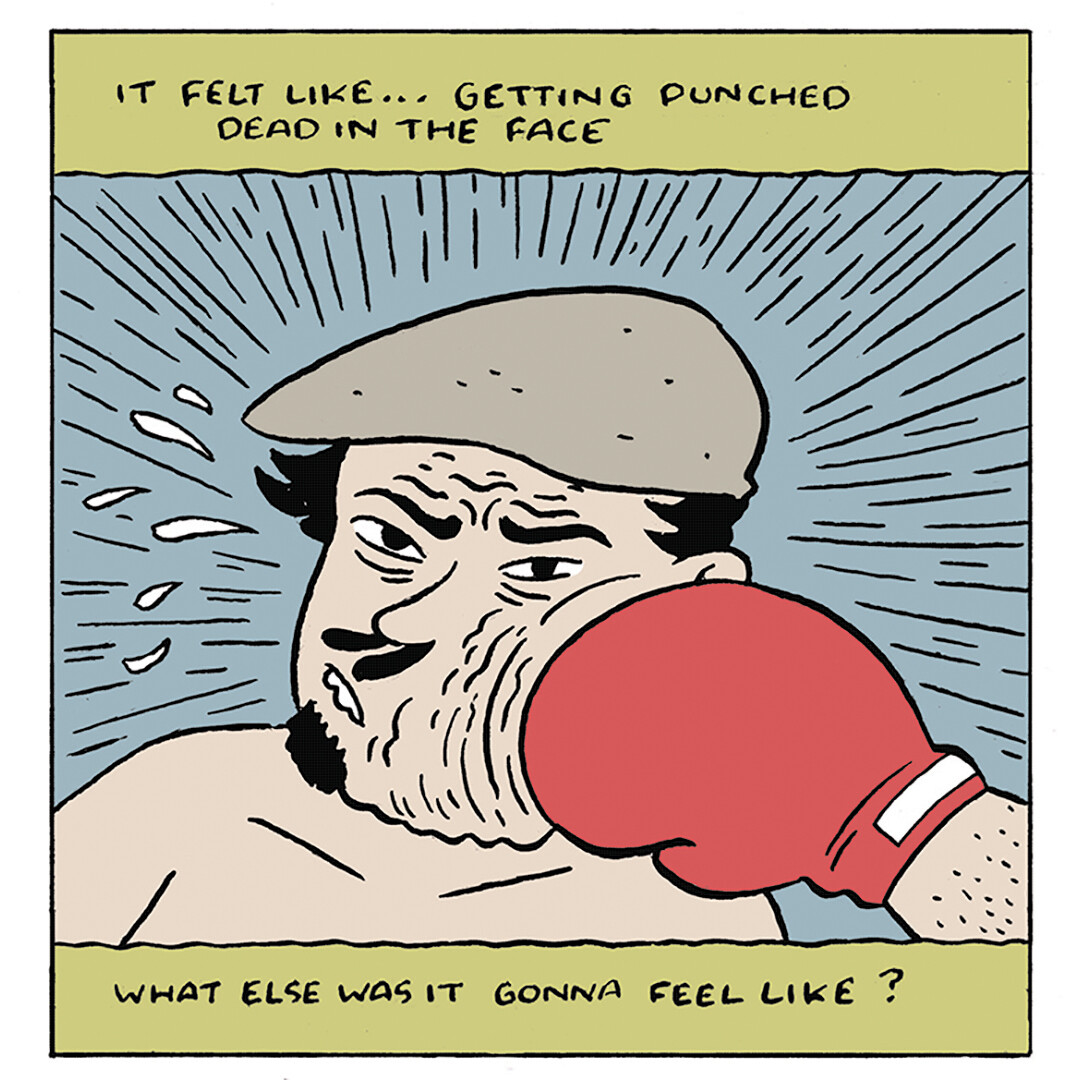
To be sure, Baylis has written about personal things before, especially with regard to his relatives. This issue feels a little different, though. In one story, he goes into greater detail about being bullied and talks about learning how to spar in a boxing gym. With Josh Pettinger giving the story just enough cartoony distance to soften the subject matter, Baylis talks about how literally learning how to take a punch in a boxing ring. In a series of increasingly-visceral panels where Baylis' face swells up with each blow received, he unleashes a torrent of grief: disease, death, job loss, and family crises over a relatively short span of time. A more naturalsitic approach would have been unbearable, but Pettinger nails this litany of blows landed, just as Baylis lays it out plainly. There's not a happy ending per se, but he ties it back into boxing by learning how to take a shot and keep moving. 

On a lighter night, strips about his son reading his comics and being absolutely delighted to see the word "shit," much to Baylis' consternation, is fun at his own expense, but he also clearly enjoys this dynamic. A strip where he helps a pregnant woman get to a hospital is given some soulful emotion when he realizes it's the place where his wife gave birth. The montage of images from the husband-wife duo of Kevin Colden and Miss Lasko-Gross is especially effective in portraying the profound gratitude he has for this place and that time. As with many of Baylis' comics, the whole tends to be greater than the sum of its parts, which is a testament to his editing and sequencing of his pieces. 

Monday, January 21, 2013

Grief and Joy: Carol Tyler's You'll Never Know

My father died five years ago this month. He and I were not especially close; we got along fine after sorting out our difficulties a couple of decades ago, but we had little in common. I liked him well enough but didn't have any especially strong feelings for him. My mother died thirty years ago last month, when I had just become a teenager. There was no one else in the world I was closer to at the time. My reaction to the two events could not have been more different, though not in the way one might expect. As a teen, I was not able to fully process my mother's death. I simply retreated to my room for a week and read stacks of comic books. I never experienced a demonstrative emotional reaction until the day before my wedding, over twenty years later, when I saw an old black & white photograph of my fiance's grandmother on her wedding day, standing next to her mother. Something about that sense of familial continuity stirred an emotion in me I heretofore had never truly felt: grief. I sobbed uncontrollably, unable to contain the buried emotions for another moment. It took me a while to fully process that experience, given the intensity of the emotions that surround one's wedding day, but I knew that it felt cathartic.

When my father was dying, I traveled a great distance to see him in his hospital. There was a look in his face of wonder and almost gratitude when he saw me. None of my feelings had really changed regarding him, but I knew I was entering a new kind of emotional space, albeit one that was familiar and from an earlier life. I spoke at his funeral and was sincere in the way that I praised him, the way he lived his life toward the end and how he battled depression. After the funeral, I collapsed into my brother's arms, once again sobbing uncontrollably for a few minutes. After that release of grief and the subsequent, low-key wake, I had a number of personal epiphanies regarding why all societies and religions have grief rituals. It's not so much the substance of the ritual that's important, but rather the chance as a family and community to engage that grief, to be present and truly feel that grief, rather than let it fester. It was also at this moment that I realized I was ready to become a father.

When my daughter was born, I intellectually understood what I was about to receive: the gift of unconditional love. It's one thing to know it and quite another to actually experience it. It was powerful and ecstatic, and I've come to understand it as a remarkable tool for the survival of our species. Raising a child is such difficult and unrelenting work that this gift is sometimes what keeps a parent going. Of course, the flipside of this love is grief; losing someone that you give or gave this unconditional love to is devastating, even if that bond one feels as a child ebbs over time. Losing a child as a parent is the most unthinkable disaster of all; a gift cruelly and randomly snatched away. As a father, it is what I fear most.

The world of alternative comics is starting to see more personal narratives directed toward child-rearing and the emotional complexities thereof. As a reader, I feel especially drawn toward personal narratives that speak a kind of truth about the sheer terror of the parenting experience, especially the sense that one is somehow doing it wrong. Comics have the power to speak to this experience with a particular kind of power, given the way that they can be more or less naturalistic in style and modulate emotion with any number of visual & narrative tricks. The work of art that speaks to me the most in how it runs the gamut of emotions regarding being a parent is cartoonist and fine artist Carol Tyler's You'll Never Know series.

You'll Never Know (Fantagraphics Books) spans three volumes, 350+ pages and eight years. All of that work, a career-topping labor of genius, stems from a single question: "Why is my father incapable of showing me love?" That single question mushroomed such that Tyler found herself having to explain everything: her father's service during World War II, the stormy but steady relationship of her parents, her wn failed marriage and subsequent time spent as a poverty-stricken single mother, the mental illness of her daughter, the slow and uneasy reunion with her husband, and her own status as daughter, mother, sister, wife and artist. If this sounds a bit all over the map, that's because it is, but Tyler slowly pulls the strings of her narrative taut in some astonishing ways, especially in the third volume.

Tyler's theory regarding why so many men from the "Greatest Generation" were incapable of showing love was that the war was horrific but that the soldiers were discouraged from processing their trauma. Unprocessed trauma, like any strong negative emotion, never really goes away. Tyler set out on a quest to get her dad to talk about his experiences and document them in her loose comics form that mixes and matches collage, painting, drawing and craftwork. That quest was a way of distracting herself from the mess her own life was in after her husband left her and their young child for another woman, as well as a way of trying to examine her own emotional state. Her father finally did open up a bit to experiencing horrific events like witnessing "rivers of blood", things that transformed him from happy-go-lucky to grim. Tyler curses the specter of Hitler and war in general at the end of the first volume, "A Good and Decent Man", trying to reconcile her father's emotional deadness with her image of him as a good person.

The second volume, "Collateral Damage", examines the grief of wives and mothers. It discusses the many ways in which Tyler's mother had to put up with her father's rages and unpredictable moods. It also goes to the heart of her mother Hannah's grief in "The Hannah Story", which was about her mother finally coming to terms with the death of her young daughter Ann decades later. This story is all about repressed grief and the toll it takes, as she was never allowed or encouraged to mourn. Instead, she was pressured to think about her duty and moving on, an attitude that served no one, especially as the other children were forbidden to say her name. In one of the most powerful sequences in comics history, Tyler depicts her mother allowing herself to feel that loss as she went through a box filled with Ann's things, with Tyler noting that Ann's name will always be nestled inside her mother's.The third volume sees Tyler trying to find herself as a woman in a marriage whose boundaries were nebulous, tending to her daughter's obsessive-compulsive disorder that had gone unchecked (unbeknownst to Tyler) for far too long, and attempting to wrap up this project with her increasingly cantankerous father. There's a moment of closure when Tyler takes him to the WWII Memorial but not in the way she expected. When her father breaks down in tears in their car, it's not because of the memorial, but because he too was wrecked by the death of his daughter. Tyler skillfully depicts the way in which her father is stunned by his own connection to that long-ago grief and what it made him become. The war may have left a terrible mark but not one worse than the devastation he faced at home.

The overriding theme of the book is that "you'll never know" the feelings of one's parents, of other people in general. Tyler manages to bridge that gap in attempting to grapple with her own grief regarding her marriage and her daughter, knowing full well that the dread of potential loss lurks in the shadow of the everyday joy of having a child. The book represents a grueling but priceless experience of knowing that she may not be able to relate to her father's experience during war, but she certainly understands the feelings associated with not being able to protect or save one's own child. It's a remarkable example of an artist being totally honest about their own feelings of grief and joy in a manner that provokes growth and fully embraces the relationship between the two. It's also a scathing rebuke against the societal forces that pressure us to withhold grief and fear. Tyler experienced both on a regular basis as a mother, during and after her postpartum psychosis that she touches on in this book as well as her other major work Late Bloomer, and it's clear that only through allowing herself to have felt strong negative emotions toward her baby was she able to move beyond them and the guilt associated with those feelings. In the end, Tyler emphasizes the joy of her relationship with both her daughter and her parents, relishing giving and receiving a deeper and richer version of a child's unconditional love.

Wednesday, July 27, 2011

You'll Never Know, Book Two: Collateral Damage


Carol Tyler's first volume of her masterful trilogy, You'll Never Know, establishes a journey that begins with a single question asked of her father as a teen-ager: "What was it like for you in World War II?" The answer to this question winds up being overwhelmingly complicated, involving her parents, her husband and her daughter in unexpected and frequently upsetting ways. When her father, a notably cold and distant (but frequently funny and always steadfast & capable) man, calls her up and starts ranting about "rivers of blood", it sets Carol on a quest to finally gain some sort of understanding and connection with him. At the same time, it leads her to an understanding of why she wound up in dysfunctional relationships with men who were emotionally withholding. The book ends with Carol hoping for a breakthrough with her father Chuck but instead gets faced with him ranting at her mother, Hannah.

The book is titled "You'll Never Know", a phrase that takes on a number of different meanings throughout the book. It's Chuck & Hannah's favorite song, for starters. It refers to the average person not knowing that Chuck was a solider who faced horror. At its core, it speaks not only to Tyler's inability to truly "know" and connect with her father, but how impossible it is to every truly know another's pain, self and emotions. The second volume is titled "Collateral Damage" and it aims to get at the damage that Chuck unknowingly causes to his wife and children.


Throughout the first volume, "A Good And Decent Man", Tyler makes a point of noting that her father lives up to that subtitle and refuses to blame him for her own mistakes with men. The second volume begins with her frantically driving to Indiana to see her parents and to make sure that her mom's OK. Unsurprisingly for a couple that made a habit of bottling up emotions (only to have them explode from time to time), both pretty much act as though nothing has happened. Carol sees a house and a couple in bad shape, with mice having eaten through their pantry. Her mother's stroke diminished her activity and mental capacity, while her father always expected this sort of work to be done by his wife. An unbelievably harsh dismissal from her father comes on the heels of the true reason why he called her and started talking about the war: his belief that the army owed him disability money. Her "failure" to prove this for him brought about all sorts of unkind cuts and brought Carol to one of several crises points in the book.


That particular crisis brings a lot of unpleasant feelings about her father to the surface. Tyler admits the resentment she feels for her father's distance, cutting comments, disinterest in taking care of her, crazy mood swings and most damning, never showing or expressing love in any tangible fashion. This is one of several emotionally brutal sections of the book, as Tyler condemns herself for her own dumb choices made once free of her parents as she became a self-fulfilling prophecy of what her father feared: a wild child. It's almost a relief for the reader when Tyler turns back to the sepia-and-olive drab tones of the "photo" scrapbook section of the book depicting his tour of duty. The high spirits and tomfoolery of the first book are replaced with hellish depictions of not just combat, but being placed in a position where his men have to destroy the lives and livelihoods of civilians.


A seemingly innocuous scene of chatter with her cheery teenage daughter is a portent of something far heavier later in the book, as Tyler recalls how she came to leave California after her husband left her for another woman. A full-page, light-hearted drawing of the pair floating outside their apartment building as they head downstairs takes on a double meaning considering that later section of the book. In a narrative sense, the interlude reminds readers that Carol at this time (in the early 2000s) is still holding out hope that her ex will return to her, as much as for the sake of her daughter as herself. It's a crucial scene for a book that, up until this point, is much more fractured and all over the place than the first volume.

The next section of the book is a long account of when Tyler stayed with her parents when his father battled cancer but somehow built a house from scratch out in the woods. It fills in some blanks in terms of their personal narrative (especially in the way it fills in the picture regarding the true state of her mother's health) but otherwise merely serves to support and amplify the points she makes earlier in the book regarding her father. The next segment of the scrapbook ends with Chuck (thinking that the war was nearly over after D-Day) being mustered into fighting the brutal Battle of the Bulge. That segment ends with Tyler getting a fateful phone call.

The last two sections of the book are a devastating one-two punch, especially to any reader with children. Much of this book falls into a holding pattern, going back and forth about Tyler's mixed feelings about a complicated man. It's an assessment of the collateral damage that she took on as a consequence of his experiences, as well as what her mother went through. Forget about getting her father to say that he loved her; Tyler would have accepted a simple "I'm sorry" for his failures as a parental figure. That said, even a complicated relationship is better than no relationship, as the chapter regarding cancer underlines.

When a parent is faced with the prospect of their child having a serious illness, it's a devastating feeling. When it's mental illness, it's an even more helpless sensation. In a section marked by red panel borders, Tyler talks about the time her daughter was first caught violating school rules and then finding drugs, alcohol and razor blades in her backpack. Much more disturbing was her daughter trying to jump out of a window, claiming "the bird man" told her she could "suck in air by jumping". Carol literally had to tackle her daughter to bring her back inside before she took her to the ER. That experience causes Carol to think of her mother's own tragedy: the death of her young daughter.


This is where Tyler reprints "The Hannah Story", which is simply one of the greatest comics short stories of all time. It's about her mother living with Chuck's family during wartime, and it was not exactly a cozy set-up. Chuck's mother was a hateful woman who had it in for Hannah and even pronounced a curse on Ann, their first child. Two years later, Ann died in a hospital after scalding herself by accident. It's the way the story is structured that makes it so brilliant, as it's staged as a conversation in a garage between Carol, Hannah and Carol's sister Virginia. A long-buried pain finally spills out as Hannah finally talks about the burden she had been trying to forget all these years. But pain can't be forgotten and emotions can only be tamped down for so long: they always emerge somehow. There's another bit of collateral damage reported here, as Chuck slaps Hannah until she stops crying about Ann. Unburdening herself of the pain allowed her to remember the brief but beautiful moments she spent with her daughter, a moment she managed to achieve when she saw Carol give birth, asking "Don't I have a right to the good parts of her life...beyond the pain I feel." The final image of the story, featuring an oriental rug with the features of all the Tyler children, is bright and hopeful, and the final line "Hannah--whose name will forever cradle her daughter's" is drawn with a heart around "ann". Tyler's light and expressive touch makes this moment powerful and resonant without being mawkish.


Thinking of the story makes Tyler realize that her daughter is still alive and in need of her. Back at the apartment building to change her clothes, she catches sight of the window she almost jumped out of and is horrified. At the end of the first volume, Tyler used Hitler as a character designed to represent the toll of war itself. At the end of this volume, Hitler returns in the person of "the bird man" (in the person of the Eagle of the Third Reich), gloating over Julia's near-death experience. If there was a sense of feeling overwhelmed at the end of the first volume, the second ends in anger. Tyler took the time to process her grief over her childhood in this book, but its real power is in how she comes to terms with that quickly when the life of her daughter is concerned. There's a certain hokeyness in the way Hitler is used here so literally, but Tyler earns that on-the-nose metaphor with the wringer she puts herself and the reader through in the course of the book. More than anything, this segment once again circles around to the book's title: she didn't know her daughter was having these suicidal/psychotic thoughts, and there was no way she could have known.


Visually, Tyler's style is unique in the comics world. Only Vanessa Davis comes close to doing the sort of thing she does in terms of using a painter's sensibility while drawing comics. The scrapbook design of the book is just one of many remarkable decorative touches she adds. Color is tremendously important both in a narrative sense (identifying key times and characters) and an emotional sense (modulating feelings felt on a page in an expressive style). The complexity of her page design (changing formats on an almost page-to-page basis) is brought to earth by the simplicity of her character design. The result is what feels like an ornate, powerful and cohesive sketchbook/journal. Even when the story goes off an a tangent, Tyler always manages to tie things back into the main narrative. Jumps forward and backward into time never obscure the main narrative through-line. Visual call-backs abound in the book, both to the first volume and to key sequences in the book. Most impressively, Tyler manages to bring a static kind of craft (a sketchbook) to life with panels that crackle with energy and movement. There are no easy outs or answers in Tyler's attempts to create, maintain and understand connections with her loved ones, so I'll be curious to see what kind of conclusions she winds up with in the last book of the trilogy.

Tuesday, September 29, 2009

Another Generational Shift: SPX 2009

Rob reports on this year's Small Press Expo in Bethesda, MD.

I've been attending SPX since 1997, the last year that it was a one-day show. As always, the types exhibitors present made it possible for attendees to have completely different kinds of shows, depending on their interests. In its old location, the show was small enough for me to feel like I'd exhausted every possibility in terms of seeing old favorites and carving out time for new discoveries. The show has changed in ways that no longer make that possible, something I discovered last year and really had driven home to me this year after I left. Here's a list of observations about the ways SPX has evolved in its fifteen year history and other observations related to this year's event:

* The sustained presence of web cartoonists. Kate Beaton stunned all sorts of people with her rock-star reception last year, and it was more of the same for many fans who came to see their favorite webcartoonists and who had little interest in other exhibitors. By the same token, many fans who came to see their favorite print cartoonists were baffled by the lines the webcartoonists had at their tables. The Comic Strips: Online and In Print panel was absolutely packed with fans in a way that few other panels could boast.

* The absence of well-known cartoonists from New York and the west coast. There was no table from Artists With Problems, no one from Meathaus, a tiny turnout from the Sparkplug gang, few cartoonists from the Portland or Bay Area scenes, and so on. This represented a generation of cartoonists mostly older than thirty that weren't at the show. I'm not sure how much of this was local shows drawing those cartoonists in (Portland has Stumptown, and there's going to be a new alt-comix show in Brooklyn), the national economic crisis, or simply folks getting older and not having the time to make it to the show. Along the same lines, there simply weren't too many artists older than 30 at the show, including any number of long-time stalwarts at the show. There were exceptions: Josh Neufeld (completing his rise from self-published artist to receiving national & mainstream praise for his recent Pantheon book), James Kochalka, Jeffrey Brown, Kevin Huizenga, and Dan Zettwoch, to name a prominent few.

* The influence of formal comics education. Schools like SCAD (Savannah College of Art & Design), MCAD (Minneapolis College of Art & Design), SVA (School of Visual Arts) and especially CCS (Center for Cartoon Studies) are producing wave after wave of young, enthusiastic cartoonists. CCS-related cartoonists had a dozen or more tables, with nearly three dozen students or alums in attendance. In talking to a number of CCS folks, I was struck not only by how many alums stick around White River Junction after graduation, but by how totally sold out to comics they are. A culture has been created that not only provides support and encouragement but also demands a strong work ethic and a commitment to constantly growing.

I spoke to Zak Sally, who is currently a teacher at MCAD, about how he felt going from being a DIY cartoonist to an educator. He noted that he felt conflicted about this at first, but that quickly faded when he saw the impact that he had in helping young cartoonists solve storytelling problems and their enthusiasm. To me, this feels less like going to school to learn cartooning and more about old-fashioned apprenticeship. There's a tradition of younger artists learning the nuts and bolts of the art from experienced masters, and it's a tradition that seems to be coming alive now. The best way to go about this is still a matter of some debate, so I will be curious to see how Jesse Reklaw and a number of Portland cartoonists approach this problem with their educational program at the Independent Publishing Resource Center (IPRC).

* The wane of traditional genre comics. A decade ago, the show was roughly 50% genre comics of some sort (many of them superhero comics), 50% alt-comics. Now it's more like 15% genre comics, 85% alt-comics--and most of the genre comics are either fantasy or horror (there were lots of zombie-related comics around). Minicomics dominated this show, and there seemed to be a sensible balance between mini as art object and mini as storytelling device. That said, the distinction between genre and non-genre comics has not only become less important, but it's started to blur. The New Action panel dealt with artists who drew genre comics of a kind, like Kaz Strzepek's THE MOURNING STAR. This is a post-apocalyptic story that's published by Bodega, one of the most refined of all publishing concerns.

* The strength of the programming. In the older days of the show, much of the programming was strictly perfunctory, with the exception of events related to ICAF (International Cartoon Art Festival, which brought in any number of interesting guests). Since Bill Kartalopolous took over the programming four years ago, nearly every panel is worth seeing. Bill dutifully made sure events started and ended on time and that panelists & moderators were in the right place at the right time. That also speaks to the organization of the show. Simply put, this is the best-run show I've ever attended, and it's only gotten better since it moved to North Bethesda.

This is a nice segue into the panels I attended or participated in during the weekend. First up was Debut Cartoonists, a panel I moderated. I showed up right at the 12:30 start time, running a bit later than I would have preferred, but all four participants had arrived. The panel was devoted to four cartoonists debuting new work at the show, a sort of replacement for the always-nebulous Best Debut Ignatz award which had been done away with. The group included Ken Dahl (aka Gabby Schulz), debuting MONSTERS; Zak Sally, debuting a collection of older material called LIKE A DOG; Eleanor Davis, debuting the kid-aimed THE SECRET SCIENCE ALLIANCE (AND THE COPYCAT CROOK); and Hans Rickheit (THE SQUIRREL MACHINE). After a slow start, the artists started to bounce ideas off each other, resulting in a panel that felt a bit like a cathartic therapy session at times. Sally talked about the struggles he had in going back to old material and trying to reconnect to the feelings he had about comics at the time. He and Dahl (a natural storyteller) commiserated on fighting feelings of worthlessness and self-loathing as an artist and allowing themselves to say that it was OK to seek feedback and get people to read their work. Davis was the panel's catalyst, engaging her friend Dahl on several occasions and creating debate around the feelings an artist gets when a project has been completed. Rickheit talked about his creative process and working from dream imagery, and noted that he particularly enjoyed hearing new interpretations of the book's ending from readers. I've rarely seen a panel where the artists really engaged each other so thoroughly and on so many levels.

I participated in this year's Critics' Roundtable once again, with Gary Groth, Douglas Wolk, Chris Mautner, Joe "Jog" McCulloch, Sean T. Collins and Tucker Stone. Moderator Bill Kartalopolous asked us questions less about specific works and more about a variety of experiences related to writing and critique. Johanna Draper Carlson had a nice summary of the event on her blog. For my part, I wished the event was about three times longer, so as to get longer answers from everyone. What I liked best about the panel this year was the looser feel of the event, with more give and take between panelists. We were just starting to get warmed up on the subject of negative criticism when we ran out of time. I could feel half of the panelists bristle when I noted my disdain of snark in criticism, and I would have enjoyed some back and forth on that topic. Collins has audio of the panel.

The attendance at panels and spotlights varied widely. For reasons I don't quite understand, the critics' panel was packed. On the other hand, the spotlights on legendary artists Carol Tyler & John Porcellino were sparsely attended. Porcellino's longtime friend and current publisher Zak Sally loosely moderated his panel, which began with a slideshow presentation of his brand new King-Cat collection from Drawn & Quarterly, MAP OF MY HEART. The material from this book is rather downbeat, given that it covered a period of time when he had to deal with sickness, divorce and loneliness. I asked him about his work in relation to poetry and its rhythms, because the actual comics only cryptically alluded to the real-life events that inspired them. He replied that he indeed took a cue from poetry in the way he pared away anecdote and tried to get at the feelings behind them. This work covered a fairly long span of time, and one could see the way his minimalist style became even sparer, yet more confident. The same is true of his use of language, which has a remarkable precision. Porcellino noted that while this material dealt with depression, he was also hungover and was hoping for some fun questions. Someone asked him about his beloved Chicago Bears and a fan told him that he used to use one of his book collections as a defacto bank.

Tyler, as one might expect, was a warm and charming raconteur. Douglas Wolk moderated her panel, wherein she discussed her brilliant comic YOU'LL NEVER KNOW. She spoke at length about the new audience she's acquired in the publication of this book about her father's World War II experiences. That includes places like American Legion meetings, VFW gatherings, etc. Her book is about trauma and how a generation was trained to subsume it, and how it came out in other ways. At one meeting, she talked about laying out the art on a number of tables for the veterans to walk around and peruse, and she noted how many of them were reaching for their handkerchiefs and gruffly blowing their noses so as to not reveal their tears. Tyler spoke of trying to bridge the generation gap and telling these men it was time for them them to tell their stories. To that end, she said that she invited a large group of veterans to the class she teaches at the University of Cincinnati on comics. She paired up students with veterans and assigned the students the task of interviewing them and adapting their stories to comics. That's an inspired move, and she noted it was her way of breaking the students out of their navel-gazing comics by telling someone else's story--of something that was important.

I don't know the final numbers, but I was impressed by the attendance at the show. Even with panels pulling in a couple of hundred fans for an hour, traffic on Saturday was shoulder-to-shoulder. SPX Director Karon Flage told me that DC folk not only flock to this show, they do so looking to spend money. A lot of exhibitors told me that sales were doing quite nicely for them, which had to be heartening given the economic downturn. This is an event that people save up for, and everyone seemed to get something out of the experience. While it is unfortunate that the encounters fans have with artists here is primarily a commercial one, as artists are looking to make sales, I was struck by the number of lingering conversations and interactions I saw at the tables. I still dream of a juried art exhibit room for SPX, where fans can peruse original art (and make arrangements to buy it later if so desired). I'd also love to see the CCS workshop on both days of the show, given its popularity and opportunity for fans to experience comics in yet another different way. As a venue, the Marriott is functional, if a bit stiff and cold for such an event. On the other hand, the surreality of seeing a beauty pageant or gospel music event next door to SPX was amusing.

Flage noted that no changes were planned for SPX in terms of size, and that none would happen unless attendance continued to grow. At this point, I'm not sure that will happen anytime soon. There are simply too many regional comics festivals that have sprouted up to make SPX a can't-miss event on a national scale every year. The reality is that there are no can't-miss events anymore, because chances are that both fans and exhibitors will have any number of chances to attend a relatively nearby comics festival of some sort. Still, with guests like Gahan Wilson (whose spotlight session was quite well-attended), SPX is still the premier show of its kind--especially given the recent organizational problems that MOCCA has suffered. All told, the generational shift has been good for the show, keeping it fresh for both participants and exhibitors.

Tuesday, September 22, 2009

High-Low At SPX and 12 Artists To Seek Out

I will be at SPX, perhaps the premier alt-comics event, this Saturday, September 26th in Bethesda, MD. I'll be part of the Critics' Roundtable at 3:30pm in the Brookside Conference Room, along with Gary Groth, Douglas Wolk, Sean T. Collins, Chris Mautner, Tucker Stone and Joe "Jog" McCulloch and moderator Bill Kartalopolous. I really enjoyed last year's panel and I'm looking forward to having a discussion with so many esteemed critics. I'll also be hosting a Debut Cartoonists panel, spotlighting new work by Hans Rickheit (THE SQUIRREL MACHINE), Eleanor Davis (THE SECRET SCIENCE ALLIANCE), Ken Dahl (MONSTERS), and the great Zak Sally (LIKE A DOG).

Here's my annual list of artists to seek out at the con. This is obviously not any sort of exhaustive list of artists that I like or will seek out on my own. Consider it a survey of new artists, significant artists making their first appearance at SPX, artists with interesting new releases, artists deserving greater exposure and folks whose work I simply admire.

1. John Porcellino. One of the greatest exemplars of minicomics as a viable format of their own, separate from potential collections. He'll have not just a collection of KING-CAT out from Drawn & Quarterly called MAP OF MY HEART, he'll also have a brand-new issue of the series. SPX is one of the first stops on his extensive book tour of the country celebrating his 20th anniversary of his career. His extremely spare line is a testament to how one can be devastatingly expressive using a minimalist style. Porcellino will also have original art for sale. This is his first appearance at the con since 1997, and a generation of cartoonists has been strongly influenced by his approach. He will have a 2pm spotlight on Saturday in the White Flint Amphitheater and will be signing at the D&Q table on Saturday from 11:30-1pm and Sunday from 1-3pm. Sally will moderate the spotlight session, and I should note that he's most certainly another artist to seek out.

2. Colleen Frakes. One of my favorite graduates from the Center For Cartoon Studies (along with Chuck Forsman, Sean Ford and the rest of the Sundays gang), Frakes' recent WOMAN KING was simultaneously lovely and disturbing. I'd also seek out her older TRAGIC RELIEF minicomics.

3. Carol Tyler. One of the greatest working cartoonists makes her SPX debut. Her YOU'LL NEVER KNOW is my top comic of the year. She'll be signing at the Fantagraphics booth on Saturday from 12-2pm and Sunday from 2-4pm. Tyler is also a delightful storyteller, so be sure to check out her spotlight on Sunday at 1pm in the White Flint Amphitheater.

4. Josh Neufeld. This long-time SPX attendee is basking in the glow of the well-earned acclaim that his AD: NEW ORLEANS AFTER THE DELUGE has received. One of the best books of the year, Neufeld will have his own spotlight panel on Sunday at 2pm. Neufeld is a perfect example of a generation of cartoonists whose career dovetailed with SPX, going from self-published minis to illustrating Harvey Pekar to his own series with small publishers to a book deal with Pantheon.

5. Ken Dahl. Also known as Gabby Schulz, Ken Dahl has an acidic sense of humor and stunning chops. He will be debuting MONSTERS, a collection of stories about herpes, at the show, and will be on the panel I mentioned above. Simply put, Dahl is one of the best cartoonists to emerge from this decade.

6 Dina Kelberman. IMPORTANT COMICS was one of the weirder and more compelling minis I read this year. Her comics have a sort of absurdist quality that I admire, and the way she uses unusual page & panel compositions with a minimalist line is unusual. She'll be part of the Aesthetics of Mini-Comics panel on Sunday at 4:30pm.

7. Ed Piskor. Piskor is unusual in that he's a young artist heavily influenced by the underground generation (as opposed to the alt-cartoonists of the 80s and 90s). He's also had an opportunity to work with legends like Jay Lynch and Harvey Pekar, but his own voice is unique. He's taken his underground sensibilities to write about another underground culture: hackers. Seek out the first two volumes of his WIZZYWIG and watch him on his Source-Based Comics panel at 1:30pm on Saturday.

8. Eleanor Davis. Davis is another artist on my short list of "best emerging talents of the decade" thanks to her compelling minicomics and short stories in MOME. Her Toon Books entry, STINKY, was one of the best comics of last year. Her new book, THE SECRET SCIENCE ALLIANCE, is aimed at older kids, which makes sense given her style of art.

9. Jon Vermilyea. Eric Reynolds discovered his minicomics at San Diego a few years ago, and his subsequent comics for MOME have been simultaneously hilarious and disturbing. Like Dahl, Vermilyea has incredible chops and a flair for the grotesque.

10. Jeff Zwirek. His BURNING BUILDING COMIX, an Ivan Brunetti-inspired work, was one of the more clever comics I read last year. I'd recommend getting every issue to fully appreciate the level of detail he puts into his gag work.

11. Will Dinski. Dinski gets my vote for best currently self-published artist. His new comic, COVERED IN CONFUSION, is typical of his recent remarkable hot streak: funny, dark, tragic and uniquely formatted. Someone needs to give him a book deal.

12. Matthew Thurber. Thurber's 1-800-MICE is one of the best comics of the decade. That about sums it up. It's an exemplar of comics that have a lot of genre elements, humor, deeper themes, dense plots, absurdist elements and unforgettable characters. Seek him out at the Picturebox booth.

Thursday, August 27, 2009

Memory and Form: Windy Corner Magazine #3

Rob reviews the latest issue of Austin English's comics/criticism project, WINDY CORNER MAGAZINE #3 (Sparkplug Comic Books).


What I like best about Austin English's ongoing WINDY CORNER MAGAZINE is that it seeks to clarify the artist's relationship with memory and the narrative that we form from our memories, and how this is different from nostalgia. That theme was particularly evident in this issue, given features like Frank Santoro writing about Gipi's GARAGE BAND, memoirist Vanessa Davis interviewing memoirist Carol Tyler, as was as English's own explorations of his past. Of course, there's a wonderful quirkiness to this magazine that sets it apart from other comics-related publications. That quirkiness is not a pose, but rather an expression of the many hats English wears. He's a cartoonist whose style continues to evolve from issue to issue. He's an editor managing submissions, but also a curator of sorts who looks to add just the right piece to create the desired aesthetic effect. He's a critic who seeks to understand and illuminate what art means to him. Above all else, the mission of WINDY CORNER is to get artists thinking about other works of art and how it affects them, as well as the processes of other artists.


English seems to be shifting his style from crude figurework to a blockier style defined by color patterns more than line. A lot of the art in this issue leaned heavily on decorative touches as opposed to a more stripped-down narrative. That was certainly true of the introductory illustrations by Lilli Carre' and the comics-as-poetry inspired table of contents by Molly O'Connell. Carre's use of tiny blasts of color on a white page, culminating in a single figure talking on the phone with her hair on fire, created the sense of a mind gone haywire. O'Connell worked in purple ink, using the most conservative line in the entire issue for her figures that wrapped around the contents. In English's own "Life Of Francis" series, that heavy use of blocky/blobby images dominates this entry, giving a certain sense of frightening solidity to Francis now becoming an adult and living on her own. I don't think English is doing any favors to this slow-moving story by serializing it; it would likely be a more interesting reading experience taken in one shot.

On the other hand, his ongoing exploration of his earliest memories proved to be a highlight. Done in a very loose line and filled in with crayon, "Drawing" really got at the heart of his struggle with drawing, wishing that he could be like one of his friends, whose "hands always knew which line to draw next". "Bernal Heights" is another exploration of living with his family as a child, remembering odd things about the next-door neighbors as only a child might. Of particular interest was "In The Museum", a black & white piece that employed that blocky/blobby style for a story about a father's recollection of a day out with his daughter. This is an emotionally intense story, one where he's trying to figure how to communicate with her and feels constant frustration. I've always liked the direct way English deals with emotion, and the way he intermingles ambivalence and affection with his characters.

The other comics in this issue varied wildly in approach. Sakura Maku's "You Turn My Lights Into Rays" is an intense assault of color, mixed media and calligraphic effect. The way that Maku slips between painting and cartooning and song is dizzying yet exhilarating, reminiscent a bit of Souther Salazar's work. Jason Miles' interpretation of a letter received by Windy Corner uses tiny panels, blotchy art and splotchy colors in an effort to get across the sense of cartoon fellowship the letter-writer felt with English. Both comics are meant to be looked at as much as read, a reflection of the more painterly nature of the magazine. Indeed, the back cover is a painting by Joseph Hart, an assembled piece with different color and textural elements juxtaposed against each other in a way that's hard to take one's eye off of it.

As much as I'm interested in WINDY CORNER's comics, it's the analysis and interviews that engaged me the most. English once again used his intuitive, personal critical style to look at the work of children's book illustrator Garth Williams. This is the most personal essay I've read to date from English, noting that Williams' drawings had enormous power despite their simplicity. Not only in terms of what looking at them meant to him, but in terms of possibilities in terms of making marks. He singles out Williams as the biggest earliest influenced he had in becoming an artist and loving art.

Deceptive simplicity was a running theme throughout the issue's analyses, as Frank Santoro turned his brand of from-the-hip commentary on the pauses and rests of Gipi's GARAGE BAND. Santoro is very much a critic/reader who demands that Something Happen in a narrative framework, yet he found much to love in a story that was entirely driven by character beats both overt and subtle. In particular, he talked about "the synthesis of drawing, color, narrative and symbolism" and how each element informed the other in turn. The color of the skies reflected emotion and possibility, while the elements drawn in each panel reflected the theme of family, both biological and acquired. I loved the way Santoro went chapter by chapter and not only broke down what he saw, but related how they affected him emotionally.

That running theme of how a work affected an artist echoed through Vanessa Davis' interview with Carol Tyler. Davis' free-flowing approach to creating memoir comics owes much to Tyler, and it's clear that the interview touched on a number of Davis' own concerns as an artist: the appearance of productivity, the use of a painterly (as opposed to clear-line) style in comics, the responsibility of the artist when writing about others, and whether or not autobio in general is a worthwhile pursuit. There's an intimacy to this interview that made it feel as more like an intriguing conversation that interested readers would want to eavesdrop in on than a formal discussion. At the same time, Davis managed to zero in on the heart of Tyler's work in terms of both art and artist that I hadn't seen in other interviews. The only problem I have with the interviews in WINDY CORNER is that they seem too short. While the their airm is not a career-spanning blow-by-blow, I wish I could hear a bit more of these conversations.

Even the sloppier elements of WINDY CORNER (smudges, smears, spelling errors, odd fonts, a lack of page numbers) are somehow endearing and sum up what English is all about. Translating what he sees in his mind onto the page has obviously been a career-long struggle for him, yet he continues to push forward and find ways around this problem through sheer effort and love of the form. He's sort of a younger version of Art Spiegelman in that respect--an artist with a deep love and understanding of the history of comics whose brain and eye are far more developed than his hands. Despite that difficulty, both artists soldier on. English may not be at a juncture in comics history when he can dazzle with formal inventions (ala BREAKDOWNS), but he does somehow manage to be two steps ahead of other observers when it comes to sniffing out new talent and movements in comics. English looks to the past like Spiegelman, but seeks out a different set of inspirations--and from sources even more unusual. Poetry, painting and certain kinds of film provide a framework for English's goals as much as comics do, and the observer can see the presence of each discipline start to slowly shape his work. English has a long way to go before he reaches his mature stage as an artist, but his curiosity and determination to push himself and comics in general mark him as an artist to follow.

Saturday, August 1, 2009

Puzzle Boxes: You'll Never Know

Rob reviews the remarkable new release by Carol Tyler, YOU'LL NEVER KNOW (Fantagraphics).


Carol Tyler is a unique figure in the world of comics. She's a sort of "cartoonist's cartoonist" in that she's not widely recognized by the average alt-comics fan but is deeply respected by masters like Crumb, Ware, Woodring and others. Being a single mother greatly slowed down the pace of her comics output, a subject about which she has written extensively, but certainly didn't affect the quality of her work. Best known for short stories (mostly collected in 2005's brilliant Late Bloomer), she's now put together the first volume of what promises to be her masterwork, a "graphic memoir" about her father's experiences in World War II that effortlessly mixes media in a charming, affecting, and devastating package. You'll Never Know goes beyond biography, autobiography and even as a means a therapy to ask a number of deeper questions that may well not have ready answers. It's a stunning achievement, a perfect marriage of form and content, and is my early contender for not only comic of the year, but comic of the decade.

Sometimes the answer to a single question can unlock a life's worth of mysteries. You'll Never Know is as much about Tyler's examining the choices she's made with her relationships as it is about her father, given the influence a parent can have on a child. The single question that unleashes a tidal wave of emotions for her family was made when Tyler was a teenager: "What was it like for you in World War II?" Her father Chuck sat on that question for thirty-five years, until one day he called her out of the blue and went on for two hours about rivers of blood and other horrors. When she later visited him to interview him and get more details, he froze up and couldn't talk about something awful that happened in Italy. It began to dawn on Tyler that this inability to process the horror and trauma that her father experienced was far from unique, and that men of that era were encouraged to bury those memories and pretend that they never happened. Of course, when such feelings are repressed, they surface in other ways...ways that have a profound impact on their children and spouse.


Tyler is quick not to blame her father for her own failings with men, but also notes that she wish she had had a guiding hand as steady as her grandfather was for her own mother. When her husband walked out on her and her child (for an ex-babysitter, no less), Tyler turned the grief of that experience into an art project: designing a scrapbook for her father. Unconsciously, Tyler tried to make sense of what she perceived as a personal failure of communication with her husband by deepening her understanding of her father--and giving him an offering of that understanding.


The title ostensibly refers to the song her parents fell in love dancing to, but it also refers to barriers of communication. Not only between generations (WWII and boomers), or child/parent, or those who experience war trauma and those who don't...but the impossibility of being able to fully empathize with another human being and understand their experiences. This book is as close a bridge as is possible to that shoreline that will never quite appear on the horizon, with Tyler building the bridge beneath her step-by-step with her pencil and brush. The book has a seat-of-its-pants feel to it as Tyler strings together images and memories and tries to impose structure and order on a complicated series of events and emotions. It's obvious that starting the book was problematic, as there are a series of false starts, awkward introductions, and images repeated throughout the book. It seems that Tyler wants to tell everything all at once (much like her father spilling his guts on the phone) and has to take a few steps back just to start the story. Her solution to the problem is elegant: noting that "you'd never know" that he'd fought in a war. That set the book's theme resonating from the very beginning, one that she would return to explicitly and implicitly throughout the narrative.


The book ends on a note of despair, as it seems far from certain that Tyler would ever be able to fully connect to the two most important men in her life. It's telling that Tyler's relationships with women seem to be on more solid ground, given the steadfast presence of her mother. Though the book is ostensibly about her father, her mother is a major figure in this story and earns a very affectionate testimonial toward the end, as does her wise older sister. Of course, Tyler's daughter Julia is the light of her life, and the warm & supportive manner with which she raises her was a direct reflection of the way Tyler was raised by her own mother. The hardships her mother overcame were an obvious inspiration for Tyler, and the fact that she manages to carve out a life with Carol's father had to be a further source of inspiration for Tyler's potential success in unlocking that puzzle box.


Tyler matches a remarkable array of formal tricks in framing her story with an emotional center that iss enormously powerful. Yet one never felt as though she is exploiting past trauma for dramatic effect; indeed, there's an easygoing nature, a folksy, warm and welcoming quality to her storytelling. The book's tone is self-deprecatory without devolving into insecurity; modest without being mawkishly self-effacing. The reader immediately feels for Tyler but she never stacks the deck against her husband or her father, and in fact went out of her way to emphasize their basic decency. Indeed, the book's subtitle, "A Good And Decent Man", is Tyler's attempt to shake herself out of blaming her father for her troubles and trying to understand the ways in which the war shook him and caused him to act out. She is trying to unlock the part of the puzzle box that connected the fun-loving scamp who went into the war with the self-described son-of-a-bitch who emerged.


The book is formatted in landscape, deliberately evoking the feel of an old photo album. Which makes sense, given that this is an album about family, old and new. The portion of the book devoted to her father's war experiences are numbered and drawn in precisely as though they were in a scrapbook, printed on tan paper. Tyler mutes her otherwise vivid palette here, giving these images the sort of sepia tones familiar to any who have seen old photographs. Flecks of color pop in here and there: her mother's red hair, the red on a Red Cross sign, hearts surrounding the loving couple as they dance to their song.


On other pages, Tyler pulls back for panoramic views of countryside, highways, Chuck's workshop and the day he moved an entire house, giving context and attaching temporality to her characters. The most effective pages are the vividly painted ones where she introduces clever symbols for her parents. Her father is depicted both as a steady tree (dependable but incapable of showing love) and a wily fox (always on the move and hard to pin down). She depicts her mother as a sturdy tree that grew straight and tall thanks to her father, while she depicted herself as a bent-up sapling that was whipped in the wind by her fox of a father zipping by.


You'll Never Know has drawn comparisons to other well-known graphic memoirs such as Art Spiegelman's Maus and Alison Bechdel's Fun Home. Both of those books find children trying to make sense of their relationships with their fathers, who are distant and unknowable in different ways. Like Maus, You'll Never Know explains the role of traumatic events surrounding war and the eventual effect it has on men who became parents. Tyler's approach to this subject and the conclusions she drew are radically different than Spiegelman or Bechdel. Her line is more lively and witty than the overly fussy and labored approach that Bechdel employs. She varies between an expressionistic and naturalistic take depending on what she was discussing, as opposed to Spiegelman's metaphorically anthropomorphic figures.


What distinguishes this book is the nature of the puzzle that Tyler was grappling with. Bechdel was putting together information from a man who was already dead, while Spiegelman had a willing (if difficult) subject. Tyler is trying to unlock the memories of a man who is reluctant to do so, unlock the secrets of her own behavior and unhappiness, unlock the misery of an entire generation and establish a bond before it was too late. She is under no illusion that she can entirely succeed or indeed that anyone could succeed, hence the book's title. We can never truly know another's mundane experiences, let alone the horrific and alien trauma suffered during war. At the same time, it's Tyler's very attempt at blind bridge-building that creates understanding and empathy, a glimmer at a time.