Monday, July 25, 2016
First Second For Kids: Sturm/Frederick-Frost/Arnold, Reed/Flood, Wicks
Ogres Awake!, by James Sturm, Andrew Arnold and Alexis Frederick-Frost. This is the latest in the Adventures In Cartooning! series headed up by the head of the Center for Cartoon Studies and two alumni. Ostensibly designed to teach the basics of cartooning to kids, the trio of artists has also released a series of fun adventure books starring the knight who popped up in the actual instructional books. I had the benefit of my seven-year-old daughter asking me to read this book to her, sight unseen, and she loved the book's humor and sheer "loudness". The book opens with the crisis of the knight seeing a meadow full of giant, sleeping ogres, and the rest of the book is essentially a mad dash by the knight in an effort to thwart the crisis. About midway through, the artists come up with a counter plotline, wherein the knight's clamoring for battle is funneled into the knight helping to harvest food from a garden and chop vegetables, as the wise king beats the ogres by feeding them. The book is chock full of verbal and visual jokes, and Frederick-Frost's thick, brushy line sturdily carries the narrative without being overwhelmed by the book's bright colors. The endpapers, which contain brief tutorials on how to draw the characters and funny poses they can get into, were a particular favorite of my daughter, who loved the natural progression from utilitarian suggestions to sheer silliness, like a horse as a space explorer. It's the rare kids' book that goes all-out in an effort to be simply funny, without worrying about anything else.
Science Comics: Dinosaurs: Fossils and Feathers, by MK Reed and Joe Flood. The Reed-Flood team's last collaboration was the character-centered romance The Cute Girl Network. Flood's preferred thing to draw is more in the realm of monsters, which makes this clever and page-turning account of the history of paleontology right in his wheelhouse. Kicking off First Second's Science Comics line, each cartoonist will have the conundrum of just how to present their given subject in a way that draws in younger readers. Reed's solution was to create a narrative based not so much on the history and qualities of dinosaurs (although that's all here as well), but rather on the history of how scientists (as well as grifters, hucksters and thieves) have understood and classified dinosaurs. Reed focuses on the colorful personalities that populated the world of paleontology in the early days, like amateur fossil collector Mary Anning (who did not receive the credit due her), arch-rivals Gideon Mantell and Richard Owen (the latter of whom sought to discredit the former in academia), and arch-rivals Othniel Marsh and Edward Drinker Cope (whose field teams threw rocks at each other).
Reed didn't separate the book into chapters per se, but rather reset things based on the changing nature of scientific paradigms. Starting off in 1800, for example, it is considered to be a fact that the earth is 6,000 years old, that dinosaurs perished in the Great Flood, and there are no examples of them today. Every reset changed those assumptions dramatically, as science not only became more sophisticated but also started to admit to the ways in which new evidence can shatter old paradigms. Amusingly, that was backed up when Reed wrote a chapter that noted how the brontosaurus never really existed, only to have to add an endnote that said that the bronto's existence had been proven. Flood went to town drawing double-page splashes with dinosaurs but was equally up to the task of drawing historical figures. Reed keeps the narrative going with an arsenal of fascinating anecdotes, both about dinosaurs and the people who discovered their fossils. She even manages to explain some of the basics of geology along the way, thanks to her wit. While there are the occasional funny asides, Reed doesn't overdo and trusts in the narrative. Starting off a series about science that demonstrates how science is actually carried out was a smart move, as the clash between staying true to the scientific method and the human need for certainty is key to understanding paradigm shifts and the ways in which human bias can affect knowledge.
Science Comics: Coral Reefs: Cities of the Ocean, by Maris Wicks. Wicks had a taller order than Reed in talking about the science of coral reefs. Without a narrative to latch onto (other than the ecological one that essentially amounts to "Recycle and ride your bike!"), Wicks was essentially reduced to narrating a slightly whimsical nature documentary. The essence of that documentary was that despite coral reefs occupying a tiny portion of the earth, they are home to a majority of the earth's biodiversity. Once that point is made, she goes into a basic biological explication of the various phyla that can be found in and around coral reefs, all narrated by a fish wearing glasses. It's page after page of slightly cartoony drawings of sea life with amusing asides, scatological jokes and witticisms from the creatures themselves. The book picks up again when it gets into facts about the water cycle and ecological concerns, which is presented earnestly but without preaching. It's simply a matter-of-fact presentation of facts, one that presupposes a great deal of faith in the reader to do the right thing. A bit more restraint on forcing jokes might have made this a smoother read, though as I noted earlier Wicks was in a tough spot and relied on her storytelling instincts to work her way out of it. It's just that at around 120 pages, the book simply flagged once she started rattling off different species and felt padded.
Thursday, October 8, 2015
Thirty Days of Short Reviews #8: The Little Grey Spot, Sleepless Knight, Lolly Poppet's Lousy Year
Lolly Poppet's Lousy Year, by Lupi McGinty. The talented cartoonist, best known by me for her contributions to Cartozia Tales, has crafted a book with irresistibly-drawn characters. It's not comics in the sequential sense, but each page is most certainly cartooned rather than illustrated in the typical sense. There's an amusing progression from page to page as the titular character has all sorts of failures in her efforts to have fun during the year, from a spilled popsicle to getting covered in grass clippings that she hoped would scatter like leaves. The winning expressions of Lolly are what make the book work, along with that cartoonist's sense of creating motion with just a single image. The book is translated into both English and Spanish, and my main quibble with it is the printed text. Hand-drawn text would have been warmer and more in keeping with the rest of the book's aesthetic.
Sleepless Knight, by James Sturm, Andrew Arnold and Alexis Frederick-Frost. The latest entry from the Adventures in Cartooning! narrative/instructional series for kids, this book is heavy on the story and light on instruction. If there's one lesson the book is trying to impart, it's learning how to draw a particular character engaged in a number of different activities. Finding out how the character moves in space, what their body language is like, and simply experimenting with them doing different things can help young cartoonists solve a lot of problems on the page and make their characters come alive. The actual narrative is a funny story about a series of self-inflicted woes, as the titular knight is out on a camping trip with his horse and can't get to sleep because he can't find his teddy bear. It's a sort of hero's journey in reverse, as the knight meets a rabbit and a bear but manages to anger both of them instead of creating new allies for his quest. Indeed, the knight's tale winds up being incidental to the outcome, as the poor, beleaguered horse winds up having fun and eating marshmallows with the other animals. I read this one along with my daughter, who is learning to read. I was impressed by how the images provided excellent scaffolding for her to look at a word and instantly understand its context, giving her the confidence to shout it out. She also appreciated the humor and empathized with the anxiety caused by losing a sleep-comfort object. The brushy line of Frederick-Frost is a key to the book's success, as he keeps things simple but rock-solid in terms of storytelling.
The Little Grey Splot, by Nicholas Alan Straight. Published by Jordan Shiveley's Grimalkin Press, this is a straight-up kid's book without a specific comics narrative. Like McGinty's book, however, it is very much a book that was cartooned. Straight uses a cute design with the titular figure being greyscaled in contrast to the other bright blobs of paint that make up the other figures. Every other page of the book encourages doodling, scribbling and drawing in the book itself, giving the young reader examples to model and then encouraging them to use their own imaginations. The Little Grey Splot draws faces, bodies in motion, fears, ocean creatures and aliens and overcomes its lack of color with its imagination. I like the idea of a kids' book that encourages such active participation, with the added innovation of not being a coloring book but still giving kids direction and restrictions.
Thursday, November 13, 2014
Thirty Days of CCS, Day 13: The Applied Cartooning Manifesto
Sturm then goes into a series of events that should have many cartoonists nodding: living a spartan lifestyle, creating comics when they can, burning up time on social media and conventions to help build an audience and then find some way to make money off of all this labor. Sturm instead asserts that the world is changing and becoming more open to the use of comics than it used to be. Comics are being used in education, medicine, business presentations and community histories. This is what he calls "applied cartooning", wherein one's skills can be used in all sorts of profit-making sectors that aren't simply graphic design or illustration. Comics journalism is a kind of hybrid of this, as it has the passion of personal work but a platform, goals and audience quite different from the average comics fan--even an alternative comics fan.
He makes the useful distinction of "applied cartooning" vs "pure cartooning"; that is, comics strictly meant to be read as Art, not to be part of a larger project or purpose. He notes that becoming involved in Applied Cartooning doesn't mean that one shouldn't pursue their own personal projects. Taking that a step further, consider a journalist with a weekly column who also takes time to write a novel or series of essays. While Applied jobs might not be a cartoonist's passion, they are at least comics, and not illustration, graphic design or a job that has nothing to do with cartooning. For some cartoonists, especially those who don't consider themselves to be writers, Applied Cartooning could be an ideal career path. Dash Shaw, early in his career, was hired to do comics for a breast cancer website, and he mentioned in an interview I did with him that he enjoyed the job and experimented a lot with different sort of visual techniques.
The comic cribs heavily in terms of style from Scott McCloud's Understanding Comics, which means that it's clear, bold-looking and easy to understand but also that its attempts to convey meaningful information are sometimes facile. Bennett's simple and cute line was a deliberate choice, as the use of anthropomorphic animals bit directly from the McCloud "iconic characters are more identifiable" playbook. This is a manifesto and not a handbook, but there's some (admitted) fuzziness surrounding the concept. Indeed, on the last page, Sturm admits that this is not a new idea, but that giving it a name "gives it visibility, gravity and momentum". He compares it to the term "graphic novel", a term most actual cartoonists don't use very often but that "civilians" use quite regularly. All of this is prelude to offering Applied Cartooning at CCS, and this is really where the thrust of this comic will succeed or fail. How will CCS provide a diversified enough curriculum for Applied Cartooning, especially when the very concept is still such a scattered concept? It's an important question, though one must admit that CCS has had a powerful influence on comics pedagogy. It's had an impact both in inspiring other stand-alone cartooning schools (often founded as a reaction and even corrective to some of CCS's strategies) as well as mainstream art schools. After years of warning prospective students that they will likely not make any money with the degree they received from CCS, this is an interesting paradigm shift for Sturm's institution.
Thursday, November 28, 2013
Thirty Days of CCS #28: Adventures In Cartooning, CCS Booklet, Jai Gronofsky, Dan Archer, Ian Richardson
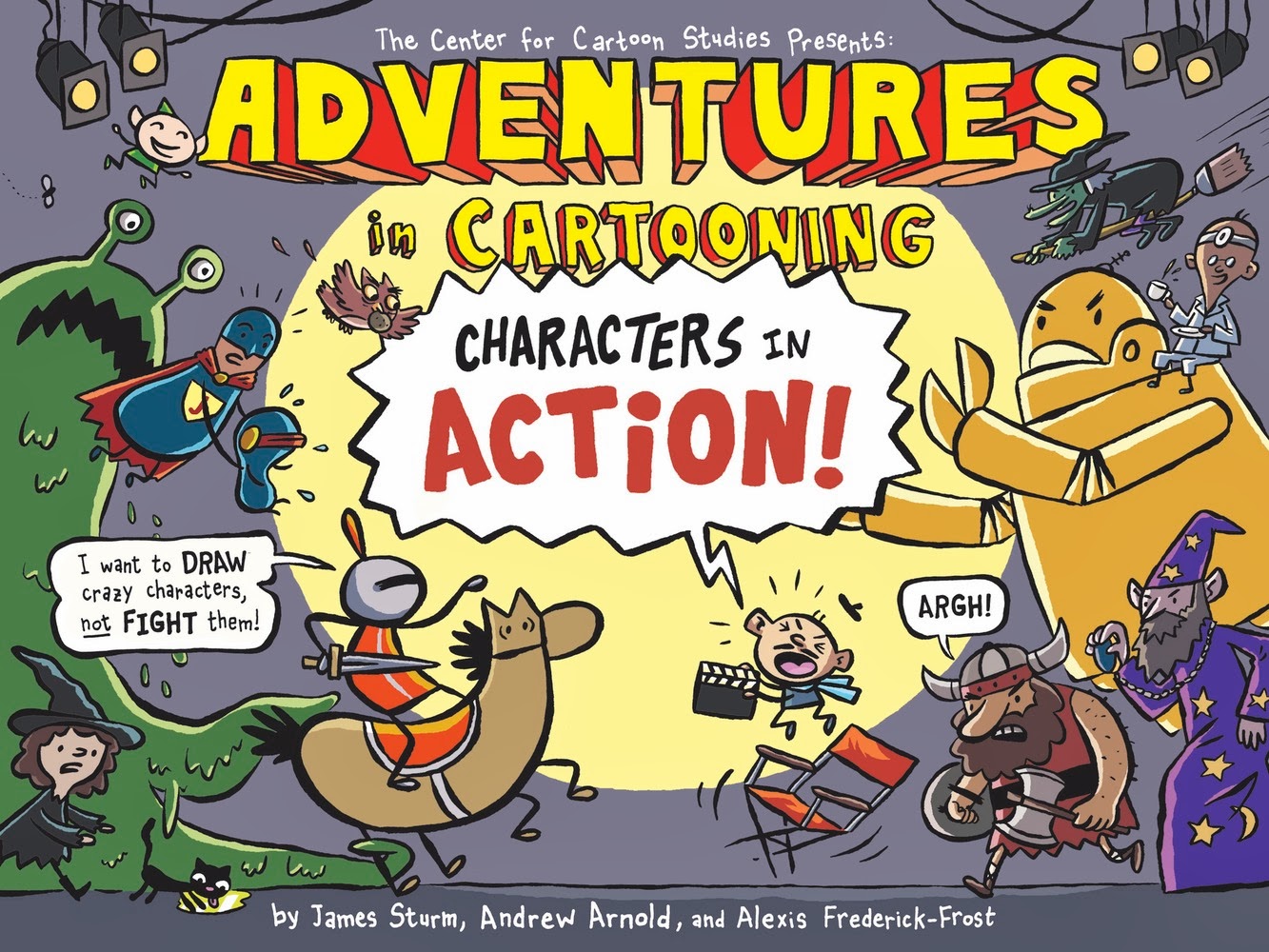
The newest book in the First Second line of Adventures in Cartooning, Characters In Action!, returns to the original's tactic of doing a full story and then explaining its techniques for imitation at the end. CCS chief James Sturm once again teams up with grads Andrew Arnold and Alexis Frederick-Frost (who handles most of the art chores) to create a charming, funny and ultimately useful guide to character generation. The story follows the knight who's been the protagonist of each book, trying to figure out why her castle is under assault by a host of weirdos. A Hollywood director named "Otto Airs" (ouch) is casting his new movie, which leads to all sorts of shenanigans. It was quite clever of the team to compare casting a movie with creating one's own comic book characters, which made it natural to discuss "wrong" fits for roles, what a "right" fit looks like, etc. When it came time to actually discuss specifics, the reader is ready to absorb the highly useful tips on how to design simple characters that are easily reproducible from panel to panel, how to tell characters apart using only body language, how to draw different character expressions, etc. There isn't an emphasis on more advanced ideas like panel-to-panel and page-to-page transitions, just a grounding in the basic skills to encourage a fledgling cartoonist to draw a story with confidence. In that respect, it's the most useful book yet in the series.
The promotional pamphlet for CCS has traditionally been a strong comic in its own right. This year's pamphlet, drawn by Brandon Elston, is no exception. His style is a mix of underground exaggeration and alt-comics cartoonyness, drawing from the same sort of classic comics and kids comics that folks like Terry Laban, Jaime Hernandez, Peter Bagge and Robert Crumb did. His style is in the same ballpark as fellow underground enthusiasts Joseph Remnant, Ed Piskor and Noah Van Sciver. However, Elston's art is much more rubbery and clear-lined than those artists. Elston uses cross-hatching when appropriate, but his work is nowhere near as dense as those peers; instead, he prefers to use strong black and white contrasts to heighten his goofy, grotesque character work. This is a talented artist still cycling through his influences but already demonstrating he has the chops to do any kind of work he wants.
Let's take a further look at a trio of CCS cartoonists who sent me word of their on-line efforts. First up is Jai Granofksy, who's doing a traditional webcomic called Waiting For Baby. It's just 29 pages in at the moment, but there's something wonderfully earnest and intimate in the way he's revealing both himself and his relationship with his girlfriend, Shira. The story starts with his courtship of Shira, one that spanned a number of years, and has stopped with Granofsky encounter a minefield of self-doubt and depression as he's wondering if he's a fit candidate to be a father. His character design is fleshy and cartoony, with lots of big bodies and expressive faces. He reminds me a bit of Mike Dawson, who employs a similar style of expressive realism in his comics as the reader always knows that this is a story with real emotional stakes that's given just a hint of distance with character design and expressions that occasionally get rubbery and distorted. His use of color is mostly muted and restrained, until he needs to emphasize something like a bedbug infestation. That restraint allows him to occasionally use color as a sort of exclamation mark,and it's an effective storytelling tool. Granofsky's story is one that's as much about his own painful self-exploration as it is (at this point) about the pregnancy and fatherhood, as a family dynamics experience hammered home his terror that he might pass on bad genetic traits. The framework of the pregnancy takes it out of the realm of simple autobio navel-gazing, as does his honest devotion and care for both his girlfriend and the future baby.
Second is Ian Richardson, who sent me links to three stories. All three are about prey and predators to some extent. "Prey" is the most visually direct version of this kind of horror story, as a creepy man follows a young girl (complete with balloon) down into a deserted subway stop, only to find out that prey that was too good to be true certainly was. This comic is interesting because of Richardson's interesting use of weird angles to create a disorienting effect for the reader. "Husk" has a visceral quality not unlike that of a Tom Neely comic (without the same level of polish), as this time the predator is a former companion: a black, mossy substance that has sharp, needle-like edges. That substance protected a mariner who happens upon a magical island (that looks not unlike human skin), but when it looks like the island's magic will free him of it, the substance acts violently. The least successful of the three stories is "Alpha", an overly talky comic about a dog that eventually takes revenge on an old woman who kills her husband (and the dog's master). This revelation is not made explicit, but is telegraphed way ahead of time like an old EC comic. That's the oldest story discussed here, and the subsequent stories feel like Richardson attempting to explore the same kind of idea in more subtle and visually exciting fashion. "Prey" in particular is especially promising because it succeeds in providing the kind of visual shock that "Alpha" does not.
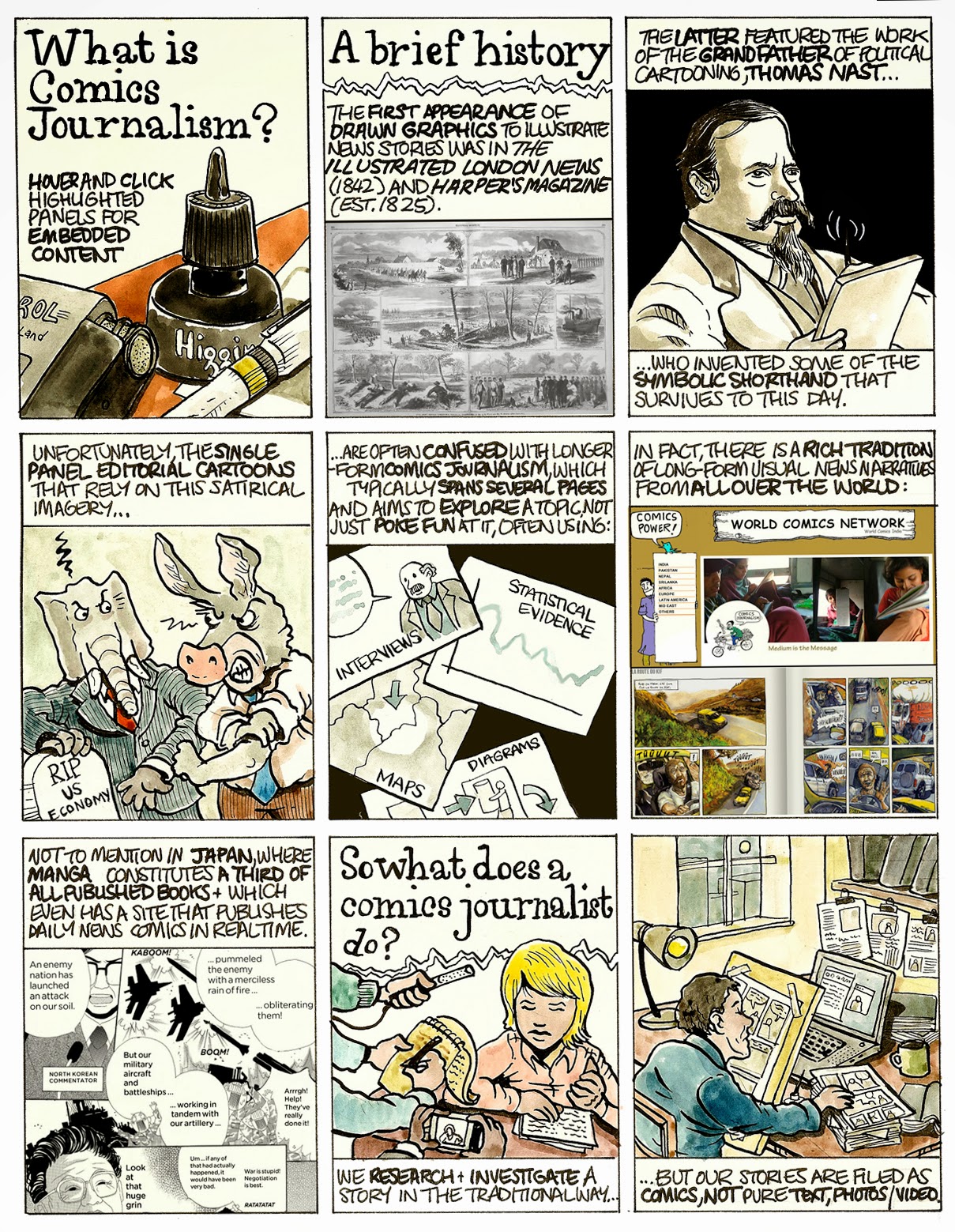
Lastly is the prolific Dan Archer, the cartoonist/journalist whose work is everywhere these days. His "Introduction to Comics Journalism" is a useful an d visually fluid overview of the discipline/art, one that gets to the heart of the "objectivity" debate in journalism. Archer makes up for his limited rendering ability by trying to think of innovative, interactive ways comics can relate a story, like in this account of the 2007 Nissor Square shootings in Iraq. Archer uses a slide show to advance the timeline on top of a map with simple icons, and the reader then clicks on "hot spots" to read a brief comic describing the action. It's an amazingly effective way to get across eyewitness accounts of a complicated and awful incident. This strip is a more standard approach, as Archer uses the effective device of using one person's anecdotal experience to bring the global slave trade into sharper relief. When Archer uses a single shade to accentuate his drawings, it gives his comics power and consistency. However, when he tries to use too much color in too small a space, like in this strip about the US banking crisis, the result is a cluttered and fussy looking page that's hard to read. That strip about the shootings in Iraq was like nothing I've never seen before; it had some small elements of animation but its design and heart was all about comics. I'd love to see a similar kind of comics/map/timeline combination for other events in the future from him, as it really takes advantage of technology without simply having bells and whistles for their own sake.
Wednesday, September 5, 2012
Comics For Kids; Toon Books, Adventures In Cartooning, Anna & Froga
The Toon Books line is an interesting success story, given that editor and publisher Francoise Mouly was initially unable to sell her idea of comics for very young readers to a single big publisher. Fast-forward a few years, and the line has sold a lot of books and won several awards, and is now an imprint of a larger publisher. Mouly still retains control, but she's started to farm some of the work out ever so slightly to her daughter Nadja, who was a "guest editor" on a couple of the recent books. Mouly has expanded her initial vision for the line, concretizing the notion that some of the books are aimed at pre-K kids and others are for more slightly advanced readers. As such, a couple of the books here are longer and more challenging than any of the prior volumes, but Mouly is also careful not to abandon established formulae, like the beloved Benny & Penny books of Geoffrey Hayes.
Let's start with Hayes. His latest Benny & Penny book is called Lights Out!, and it's once again an evocatively drawn story about two siblings at bedtime.Hayes has an incredible knack for portraying their relationship with great affection yet still understanding the ways in which children squabble and generally enjoy making each other miserable at times. Here, the mischievous Benny can't settle down at bedtime, annoying his sister in every way imaginable, until he has to go get his all-important pirate hat from the playhouse outside. Throughout the series, Hayes has loved folding back a story's conflict onto the aggressor (usually Benny), putting them in the sort of situation that they taunted the other about. Once again, Hayes masterfully balances his background as a traditional illustrator of children's books with making this work as a comic, including finding ways to lead the reader's eyes across the page as simply as possible. At the same time, he provides a wave of eye pops, as characters bleed off-panel or tiny bugs pop up in the same place. For the youngest of readers, these are perfect story and art objects.
Frank Viva (an illustrator for the New Yorker) takes a completely different approach in A Trip To The Bottom of the World. Drawn in Illustrator, this book is much colder and starker than Hayes' work, filled with a confluence of basic shapes and colors that pop off the page.This book is actually based on Viva's own experience on an Antarctic research vessel, as the things that the explorer's mouse sees are things Viva spotted. The plot (with the mouse constantly wanting to go back home, until the trip is over) is fairly boilerplate for this kind of thing, but it's Viva's visuals that make this one worth a look.
Mouly switches things up once again with David Nytra's pen-and-ink comic The Secret of the Stone Frog. It's more than a little influenced by Lewis Carroll (and of course the illustrator John Tenniel) by way of Winsor McCay, as a girl and her younger brother try to find their way home in a mysterious forest, aided by the immobile but loquacious titular frogs. This 80-page book is the longest of the Toon Book entries and is billed as the first Toon graphic novel, and as such it's obviously aimed at a six or seven year old as an early "big" book for them. The book is beautiful to look at and carries the line's usual sterling production values, even if it does feel derivative.
The gem of Toon's fall batch is Rutu Modan's Maya Makes A Mess. It's a pure visual joy and has some of Modan's best-ever cartooning. It's about a messy little girl with bad table manners who is called to eat with the Queen, and her uncouth nature (done because it's more fun to eat with your hands) has a surprising effect on the Queen and her court. Modan's line is crisp and clear, and her already highly-developed color sense makes every page a treat, without going into too much pyrotechnics. There's also a running gag at the bottom of the page that appears to simply be a visual flourish at first, but is revealed to simply be a time-release joke. I love that this book does not desire to teach any sort of lesson about good manners but rather is all about pursuing a joke to its logical end.
The Center for Cartoon Studies team of James Sturm, Andrew Arnold and Alexis Frederick-Frost return for their third book in the Adventures In Cartooning series, this time with the every-sturdy Christmas Special. This book really does have "stocking stuffer" written all over it, as it's by far the least interactive of the three books. The first one taught cartooning basics and the second volume was pretty much a cartooning workbook, but the Special is mostly just an extended series of (effective) gags and rhymes about Santa struggling to deal with giving gifts in the digital age. All the reader gets to do is write a comic strip for Santa about something cheerful, and they are then encouraged to send it to CCS ("Halfway to the North Pole") for Santa's benefit. It's a clever idea, and I'm curious to see what kind of responses they will wind up getting. The book takes a while to warm up, but once the cartooning elf summons forth the cartooning knight of the first two books, the gags start flying and the visual storytelling of the trio starts popping. I'm still not quite sure what the division of labor is like on these books, but it does seem like I sense Frederick-Frost's hand most strongly. I'm not sure where this series goes next; does it try to teach a more advanced lesson, or will it stick with concept books like this one? I'm hoping for the former (at least another challenging activity book), but I'm guessing the latter would be an easier sell.
It makes sense that Ben Jones blurbed the translation of Anouk Ricard's Anna & Froga: Want a Gumball? That's because her figures look a lot like Jones' own weird, crude and ugly drawings. Like Jones, however, those figures have an enormous amount of personality and power on the page, thanks in part to what looks like a lively application of magic marker. I've never seen a book that had so many ugly drawings on it that made me want to stare at it for hours. Part of that is Ricard's judicious use of negative space on every page, saving the reader from being overwhelmed by the drawings and the colors. Indeed, the use of white made it easy for anyone to follow the characters across the page and zero in on the gags at hand. As interesting as the art is in this book, it's Ricard's skill as a humorist that makes this book endlessly readable. The title characters, plus dog friend Bubu and cat friend Ron form a kind of Seinfeld gang that milks a lot of humor from awkwardness, vanity, self-deception and a healthy sense of mutual aggravation. On some pages, Ricard goes from her crudely-drawn comic strip to beautifully painted full page strips that comment on the previous story. One of the best things about this book is Ricard's storytelling rhythm. With each story running about three or four pages, that allows Ricard to pack a lot of gags into this forty page book. She ramps up the awkwardness in each strip until the climax of the final punchline, gives the reader a palate cleanser with her paintings, and then repeats the process ten times. The result is a highly meaty forty pages, though I found myself wanting more by the end. This is a truly outstanding book for kids, one they will be able to follow with ease as well as appreciate the jokes, which generally wind up with a chase scene, things being thrown, or something gross or cruel happening to one of the characters. I hope this sells well enough for Drawn & Quarterly to publish many more volumes.
Tuesday, July 10, 2012
Anthologies: Lies Grown-Ups Told Me, Cartoon Crier
Lies Grown Ups Told Me, edited by Nomi Kane, Caitlin M, and Jen Vaughn, is yet another quality anthology assembled by two CCS alums and the former Schulz Library librarian (Caitlin McGurk, now at Ohio State). Not everyone in the anthology is or was associated with CCS, but it's a good 90% of the book's contents. The anthology's theme is simple, yet proves to be fertile ground for its artists. There's not a single clunker in the whole book, even those strips whose draftsmanship isn't in the same class as the best artists in the books. Some of the very best CCS draftsmen are featured here, including Nomi Kane, Dakota McFadzean and faculty member Jon Chad. All three members of that trio do not disappoint. Kane's story is hilarious, as she repeats as a matter of fact that pregnant women shouldn't swim with dolphins because their sonar can detect the gestating baby, leading them to corner the women and kidnap the babies to raise them as their own. Until she says this out loud to her friend, she believes it to be true. Kane's figure work is pure eye-candy: expressive, amusing and packed with clever details. Speaking of detail, McFadzean's story about his grandfather's claims of being able to draw the best Donald Duck is both warm and wry, bringing past and present together in a simple satisfying manner. There's a clean elegance to his line that nonetheless always conveys warmth and emotions just below the surface. Chad's story about his parents inadvertently realizing that a television show that signaled bedtime meant putting him to bed whenever they wanted is a pretty simple one by his visually lush standards, though he still manages to throw in some clever flourishes.
Most of the contributors play the theme for laughs, and the sheer variety of lies they later discovered makes for a lively book. Some are a bit more sobering than others, like Tom Casteel discovering that hard work and dedication doesn't always pay off in "Patrol Boy of the Year", or Cody Pickrodt wondering why on earth he thought his dad thought it would be funny to pretend that he died after a rough-housing session with his two young children and no other adults around. Saying things to scare kids is another running theme, as Beth Hetland's sister freaks her out with tales of the "The Undertoad" living in the ocean, Bryan Stone's grandmother keeps him from exploring the forest by telling him that "Red Eyes" lives there and will eat his dog, and (worst of all), Andrew Greenstone's parents keep him in line by telling him of his "other brother" Igor whom they killed and buried in the backyard because he was a naughty boy. Ben Horak's "Sweet Trap" was along those lines but even better because the threat was silent. He and his brother kept raiding the cookie jar, and his frustrated mother put up a bunch of wires and other junk on it, saying "Now I have to do something drastic!" There's a hilarious two page spread of Horak and his brother imagining what kind of trap their mother might have set, when the reality is that it was just a hoax.
Overall, the tone of the book is breezy and affectionate. That's best encapsulated by Lena Chandhok's "Earth Girls Are Easy", an account of watching that movie as a preteen with her grandfather and younger sister. It's a lovely story because it captures the moment when Chandhok realized that she was suddenly on the other side of the divide of adult and child, knowing something that her younger sister didn't. I liked that the editors reached out to plenty of non-CCS artists as well, like letterer/caricaturist Rick Parker's illustrated story about being accused of cutting up a garden hose, Jesse Lonergan's hilarious account of being duped as to the origin of broccoli, and the superb Scottish artist Lorna Miller chiming on in on the reasons why she was told not to pick dandelions as a child. The editors do a nice job of alternating the truly silly stories with the slightly more contemplative or serious ones, though the tone throughout is fairly lighthearted.
Another CCS anthology with precisely the opposite tact is The Cartoon Crier, edited by Cole Closser, James Sturm and R.Sikoryak. This is a free, 36-page comics broadsheet that's a collaboration between the National Cartoonist's Society and CCS, with the theme being sadness and crying. This is a fascinating snapshot of contemporary newspaper cartooning and the next young wave of cartoonists, as the editors plumb the depths of veterans like Mort Walker to find those strips that defy conventional punchlines in the service of expressing misery. I imagine this project owes much to the Comics Editor of King Features Syndicate, Brendan Burford, who is also a small-press cartoonist. He contributes a strip theorizing how cartoonists transformed from garrulous men-about-town in the early part of the 20th century to the more introverted and downbeat characters of recent years, and guesses that the influence of Charles Schulz had the biggest impact. It's obvious that the hand of Schulz can be felt in many of the modern strips when they do turn away from gags.
Consider Lynn Johnston, whose series of strips regarding the death of a family dog is absolutely shattering. Like Schulz, the strips have the rhythm of a comedic strip, but she eschews punchlines in some for portents, while the punchlines in other strips later take a dark turn. Sturm provides an example of a brutal strip by the Family Circus' Bil Keane that technically contains a gag but only in the bleakest of terms. In general, the strips by the CCS cartoonists are more interesting and daring than the NCS strips, which is understandable given the total freedom they have. While there a few CCS veterans and some other outside artists, most of the contributors to this comic are either current students or 2012 graduates, and they give a fine accounting for themselves given this format. April Malig's simply-drawn strip about her difficulty controlling her tendency to cry is clever, especially given her solution. Sophie Goldstein's full-page "Potato Baby" is hilariously depressing as it doucments the ridiculous travails of the tile character. Rachel Dukes' slickly-drawn "Lucky Dog" is even more over the top, as it addresses the side issue of the lonely life of the cartoonist. Closser's own "Little Tommy Lost" and his activity page are evocative of classic newspaper cartooning. The former is an homage to Milt Caniff-style adventure strips, while the latter goofs on being maudlin. Donna Almendrala's Nancy pastiche is hilarious, expertly evoking the cadence of that strip while staying on theme. (She also had a strong strip in Lies Grown Ups Told Me.) Max Riffner and Dakota McFadzean are two cartoonists whose slick draftsmanship is clearly strong enough for syndicate work, even as their strips here both take enormously dark turns.
The lineup of veteran cartoonists, CCS alumni and CCS fellows here is killer. Sturm's autobiographical strip about getting older, drawn in the form of a superhero comic, is thoughtful and smart. Sikoryak, the comics/literary mashup master, this time around puts together Dilbert and Herman Melvile's Bartleby The Scrivener, an inspired pairing given that both address workplace ennui and forms of rebellion. Scribbly autobio specialist David Libens contributes a marvelous strip about a kid visiting the grave of his dead pet and telling her a secret: that he no longer uses a potty seat. It's a strong use of detail, as Libens has a knack for translating how little kids talk into comics form. Melissa Mendes has a typically strong but understated story about a girl who sees her dog die in an accident, with the last panel showing her back to the reader as she processes the grief by drawing pictures of her beloved pet. Jon Chad goes literal with an ingenious, thin-lined strip about a "scientist" who takes us through a series of background sight gags about how and why humans cry. Joe Lambert's "Retainer" is yet another example of the artist's increasing complexity and maturity, even as he continues to explore the dynamics of children and teens. Ariel Bourdeaux, the 90s comics veteran who recently graduated from CCS, contributes a funny strip about crying listening to children sing, and the embarrassing feeling of being spotted in public in a bright room, crying uncontrollably. Laura Park's story about someone recalling their mother being sent away before their fifth birthday because of mental illness is all the more heartbreaking when the final panel reveals that she was glad because she knew that she'd get the biggest slice of cake. Robyn Chapman's story about a woman who is unable to cry after a childhood as a crybaby is restrained yet powerful.
The broadsheet also contains commentary by Shaenon Garrity on the saddest comics she's ever read, while Andrew Farago compiles the results of a survey of cartoonists about the same question. Overall, The Cartoon Crier isn't necessarily a compelling read from page to page and strip to strip, as many of the syndicated strips are still rather banal. This comic is better read like a regular newspaper section--with some brilliant strips, some reliable favorites, some interesting discoveries, and a good deal of dross. Its goal of comparing and contrasting two entirely different worlds of cartooning and finding common ground was an interesting one, especially since Schulz is an influence on nearly every cartoonist. What's most impressive about it is that the youngest cartoonists really took this assignment seriously and did their best work. It's not unusual to be impressed with CCS cartoonists after reading an anthology, but it's rare that every contributor does their best work. It's this group that's the true backbone of this anthology.
Wednesday, June 13, 2012
A Day In The Life Of A City: Denys Wortman's New York
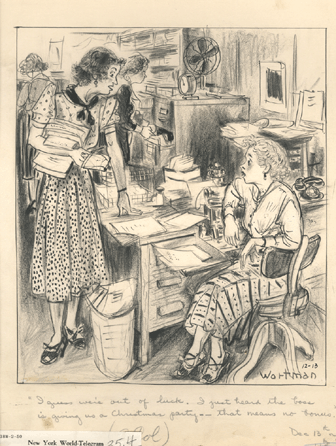
What's interesting about this book is that the quality of the drawings is far better than a book that simply reprinted his work from newspapers or tear sheets would be. The book is shot directly from Wortman's pencils, which have an amazing power and sheer presence. This is a book about the teeming millions: young and old, rich and poor, working and unemployed, on the sidewalks or at the beach. It starts off in the morning, as housewives hang laundry outside their fire escapes and craggy old men rush to the subway. Young women rush to work as secretaries or factory workers, while middle-aged men try to find ways to collect on bills. Though the strips are not printed in anything resembling chronological order, Sturm & Elston still whip us across the city at work: the theater district, the garment district, maids, janitors, executives, and cooks at diners. With much of the strip running through the depression, Wortman shows us people desperate for aid and jobs. There's a jaw-dropping set of strips set in Coney Island, the vacation spot of choice for the working class. Though Wortman worked with a lot of photo references, he still does an uncanny job at capturing the spirit and the motion of so many people. The beach scenes are memorable because they depict huge crowds of people on the beach, on the boardwalk and under the boardwalk (with some poses that must have made the newspaper's censors a little nervous). He captures that sense of people wanting to pretend that they were somewhere exotic, even if every other New Yorker seemed to be there as well.
Wortman was also aces at drawing kids: out on the street, reading comics, running through fountains, and playing macabre games like "electric chair". His understanding of gesture and body language made every strip come alive, and his attention to detail like clothing is especially remarkable. This book is practically a class on New York fashions over a thirty year period, both of the rich and the working-class. We take a peek into classrooms, hospitals, doctor's offices, and beauty salons. We follow shopping trips and pretzel salesmen. We take a look inside the Museum of Natural History (that blue whale has been in the same place for a long time) and see the game from behind home plate at the Polo Grounds. We see the city in the sun and in the rain, go out on the town to dinner and the theater/movies/opera. We follow sailors going dancing and attend many a wild, late-night party. Finally, we see people make their way home, including one man on an empty subway who nonetheless can't help but stand up out of sheer habit.
Most of the captions to the images were written either by Wortman's wife or someone else; they were more capstones to the images than real gags. Some of them don't even try to be very funny--just accurate. The captions help provide some context and flavor for the images, though most of them could easily stand on their own. What I like most about Wortman's drawing is just how intuitive it is. He seems to know just when to use his charcoals to add some fuzz and shading to an image, and when to sharpen his pencil and let certain kinds of details pop off the page. These are not photorealist drawings, nor are they entirely expressionistic. These captions carry their own sense of reality, thrusting the reader into the image and giving one a true sense of what it might have been like to been in that particular moment, to see a wide range of actions unfolding in front of your eyes. The mass of humanity he depicts in page after page creates an imaginary buzz, as the reader imagines what all those people together must sound like. It's a rare art book that turns out to be a page-turner, but that's certainly the case with Denys Wortman's New York, and that's a tribute to the talent of the artist and the vision of the editors.
Saturday, October 29, 2011
The Comics Journalism of Josh Kramer

Cartoon Picayune #2 by Josh Kramer. Kramer, like Dan Archer before him, had journalism on his mind when he went to the Center for Cartoon Studies. Unlike Archer, whose comics have a political bent, Kramer seems to prefer human interest stories. The second issue of his journalistic anthology series finds him including other correspondents, but all of them are subject to his rigid rules regarding sourcing and quotes. Even if the stories are drawn as a narrative with dialogue, Kramer makes a point of making the reader understand that his stories are "rigorously reported". The Cartoon Picayune reminds me most of Brendan Burford's Syncopated anthology, which features similar first and second person reporting styles. Unsurprisingly, Kramer's reach is a local one, with stories about a local high school ski jumping team, a gubernatorial primary, a day camp for rock, and the evolution of a local brewing company.

"Fly By Night" is hampered by being the second part of a story about that ski jumping team. The angles he was approaching did become quickly evident, however, like the young rookie girl and the team's star who was trying to beat the best jumper in the state. When Kramer is drawing diagrams or depicts motion, his art is certainly up to the task of getting across his ideas. His major flaw as an artist is depicting different faces. In this story that features so many different characters, this is a significant problem. I think Kramer is cognizant enough of this problem to get around it by emphasizing emotion through using lettering and body language. Kramer is admirable in that he doesn't try goosing the results of his story to make it more dramatic, which is especially unusual for a sports-related story. Instead, Kramer is more interested in the mechanics of the sport, how the kids got into it, and the minutiae of how a ski jump meet is conducted. In terms of the action, Kramer is best at drawing sharp angles, which made him perfect for depicting the actual jumps.

"School's In For Summer" sees Kramer change some of his approach a bit, giving his characters tiny white circles for eyes. There are still some awkward drawings of characters in some panels, but there's generally a better balance between character and background. The story itself is a quick but thorough examination of a "school of rock" summer program, going through the program's goals and interviewing some of the kids. Kramer also did a separate mini called One Place, One Cheese, which details the process two local cheesemakers go through in creating their product, as well as providing other details about their lives. In each of his stories, Kramer has a way of letting his subjects speak for themselves without adding his own editorializing as to why they're interesting or significant. The simple choice he makes to write about them indicates that he thinks they're worth of reportage.

Bill Volk's story about the history of Iron City Beer in Pittsburgh, "'arn", suffers a little from letting the new CEO talk at length without really challenging any of his premises. Volk's cartooning is quite lively, however, and the slightly grotesque touch he added to his character designs was an interesting choice. The folksy reporting style of James Sturm and the delicate character drawings of Katherine Roy were a perfect match in the depiction of a day in the life of a candidate for the governorship of Vermont, "Honk and Wave". Given that this was a story consisting entirely of talking heads, it was to Roy's credit that she made it so interesting to look at. Kramer certainly did a nice job as an editor, balancing three different kinds of stories in the sort of anthology that's quite rare. Kramer's rock-solid standards as a journalist and his editorial eye are a great foundation for his work; it will simply take time and experience as a cartoonist to bring that aspect of his work up to the rest of his standards.
Sunday, July 3, 2011
Quick Comments On Kids' Comics

The Super Crazy Cat Dance, by Aron Nels Steinke . (Baloon Toons/Blue Apple Books. Aimed at ages 3-6). This is modeled after Francoise Mouly's Toon Books line, right down to the shape and design of the book. Of course, those books were modeled after Golden Books and other classic book designs for kids, which are heavy on decorative properties. Steinke has an idiosyncratic voice as a writer, a tone that winds up being perfect for a kids' book. That's partly because while he channels Dr. Seuss for the rhymes about cats that make up most of the book, he screeches to a halt to actually write about the title dance in a way that's genuinely amusing and unexpected. His line is simple but he adds a lot of detail and "eye pops" on every page, making this an ideal book for a child to read again and again as they take in new images. Lastly, the colors in this book are simple but warm & inviting, providing an interesting contrast to the predominant use of black as a background color. Steinke seems to have really found his niche with this book.
Gumby's Gang Starring Pokey #1, by Michael Aushenker & Rafael Navarro. (Gumby Comics. Aimed roughly at ages 7-10.) This is an agreeably dopey comic jammed with funny visuals, dumb puns and just plain nonsense. In other words, this time travel story is a snug fit in the continuum of strangeness that is the world of Gumby & Pokey. Navarro's loopy line and Lance Borde's garish colors give the reader something interesting to look at in every panel. Gumby and Pokey are funny-looking characters to begin with, but Navarro's drawings of Gumby & Pokey as Run-DMC, cube-headed people of the future and Gumby climbing the Trojan Horse are simply funny apart from their larger context. Aushenker's references to 80s rap, the Minutemen, and Suicidal Tendencies are meant to fly over the heads of any kids who happen to be reading the comic (sort of the way The Adventures of Rocky & Bullwinkle did). Aushenker's frantic, silly and absurd style of humor is a contrast to the gentler, slower pace of the original cartoons, but creator Art Clokey designed these clay characters to be flexible in every sense of the word. Aushenker clearly respects the source material but exploits that flexibility to expand the world and references of its star characters. I don't think every kid who reads this would like it, but a certain kind of kid to whom absurdism is appealing would no doubt re-read it endlessly.
Adventures In Cartooning Activity Book, by James Sturm, Andrew Arnold & Alexis Frederick-Frost. (First Second. 78 pages, aimed roughly at ages 6-12.) The follow-up to the excellent comics/textbook for kids encourages cleverly disguises its exercises as fun activities. The book follows a knight in search of adventure who is encouraged by an elf to draw. The reader is asked to draw increasingly more complex objects, starting with free-form doodles to copying a simple horse to making up food items to draw in a fridge. From there, the reader is introduced to sound effects, decorative aspects of drawing, simple perspective, backgrounds, dialogue, sound effects, lettering, panel sequencing and transitions, motion, and the passage of time. To my eye, it looks like Frederick-Frost's line is responsible for most of the figure work, with his simple brush line and supple figure work delighting the eye at every turn. There's a warmth and approachability on every page that's designed to draw in readers, but the book also challenges its readers with the final exam of doing all the work (save panel design) for a 14-page story. Hopefully, there will be future activity books that up the ante a bit further.
Pilot & Huxley: Their First Adventure, by Dan McGuiness. (Graphix!/Scholastic. 62 pages, aimed at ages 7-9.) There's a reference to South Park in this comic, which I thought odd given its target audience. In many respects, the smart-ass give-and-take between the title boy characters and the deliberately crude, stilted art make this a sort of action-adventure version of South Park, minus the swearing and sex jokes. McGuiness does actually land plenty of good gags in this silly book about two boys hopping between dimensions, but the computer-drawn art is crude to the point of distraction and too many of the gags rely on gross-out humor. It's also surprisingly meta for a comic aimed at kids. None of that would have been a problem if the art (and that goes for the garish coloring) was simply more interesting to look at.
Missile Mouse: Rescue on Tankium3, by Jake Parker. (Graphix!/Scholastic. 158 pages, aimed at ages 8-12.) It's no surprise that Parker has a background in animation, given the clean lines and functionally attractive use of color in this book. This science-fiction story is an entirely tidy adventure that focuses on its episodic plot and simple characterization. Parker's anthropomorphic mouse hero is a triumph of character design, as is his primary antagonist in the book, the Blazing Bat. Parker skillfully introduces visual elements early in the book that either wind up becoming plot points or recurring bits of comic relief. The result is a smooth, pleasant read that is generic and not especially memorable, in part because the main character is such a generic action hero. Like many an animated action feature, the focus on action over character makes it difficult to create a connection with the titular character. Still, the clarity of action, simplicity of the humor and crispness of the color & character design will no doubt be appealing to readers at the younger end of its target audience.
Sidekicks, by Dan Santat. (Graphix!/Scholastic. 224 pages, aimed at ages 8-12.) This is a book about the super-powered pets of a generic (but older) superhero named Captain Amazing. It's got two chief assets: the chunky & blocky drawings are expressive and funny, and Santat lets the characters dictate the action at all times. The plot is simple and the twists are telegraphed, but both serve simply as a stucture for the four animal characters to interact. The emotional plot of the book involves three of the animals (a dog, a hamster and a newly-arrived chameleon) wishing they could spend more time with their master, a hero on the verge of retirement. The hero decides to get a new sidekick, and the dog (Roscoe) decides to try out for the role. When the hamster (Fluffy) and chameleon (Shifty) decide to do the same, they encounter the cat (Manny), their former "brother" who had run away from home after a long stint as the hero's sidekick. That emotional structure is imbued with genuine warmth to go along with slapstick, and it's the key to the book's success. The story is otherwise pretty silly superhero boilerplate, but each character's personality drives the book in different ways. The dog is loyal but stubborn, relying too much on brute force; the cat is prickly but clever, slowly letting his guard down with regard to his brothers; the hamster is good-natured and relentlessly loving; the chameleon is a bit baffled but eager to fit in. Santat's use of color is expressive and appealing, spotlighting his idiosyncratic visual style. This was the best of the Scholastic books by far.

Ghostopolis, by Doug TenNapel (Graphix!/Scholastic. 268 pages, aimed at teens.) I've always found TenNapel to be a clever cartoonist whose comics tend to wind up being all over the place. This book is no exception. It's a love story about a shiftless ghost hunter and a clever ghost. It's a family rapprochement story. It's a sick child story. It's a monster story. It's a quest. It's an action/adventure story with fantasy elements. It's a story about belief. Gross-out gags are mixed with cloying sentiment. It's not complex as much as it is cluttered, with some characters possessing rich backstories and others lacking enough depth to justify their heroic arcs. There's plenty to recommend in this volume (the character designs, unsurprisingly, are all top-notch, with clever variations on familiar designs), but it simply doesn't cohere--especially at an emotional level.

Bad Island, by Doug TenNapel (Graphix!/Scholastic, 224 pages, aimed at ages 10-13.) This book by TenNapel has a much tighter focus, following a family of four and their life-and-death adventures after they get shipwrecked on a mysterious island. Like Ghostopolis, this book concerns a dysfunctional family and how the extreme conditions of an adventure scenario provides a crucible for its repair. In particular, TenNapel zeroes in on wayward sons, and Bad Island provides a clever set of parallel narratives regarding two sons trying to assert themselves as adults in different but equally inappropriate ways. TenNapel quickly sets up the personalities of each family member before putting them on the island, and then jacks up the danger & action quotient steadily. The connections between scenes and flow of the action are reminiscent of Carl Barks at times, and his character design (as per usual) is elastic, animated and expressive. The one sour note of the book is the character of the mother, who is at first a sour scold and doesn't advance much past that. The female characters in both of his books are one-note: the wacky girl in this book, as well as the bitter mother & sadly scorned ex-girlfriend in Ghostopolis. Those latter characters go through what I call a binary arc, switching from unhappy to happy without the same sort of journey as the male characters. As a result, that change feels forced and unearned. On the whole, the action in this book is compelling and the family elements ring true without being too didactic.

Bone: Quest For The Spark, Book One, by Tom Sniegoski & Jeff Smith. (Graphix!/Scholastic. 218 pages, aimed at teens.) Smith's Bone series is the gold standard for young adult comics over the last twenty years after it initially garnered an enormous adult audience as well. While Smith won't be writing new stories himself, the Bone empire rolls on with a new series of novels written by long-time collaborator Sniegoski and illustrated by Smith. This book is right in the Bone pocket: sinister & mysterious force threatening happiness in the valley; a young and unlikely hero teaming up with a group of Bones; a desperate quest to find the one thing that can defeat the enemy, picking up strange allies along the way. Sniegoski's take on the Bone mythos is perfectly competent, but I've always felt that his writing was a bit on the broad side--which is saying something, because Smith certainly went for some broad punchlines throughout the course of his original series. In this book, he reins himself in a bit, but he lacks that certain quirky something that made Smith's series such a huge success. This being prose instead of comics doesn't help matters much, given that the kinetic quality of Smith's panel-to-panel transitions carried so much of the series' momentum. As a result, the book winds up being a pleasant visit with some old friends but not much more.
The Good Neighbors: Book Three: Kind, by Holly Black & Ted Naifeh. (Graphix!/Scholastic. 112 pages, aimed at teens.) This book is radically different from the others on this list, in that it's not a "boy's adventure" action quest. In terms of packaging and even certain story elements, there's a certain resonance with the mega-successful Twilight novels. The cover features a young woman clearly being torn between two different lovers (which is indeed the case, as the story reveals). How this book is radically different from Twilight is that the female protagonist here is a decidedly active one, as opposed to the more passive Bella. I had not read the first two books in this series and so missed the full emotional ramifications of the initial premise: an odd teenage girl named Rue learns that her mother is in fact a faerie and that she has all sorts of magical powers. The end of the second book finds her city being merged with the land of Faerie, with all of its attendant nastiness and a potential war brewing between the two peoples. Rue's struggle is being caught in-between, with no clear choices for resolution: between her mother and father, between being human and immortal, between her boyfriend and a newer lover, between her friends & the life she knew and a different life in a magical realm. Black, the writer, wrings every bit of angst possible out of these conflicts, rendering the entire book an overwrought series of pained internal monologues. After a while, this gets to be tedious. To her credit, Black doesn't cop out with any easy decisions at the end, and the choice Rue makes is a surprising one in many ways. Naifeh's work is excellent throughout; his shadowy pages are reminiscent of a slightly more cartoony Gene Colan. He does his best to add life and atmosphere to the story, contributing nicely to its downbeat mood. While I am far from the target audience for this book, I appreciate Black attempting to steer away from cliche' as much as possible while still including the sort of story elements that that audience expects from a fantasy series.
Monday, April 20, 2009
Expanding Pedagogy: Adventures in Cartooning

It's a golden age for comics in many respects, but it's especially a great time for comics textbooks. With schools such as CCS, SCAD, SVA and MCAD offering formal instruction and cartooning courses popping up everywhere, it makes sense that we should finally see some practical comics textbooks. From Ivan Brunetti's informal CARTOONING book to the densely-detailed DRAWING WORDS AND WRITING PICTURES from Jessica Abel & Matt Madden along with Lynda Barry's more general inspirational guide WHAT IT IS and Kyle Baker's goofy HOW TO DRAW STUPID, there's now an embarassment of riches for anyone designing a course for teens or adults. First Second, a publisher that has gone out of its way to publish a number of comics aimed squarely at children, has stepped up to supplement the Abel/Madden book with ADVENTURES IN CARTOONING, which is designed to both educate and inspire younger children as to the formal properties of comics while telling a story.

Not surprisingly, the book was put together by the head of the Center for Cartoon Studies (CCS), James Sturm, and two graduates of the school, Andrew Arnold and Alexis Frederick-Frost. Frederick-Frost has already won a Xeric grant for his LA PRIMAVERA, and all three artists have collaborated here with a pitch-perfect blend of pedagogy and fun. The book starts off by asking if the reader can draw simple shapes and promises them the ability to draw comics if they can. ADVENTURES simultaneously folds in an adventure about a knight trying to rescue a princess from a dragon into a lesson about the basics of comics, with the knight as a stand-in for the reader and a magic elf as the instructor.

The reader learns about the basic unit of the page, the panel; how to depict motion against a background, the way text influences the way we perceive image, word balloons vs thought balloons and other concepts--all within the context of a comedic quest adventure story. It's actually a delightfully meta sort of story, like a less malevolent DUCK AMUCK, as the characters find themselves able to manipulate the rules of their world as they understand more and more about comics. The end result is extremely clever, as the book surprisingly becomes an exciting adventure story, a brief comment about gender equity, and an open-ended invitation to the reader to create their own stories. The book finishes with a handy appendix of other comics concepts (like gutters), and a step-by-step series of instructions on how to draw basic characters like horses and people. It's hard to tell what the division of labor was between the three artists. I recognize Frederick-Frost's brushstrokes in how the figures are finished, but the way the action is depicted makes it seem like Arnold did the layouts. Sturm may well have written it, given his recent background as an educator, though I'm sure all three artists had input in every segment of the book.

I'll be curious to see what sort of effect this book has on children, and what the best age group would be for it. I'm guessing that the ideal group would be somewhere between seven and ten years old. The book is probably a little too simplistic for anyone older, but I'm not sure its ideas will sink in with anyone younger, unless they have an adult working with them. I do like that there's a sample of an actual child's story based on the book's characters in the back, showing a reader that their own work doesn't have to be as exact as the creators of the book. That said, the only flaw of the book is that it may not be interactive enough to really force the reader into making their own strip. The reader is introduced to a number of concepts, shown how they can work in a story, but then gets swept along with the story. At the very end, the book asks the reader to create their own stories, but this requires a bit of a leap for a child that doesn't already draw. On the other hand, the book could be a way to get children to "turn your doodles into comics!" as the front cover suggests. It's supposing that most children will have the raw material to want to start to draw comics, just not the tools. As such, ADVENTURES IN CARTOONING is more of a toolbox (or perhaps toybox) than a textbook, explicitly providing aspiring cartoonists with the fundamentals an implicitly showing them how to write the sort of story that they'd want to read.