Showing posts with label drawn and quarterly. Show all posts

Saturday, October 31, 2015

Thirty Days of Short Reviews, Bonus: Drawn And Quarterly: Twenty Five Years of Contemporary Cartooning, Comics and Graphic Novels

The Drawn and Quarterly 25th anniversary anthology (henceforth (D&Q25) is a massive book that's scattered, lacks a cohesive focus but bears examination from a number of angles. As such, here are a number of scattered thoughts about this fascinating monster of a publication.

* This book is a sprawling, joyful exercise in both back-patting and celebration of its departing publisher, Chris Oliveros. As such, the many critical essays in the book aren't exactly hard-hitting, and I thought the way some of the essays rewrote history a bit so as to minimize the efforts of other alt-comics publishers during this period (especially Fantagraphics) bordered on being disingenuous. In defense of this unwieldy cudgel of a book, there is really no attempt at coherency to be found in its production. It's more a victory lap than an anthology, highlighting the many aesthetic (and even a few commercial) victories in Oliveros' reign as publisher. There is the germ of a great anthology to be found here. There were also the beginnings of an authentic history of the publisher, but that history tended to smooth over or ignore the bumps in D&Qs road, except when to mention them would valorize Oliveros and his crew. It's a testament to the quality of D&Q's contributors over the years that this glorified vanity project is so often such a compelling thing to read. For that matter, there are a number of excellent comics in among the more standard-issue tributes.

* The design of the book is typical in that it is beautiful; this is not surprising, given that D&Q brought a beautiful design sense to comics for the first time. Opening up with Tom Gauld's droll minimalism and Dan Zettwoch's elaborate chart-making tendencies gave the book a certain sense of self-effacement and restraint.

* The Sean Rogers-penned History of D&Q hits all the major highlights, especially in terms of zeroing in on D&Q's early reputation as a publisher mostly interested in autobio comics. While the problem of comics as a boy's club is addressed, Rogers overlooks the frequently problematic comics of Joe Matt as a symptom of that club.

* The book is jammed full of testimonials, most of which are at least well-written, if not especially revelatory. The exceptions are those of former employees like Rebecca Rosen, since they really convey precisely what it was like to work at D&Q and what the world of comics was like in general.

* I like that the book connects D&Q's publishing history with that of alternative comics in general, especially in terms of aggressively courting the bookstore market.

* The book goes out of its way to not play favorites in terms of its praise of its roster of artists, which I found understandable if evasive. Every one of their artists is simply awesome, though the book makes no mention of artists leaving D&Q for other publishers or D&Q ceasing to publish authors that had been on their roster for years, like Michel Rabagliati or David Collier. I don't know the whys and wherefores of their departure, but these were two key artists that stopped publishing with D&Q and started publishing with Conundrum Press instead. An honest word or two about how and why the modern roster was constructed and the ways in which business may have interfered with art would have been appreciated.

* I found most of the interviews to be revealing and was surprised at how little overlap there was. Interviewing retiring publisher Chris Oliveros of course made sense, as did new publishers Peggy Burns & Tom Devlin. However, I thought the interview with translator Helga Dascher was a bit much in an already oversized book.

* There were four kinds of comics in this book. There were strips about or in honor of D&Q's 25th anniversary, strips about other subjects, reprints of little seen work and reprints of widely-seen D&Q material.

* The Jillian Tamaki strip about a young women turning her internship at D&Q into a lucrative blogging and then film career is hilariously over the top. Kate Beaton's strip about her "formula" is a gag that's right on the nose, while James Sturm's full story about a "sponsor" for cartoonists kvetching about the success of others is almost a shaggy dog tale, given its punchline. Kevin Huizenga's strip highlights his mordant sense of humor, as he gives a "future history" of his involvement with comics.


* Some of the essays on the artists themselves were quite good, with Joe "Jog" McCullough's essay on Huizenga being particularly instructive. It was a nice touch to have an artist profiled, then to have that artist profile a classic cartoonist whose work was being reprinted, like Chris Ware with the Walt & Skeezix books or Adriane Tomine with Yoshihiro Tatsumi.

* There were a number of interesting "other" strips, including a classic bit by R.Sikoryak, mashing up Walt Whitman with Jack Kirby. Zettwoch's strip typically covers an aspect of Americana without sentiment and with cut-away drawings. Genevieve Castree's story about blankets is probably the most standout in the whole book, as she uses clever design and heart-rending reveals to discuss the roles different blankets have played in her emotional life.

* One of the more interesting features of the book is how it presents little-seen material from its big stars. Chester Brown has two such strips (along with three separate appreciations!), while there's material from a forthcoming book from Tatsumi, new stuff from Ware, etc. There's also brand-new work from Joe Matt that is probably a few years old at this point in terms of when he drew it. The appreciations of Seth by Lemony Snicket and Leslie Stein (respectively) were among the best in the whole book. There's also some interesting archival material from Lynda Barry regarding her novel Cruddy.

* The other reprints mostly mined old issues of the Drawn & Quarterly series, as well as several other books. I found this material to be the most disposable, though I can see why for the sake of completeness it was kept in the book. That inclusion made this an interesting historical document, but not a better anthology.

* Indeed, this may as well have been called the Encyclopedia D&Q, given the number of essays and historical pieces.

* This book is a victory lap and a bit of well-earned log rolling for a company that defied the odds in both surviving and thriving.

* The book is far too unwieldy to read in a single sitting like a typical anthology; it's best digested in fifty page chunks.

* I did appreciate the genuine effort made to give the reader material that, if not new, at least was obscure.

* I thought the balance between D&Q's "big five" cartoonists (Julie Doucet, Joe Matt, Seth, Chester Brown and Adrian Tomine) and the more recent successes like Beaton and Barry was reasonable, although I thought the long section on Art Spiegelman (who has published exactly one book with the publisher) was perhaps a bit overblown.

* I found myself wishing for a more warts 'n all treatment of D&Q, its mistakes (remember the flop of Crumb's napkin sketch book?) as well as its triumphs. This is an interesting oral history, but a highly filtered one.

* In some ways, this book should be thought of as an artifact, something to be referred to in the future as a wonderful bonus. It's an 800 page lagniappe.

* I was baffled that there was no mention of publishing Tani Gevinson's highly successful Rookie books.

* The final irony of this anthology is that the way in which its many editorial voices contributed to its incoherency is amusing, considering that that the publisher was known for 25 years of having a single, distinct editorial and aesthetic voice. To be fair, Burns and Devlin have done much to expand and change that aesthetic since their arrival, creating the beautiful mutant Highwater/D&Q/webcomics creation that marks the publisher today.


Friday, June 29, 2012

Talking Tatsumi: Fallen Words


At the age of 77, it's remarkable to see just how restless Yoshihiro Tatsumi is as an artist. The father of gekiga ("dramatic pictures"), a subset of manga notable for its realism and mature subject matter, can't seem to help wanting to continue to innovate, even in the twilight of his career. There's no question that the quality of his cartooning is still masterful, with a loose but fluid line at work in depicting the characters in this series of period-piece short stories. Indeed, his book of all-new material, Fallen Words, acts as a work of comics fusion, with some very interesting source material. He combines the dark tones and harsh emotional truths of gekiga with the oral storytelling tradition known as rakugo ("fallen words"). In many respects, this innovative fusion actually goes back to his roots and the roots of modern manga itself.


Tatsumi started drawing manga as a teenager by submitting 4-panel comedy pieces to publications that catered to children and sought their material. Before manga was widely available, there were also men who used to go around in public and charge a small fee to read and re-enact popular stories of the day. Though Tatsumi quickly grew bored with doing gag strips, and those performers disappeared after the paper shortage ended, it's clear that some part of that development remained a part of his creative DNA. It's no wonder he was drawn to rakugo, a comedic and performative oral storytelling tradition that goes back many centuries and is still alive today. His task was turning these fables into visual narratives on the page, bringing out the pathos as much as he guided each story to its gag or twist ending. His light, cartoony style makes it easy to retain the humor in each piece, but his deliberate pacing adds an air of solemnity to even the most ridiculous story. That actually makes it funny, as Tatsumi the artist becomes the perfect straight man for Tatsumi the jokester.


Take "Escape of the Sparrows", which may well be the world's oldest shaggy dog story. It's a fascinating, elaborate and even elegant story about an artist with no money who manages to con himself into a stay at an inn, complete with being severed sake morning, noon and night. Tatsumi begins this story talking about a particular piece of Japanese history regarding travel: it was done either by horse or by palanquin, a sort of carriage carried by two men. Known as "the cage", the highly disreputable rough-and-tumble types who carried them were known as "cage drawers". That detail is set aside as the artist paints the innkeeper some sparrows as collateral until he returns with money. Miraculously, the sparrows fly off of the canvas every morning and eat, returning to the stillness of the painting afterwards. Tatsumi builds tension by piling on detail after detail of how the innkeeper started to grow rich thanks to the customers who wanted to witness this miracle. An older man comes by, guesses who painted the sparrows, and then notes that they are dying.  He offers to paint a branch for them to sit on so they can rest, and draws a cage around that. When the young artist returns weeks later, he is despondent. The reason he gives is the shaggy dog joke's punning punchline, a head-slapping groaner that took me completely by surprise. Like all great shaggy dog stories, it's the details between premise and punchline that make it stand out.


The other stories range between the mundane and the totally ridiculous. A spooky story featuring the spirits of a man's wife and mistress battling each other beyond the grave has another shaggy-dog joke ending, but that doesn't detract from the can-you-top-this viciousness of their jealousy. A story about a brat getting a small bit of comeuppance is entertaining not so much for the punchline (which is weak sauce) but for the way Tatsumi brings the brat to life with astonishing force. He really is the worst kid in the world, matched only by his indifferent father. "The God of Death" is a genuinely creepy story with yet another gag as a punchline--only this time the gag has fatal consequences. Not every story resonates with a non-Japanese audience; the ending of "The Innkeeper's Fortune" fell flat because the punchline (having to do with wearing sandals indoors) is something that would be obvious to a Japanese person but a bit out of the purview of Western audiences. Leading off the collection with this story (and the equally weak gag of "New Year Festival", the story about the brat) was confusing to me as a reader, because I had no idea what on earth Tatsumi was trying to do. Reading some of the background information about the history of rakugo helped, but things also became much clearer by the time I got to "Escape of the Sparrows".


There's an earthiness to these stories that made them feel quite modern. Considering that most of the characters in the book were either trying to get drunk or trying to get laid at a brothel (the source of many jokes), Tatsumi cleverly bridges the divide between cultural politeness and the realities of everyday living. The final story in the book, "Shibahama", is a bit more along the lines of an O. Henry story in its mild twist ending that sentimentally confirms that a wife's decision to fool her husband into thinking that his discovery of a walet stuffed with money was just a drunken dream was the right one. Tatsumi takes the lessons and jokes dealt at the end of each of these stories and reverse-engineers the stories into one that matches the tone and earthiness of his own stories. Oral traditions depend on the cleverness of each generation to subtly adapt and evolve their stories while retaining their essence, and Tatsumi's attention to background detail and period eccentricities is a big part of the creating the atmosphere in these stories that allows the joke to develop naturally. It also doesn't hurt that a performative art like rakugo is an inherently visual medium, making it a little easier for Tatsumi to frame his comics. Still, it's Tatsumi alone whose character design is so essential in getting across so much of the humor, allowing even a Western audience to understand most of what he was attempting without too much difficulty. More to the point, this book sees the short story master creating a coherent work that is nonetheless comprised of the short stories for which he is known. While none of the stories are directly linked to each other, they still take place in the same time, the same place and with the same sense of humor, a pitch-black kind of comedy that incorporates the lowest forms of humor with a frequently nasty view of humanity. Tatsumi's work manages to be simultaneously dark and uplifting, allowing the reader to identify with and laugh at foibles we all share.

Wednesday, June 27, 2012

Talking Tatsumi: Black Blizzard

 
In 1956, at the tender age of 21, Yoshihiro Tatsumi was already a three-year manga veteran, having drawn 17 volumes and numerous short stories. As depicted in his memoir A Drifting Life, he was inspired by the novel The Count of Monte Cristo to create a prison escape yarn. Always driven to innovate and experiment, the young man blasted out the prison escape thriller Black Blizzard in a mere twenty days, a spate of creativity that saw him write and draw six pages a day! It was unlike anything that had been produced by a Japanese artist, though its hard-boiled story will seem familiar to modern audiences. The book really does look like it poured out of Tatsumi's pen, even as he came up with interesting formal tricks on the fly.  For example, as Tatsumi's brother points out, a large portion of the story is dominated by diagonal lines, so as to represent the titular blinding snowstorm. It's all part of what Tatsumi does best in this story: create atmosphere.


The story involves a hard-boiled cardshark and a pianist framed for murder traveling under police supervision on a train.  When the train derails, the pair, handcuffed together, flees the scene. Tatsumi creates a tense atmosphere for the duo, with howling winds, unrelenting police searches and their own distrust of each other. The card shark eventually declares that they'll never get anywhere bound together and pressures the pianist to chop off his hand. When he naturally refuses, this becomes a running conflict that is set on hold temporarily when they try to escape their pursuers but later picked up again in earnest. If Tatsumi makes a mistake as a storyteller here, it's the way he has the pianist artlessly talk about his backstory, wherein he fell in love with a circus singer and was subsequently given the brush off by the man who claimed to be her father--the ringmaster. While Tatsumi makes it pretty obvious who the real killer is, he throws another curveball at readers that's quite clever, redeeming the long flashback in the middle of the otherwise tense narrative. The concluding scenes are genuinely gripping, with all sorts of interesting twists and turns.

Tatsumi's formal tricks are interesting, even if they all seem familiar today. Still, they fit seamlessly in with the narrative, with every technique serving the story and the atmosphere he creates. At this point of his career, his grasp of anatomy was rudimentary at best, giving a number of pages a cartoony quality that he was unlikely trying to convey. As a result, his figure drawing is a bit on the melodramatic side as he really tries to sell the book's uneasy showdown scenes. At the same time, his understanding of body language and how figures relate to each other was already quite strong, giving these scenes their true power. The overall result is something every bit as good as a contemporary EC comics potboiler (in terms of the writing and formal innovations), which is pretty astounding when one considers Tatsumi's age and the fact that he was making it up as he went along. Tatsumi described the feeling of doing this book as the cartoonist's equivalent of the "runner's high"; at a certain point, things like fatigue fell away for a sensation of pure joy in the sheer act of putting pen to paper. While lacking the thematic sophistication of his later comics, Black Blizzard is a fine genre comic that delivers thrills and pathos in equal measure.


Monday, June 25, 2012

Talking Tatsumi: A Drifting Life

 
Despite my interest in international comics, one of my long-time blind spots has been manga. This is for any number of reasons: the clannishness of its American fans that makes entry into manga seem impenetrable at times; the sheer amount of material; but most especially the juvenile nature of much of its subject matter. Of course, there is also a long history of adult, experimental manga, and a smattering of that is being translated for American audiences. What better place to start than with the work of Yoshihiro Tatsumi, one of the creators of gekiga. That word refers to comics that broke that standard rules of manga and eventually dealt with the kind of ideas and topic of everyday life that alt and underground comics would later address in the US and Europe. I'll be examining three of Tatsumi's translated comics this week: A Drifting Life, Black Blizzard and his new collection of comics, Fallen Words.

A Drifting Life is a slightly autobiography, detailing Tatsumi's entry into doing manga as an amateur and ending with his continuing allegiance to the style he pioneered. For a book that's 800+ pages, it's quite a breezy read, with Tatsumi breaking up his personal narrative with chapter breaks, complete with splash-page illustrations for each new chapter. He also makes a point of ending each chapter either with a cliffhanger, a concluding panel or an allusion to how current events might affect the future. For Tatsumi, who started getting his work published as a teenager (along with his brother), the personal and professional are entirely intertwined. Telling the story of how he became an artist meant not only talking about his family and personal life, it meant talking about the cultural and political history of Japan in the postwar era and the 1950s. It's a story that begins with deprivation and a family beset by sickness and an undependable father, with any number of ups and downs as Japan slowly rebuilt itself into an international economic power. During a time when there weren't necessarily a lot of great jobs available, it was perhaps less of a big deal for young "Hiroshi Katsumi" (Tatsumi's name altered for the book) to be a manga fanatic.

There's a delightful purity in Tatsumi's obsession with reading and drawing manga, especially when he's able to meet with the great Osamu Tezuka (the most influential manga artist of all time and a standard top-five pick for greatest cartoonist ever) and gain confidence. Throughout the book, Tatsumi is a man in the right place at the right time, even if it leads to the directionless "drifting life" of the title, where one is at the whim of one's publishers. As a result, he's able to publish an astounding number of books (mostly aimed at children) in a ridiculously short period of time, even as he becomes dissatisfied with what he's doing and longs to do full-length, intelligent comics--at the very least, comics for teenagers and not pre-teens.


This book is masterful because Tatsumi is able to create a remarkable storytelling rhythm while keeping a number of scenarios in his rotation. The book is partly about his family, with his occasionally shiftless father and his older brother being the key characters. His brother, who is sick for the early part of the book, is also a manga fanatic and is jealous that his brother is making money from publishing manga and hanging out with Tezuka while he has to go to the hospital. Later, his brother joins him as an author and co-initiator of the gekiga movement. The book is also about the bizarre and colorful characters in the world of Japanese manga publishing, with the Hinomaru group being the craziest. Publishers trying to get sole custody of artists, wars between publishers, representatives tracking down artists in person and other histrionics are played both seriously and for laughs by Tatsumi. He plays up the ridiculousness of the situation in the goofy way he draws a number of these characters, giving their eyes a crazy glint. Kurodo, the hard-drinking, bitter "sensei" of Hinomaru, is an amusing figure with his beret and unshaven face. The book is also about Tatsumi's quest to develop himself as an artist, his struggles with productivity at times, his creative breakthroughs and the ways in which the money flying around for manga had an enormous impact on him and his friends. In this way, the book reminds me a bit of the three-volume The Dick Ayers Story, by the American artist whose tenure extends back to the Golden Age. He spends a lot of the book discussing his assignments, how much he makes for each one, and how that adds up at the end of each year. The book is also about the artistic community and the friendly nature of their competition as the young guns tried to one-up each other with new and more creative new techniques in making comics. Finally, the book is also about Tatsumi as a young man trying to figure out how to deal with women and how to best incorporate other cultural influences, even as Japan slowly starts to revive as a country and a culture.

Tatsumi's portrayal of himself is fascinating. He draws himself wide-eyed and goofy as if to emphasize his naivete', with a cartoony block head and slightly bulbous nose. He's hopelessly earnest about his art and hopelessly clueless about business, until he starts to grow up a bit and puts his artistic interests ahead of everything else. He also doesn't spare himself for criticism when he goes to Tokyo and starts to act irresponsibly. It's a bit distracting at times to read about this goofy-looking character who takes himself and his ideas so seriously, but Tatsumi makes it work with his overall light touch and stunning talent for caricature. His understanding of body language, gesture, and the ways in which bodies relate to each other in space is surpassed only by Jaime Hernandez, and this is why A Drifting Life is such a compelling read, despite the occasional dryness of its subject matter. Tatsumi uses his instincts as a former detective story writer to keep the reader in suspense, plays up the crazy nature of publishing in the 1950s, and when in doubt, uses himself as comic relief. The result is a memoir that's less about the author than it is about the author's ideas and a particular era. For this reader, it served as both as a powerful narrative and a much-appreciated introduction to an underdiscussed aspect of manga history.

Friday, June 22, 2012

Answering The Two Questions: Everything, Vol 1: Blabber Blabber Blabber


It's heart-breaking to think how close Lynda Barry's works came to falling into complete obscurity. A mainstay of the dwindling alt-weekly newspaper market, her collections were all out of print and no publishers were interested in her books. To the rescue came Drawn & Quarterly, publishing two original books based on her creativity course, the excellent and inspiring What It Is and Picture This. D&Q's next project was reprinting her complete works, in a series of volumes aptly titled Everything. The first volume, subtitled Blabber Blabber Blabber, is a new kind of comics reprint. It's a reprint that features new annotations by Barry done in her unique mix of handwriting, collage, painting and comics, the style she used for her past two books. It's an approach that makes the book look constructed as much as it's drawn, and puts her comics into historical and personal contexts. Given that What It Is was as much autobiography as it was instructional book, it's obvious that the simple act of drawing is the single most important factor in understanding Barry and how she reacted to a clearly fractious childhood.


Barry sadly notes that there aren't many of her actual childhood drawings that are extant, so the bulk of the strips here are from ages 25-28. The comics in this volume can be divided into roughly three sections that are all quite different.  The first features the early years of "Ernie Pook's Comeek" and mostly tend to be sweet, silly and absurd comics. The second section features "Two Sisters", a strip that merged that early surrealism with a painful verisimilitude that felt too personal too be fictional. The third section features "Boys and Girls", a collection of strips about relationships that tipped heavily on the bitter side of storytelling. Barry talks about trying to balance bitter and sweet in her storytelling, changing her strip depending on which style she felt more affinity with. She also notes that the two ingredients require a third, ineffable quality that is difficult to talk about but obvious when present.

 
Very early in her career, Barry's style had the "beautifully ugly" quality that she continues to employ in her modern comics. One can see the hand of her friend Gary Panter at work in a lot of her early work, but it's clear that the cynicism of her former college editor Matt Groening inspired her to explore the darkest areas of her mind. Even the darkest of her strips still has a strange buoyancy, in part because drawing itself is a buoyant activity for Barry. When exploring the ways in which a parent can be uniquely hurtful to her children, or the ways in which men and women mistreat each other or refuse to understand each other, there's a cheeriness in the quality of her drawings that makes these strips inspiring to read. It's a quality she shares with Mark Beyer, whose suicidal Amy and Jordan strips were hilarious precisely because of the quality of his line. The raw nature of Barry's stylization brings out what's funny about the darkest of situations, letting us laugh even when her characters are despondent.


The depth and richness of characterization Barry would achieve later in her career with her weekly strip is not present in this first volume of strips, as she mostly flits from situation to situation and character to character.  The exception is in the strange conclusion of Two Sisters, where the unseen mother of the quirky girls is suddenly thrust front and center as she goes back in time to her teenage years, only she has her current memories. It's strange and touching to see her struggle with her life and her sister after seeing the way she struggled as a mother. Barry understandably lost steam with that strip, clearly wanting to explore not only a new tone of storytelling, but she laid the foundation for the kind of comics for which she would become best known. That's probably the best way to look at this book, as the seeds for greater work to come, but there's plenty to like here on its own merits. Anyone seriously interested in her work needs to read this book, especially for her annotations. It's gratifying that this, the Golden Age of Reprints, is not neglecting great and uncollected work from the 1980s, and the fact that Barry is being unambiguously being regarded as one of the great cartoonists is a direct result of the care that D&Q has shown in keeping her work alive.

Wednesday, June 20, 2012

The Color of Night: The Wrong Place


Brecht Even's The Wrong Place is a simple triptych of stories about the nocturnal social adventures of two longtime friends.It's a visually stunning achievement in the way Evens uses watercolors to create his comics page, giving it a surprising amount of structure and solidity. What I like best about it is Evens' lack of judgment regarding his two protagonists, Gary and Robbie. Gary is a classic comics sad-sack loser who is desperate to be liked and loved, while Robbie leads a charmed life, creating entire social scenes simply by showing up. Robbie has a fantastic sort of naivete', flitting from person to person without entirely understanding the effect he has on them. Gary is oblivious in a different way, not entirely wanting to understand why people have no desire to be around him. They're both social mirrors: Robbie reflecting confidence, joy and spontaneity and Gary reflecting self-loathing and desperation. To be around them is to see either the best or worst in oneself, though neither seems to fully understand this as both are narcissistic in different ways.


The book's first segment sees Gary throwing a party, luring a bunch of people up to his lame event in a fifth-floor walk-up apartment. The reader slowly learns that every guest came because they though Robbie, Gary's childhood friend, would be there. In a series of hilariously awkward interactions, Gary completely fails to successfully engage any of his guests (my favorite part is when he tells one of his guests to crank up Jimi Hendrix's "Purple Haze" as party music), keeping them at his part only because Robbie has assured him he would show up later.  When he finally doesn't show, everyone leaves. The second segment begins with a shy young woman who is hung up on Robbie going through the process of getting ready to go out to a club he likes, in hopes of seeing him. She hits the jackpot, hooking up with Robbie and getting caught up in his magical trail. Robbie is one of those rare individuals who has the power to create a magical adventure no matter where he goes, and if you're lucky enough to be picked to go with him, you get to be part of that story. The price one pays, as she learns, is that once the night is over, so is the magic. Robbie's ability to totally engage with someone and then detach completely is what makes everyone fall in love with him and follow him around, hoping that he might come around to them again.


That's what makes the third segment so interesting. Gary goes to Robbie's favorite club, and his old friend greets him warmly. While Robbie is happy to reminisce about old times, it's clear that Gary wants to bask in the glow of his friend's charisma and go on a magical adventure. Gary clearly wishes that he could have Robbie to himself all the time, though the attraction isn't a sexual one; Robbie's charisma makes straight men want to be his partner in adventure. Robbie takes him on one of these adventures, but when the time comes for Gary to jump off a balcony to get caught by a crowd like Robbie just did, he demurs. Robbie assures his friend that the crowd will catch him, but Gary doesn't do it. Part of the reason he draws back, I would guess, is that he's simply afraid to take a risk; he has no confidence in himself. There are other reasons, though: he may well think that the crowd won't catch him, because he's Gary and Robbie is Robbie. More to the point, he can pretend to be like Robbie, but in the end he can't do the things that Robbie does, and that scene is cold, hard proof. That scene is the dawning realization that he's kidding himself to think otherwise. Though Robbie urges him to push on through, he eventually lets his friend go, accepting him as he accepts everyone.

 
This book is one of the splashiest characters studies I've ever read, as Brecht uses the looseness of his watercolor approach to get expressionist and almost abstract on some pages, like the sex scene with Robbie and the girl he picks up in the second part of the book. The reader is fully pulled into the strange night world of the club, with patches of darkness being illuminated by gaudy outfits and colorful lights. The sections of the book that are devoted to characters thinking and talking about Robbie are as interesting as the Robbie segments themselves, and Evens doesn't disappoint by talking up Robbie for a chapter and a half before finally introducing him to the reader. Robbie is a tall, odd-looking person who has a simple and powerful sense of enthusiasm that others emulate because of the way he embraces life and the ease in which he negotiates every environment. One gets the sense that if he had asked to hear Jimi Hendrix at Gary's party, others would have gone along with it gladly. Evens impressively conjures up a setting where the stakes are high for its participants, even if they seem low to an outside observer. It's a period of time as a young person where one's nocturnal adventures are both a tether to youth and what gives meaning in an otherwise dull life, and Evens captures every detail along the way, both for his male and female characters.

Monday, June 18, 2012

No Romance: Paying For It


Chester Brown's highly-publicized Paying For It drew a lot of controversy for his views on the legalization of prostitution. To be sure, he spends much of this book discussing his experiences as a john and discusses the pros and cons. He backs all of this up with a detailed set of appendices arguing his points further, making the book less a memoir than an out-and-out polemic. I would argue, however, that the view he's arguing most vehemently is not in favor of prostitution, but against romantic love. To be sure, he has to move the goalposts several times in order to precisely define what he's opposed to with regard to romantic love, eventually settling on "possessive monogamy" as the villain of his book. I don't use the word lightly, given that he out-and-out declares marriage and romantic love to be "evil", an assertion that he argues almost entirely by anecdote rather than reason or statistics. As a philosophical argument, arguing by anecdote tries to make universal one particular personal observation. However, asserting that fire is bad because one person you know got badly burned is an erroneous leap of logic. By the same token, Brown's own miserable experiences in romantic relationships naturally prejudice him against the very concept of "possessive monogamy".


It's difficult to review this book without coming to grips with the arguments he puts forth. As such, in most respects I find it to be Brown's least significant work in a body of work that is obviously extremely accomplished and significant. One can't overestimate the impact a story like Ed The Happy Clown and I Never Liked You on a couple of generations of cartoonists, and Louis Riel was also a stunner. Unfortunately, Brown handicaps himself in a myriad of ways in this book. For example, he notes that if he were able to provide more details on the women he saw that made these experiences so worthwhile, he would have had a stronger book.  He's right. The rote, almost robotic nature of the interactions as he depicts them here make him come across as an emotionally stunted, borderline monstrous person. Obviously, there are any number of people in the world of comics who vouch for Brown's sweetness and caring as an individual, but that's neither here nor there with regard to the Brown we see in the text itself. In the book, Brown tries to defend seeing escorts who might possibly have been mixed up in human trafficking by downplaying the likelihood that the scenarios he encountered might have fallen under that category. What cannot be denied is that one young woman he saw was reluctant to see him and was urged to do so by the madam in the room; if that's not sex under coercion, I don't know what is.


There are other critiques of Brown's portrayal of sex to be made. One implied aspect of romantic love is mutual sexual satisfaction. Obviously this does not occur for every couple in every scenario, but a financial transaction by its very nature is supposed to be an investment on the part of the purchaser that their pleasure is the only important part of the transaction, which is a rather limited way to experience sex. Certainly, many escorts advertise "the girlfriend experience" which can imply mutual pleasure, but a world where all sexual encounters were purely financial would be a more tedious and less warm one.


Beyond any critiques of Brown's defense of prostitution and to what degree he draws satisfaction from these experiences, it's his attack on romantic love that I find more interesting and more problematic. There are a number of fascinating exchanges between Brown and his longtime friends Seth and Joe Matt (and the scenes with the three of them are uniformly fantastic), with Seth scoring the most direct hits. When Brown says that he enjoys talking to the escorts makes the experience seem "less cold and impersonal". Seth retorts, "If you want a sexual experience that's not cold and impersonal--get a girlfriend." Later, Brown makes a reasonable point against lifetime ("possessive") monogamy when he says that people change over time, and can't be expected to be compatible in the same way several years into the relationship. When the escort he's with says that if you love you're partner, you'd at least be willing to try to make it work. Brown's reply is truly the heart of his position against monogamy "Romantic love is work. Call me lazy, but I don't want to do the work". What it boils down to is that he's not interested in doing the kind of scary communicating and negotiating with a partner that leaves one vulnerable to being hurt, in exchange for the possibility of strengthening bonds and retaining intimacy. Nor is he willing to risk the possibility of drifting apart and breaking up, with the messy outcomes that involves. That is entirely his right, but using this argument by anecdote to create a universal maxim a la Ayn Rand is astoundingly puerile and in denial of empirical evidence. It denies the existence of romantic love and the potential value of monogamy as he defines it simply because it's too much work for him.


The punchline is that he's effectively monogamous with an escort named Denise. He justifies this by saying that there's no contract tying them together, which is a weak sauce argument given that few marriages stay together simply because of that piece of paper. What is sad in the end is that Brown admits he's not sure Denise would still have sex with him if he didn't pay her, despite the fact that he's her only client at this point. While he derives a certain thrill from being able to have sex with women without the burden of going through social rituals that he's not adept at playing, that thrill has to be blunted by the knowledge that without the financial aspect of that relationship, they wouldn't spend time with him. Brown makes no differentiation between sex and intimacy in this book, nor does he ask himself the question if intimacy is truly possible in a purely financial transaction. If intimacy isn't important to him, it's not his right to declare romantic love to be "evil" if one of its benefits is something he doesn't experience. If it is important to him, how can this be experienced in an escort/john situation? Intimacy involves vulnerability, and vulnerability implies risk. Intimacy implies the possibility of getting one's feelings hurt and hurting someone else's feelings.  In other words, it involves the frequently painful aspects of human interactions in a relationship and means that in order to achieve it, a commitment to working for it is necessary. Just because Brown isn't interested in that kind of work doesn't mean the rest of humanity isn't willing to try the frequently painful and frustrating but also often rewarding and fulfilling process of love. Brown is so busy engaging technical and moral arguments about prostitution's legality and existence that these other issues either barely register or are brought up and never engaged. It's a shame, because Brown is otherwise amazingly forthcoming about his desires (in a way that is usually not especially flattering to himself), is clever in his cartooning, and provides many moments of humor.

Wednesday, June 13, 2012

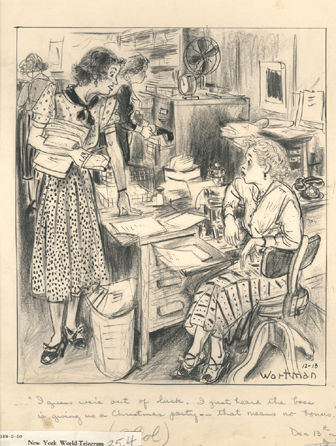
A Day In The Life Of A City: Denys Wortman's New York

One of my favorite comic art books from the past couple of years is Denys Wortman's New York, a bok that arose thanks to some digging by the head of the Center for Cartoon Studies, James Sturm. Wortman was one of those famously anonymous cartoonists from the first half of the twentieth century who produced a new one-panel comic four times a week for about thirty years. Other than a couple of collections with limited print runs, the strip mostly just disappeared from the public consciousness the way that so many strips are gone and forgotten, byproducts of an ephemeral form of media. Sturm was fortunate enough to get in touch with Wortman's son, who happened to be sitting on a treasure trove of over 5,000 originals by his father. Sturm, along with former student Brandon Elston, took a selection of these strips to form a narrative of sorts. The narrative doesn't follow a particular person, but rather the life of the city itself over the span of just one day. It's an extraordinary solution to the problem of how best to present this material in a way that doesn't drag.


What's interesting about this book is that the quality of the drawings is far better than a book that simply reprinted his work from newspapers or tear sheets would be. The book is shot directly from Wortman's pencils, which have an amazing power and sheer presence. This is a book about the teeming millions: young and old, rich and poor, working and unemployed, on the sidewalks or at the beach. It starts off in the morning, as housewives hang laundry outside their fire escapes and craggy old men rush to the subway. Young women rush to work as secretaries or factory workers, while middle-aged men try to find ways to collect on bills. Though the strips are not printed in anything resembling chronological order, Sturm & Elston still whip us across the city at work: the theater district, the garment district, maids, janitors, executives, and cooks at diners. With much of the strip running through the depression, Wortman shows us people desperate for aid and jobs. There's a jaw-dropping set of strips set in Coney Island, the vacation spot of choice for the working class. Though Wortman worked with a lot of photo references, he still does an uncanny job at capturing the spirit and the motion of so many people. The beach scenes are memorable because they depict huge crowds of people on the beach, on the boardwalk and under the boardwalk (with some poses that must have made the newspaper's censors a little nervous). He captures that sense of people wanting to pretend that they were somewhere exotic, even if every other New Yorker seemed to be there as well.
Wortman was also aces at drawing kids: out on the street, reading comics, running through fountains, and playing macabre games like "electric chair". His understanding of gesture and body language made every strip come alive, and his attention to detail like clothing is especially remarkable. This book is practically a class on New York fashions over a thirty year period, both of the rich and the working-class. We take a peek into classrooms, hospitals, doctor's offices, and beauty salons. We follow shopping trips and pretzel salesmen. We take a look inside the Museum of Natural History (that blue whale has been in the same place for a long time) and see the game from behind home plate at the Polo Grounds. We see the city in the sun and in the rain, go out on the town to dinner and the theater/movies/opera. We follow sailors going dancing and attend many a wild, late-night party. Finally, we see people make their way home, including one man on an empty subway who nonetheless can't help but stand up out of sheer habit.
Most of the captions to the images were written either by Wortman's wife or someone else; they were more capstones to the images than real gags. Some of them don't even try to be very funny--just accurate. The captions help provide some context and flavor for the images, though most of them could easily stand on their own. What I like most about Wortman's drawing is just how intuitive it is. He seems to know just when to use his charcoals to add some fuzz and shading to an image, and when to sharpen his pencil and let certain kinds of details pop off the page. These are not photorealist drawings, nor are they entirely expressionistic. These captions carry their own sense of reality, thrusting the reader into the image and giving one a true sense of what it might have been like to been in that particular moment, to see a wide range of actions unfolding in front of your eyes. The mass of humanity he depicts in page after page creates an imaginary buzz, as the reader imagines what all those people together must sound like. It's a rare art book that turns out to be a page-turner, but that's certainly the case with Denys Wortman's New York, and that's a tribute to the talent of the artist and the vision of the editors.

Wednesday, May 11, 2011

New Post: Developments Arrested-- Mid-Life and Reunion


Pascal Girard's Reunion and Joe Ollmann's Mid-Life are books with similar sensibilities but different approaches. Both are self-deprecatory (sometimes to the point of self-flagellating) accounts of emotionally stunted men at facing crises that are entirely of their own making. Both books are autobiographical up to a point, but clearly take a lot of creative license in order to stitch together a narrative as well as emphasize the humorously pathetic nature of their protagonists. Girard's "Pascal Girard" character is faced with his ten year high school reunion while Ollmann's "John Olsen" is a new dad at 40-something years old who finds himself smitten with a children's music performer. Both characters are dissatisfied with their lot in life in a typically bourgeois kind of way; both have perfectly nice, successful and satisfying lives but have the nagging feeling that there's an ideal version of themselves that they're not quite living up to. It's certainly not an unusual feeling for men of that age, and both books are mostly predictable in how they unfold. Both men are obsessed with their appearance, both men sabotage their own successful lives for their ridiculous fantasies and both men wind up humiliating themselves in spectacular (if differing) ways.


Girard's approach is as loose as Ollmann's is labored. It feels like something torn out of a sketchbook, with no narrative captions, no chapter separations and no panels. Each page feels open and loose, an organic and relaxed approach that belies the sheer relentlessness of Girard's comedic assault upon the reader and his own person. The very first page introduces the reader to Girard's self-caricature, an awkward & stubbly presence throughout the book. The character is obsessed with being considered a "winner" and so is lured to the reunion by an email from a girl for whom he always harbored a crush. He hides that from his girlfriend as he decides to lose fifty pounds to look good for his old crush. That triggers a series of events where Girard, to use some delightful Yiddish terms, is both schlemiel and schlemazel. That is, he's an awkward person who manages to offend and annoy any number of well-meaning friends and acquaintances, as well as someone who has a lot of bad luck.


With 156 pages of this material, Reunion at times feels like too much of a good thing. Girard never embues "Girard" with a single positive trait. It's a bold move to make your protagonist so thoroughly pathetic and loathsome, especially when you throw in the cruel self-caricature (the exaggerated chin he draws on himself and the sweat stains he draws on his clothes are especially amusing) without narrative captions to help defend himself. The first half of the book sees him preparing for and anticipating the reunion, as he looks at Facebook photos of sexy old classmates and fantasizes about being desired by Lucie, his old crush. He starts to lose weight but is in pain from a bad tooth and constant cramping in his legs. Even as he loses weight, he tries to ignore a huge wart on his finger and the fact that his jutting jaw is becoming ever more pronounced. He manages to offend everyone at a dinner party he's dragged to while embarrassing himself by revealing that his socks are full of holes when he has to take his shoes off.


At the reunion itself, he arrives overdressed and proceeds to either abuse or get abused by every single person. He ignores the people who genuinely want to see him. He interrupts conversations and overreacts to perceived slights. The climax of the book comes when his mouth is in pain, he cramps up and his glasses get broken. Friendly former classmates work on all three problems at once as he squirms on a bench, creating the funniest photo of the night. He gets several lectures on not focusing so much on appearances and being a "winner". I was worried that Girard was going to cop out as his namesake went through a pat learning experience, but he stays the course and piles on an exquisite final physical comedy sequence and a topper gag on top of that as the final panel.

The book was a bit of a grind at times, especially during the first half. It's a book whose humor is dependent on schadenfreude at the expense of the author, but the author invites the reader to laugh at his hubris and vanity. There are times that he perhaps thinks his foibles are funnier than they actually are, but it's a credit to his skill as a cartoonist that he was able to blast through the book's slower moments with a series of gags that were not only funny in the moment, but paid off earlier set-ups. Mid-Life similarly has a final act filled with hilarious humiliations, but how Ollmann gets there and the ultimate message of the book are quite different. There are lessons to be learned in Ollmann's book, whereas for Girard, the lessons are far less important the comedy inherent in them.


Ollmann's book is rigidly structured and it's obvious that every page and every panel has been labored over intensely. There's an almost tortured quality to his line, as if he's afraid of having much white space poke through. His line is thick, and while his characters are cartoony (with some of them bordering on the grotesque), he fills them with detail. Olsen in particular gets lavished with a sort of self-loathing and self-obsessed detail: liver spots, lines on his forehead, random tufts of hair, a paunchy stomach, etc. That said, one never gets the sense that Ollmann doesn't trust his line enough to really tell his story, as he uses a lot of distracting greyscaling to fil up space. This is unfortunate, because his drawings are funny enough to carry the story on their own.


The book's first page is hilarious, as the Olsen character has to deal with the shit of his three cats and a feces-filled diaper left on the floor; the line "there's more poop in my life than a German porn film" was a laugh-out loud moment for me as a reader. Ollmann proves throughout the book that he's witty writer who can dish out punchlines and shtick. Indeed, Ollmann is as sure-footed a scripter as he is unsteady a draftsman. At times, text overwhelms his panels, either with Olsen's brutally self-deprecating narrative captions or frequently long-winded dialogue. There were times that I wished he used a smaller 2 x 3 or 2 x 2 grid instead of the 3 x 3 grid that Ollmann employs with few exceptions throughout the book in order to let his pages breathe a little. Mid-Life has a cramped, frantic quality as a result of its panel layout that doesn't always seem to be the author's intention.


Indeed, what I like best about the book is the way Ollmann brings the narrative conflict to a slow boil and frequently pauses along the way in order to reflect. The story involves an exhausted Olsen, having passed 40 and in a constant state of exhaustion due to dealing with a young child, desperately wanting to feel young and vital again. The wrinkle here is that he was a young parent and has two adult daughters, meaning that he never did get to have those carefree days of youth. He spends time after he and his wife divorce trying to play catch-up, and there's a sense throughout the Olsen is chasing some idealized state of youth and desirability that is entirely a fantasy.


Olsen develops a remote crush on Sherri Smalls, a children's musician who is on the cusp of a major career decision: should she accept a job as the host of a kid's show on a Disney Channel-type network, even if it means completely selling out? That crisis is punctuated by her inability to find the right kind of relationship, even as she's attracted to older men (in a bit of foreshadowing that is not exactly subtle). Olsen's burgeoning obsession affects his job performance and his relationship with his second wife. It's as much a fantasy about creating an escape hatch from one's current life as it is something centered on someone in particular. Throughout the book, Olsen simultaneously apologizes for and tries to explain his position while letting the reader know his behavior is awful. At 172 pages, there are about fifty pages of exposition that drag the book down and feel ridiculously self-indulgent. Olsen starts to repeat details and feelings that seemed obvious and cliche' the first time around, let alone the second.


That said, once Ollmann gets to Chapter 17 (103 pages into the book), the book picks up in painfully funny fashion. Contacting Smalls to do an interview in New York City as part of a related work assignment, there's an amazing scene the night before he leaves where his wife pours her heart out to him, regretting their recent lack of intimacy and their constant bickering. Olsen doesn't want to hear it, in part because he wishes he could meet Smalls with his marriage in a state of uncertainty, a feeling that immediately produces guilt but doesn't go away. The New York sequences are as sharp as the middle of the book was flat, as Olsen and Smalls meet, he lies to her about being married, they find they have chemistry, and a guilt-ridden Olsen decides not to go through with it. However, a baffled Smalls calls to tell him she's coming over to talk about this, leading to a number of scenes of great physical comedy that climaxes with Olsen hiding behind a plant in the hotel's lobby in an effort to hide from her.

Regrettably, Olsen tries to tie up loose ends into a neat package at the end, as he ponders all of the ways he plans to change, how the trip was an eye-opener for him and he owed his wife honesty. Sure, there's a plot-derailing bit at the end, but it still feels a bit like Ollmann lets his character off the hook more than a little, and certainly much more than Girard did. There's still a lot to like in this book and I admire Ollmann's willingness to flog himself for humor as much as he did, but the book would have benefited from a less-is-more approach.

Saturday, February 27, 2010

Review: John Stanley's Thirteen Going On Eighteen

Rob reviews the collection of John Stanley's THIRTEEN GOING ON EIGHTEEN over at The Comics Journal.

Wednesday, November 18, 2009

Artist Introspective, Part 3: Map Of My Heart

Rob reviews John Porcellino's recent King-Cat collection, MAP OF MY HEART (Drawn & Quarterly), as the final entry in a three part series on artists with recent publications that look back on their careers.


John Porcellino's MAP OF MY HEART is the most devastating of the three books I've examined in this series, because here the artist's struggle with self-worth and the desire to create was inextricably tied into his own mental illness. That illness was exacerbated by a life-threatening physical ailment as well as his wife leaving him, leading to full-blown obsessive-compulsive disorder. OCD often has a strong link to depression as well, leading to a crippling paralysis of will. Porcellino fought through this, in part, through his deepening studies of Buddhism and his unquenched desire to keep producing issues of King-Cat Comics. This was the period where Porcellino went from good to great as an artist, making his style and prose spare & compact. Like with Zak Sally, it was the work that counted, and it acted in some sense as much as a lifeline than as something to conquer. Porcellino supplemented the comics with extensive endnotes, much like Sally. His approach was less a free-flowing essay than a series of fragments: journal entries, unpublished drawings, and detailed context regarding a particular line or strip. This made complete sense, given that one could always "read" Porcellino himself as someone composed of these small moments. He was entirely emotionally transparent simply by what he chose to depict and how he chose to do so.


The book's title, taken from a piece of children's art he saw, is the most accurate way to describe this process. Bit by bit, moment by moment, the reader comes to understand Porcellino's point of view and the nature of his struggle. This is far from typical mopey autobio work, but is instead the one instance where the map and the territory are virtually the same thing. He was in pain and worked through his pain, and from his current vantage point, time did nothing to soften the feelings he experienced. The book ended on an enormously upbeat note, thanks to him meeting his future wife Misun, but in many ways that was less a payoff for the reader than simply another part of the struggle.


There's a surprising cohesiveness to this book as an individual entity, even though it's composed of a number of different issues of King-Cat. The issues are pretty much reprinted in their entirety (including letter columns), with the exception of chapters from stories that would be reprinted elsewhere. The remainders of those issues tended to be meditations on his environment, anecdotes from his past, or spare but aching visual poems that reflect on his divorce obliquely. He also started adapting poems and stories from his Buddhist teachings into comics, a combination that wound up creating some of the most charming stories in the book. Given the success of his THOREAU AT WALDEN adaptation, I'd love to see an expanded collection of Porcellino's Buddhist story adaptations.

The Zen Buddhist influence is key to understanding this collection and the way that Porcellino's style evolved. Porcellino took up Buddhism at perhaps the lowest ebb of his life, a life filled with noise and activity. Buddhism's central tenet is that desire is the cause of suffering, and Porcellino's comics were always about desire, longing and the urge to find one's place in the world. Buddhist art and poetry has always been an attempt to describe the indescribable, the feeling of Zen enlightenment and bliss called satori. I've always felt that the attainment of satori is less an intellectual or emotional process than it is an aesthetic one. The experience of beauty can be described or reduced to familiar emotions, but those descriptions are not the experience, and as such, can't be communicated fully to others. So it's no surprise that Zen teachings are done through poems, paintings or oblique aphorisms--all forms of art that demand intense engagement from the audience. It's entirely up to the audience if they're ready to engage the work and draw meaning from it--and what that meaning is can vary.

In MAP OF MY HEART, Porcellino followed the Zen model when he started to go with less. His line--already a simple, minimalist tool--became even sparer and less fussy. More of his pieces were his own version of Zen poetry, carving away complex emotions and events and leaving only their essence. Porcellino has a fascination with nature that pervaded this volume, from the lives of ants, birds, root hogs and pill bugs to the stillness of bogs and the sound of wind. Zen poetry and art focuses on nature--that which surrounds all of us, is older than us and bigger than us. Considering nature is humbling for any individual who truly ponders their place in the world, and as such is a perfect avenue for teaching the lessons of Zen. While this is true for Porcellino, he also simply delights in his environment. He loves taking walks, listening to the sounds of his neighborhood, blazing trails in places where people don't usually go, and the way the cold air felt. There are also amusing quotidian stories about shopping with his mom and hanging out with friends that showed off his sense of humor.

Above all else, he loved his faithful cat, Maisie Kukoc. Kukoc was an anchor for him in more ways than one. Porcellino was quite frank in his endnotes about his battle with OCD and depression, and the feelings of self-hatred and self-destruction that ensued. At one point, he noted that he avoided suicide only because he worried about who would take care of his cat. It's a stunning low point, but also a triumph of sorts because he was looking for a reason to live, not a reason to die. His struggle was perhaps best reflected in the wrenching story "Forgiveness", a story from his childhood. It was about John exploring an environment and dealing with the human urge to destroy and the enormous feelings of guilt that came about as a result of killing a bird with a slingshot. When a ball went into the basement and the family dog ran after it, John was paralyzed by grief and guilt once again. One almost senses that John's guilt was even greater as an adult than as a child; it felt like he didn't fully process the emotions felt from the experience until he drew the story. There is no pat resolution to the story, just the feeling of remorse and the desire for self-nullification.

Porcellino faced these feelings head-on, forcing himself to experience the guilt and work through it. He attacked the feelings of powerlessness through taking walks, leaving towns, seeking experiences and embracing his relationships with others. Porcellino learned the valuable lesson that one can only make connections when one is open to the risk that such connections entail. It's letting go of one's fears, which are directly related to one's desires for self-protection. Leaving himself open allowed him to embrace the connection that would become meeting his future wife. That relationship alone didn't dissipate his OCD, but it gave him another weapon with which to fight that spiral.

When they began as a long-distance relationship, Porcellino did a strip that obliquely referred to his longing to see her. In many ways, this strip was the essence of what it means to live in the world while trying to follow Zen. One option for being a Buddhist is to withdraw entirely from the world and worldly sensations. Another point of view is that one can't abandon the world but instead must try to view quotidian concerns with a Zen approach. The world exists and we choose to interact with it; the key is not to become obsessed with dominating it. In this strip, Porcellino acknowledged his aching desire and allowed himself to feel it fully in the moment. He didn't curse their separation, but instead acknowledged it while experiencing his environment, noting that it was "the first hot night of the year". It's the page that's the best representative of his work in the book, spotlighting the insight of a man who allows the world to reveal itself to him rather than trying to impose himself on it.