Showing posts with label emi gennis. Show all posts
Tuesday, January 31, 2017
Kilgore: Emi Gennis, Tom Van Deusen
The Plunge, by Emi Gennis (Kilgore Books). Gennis' line and prose are extremely similar: precise, clear and fluid. Gennis is known for her sharply-paced historical comics that often dwell on morbid subjects, so she actually had me in suspense in reading the story of Annie Edson Taylor, who went over Niagara Falls in a barrel in 1901. While the story was very much a procedural on how she came to the idea, how she designed the special barrel and what happened during and after her attempt, this comic is really about all of the things that really made Taylor interesting. She claimed to be 43 but was really 63, and what she hoped to accomplish as an unmarried, older woman was to make enough money to essentially set up her retirement fund. She claimed to have been all over the country, teaching and founding various schools, even though her claims were invalidated. What was clear was that she was single, was clever and was a survivor above all else. The tragedy of the story was how this independent, intelligent woman was ultimately exploited and tricked by a con man, denying her the legacy and security she so feverishly worked for. Of course, she was trying to exploit her own shock-value hucksterism, but in a time when women had so few channels for achieving material success and security, it's no wonder. Visually, Gennis chiefly uses two tricks: dense hatching and claustrophobic page design and panel composition when she's confined, and the use of a lot of negative space (implying that freedom she hungered for) on most of the the other pages. This is a compelling, well-told story with a number of different angles, both factual and anthropological.
Scorched Earth, by Tom Van Deusen (Kilgore Books). This is viciously funny satire, with autobiography-as-fiction informing these stories of a Tom who is a slovenly and grotesque figure whose worst features are his massive sense of entitlement, infantile emotional development, and a narcissistic streak that's a mile wide. In reviews here and here, I compared him to a sociopathic Peter Bagge character like Stinky Brown, or perhaps more precisely the logical extreme of beta male who feels like they're being persecuted. When given the slightest amount of encouragement or power, Tom abuses it in some extreme but completely realistic ways. He fancies his one-night-stand as a girlfriend that he can brag about to his mom, then turns her polyamory as a way to hit on younger girls at a party. There is a disturbing level of authenticity in terms of "Tom's" speech patterns, behavior and thought processes, as though Van Deusen dredged the depths of his desires and imagination and came up with his worst possible impulses as fuel for satire.
The material that wasn't in the first two issues of Scorched Earth goes even further in some ways, though Van Deusen makes it very clear that his Tom character is meant to be a buffoon and not taken seriously. One could draw that conclusion from his earlier strips, but there was just enough ambiguity to really give his comics a surprising level of shock value. The strip where he's talked into getting an absurd, dangerous and expensive vaping device makes him like like an obvious idiot, even as the salesman plays him like a drum. He falls for rhetoric praising his taste, his masculinity and his "executive" status, and eventually winds up catching on fire. In another story, he does a youtube unboxing video for a new katana he bought (sort of like people do for toys), mostly to insult another youtube user. Van Deusen does something interesting here, as most office comedies tend to focus on a protagonist working against an irritant.
Here, the irritant (Tom) is the protagonist, which is done to deliberately make the reader feel uncomfortable while giving him characters to bounce off of, as he incredibly brings his sword to work and proves to be insufferable to his rational co-workers. In another work story, he's given that tiniest modicum of authority (interviewing a job candidate) and it immediately gives him a god complex, as he tries to fire a co-worker who annoys him and he starts the interview in the bathroom in a misguided attempt to see if the interviewee can think on his toes. It's cringe humor at its best, as is the follow-up to the story where he gets dumped and decides to hire someone to harass the guy whom he thinks is going out with his girlfriend. Here, Van Deusen goes beyond the plausibly douchey and goes straight to absurdity, even as the tone of the story remains entirely consistent. This is where Bagge's influence makes itself clear, as there's an escalating series of poor decisions and deals with unstable wild cards that ultimately make a situation turn absolutely bonkers. This comic is very much an antidote and answer to autobio comics where the actions of the author go largely self-unexamined. Van Deusen's storytelling and sometimes wobbly line add to the whole aesthetic of depicting someone who is just moments away from saying or doing something horrible, or having his entire life collapse around him.
Wednesday, May 6, 2015
Minicomics Round-Up: Baylis, Carter, Gennis
So Buttons #7, by Jonathan Baylis and various artists. Baylis continues on in the Harvey Pekar mode of shifting story content over to different artistic collaborators, with the trick being finding the right artist for the right story. He certainly nailed "So... Crumby", an account that purports to be about his degrees of separation from R.Crumb but was really about a friend who knew Crumb. Drawing in that Crumb style is Joseph Remnant, the young and super-talented artist whose underground-inspired work is very much in Crumb's tradition. The friend was "Citizen Kafka", one of those New York characters who's been everywhere and seen everything. The Crumb-style talking head panels are further accentuated by the color palette, which was very rich and dense, just like Remnant's pencils. It thrusts the reader into this particular world and does so with wit and warmth--two of Baylis' trademarks as a writer.
The second story, "So...Embarrassed", is a nice piece of design work by artist Paul Westover, who frames this story about the transition between being a normal kid and a target for bullies in the style of Star Wars cards of the era. His clean, cartoony style nicely encapsulates the little-kid setting, as do the lighter colors. This is a funny, self-deprecating story that nonetheless does little to mask how the feeling of embarrassment he felt in front of his class and teacher still stings to this day. The final story, "So...Smiley", features evocative, realistic art by David Beyer, Jr. This is just a two-pager, and it's less a story than it is a brief statement about how certain sensations bring about a simple feeling of contentment. Throw in a funny and lurid Danny Hellman cover (an ode to EC Comics) and you once again have a carefully-crafted and planned bit of autobio that's greater than the sum of its parts.
Life Was Hard, by Kirk Carter. I was charmed by these autobiographical vignettes about growing up in the harsh winters of Maine. For a comic that almost certainly looks like it was drawn using a computer, it has a restrained, simple style that retains a sense of the artist's hand. Rather than try to overrender or get flashy, Carter keeps the lines utilitarian but funny (there are a lot of funny-looking kids in this comic) and uses a very light color palette as a way to embellish and make the images pop a bit. The background colors are pastels and the clothing is a shade or two darker, and this simple formula works in strip after strip. The vignettes, memories and observations are nothing earth-shattering, but therein lies their appeal: watching TV and being confused by the Canadian channels, ordering only the first, free volumes of encyclopedias and thus retaining all sorts of facts about things starting with the letter "A", playing with siblings and "cousints" (their vernacular for "cousins"), and the ridiculous things that happened in cold weather. Carter's ambitions were modest in this comic and he certainly exceeded them with a number of amusing and memorable anecdotes.
Trepanation, by Emi Gennis. Two quick observations about Gennis's comics: they continue to look sharper and their subject matter continues to grow weirder. Her character design in particular is expressive and naturalistic at the same time, allowing for that aforementioned weirdness to really take root. Her use of hatching is a little less precise and takes the reader out of the panel a bit because it looks like an art effect rather than looking like the shading on an object; really, her control over her line is such that she hardly needs hatching. With regard to the subject matter, this is an even-handed look at the history and current practice of trepanation, a type of surgery design to drill a hole in one's head. It's an ancient practice, and some apparently swear that it can cure depression, end headaches and boost energy, though there's no particular reason why it should do so. Gennis gives every point of view ample room to state its case, though it's clear that the damning counterpoints of standard medicine are difficult to refute. The benefits of trepanation are anecdotal at best and may well be a result of the placebo effect, but each of the testimonials are interesting and compelling in their own way. What's clear is that Gennis had a great deal of fun drawing people getting holes drilled in their head and perhaps had even more fun sharing her research on the subject.
Monday, July 8, 2013
Two New Anthologies From Hic & Hoc
The Hic & Hoc Illustrated Journal of Humor, Volume One: The United States, edited by Lauren Barnett and Nathan Bulmer. In my idle fantasies where I suddenly become a multi-millioniare, I dream of funding and publishing a cutting-edge humor anthology featuring the best of new and old talent. The Illustrated Journal of Humor is remarkably close to my vision of what that anthology would look like. Editors Barnett and Bulmer are funny cartoonists in their own right, and they've assembled a book that has a lot of key veterans as well as younger talent. Their "Note From the Editors On Humor" is one of two expertly-executed fart jokes in this book, and it's rare that scatological humor in general makes me laugh at all.
The book opens with a fantastic Noah Van Sciver piece that positions one of his typical sad-sack characters who is sick and can't get sleep. Suddenly, there's an insistent narrator who questions him and urges him to look at the naked one-eyed monster in his bedroom, rubbing his genitals all over the character's beloved and important stuff. Lines like "It's true. You do indeed have a gun. It's right there being rubbed all over a dick" made me laugh out loud. There's also plenty of anti-humor and meta-humor, like Bort's hacky-punchline busting series of strips, or most especially Martha Keavney's "Buster" strips. Keavney has been a long-time favorite of mine, thanks to her Badly-Drawn Comics and Spelt-Rite Comics, and she's certainly someone I'd be eager to publish. The "Buster" strip is a hilarious take-off on hacky pet comics/sit-coms, only it's from the point of view of aliens with a pet human. Keavney's understanding of the timing needed to make such mimicry work is incredible.
Some of the artists, like Nikki Burch, use an exaggerated visual style to tell a simple joke. Others, like Sam Spina's excellent "Pern", use a simplified style to relentlessly pound the reader with a series of jokes associated with a couple having sex. The jokes are mostly in the dialogue, with the exception of the screwed-up angry face of the woman when they're indulging in "age play" and she slaps him and snarls "Don't you EVER talk back to mama.". It's hilarious because it's so incongruous. Of course, there's also the king of minimalist gag work, Sam Henderson. He's another obvious choice for such an anthology, and his mix of visual gags and puns always deliver. Then there are strips that are funny because they exaggerate everyday situations, like going shopping for clothes. Madeline Flores' page of simple but exaggerated drawings and screaming things like "This shirt makes my tits look GOOOOOD!" was another stand-out in a book that was incredibly dense with great contributions. The same is true for Jane Mai's outrageous page of designing men's lingerie, slapping packages into "snake" or "elephant" and humiliating her man into getting a "shame boner" before she simply goes to sleep.
Not every strip uses exaggeration in its visuals, nor do they go for strict gags. For example, Grant Snider's comics are contemplative and amusing, where every panel is funny in its own way without building up to something larger. Dustin Harbin's "Lives of the Generals" similarly starts with a simple premise and riffs on it for panel after panel in his crisp and cartoony style. Sam Sharpe's strip about a boy's relationship with a beloved superhero of his youth carrying on into the bigger questions is more bittersweet than laugh out loud, even as the conceit of the strip (the answer to the question asked in every panel is "no"). Julia Wertz's amazing "Life Like This" equates being a "funny" cartoonist to a vaudeville act that's booed off the stage when she tries to discuss something serious. Despite (and really, because of) the gruesome ending, Wertz still manages to throw in a punchline. It really is her entire career boiled down to a single bit of brilliance. There's also solid work by Jeff Lok, Dakota McFadzean, Patt Kelley (pretty much the ultimate fart joke), Nathan Stapley and others. Even the worst strips in here are still solid, as Barnett & Bulmer both did a fine job of balancing the absurd, the grotesque, the whimsical and the flat-out funny. This is a smash-hit success.
Hic & Hoc Presents: Unknown Origins & Untimely Ends, edited by Emi Gennis. The titular subjects are objects of fascination for Gennis, who frequently writes about weird but true deaths in her comics. This anthology is the comics version of shows like In Search Of... or Unsolved Mysteries, further combined with urban or folk legends particular to certain areas. As is generally the case in such instances, I found that the stories that had more of a foot in reality were more interesting than the stories that relied on the potential of ghosts, monsters, UFOs and other some ephemera. For example, Jackie Roche's "The Leatherman" is a very humane look at an enigmatic man who made the rounds on foot in northeast America. Aaron Whitaker's "The Monster With 21 Faces" is one of several stories regarding unsolved crimes; this one was about a group that kidnapped the head of a candy company, let him go, threatened to poison his product and then later taunted the helpless police department. "The Voynich Manuscript", by the always excellent Julia Gfrorer, turns her spooky storytelling style on a mysterious manuscript that has never been decrypted. I also thought "Goo" by Jason Bradshaw and "Meat Shower" by Noah Van Sciver were funny and weird examples of strange stuff falling out of the sky for no discernible reason. Though it crossed over into urban legend territory, Tod C. Parkhill's "Polybius", is an elegant and creepy tale. It's about a legendary arcade game similar to the vector graphics action of Tempest and the nightmarish effect it had on some gamers, and it's done in that same vector line drawing style. Though the story devolves into men-in-black style conspiracy theories, it was stylish and just credible enough to be of interest.
In the "Untimely Ends" section, there are plenty of stories about unsolved murders, people who mysteriously disappeared, death that are totally unexplained, and certain famous people. WIthoutcomingout and saying it, for example, Phillip Sevy links the death of a young would-be actress named Elizabeth Smart to Orson Welles, connecting the dots in such a way as to explain why he left Hollywood, why he became so depressed and why his career never recovered. Lizz Lunney's take on the influence and death of Rasputin is played for laughs thanks to her cartooning style, alleviating the heavy sense of dread and mystery that most of the other stories in the book are burdened with. I appreciated the thoroughness with which Emi Gennis and JT Yost approached their murder-mystery stories, sticking as close to the facts as they were known while acknowledging the crazier theories surrounding their cases. Jenn Woodall and Sam Alden approached their subjects (a haunted forest, a ghost ship) in a more poetic manner, relying heavily on illustrations as a way of juxtaposing rather than simply guiding the text. For the most part, the very specific voice of each cartoonist was turned down a bit in service of their anecdotes, which makes this anthology something to pursue if you're interested in the subject rather than a particular cartoonist.
Thursday, July 4, 2013
Minicomics: Friedman, Fleener, Gennis, Alden
My Senior Year, by Sarah Friedman. Friedman is a comics newcomer just finishing up college, and this modest but witty minicomic is her first attempt at autobio. I really like her self-caricature: freckles, curvy eyebrows, pointy chin, and a short shock of hair. In this comic, she keeps things short and stays within her limitations without over-rendering her figures. Indeed, she makes nice use of negative space as a way of varying her pages and tries to hit on the highest points of her anecdotes to create a strip with a bit of comedic impact. "Babysitting" is a good example, as the two kids she's taking care of first declare that they're not going to go to college, then express interest because they wonder if one "gets to see people's butts". Friedman's palpable discomfort is nicely captured in the way she draws her mouth screwing up. Other strips see her understanding her future as a cartoonist, like when she turns down a party to finish a drawing. There's nothing revelatory about these strips, but they do indicate someone with a good sense of storytelling and how to get across a gag. Hopefully, she'll keep going and we'll see what else she's capable of.
The Less You Know, The Better You Feel, by Mary Fleener. Fleener is one of my all-time favorite cartoonists, both for her outstanding autobio comics and her occasional forays into filthy fiction. In February of 2012, she started doing a weekly political cartoon for the Encinitas Coast News, in part as a reaction to the rampant greed and opportunism of her city's government. As a native of Miami, I know only too well the ways in which politicians will roll over when given a chance to line their pockets with money from developers. Fleener had never done political cartooning before, and that shows in a number of her early strips. She's overly reliant on labeling her illustrations to represent specific people, ideas or events; while this is a long tradition in political cartooning, it can also be a bit of an easy cop-out. As she went forward, her own natural creativity and style started to take over the page, coming up with narratives like the one above regarding how trees and their owners were suddenly treated. Fleener also goes on tangents regarding the flora and fauna of her beloved small coastal town, giving a reader a true sense of the flavor of Encinitas. The strips also get funnier and meaner as she gets more comfortable with expressing herself in such a compact manner. Visually, they are impeccable, as her character design and visual flourishes add a dimension to the political cartoon that is not usually seen in typical fare If she hasn't already, I hope she joins the American Association of Editorial Cartoonists (AAEC), because she deserves to be recognized by a new group of peers.
Unfortunate Mishaps In Aviation History and The Unusual Death of Gregory Biggs, by Emi Gennis. Gennis is making an interesting side career out of depicting weird ends "from the Wikipedia list of unusual deaths". What's interesting about these exercises is how they've made her a better artist. Simply put, her character design, backgrounds and sheer drawing ability have improved tremendously over the past few years as she's had to draw machines, people in different eras, and weird situations. Of course, this material strikes a chord in Gennis as well, as evidenced by her editing an anthology's worth of stories about "untimely ends" for Hic & Hoc. Unfortunate Mishaps is a cruel but often funny account of two incidents of sheer hubris, wherein dumb inventors and unprepared explorers thought that their sheer intellect and ingenuity were a match for things like gravity and the Arctic winter. The death of Franz Reichelt is about a man trying to perfect a working parachute who decides to use a live model (himself) and jump off the Eiffel Tower on a windy day. The Arctic expedition went awry because the explorers made no attempt to understand the terrain.
Gregory Biggs is a far more unsettling comic. The title character was slammed into while walking on the side of a highway, and he went flying into the woman's windshield who hit him. She was all kinds of high, which may have led to her spectacular disconnect from reality. She apologized, drove him, had sex with her boyfriend and woke up the next morning to unsurprisingly find him dead. Her boyfriend helped her cover it up, but she got drunk at a party and bizarrely bragged about the incident. Gennis takes an understated approach here, letting the events speak for themselves with an extensive use of cross-hatching and negative space. Gennis is ready for a major project.
Patron Saint, by Sam Alden. Published by Space Face, this recent Alden mini is another leap forward. Using this kind of crazy, angular drawing style that emphasizes negative space, Alden tells the story of a young production assistant on a film set and interpolates it with the haunted story of Astro Boy. Seeing Astro Boy, whose ghost (according to a sound man) haunts the earth after he plunged himself into the son, is an ill portent, but the PA instead turns all of her frustration toward her asshole boss (centering around batteries) into a single moment of reality-warping and fantasy-fulfilling violence. It's a remarkable set of panels, made possible by the slightly rubbery quality of his line.
Labels:
emi gennis,
mary fleener,
sam alden,
sarah friedman
Monday, July 2, 2012
Autobio Minis: Harbin, Boyce, Taylor, Gennis
Time to check in on the world of autobio minicomics:
The Melinderly #1, by Melinda Tracy Boyce. This full-color minicomic is the end result of a Kickstarter campaign. The Austin-based Boyce reminds me a lot of Vanessa Davis, both in the way she uses a slightly cartoony, painted style and the upbeat nature of her strips. Boyce's mission seems to be capturing magical moments on paper, like the events of "Drinkapalooza", a meandering story about a funny drinking game that involves adding bizarre articles of clothing where its participants wind up going to a party. The inebriated characters proceed to become the life of the party, even as Boyce hints at their slight obnoxiousness. "I Got You Something" reminds me the most of Davis, in that it's a strip about her mother and her gift-giving quirks that winds up with quite a punchline. Boyce makes great use of color (watercolors?) in her comics, giving herself a freckly, apple-cheeked complexion that's the cute anchor in a comic filled with cute-looking characters. Her use of detail in her stories gives them some nice comedic depth, like drawing herself, hiding in the bushes and smoking an apple bong at home. "Night of the Wonderful Wheatpaste" is an account of her boyfriend and another friend accompanying her on a late-night graffiti session, using home-made paste to put up art in the city. It's the essence of her work: distilling and capturing the sort of tiny moments one experiences in one's youth. The first chapter in her only fictional story, "Lustwander", establishes a very attractive food blogger with a video game-playing lump of a boyfriend who receives a secret admirer's love note. Boyce stacks the deck by making her character irresistible and her boyfriend a sexless lump, but we'll see where she takes this. It's clear that Boyce is as close to a fully-formed talent as I've seen in a young cartoonist, one with a strong and sweet voice with a knack for pleasing, low-stakes storytelling.
Diary Comics 3, by Dustin Harbin. I tend to say the same thing about Harbin's comics every time I review them: he has a great deal of talent but is still trying to figure out what he wants to say as an artist. His diary comics, which conclude with this third volume, seem to have helped him a great deal in this process. A daily diary comic can help artists process their feelings, hopes and worries even if that deeper conversation mostly takes place in asides or deflections. In his strips, Harbin portrays his depression as a heavily hatched cloud that surrounds him as well as a shadowy other self that paralyzes him. There's an implication that he's literally trying to outrun his own depression at times, which can be difficult when one's career is both sedentary and solitary. The routine of a daily strip, even one that's polished up after the fact, takes away from the kind of preciousness and perfectionism that can doom an artist's productivity.
Harbin has two chief virtues as a cartoonist: he's funny and he's a superb caricaturist--especially of himself. The big-eared, snaggletoothed, fuzzy-faced and gangly self-caricature is a delight to follow across the page. Despite his battles with depression, there's a light-hearted quality to all of his comics, especially the convention reports. Those positively glow with optimism and the thrill of camaraderie with a group of cartoonists he obviously admires but is still trying to understand how he fits in with them. One thing that comes across in this comic is his sense of gratitude to people like his publisher Anne Koyama and friend Kate Beaton, both of whom have boosted his confidence level simply by encouraging him. I'm not quite sure what Harbin being "there" would look like at this point. He's clearly a humorist at heart, but I'm still not sure what kind of fictional storyteller he is, especially for a longer narrative. If I had to guess, I'd say his best shot at success would be in adapting and expanding upon some of his childhood stories (his childhood caricature is irresistible). I just get the feeling that it's all going to click for him and he'll come out with something that really turns heads.
Relics, by Whit Taylor. Taylor is another emerging talent who's trying to figure herself out as an artist. This 26-page mini is her longest sustained effort, one that allows her to think about her past while her future is in flux. It's a simple idea: a trip to the magnificent Museum of Natural History in New York with her boyfriend. The trip allows her to muse upon her many worries while trying to put them in perspective. She thinks about her parents divorcing and wondering if people were meant to be monogamous for a lifetime, especially after one's offspring "become viable". She ponders the recent and sudden death of her grandfather and wishes she was part of a society that allowed itself more space to mourn. She considers her own creeping depression and anxiety and fantasizes a bit about animals not having to face existential depression. Above all, she wonders about her place in the world after graduating with an advanced degree in a brutal job environment. There are no answers to be found here, but she clearly draws inspiration from the "buck up!" quotes from Theodore Roosevelt and the show at the planetarium, along with the rest of the museum. "It's important to get outside of yourself", she notes, as she takes comfort in being reminded of her cosmic insignificance as well as the fact that her own existence is as important as anyone else's. While still limited as a draftsman (Taylor goes for a realistic style but doesn't get there), this is her best effort to date, as she clearly spent a lot of time in getting across the details of the museum as well as its incredible scope. The success of this comic hinged upon her ability to do that, and even someone who's never made it to the Museum of Natural History will get a sense of just how vast and impressive it truly is.. Taylor notes that she's going to concentrate on doing non-fiction in the near future, and this thoughtful and forthright comic is an excellent grace note for her early autobio career.
Spaz! #5, by Emi Gennis. Gennis is a sharp cartoonist who can go from naturalistic to cartoony styles with great ease. Even her own self-caricature changes from story to story. Gennis' specialty is mining her own neuroses and obsessions for comedic purposes. For example, her ongoing series from the Wikipedia List of Unusual Deaths can vary from ironically amusing to downright chilling, especially the infant who died because her parents were off at an internet cafe, playing a game in which they raised a magical child. Contrasting that with her ongoing battles with the anthropomorphic Zygote that keeps urging her to have children before it's too late reflects her own obvious fears as well as the way she feels the desire to be a mother. Even as Zygote gives Emi a makeover and gets her tarted up to go to a club, Gennis uses her bug-eyed, cartoony self-caricature to deflect the seriousness of the subject matter. In "You Know What's Fucked Up?", she further explores this discomfort by discussing the mental illness called Munchausen's-By-Proxy, in which mothers deliberately but secretly harm their children to get sympathy from others. Here, she uses a realistic style but involves herself as the narrator, once again exploring the way that becoming a parent can either reveal or transform someone in a monstrous fashion. "Paul" is the flipside of this fear, as she recounts a younger boy she knew in high school who wound up murdering his father. Gennis lightens things up a bit with a strip about the various kinds of potential roommates who advertise on the internet, before concluding with another death story: this time of a guest who drowned at a party attended entirely by lifeguards. I love the way that Gennis fixates on the ways things that we deem to be certain and dependable are frequently the things we should trust the least, and the subtext of the comic is her own fear of being put into a position where she's any kind of authority. For a funny comic, there's a lot of bracing material from this very interesting young cartoonist.
The Melinderly #1, by Melinda Tracy Boyce. This full-color minicomic is the end result of a Kickstarter campaign. The Austin-based Boyce reminds me a lot of Vanessa Davis, both in the way she uses a slightly cartoony, painted style and the upbeat nature of her strips. Boyce's mission seems to be capturing magical moments on paper, like the events of "Drinkapalooza", a meandering story about a funny drinking game that involves adding bizarre articles of clothing where its participants wind up going to a party. The inebriated characters proceed to become the life of the party, even as Boyce hints at their slight obnoxiousness. "I Got You Something" reminds me the most of Davis, in that it's a strip about her mother and her gift-giving quirks that winds up with quite a punchline. Boyce makes great use of color (watercolors?) in her comics, giving herself a freckly, apple-cheeked complexion that's the cute anchor in a comic filled with cute-looking characters. Her use of detail in her stories gives them some nice comedic depth, like drawing herself, hiding in the bushes and smoking an apple bong at home. "Night of the Wonderful Wheatpaste" is an account of her boyfriend and another friend accompanying her on a late-night graffiti session, using home-made paste to put up art in the city. It's the essence of her work: distilling and capturing the sort of tiny moments one experiences in one's youth. The first chapter in her only fictional story, "Lustwander", establishes a very attractive food blogger with a video game-playing lump of a boyfriend who receives a secret admirer's love note. Boyce stacks the deck by making her character irresistible and her boyfriend a sexless lump, but we'll see where she takes this. It's clear that Boyce is as close to a fully-formed talent as I've seen in a young cartoonist, one with a strong and sweet voice with a knack for pleasing, low-stakes storytelling.
Diary Comics 3, by Dustin Harbin. I tend to say the same thing about Harbin's comics every time I review them: he has a great deal of talent but is still trying to figure out what he wants to say as an artist. His diary comics, which conclude with this third volume, seem to have helped him a great deal in this process. A daily diary comic can help artists process their feelings, hopes and worries even if that deeper conversation mostly takes place in asides or deflections. In his strips, Harbin portrays his depression as a heavily hatched cloud that surrounds him as well as a shadowy other self that paralyzes him. There's an implication that he's literally trying to outrun his own depression at times, which can be difficult when one's career is both sedentary and solitary. The routine of a daily strip, even one that's polished up after the fact, takes away from the kind of preciousness and perfectionism that can doom an artist's productivity.
Harbin has two chief virtues as a cartoonist: he's funny and he's a superb caricaturist--especially of himself. The big-eared, snaggletoothed, fuzzy-faced and gangly self-caricature is a delight to follow across the page. Despite his battles with depression, there's a light-hearted quality to all of his comics, especially the convention reports. Those positively glow with optimism and the thrill of camaraderie with a group of cartoonists he obviously admires but is still trying to understand how he fits in with them. One thing that comes across in this comic is his sense of gratitude to people like his publisher Anne Koyama and friend Kate Beaton, both of whom have boosted his confidence level simply by encouraging him. I'm not quite sure what Harbin being "there" would look like at this point. He's clearly a humorist at heart, but I'm still not sure what kind of fictional storyteller he is, especially for a longer narrative. If I had to guess, I'd say his best shot at success would be in adapting and expanding upon some of his childhood stories (his childhood caricature is irresistible). I just get the feeling that it's all going to click for him and he'll come out with something that really turns heads.
Relics, by Whit Taylor. Taylor is another emerging talent who's trying to figure herself out as an artist. This 26-page mini is her longest sustained effort, one that allows her to think about her past while her future is in flux. It's a simple idea: a trip to the magnificent Museum of Natural History in New York with her boyfriend. The trip allows her to muse upon her many worries while trying to put them in perspective. She thinks about her parents divorcing and wondering if people were meant to be monogamous for a lifetime, especially after one's offspring "become viable". She ponders the recent and sudden death of her grandfather and wishes she was part of a society that allowed itself more space to mourn. She considers her own creeping depression and anxiety and fantasizes a bit about animals not having to face existential depression. Above all, she wonders about her place in the world after graduating with an advanced degree in a brutal job environment. There are no answers to be found here, but she clearly draws inspiration from the "buck up!" quotes from Theodore Roosevelt and the show at the planetarium, along with the rest of the museum. "It's important to get outside of yourself", she notes, as she takes comfort in being reminded of her cosmic insignificance as well as the fact that her own existence is as important as anyone else's. While still limited as a draftsman (Taylor goes for a realistic style but doesn't get there), this is her best effort to date, as she clearly spent a lot of time in getting across the details of the museum as well as its incredible scope. The success of this comic hinged upon her ability to do that, and even someone who's never made it to the Museum of Natural History will get a sense of just how vast and impressive it truly is.. Taylor notes that she's going to concentrate on doing non-fiction in the near future, and this thoughtful and forthright comic is an excellent grace note for her early autobio career.
Spaz! #5, by Emi Gennis. Gennis is a sharp cartoonist who can go from naturalistic to cartoony styles with great ease. Even her own self-caricature changes from story to story. Gennis' specialty is mining her own neuroses and obsessions for comedic purposes. For example, her ongoing series from the Wikipedia List of Unusual Deaths can vary from ironically amusing to downright chilling, especially the infant who died because her parents were off at an internet cafe, playing a game in which they raised a magical child. Contrasting that with her ongoing battles with the anthropomorphic Zygote that keeps urging her to have children before it's too late reflects her own obvious fears as well as the way she feels the desire to be a mother. Even as Zygote gives Emi a makeover and gets her tarted up to go to a club, Gennis uses her bug-eyed, cartoony self-caricature to deflect the seriousness of the subject matter. In "You Know What's Fucked Up?", she further explores this discomfort by discussing the mental illness called Munchausen's-By-Proxy, in which mothers deliberately but secretly harm their children to get sympathy from others. Here, she uses a realistic style but involves herself as the narrator, once again exploring the way that becoming a parent can either reveal or transform someone in a monstrous fashion. "Paul" is the flipside of this fear, as she recounts a younger boy she knew in high school who wound up murdering his father. Gennis lightens things up a bit with a strip about the various kinds of potential roommates who advertise on the internet, before concluding with another death story: this time of a guest who drowned at a party attended entirely by lifeguards. I love the way that Gennis fixates on the ways things that we deem to be certain and dependable are frequently the things we should trust the least, and the subtext of the comic is her own fear of being put into a position where she's any kind of authority. For a funny comic, there's a lot of bracing material from this very interesting young cartoonist.
Labels:
dustin harbin,
emi gennis,
melinda tracy boyce,
whit taylor
Monday, July 11, 2011
Two Minis From Emi Gennis

Emi Gennis, a student currently at the Savannah College of Art & Design, has been making minicomics that cover a lot of interesting ground. Her latest comics, Spaz! #4 and The Collyer Brothers, span autobio, gag work, rants, stories about unusual deaths and advice on how to be a wayward teenager. Gennis is a student at the Savannah College of Art & Design (SCAD) and has begun to find her own voice as a cartoonist. With her Julia Wertz by way of Jim Davis style of art, Gennis' line is cartoony but sturdy, clearly telling a story and cleverly emphasizing her figures. There's a beautiful precision to her figures' Muppet-like eyes, her hatching and the way she spots blacks. That sturdy foundation allows her to go silly or serious at the drop of a hat, even while using the same style of art.

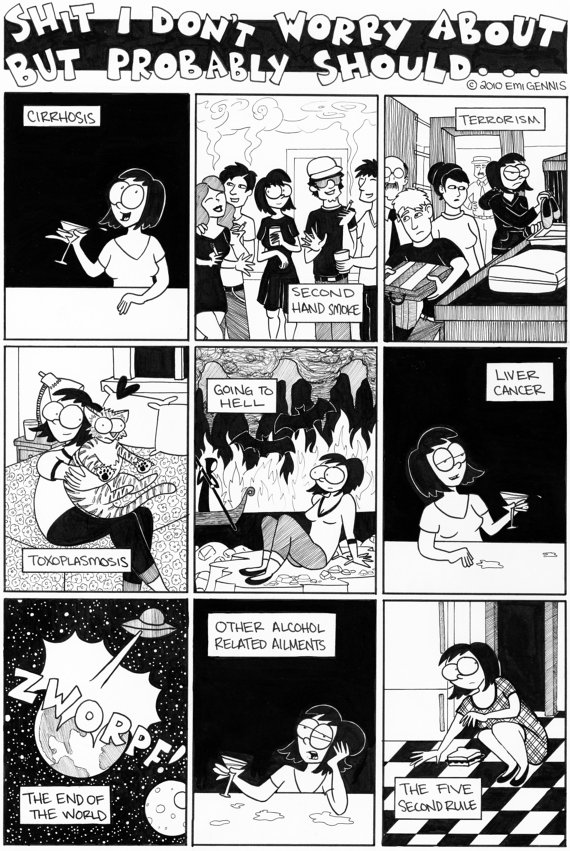
In Spaz #4, Gennis begins with an embarrassing anecdote called "Squat", detailing her difficulties in China in attempting to use a squat toilet in a public place. Gennis' even-handed but amusing account of this ordeal is cringe-inducing but ends with a great gag. Her "vent strips", "Shit I Worry About", are a combination of funny, poignant and weird, as her depictions of doing things such as falling into sinkholes and accidentally cutting off her drawing hand are genuinely funny. Just as funny is "Shit I Don't Worry About But Probably Should...", including the recurring gag surrounding drinking too much alcohol. In the same vein, "There Are Just Some Places I Don't Want To See Hot Guys" sells its premise with images of Gennis on an examination table at a hospital, as a hot guy is "very seriously pondering my vagina". Gennis draws herself with bug eyes in all of her strips, but her eyes get extra wide here, amusingly representing her mortification.

Gennis rants about obsessing over the use of anti-bacterial hand sanitizer isn't especially substantive, but it's still funny, thanks to her drawings of bacteria and white blood cells duking it out and a hilarious drawing of herself as a child, eating dirt. This best story in the book is her "Guide To Being A Teenager", a step-by-step method on how to sneak out of the house that includes going downstairs on all fours, getting picked up a block away from her house, and making Ramen noodles and bagging them before coming home as part of a cover story. Her character work is lively and expressive here (which is a contrast to the more generally static nature of her images), capturing realistic body language in a cartoony manner.

Something that sets Gennis apart from other primarily autobio artists is her running series of strips taken from the Wikipedia list of unusual deaths. What's interesting about them is that Gennis doesn't play them for laughs (like the Darwin Awards or similar death-as-gag institutions). Indeed, her account of Kurt Godel's paranoia and subsequent death due to starvation when his wife fell ill was heartbreaking. Her use of a more realistic style in these strips is probably their most problematic aspect, as she isn't always up to the task of incorporating such drawings while still crafting a fluid story. Still, there several haunting images in the Godel story, as well as in her separate mini The Collyer Brothers. The latter is about two brothers in early 20th Harlem who grow increasingly paranoid and reclusive living in a brownstone, until that paranoia winds up doing them both in. The slightly more cartoony figure work suits the story well, even as it spirals into describing the brothers' ultimately deranged but pathetic ultimate fates. This was Gennis' longest such story, and while it lacks some of the snap and polish of her autobio work, it ultimately proves to be a step forward.
Subscribe to:
Posts (Atom)