Showing posts with label andi santagata. Show all posts

Monday, December 19, 2022

31 Days Of CCS, #19: Andi Santagata & Beth Hetland

Beth Hetland has been illustrating and co-writing some big projects in the past few years, but now she's gotten back to writing and drawing her own material. (The book she's working on right now is going to make people's heads explode!) Fallow Fields is a minicomic about a figure in a field, struggling with trying to make something grow. At the same time, she is beset by a torrent of platitudes, questionable statements of "support," comments that make it all about the speaker, and also genuine expressions of concern and support. All the while, the figure pulls out weeds, fervently tilling the land in an effort to clear it out--to no avail. She collapses, weeping, even as the platitudes pile up. She starts to grow and fill up the tract around her, and tiny versions of her start to clip and mow and tend to her. There is a tacit feeling of radical acceptance at the end, as the voices of others echo away. There are any number of ways to interpret this (though a few seem more likely than others), so I won't speculate as to specific meanings. This comic is really about sitting with a certain reality and coming to terms with it. The white ink on blue background adds to its sense of melancholy, There is a powerful, visceral quality to the cartooning, as Hetland's line is thick and the figure she uses is drawn as desperately strong. There is an intimacy here that I haven't seen in Hetland's past work, and she's bold in expressing vulnerability.


Andi Santagata is a lot of things as a cartoonist, but what I like best about his work is his sense of humor. While he mostly draws horror or horror-inspired comics, at heart, he's a humorist. This is also true of his two memoir minicomics, The Compleat Trans Man Walking and Yennefer's Body. There is a tension in his scratchy, scribbly expressive work between a brash & funny humorist and a person programmed to say as little and take up as little space as possible. Trans Man Walking is a 2016 journal of his initial transition, his battles with his mom, and adjusting to life as a man. There's also a very funny version of the CCS audition comic, involving a robot and a snowman, and Santagata turns it into a gag that's also hilariously tragic. That's true of much of this comic, though there are small moments of triumph like the delight at casually being referred to as a "fella" by a bartender. Santagata's art is so beautifully scratchy and his caricatures so exaggerated that he would have made a fine editorial cartoonist in a different era. 
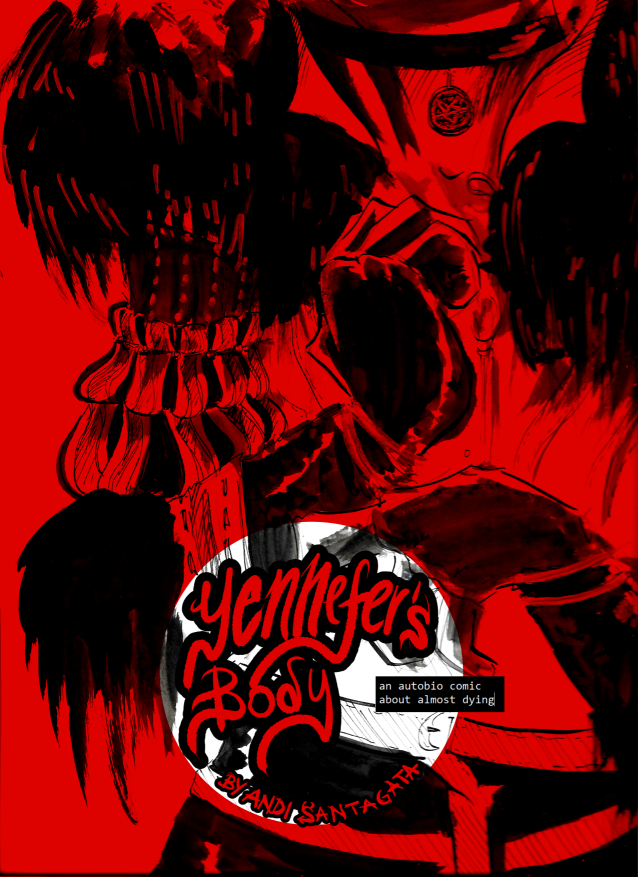


If Trans Man Walking reflects the way it was assembled (haphazardly, and as part of an immediate engagement with the internet), then Yennefer's Body reflects a great amount of thematic care and planning. This is a sequel and continuation of the story from Trans Man Walking, but it more closely fits the themes related to laughing things off, especially pain, so as not to draw attention of any kind. Of course, this approach led Santagata to ignore a huge tumor that eventually caused an enormous amount of blood loss and nearly killed him. The entire comic is an attempt to come to terms with that mortality, mediated through video games and TV shows. The video game Dragon Age is the biggest touchstone, especially as its main character has to find a way to cheat death against the will of her mother. Despite his near-death, Santagata can't shake the feeling that he was still somehow making a big deal out of nothing. There is an obvious mirror here established in his previous comics, where Santagata's mother takes his transition, his tattoos, and every avenue of self-expression as a personal offense. 

This is explored further here a bit more obliquely, on blood-red pages splattered and smeared with black ink that approximates a female shape. There's a torrent of abusive, inappropriate, and narcissistic language that Santagata obviously ignored that blames him and accuses him of trying to make his mom "look bad." That's entirely in line with Santagata going an entire day as a kid with a broken arm that no one notices because he doesn't complain. (Santagata cleverly ties this in with an episode of Malcolm In The Middle where Malcolm stops complaining but then develops a stomach ulcer.) It is Yennefer, a character from the show The Witcher, who is the final touchstone, as she also has to undergo a highly painful transformation that renders her infertile. Santagata is finally given a chance to get on testosterone, something that had been unavailable to him during his transition, as a life-saving measure against the tumor and losing so much blood. The result of this also made him infertile, something he's OK with...but it's still a change. The whole thing is a pun on the feminist comedy-horror film Jennifer's Body, which is about a woman turned into a succubus who must be stopped by her best friend. That is another film about transformation, trauma, and refusing to listen to marginalized people. 

This is a horror story, and the aesthetic matches it: black pages, red ink, scratchy & monstrous figures, and the comics equivalent of jump scares. It's also funny and sweet, as the sheer obliviousness of Santagata's stand-ins, who are so thoroughly programmed to not complain and minimize everything, literally have to be taken to the edge of death and beyond to acknowledge and live in that trauma. This comic represents every angle Santagata can think of in approaching that journey into entirely-avoidable near-oblivion, and the examples he picks do something very important: they emphasize the danger instead of minimize it. These two comics are a hell of a one-two graphic medicine punch.

Wednesday, December 18, 2019

31 Days Of CCS #18: Reilly Hadden, Andi Santagata

Reilly Hadden's comics are truly right in my pleasure-center wheelhouse. His art, his character design, and his pleasantly rambling fantasy plotlines have a deadpan quality that veers between horror and absurdity. Hadden just ended his long-running Astral Birth Canal series and has rebooted (with many of the same characters) as Astral Forest. The main difference is that unlike in the original series, which focused on a couple of characters per issue, Astral Forest flips between a few different characters in each issue. The first issue dives into a new storyline for Valentina, the earth woman who took off with space god Bork. In this story, they are living on a remote, icy planet with their baby Edward. In a long bit of scene-setting, it's revealed that some sort of anthropomorphic bird creature is watching them. In the second story, Hadden introduces Kath, a badass warrior who is on a quest while avoiding a bunch of demons who want her dead. An imp sent by her enemies winds up as her companion. Finally, there are brief interludes with Rona and Bird-Girl, who are told that there's an ancient tablet with their likenesses on it.

The second issue advances each of these stories. A group of rabbit bards hires Bork as muscle--uninvited, Bilbo Baggins-style. Kath uses the imp to escape some wolves. The tablet is actually part of a stone golem who declares that Rona and Bird-Girl are to be saviors of the Astral Forest. What I like best about these comics is that while Hadden spins a fun yarn, it's the corners and cracks of the narrative that he likes to invite the reader into. It's Bork trying to get the baby to sleep. It's Kath going on and on about the perfect sandwich and its ingredients. It's one of the bards singing an extended song. The small moments, the silly moments, and the absurd moments are the ones worth sticking around for.

Andi Santagata's work tends to deal with the reality of being embodied. It's just that the last comic I reviewed by him, Jed The Undead, was about a demonic teenager dealing with infernal ejaculation issues. The comics from this year are much more personal, including the autobio Trans Man Walking #1-2. Santagata employs a thin, scratchy line that offers that hint of horror expressiveness. It makes sense, given how many of these funny strips are about feelings of being trapped, or scared, or alienated. Santagata talks as much about being Asian as he does being trans. The highlight of the first issue was Santagata's CCS application strip, where the applicant is asked to include a robot and a snowman in their story. Santagata makes it funny and poignant, turning it into a relationship story gone horribly awry.

The second issue sees Santagata really lean into this kind of expression. The comics are tighter, funnier, and hit harder. There's a strip about how Santagata feels masculine most of the time...until he is hit with a period. The viscera and the scrawled lettering in that strip really pound its point home in a manner that's disturbing and hilarious. Santagata also points out in one strip how everyone always says the current year had so many bad things happen and counters it by noting that in 1997 his home country was returned to tyrannical overlords (Hong Kong, I presume), 9/11 happened, etc. It's a good point, one that he repudiates a few pagers later in an insert where Andi from the end of 2017 comes back from the future to warn present Andi that this really was going to be the worst year ever. The Time-Knife is a funny balance of sci-fi and autobio, as Santagata imagines how each decision we make creates an alternate self and universe where things are different. It's a warm story, as Santagata feels filled with regret at some of his decisions, but is well aware there are many others where he's truly an asshole. What it really does is speak to one's own potentiality at any given moment, and how powerful that truly is.

Friday, December 22, 2017

Thirty Days of CCS #22: Ben Wright-Heuman & Andi Santagata

Ben Wright-Heuman’s another artist from the horror-suspense wing of CCS, and his Letters Of The Devil webseries was successfully kickstarted to book form. Wright-Heuman is an example of an artist who’s able to work around his limitations to produce a successful, engrossing narrative. In his case, his actual draftsmanship is just serviceable enough to get by. Some figures and drawings are better executed than others, and he’s able to execute things like gesture and body language well enough to get around other figure drawing problems. There are times when the drawings are a distraction, but Wright-Heuman makes up for that with a sharp script, strong storytelling and a clever use of color.


The story begins with a mysterious figure talking about justice and hypocrisy who delivers a letter written with red ink and sealed with wax bearing the letter “L”. The letter, also signed with that single initial, was delivered to a detective named Cedric and contained cryptic information regarding a potentially corrupt financier. When the detective takes the bait and investigates the claim (without his partner, oddly enough), a chain of events is sent into place as various other people received letters from the mysterious L, each one providing incriminating or interesting information about another person.


Wright-Heuman sets up a delicate structure in his plotline that leaves plenty of room for characterization. He keeps the reader guessing as to whom the true protagonist might be til the very end as the story gets murkier and murkier with each murder. There’s a sense in which every character is the protagonist of their own story, an idea that Wright-Heuman follows closely as each character has an excuse for their actions that falls away upon scrutiny. Once the mystery is set into motion, the story’s gears grind away at it as Wright-Heuman loves planting subtle clues that come to fruition much later on. The possibility of supernatural intervention is an interesting aside that also keeps the reader (and the characters) guessing. Above all else, he makes the reader ask, “What kind of story am I reading?” and he chooses not to answer that til near the very end. If there’s an author that he has something in common with in terms of story structure, it winds up being Agatha Christie, only he goes several steps darker than even she does.

It is rare for a comic to take me by surprise, but CCS student Andi Santagata managed that trick when I read the first page of his mini Jed The Undead Volume One: Fire In The Hole. There was a black “adult content” band around the mini that I had to slide off, which made me curious about its contents. It took me a few moments to parse his extremely thin line art and small panels on that page, but it soon became clear that a male was masturbating to a biker babe image, penis in hand. What was unusual that when he orgasmed, he blew a hole in his roof. When the page is turned, we can that he’s a demonic teenager, and the blanket that had been covering him up was still smoldering from the explosion.


That’s quite a way to start this hilarious supernatural teen angst comic, in which the titular Jed learns that once a demon comes of age, ejaculation becomes a problem. Especially because he moved with his father to Las Vegas, and simply seeing girls is torture for him. The story is very much about the perils of adolescence write large and out of control, as he spends this issue clumsily trying to figure things out and awkwardly explain things to his extremely cheery father and his best friend Freddy. In possibly the funniest two-page spread I read this year, Jed tries again (to the cover of a Nancy Drew mystery book, of all things) and realizes that he’s about to ejaculate. So he aims outside his open window at a tree many yards away. The result is a spectacular direct hit that incinerates the tree and attracts the attention of the local fire department. His efforts to shrink into his mattress as much as possible cap off this masterfully staged scene.


The rest of the comic plays off of this problem as various solutions are considered and abandoned, and Freddy winds up coming to his friend’s rescue. Santagata is completely committed to his style of art and it shows in the confidence of his storytelling, as scratchy and occasionally difficult to scan as it sometimes is. Once the reader adjusts to his bone-dry sense of humor and storytelling rhythms, everything else follows. I did think this comic could benefit from the use of spot colors, at a minimum, instead of the grayscaling he chose to use.


Chupacabra starts in a joyride in New Mexico with a teen possibly nicknamed “Florida” by the asshole driving the car. She’s out in defiance of her mother and is clearly intimidated by the older, cooler people she’s in the car with. A lighter is demanded, which she provides, but it’s unacceptable because it’s short and white, meaning it’s bad luck. Immediately, the car slams into something, What follows is once again a mix of suspense, horror, and comedy, with the extensive use of blacks crucial in spotlighting what’s out there waiting for them. Santigata cleverly makes the lighter a key element of the narrative, turning what seemed to be bad luck into a life-saving device. It’s not as visually sophisticated as her Jed story; rather, it feels like a solid warm-up in terms of establishing pace and mood. The only other cartoonist from CCS I can think of who manages to combine horror and humor so effectively is G.P. Bonesteel, though his visual approach is completely different. It’s a small group overall to be sure, and I can see where Santagata (like Ian Richardson) might have taken some cues from Steve Bissette.