
Teen Dream Tragedy was a quickly scrawled out mini about the passion of Britney Spears, roughly speaking. On the back cover, Suburbia claims she drew this in 28 minutes and I can sort of believe that, given how she seems to be drawing from a few internet reference photos and takes it from there. Lots of text is crossed out in a move that looks deliberate, not a series of mistakes, as Suburbia is using sous rature as a method of exploring the transition between her traditional lyrical style and something far darker. The final revelation of a knife falling down from the heavens, its eventual (but unknown) use and its final disposal turns this into a story about striking out against the hierarchical forces arrayed against her own sense of agency.

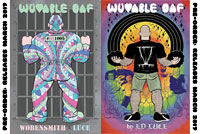
What A Dog Wears is a perfect, goofy delight, demonstrating costume after increasingly absurd costume a individual can wear in order to help with "struggling w/articulating yr personal style". This mini is just a chance for Suburbia to joyfully goof off and draw fun and funny things for twenty or so pages. It starts to get really ridiculous with "SK8 Sandwich", which is two skateboards, one in front and one in back. "The Blood of Mine Enemies" (cheerfully subtitled "Goes with everything!") is a dense, disturbing image, matched only by "Apex Predator", which is a person with a shark out of water devouring most of their body. Funniest of all is the truly unnerving "A Mascot Suit Of Yourself", complete with two eye peering out behind the "mouth" of the mascot. Suburbia has formidable cartooning and drawing skills, but it was nice to see the illustration part of her drawing take center stage with these concepts.

Cyanide Milkshake #8 is an extremely revealing but also very silly comic, and that's a dynamic that sums up Suburbia nicely. She did a flip book in the bottom right hand corner of each page of Batman licking himself in a sensitive area like a cat. She talked about shoplifting groceries from a nearby market and laments how expensive the mustard she once stole was. There's just gag after gag on some pages, like the buttons on Jughead's hat (him fucking a burger, of course), wearing her partner's face at his funeral, a joking-not-joking bit about wanting to do watersports, etc. Then in "No Identity", she gets serious, revealing that pushing herself to finish her book Sacred Heart broke her, as her lack of self-care produced depression and severe anhedonia. It got to the point that the thought of making comics was upsetting to her, and she preferred to live life for a while pursuing the most basic, visceral experiences: eating, sleeping, exercising and having sex. The end of the story had no end, other than hesitant attempts to get back in the game (like this) that were still limited, as she chose to end the series with this issue. There's one last ode to her dogs and the wrap-up of her dimension-travelling zombie story that ends with a glorious deus ex machina. Suburbia really does give her reader a lot to chew on, especially in terms of comedy, and in her own way, Cyanide Milkshake was sort of her version of Love and Rockets. There's the angle of serialized stories, a mutual love of Archie comics, strange one-offs and a punk attitude, only Suburbia's comics are even more personal in some ways. To put a finer point on it, she allowed herself to do whatever she wanted--no rules, no restrictions--and she blossomed as a cartoonist with the freedom she gave herself to experiment. The series will be collected at some point soon, but I'm hoping she's able to return to the sequel to Sacred Heart in due time.


 A key character in the book is a hallucination: Charlie and Christopher's mother. As it turns out, she claimed to have been raped by a demon, which led Christopher to his wild theories about an underground civilization of creatures that looked like demons. Charlie knew that the truth was far more prosaic (a drunk, red-headed farmer at a party), but it turned out that Christopher accidentally stumbled on the truth. The party, whose composition with a doubting priest and a scientist burning with belief made it a walking but highly unusual debate, encountered all sorts of bizarre sights. There was a man-made utopia not too far under the ground called Ultimate Thule that an insane member of the party destroys; said member naturally turns rapacious toward Charlie when he reasons that he will be going to paradise so that his actions now have no further consequences. There was the appearance of what seemed to be actual demons, which led the remaining members of a party on a long and perilous chase. There were extremes of heat and cold, tornadoes, razor-sharp ice cities, oceans of magma, roots suspended from vaulted ceilings, and giant sloth-like creatures that one could hitch a ride on.
 The book is a relentless visual feast of crazy action sequences that never allow the characters or reader more than a moment of rest before the status quo changes. Things really start to get interesting once the breathless pace of the book eases and Charlie (whose black dot eyes along with the red hair make her a ringer for Little Orphan Annie) finds evidence that Christopher is still alive. When the priest and Charlie finally find what seems to be a secure location, she encounters a demon whose horn she had partially lopped off earlier in the book--only the creature is not only attracted to her, he's submissive to her and enjoys being hit. By this point, Charlie's half-naked and she's turned on by the beast and has sex with him. That only intensifies the guilty hallucinations of her mother, who taunts her for actually having sex with a demon. This is the beginning of the complete breakdown in structure with the characters, as the priest imprisons them, believing that it wasn't safe to leave. He had created his own little utopia, a running theme in the book as every time a character believes they've managed to achieve this, it gets smashed to bits.
 The end of the book brings up certain moral issues not unlike Conrad's. When they finally find Christopher, it's slowly revealed that being in this environment has revealed him for what he truly is: a monstrous, selfish manipulator. Unlike Conrad, that transformation becomes literal in a series of horrifying pages that Charlie barely survives. Christopher never has a "the horror, the horror" moment; instead, he falls into that abyss that he gazed into in a figurative and literal sense. The world of Satania is a sentient but completely amoral ecosystem that exists to move, thrash around and destroy, but the obvious point that Vehlmann and Kerascoet make is that it's really not that much different from the surface world. Or rather, it's a difference of degree and not kind, but in neither case is it to be lauded as something utopian. That's really punched home with the final pages, where getting back to the surface is less a matter of returning to civilization than it is making a choice between two different worlds with different rules regarding cultural mores but surprisingly similar rules regarding survival.
 Unlike Beautiful Darkness, whose ending seems happy at first but is actually horrific upon further contemplation, the ending of this book isn't so much happy as it is an acknowledgment that we ultimately are responsible for our own choices, and it's that agency that Charlie relies upon throughout the book that saves her. She's the only character uninfected by cold science or fervid beliefs that negate humanity; she has the flexibility of her brother with regard to adapting to her environment without his evangelical embrace of the id-ruled nihilism that Satania represents. That fits neatly into Kerascoet and their collaborators writing books about violence, horror and deviancy that wind up finding the conventions and authorities of society every bit as monstrous and dangerous. The ending of Beautiful Darkness is horrible not because the main character found a "home" with the giant, but rather because this conventional love she felt was for a person who had killed her host. In Satania, it's Charlie's flexibility and unflappability that allow her to overcome both the physical and philosophical dangers she's presented with.




 Posts
Posts


