Wednesday, June 22, 2022

Crowdfundr for Fieldmouse Press

As you may know, one of my many hats is being a member of Fieldmouse Press, the publishing concern that puts out SOLRAD.co and just published its first book, Ariel Bordeaux's Clutter. I'm quite proud of that book, and I'm also quite proud of our upcoming Spring publishing season. 

For a variety of reasons, we have shifted away from using Kickstarter for our fundraising needs and have become the inaugural launch for Crowdfundr, a new fundraising entity. We're working directly with the folks running Crowdfundr, and we are extremely pleased with this collaboration. Here's a link to our fundraiser on Crowdfundr


We will be publishing two books and two minicomics this Spring season. The first book is Now And Other Dreams, by Daryl Seitchik. Daryl is an extremely talented young cartoonist who emerged nearly fully-formed, as readers of High-Low might remember. Nominated for an Eisner for her book Exits, Now bears some similarities to that narrative. Now is a collection of Seitchik's out-of-print dream comics and other surreal narratives. Told in her deadpan style that still allows for a number of expressive flourishes, Seitchik delves deep into her own thoughts, beliefs, trauma, and fears and comes out the other side. The collection also features two new stories. Her storytelling, line, and daring as a cartoonist feed into how she's able to create so many variations on her theme of exploring her subconscious. 


The second book is Good Person Trouble, by Noëlle Kröger, They are a fantastic German cartoonist and described this book as "Bertolt Brecht meets Judith Butler." Based loosely on Brecht's The Good Person Of Szechwan, the narrative examines trans and gender issues in an ingenious manner with characters that are anthropomorphic animals. This courtroom drama with a number of dramatic twists was translated by Natalye Childress, and it's Kröger's debut in English. 


The first mini is Magic Nation #1, by Ellen O'Grady. Ellen is a miraculous cartoonist who just started in the practice after years spent in other pursuits. Her sensitivity, her understanding of color, and the expressiveness of her characters are absolutely remarkable. This memoir of her childhood is meditative and evocative of the woods that meant so much to her. She's an instant memoir superstar. 


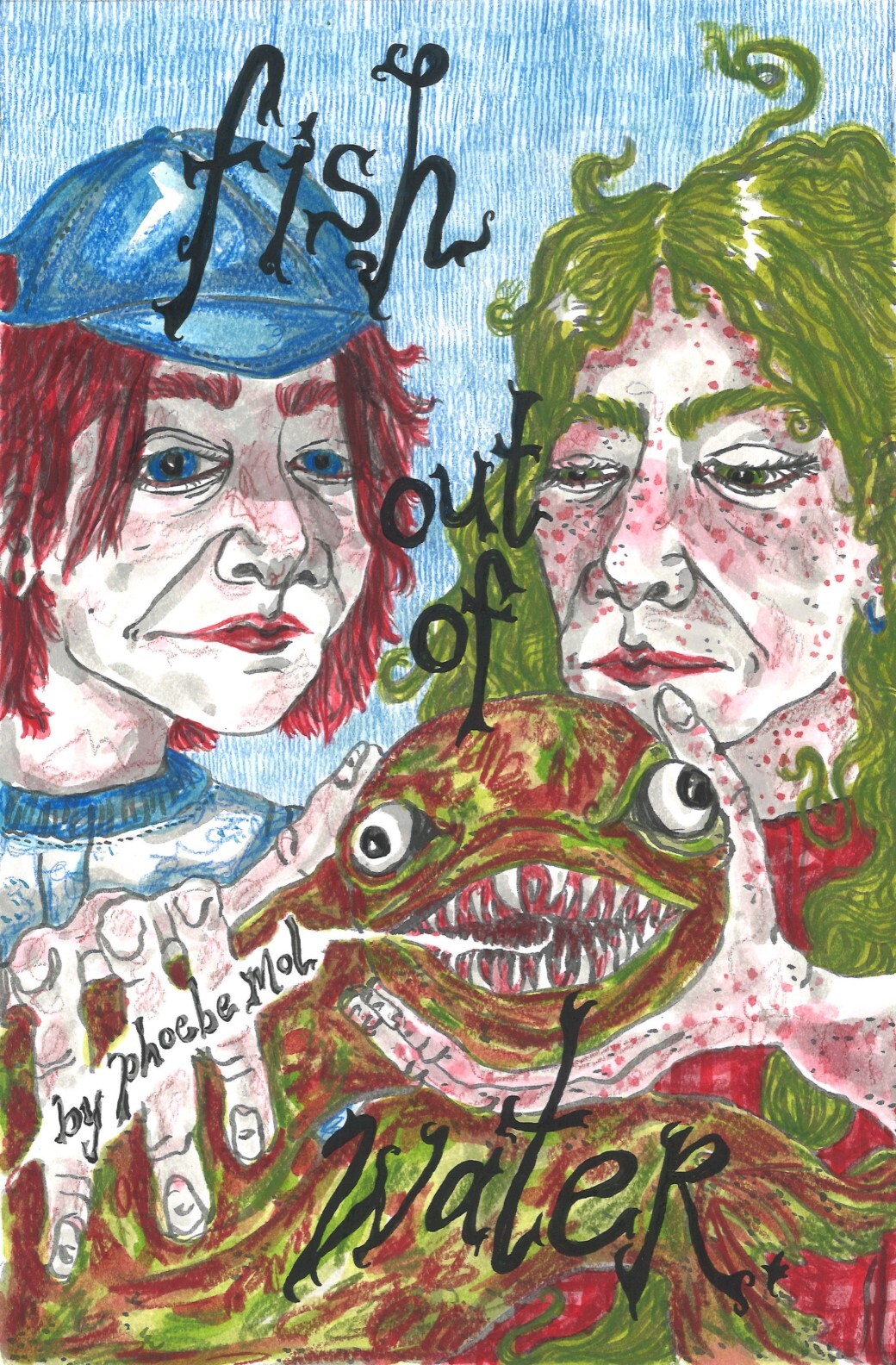
The second mini is Fish Out Of Water, by Phoebe Mol. This is yet another debuting artist, and Mol's arresting and grotesque character design and immersive storytelling style is reminiscent of artists like Juliacks. Her color sense is spectacularly vivid. 

I hope that you consider funding these books and preordering them through our Crowdfundr. Thanks for your consideration!

Thursday, June 16, 2022

Hyperverbal: Hayley Gold's Letters To Margaret

Hayley Gold's debut graphic novel, Letters To Margaret, is a crazily ambitious hybrid of comics and crossword ephemera with an avalanche of puns, wordplay, eye pops, and so much more. Gold's reach exceeds her grasp in a number of respects, but it was a dizzying and invigorating experience reading her attempt to throw the kitchen sink at her reader in the sheer number of verbal and visual devices she employed. 
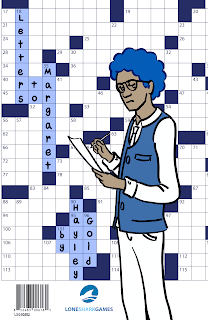


Let's unpack all of that a bit. Gold's formal ambition was staggering. The basic plot concerns a Columbia journalism student named Margeret "Maggie" A. Cross, a crossword puzzle enthusiast and blogger about that subject. She's relentlessly and painfully self-righteous, judgmental, and irascible, but she also has a razor-sharp wit and a strong point of view. The other protagonist is Derry Down, a grad student and her TA in a journalism class about column writing. As a Black grad student and fellow crossword enthusiast, he's sensitive to the way the New York Times crossword marginalizes people of color. As the gold standard puzzle, it bothers him to be reduced to words like AFRO and to see clues related to Aunt Jemima. The lead blogger on the site was his mentor, journalism professor Lewis Dodgson (a sly Lewis Carroll reference), who wrote as Vox Populi.  Another crossword blogger (a subculture within a subculture, not unlike comics criticism), Maggie eviscerated Vox as being too PC. When Derry realizes that Maggie was the blogger (she went by Anna Graham, and he by Mr. Lear), he wanted to get back at her. Things go in some surprising directions, as conflict can create sparks of romance as well as conflict. 

The core story and motivations are all relatively simple. Maggie is a harsh critic, but she's stung by rejection--and specifically having her crossword rejected by the NYT. Derry simply wants to find ways to make the crossword world feel more inclusive. Gold adds layer upon layer to the plot and the structure of her comic in order, in some sense, to approximate the chaos, complexity, and playfulness that goes into constructing a crossword puzzle. It's also about how two individuals will always see the same series of events with vastly different points of view, but that it's possible to make connections that bridge that communication gap if you make yourself open and vulnerable. 
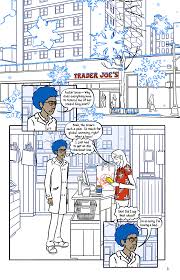

So the first thing that Gold does to communicate this is make it a flip-book. About fifty pages are devoted to the story from Maggie's point of view, and when you reach the end, one can flip the book over and read the same essential narrative, only from Derry's point of view. Considering how much of the book is subsumed by thought balloons, the reading experience is quite different, as the reader becomes completely immersed in the point of view of each character and slowly sees them navigate that gap. 

That alone would have been plenty. However, there's an additional plot device and mystery as Maggie starts getting letters from Margaret Farrar, the (deceased) crossword puzzle editor of the NYT for 27 years. "Margaret" writes as though Maggie sent her the crossword puzzle that was rejected and wrote encouraging words. This was all the doing of her junk food video-making roommate Amanda, Maggie's former crossword commentary blogging partner. 
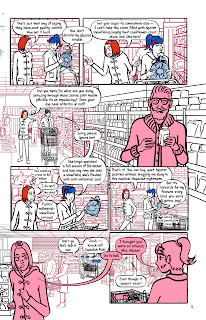


Each chapter is headed by crossword puzzles that contain clues and spoilers for the chapter itself, and Maggie's own puzzle is printed several times as it evolves. That particular gimmick is extremely clever, immersing the reader in this particular hobby and culture in the most direct way possible. Gold doesn't stop there with her visual tricks, as she makes frequent use of internal notations and metacommentary. Those comments are frequently made by talking arrows, one white and one black, named Ebony and Irony. They comment on the plot, the thoughts of characters, crossword clues, and everything else, adding another level of visual and decorative wordplay to the proceedings. On top of all that, Gold throws in some magical realism for good measure, as several of the characters are literally able to read the thought balloons of other characters, while others appear as hallucinations, bringing snacks along to enjoy. 

Throw in Derry's fascination with the nonsense poems of Edward Lear and a heavy dose of history regarding crossword puzzles, and you'd have something that even the most confident and experienced visual artists would find challenging to present in a clear, coherent manner. The biggest problem with the book was its design. The pages were absolutely crammed with text, suffocating and surrounding entire panels' worth of art with layer upon layer of text. While swimming in wordplay was part of the point of the narrative, the reader never got a chance to breathe. Gold has also noted that Amy Sherman-Palladino, creator of Gilmore Girls, was an inspiration with regard to dialogue, but even that hyperverbal show had interludes that allowed everyone to take a breath. 
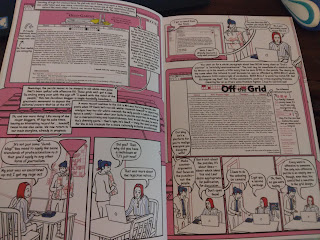

Gold does combat this problem with her cartooning, and it was often successful, especially as my eye adjusted to the frequent walls of text. Specifically, she kept her line simple and functional and used color as character signifiers, guiding the reader's eye across the page. That allowed her to integrate her comics with crossword puzzles; the crosswords took on a pleasing decorative aspect. However, this approach did not work at all when she plopped a blog down on the page, especially with the text being so small. This was another design problem; this book needed to be printed at a much bigger scale. Each page was based around an eight-panel grid, but being printed at 7" x 10" crammed too much information on one page. A 10" x 14" scale, more in line with a European album, would have made the pages breathe a bit. 

Letters To Margaret feels like a young cartoonist bursting with ideas and trying to cram them all into one project. The marginalia, the metacommentary, and other, similar elements distracted from the book's most interesting innovations. Gold's ability to alter the narrative in both sides of the flip book was astonishing and allowed her to focus on the most important aspect of the comic: its characters. Derry and Maggie were both unreliable narrators and were hard to like, but that was part of their charm for both the reader and each other. Letters To Margaret, at its heart, is about the dangers of being so hardened in one's beliefs out of spite that it prevents you from even trying to understand the perspectives of others. Derry and Maggie were both funny, sweet, nasty, and unbelievably witty on their own; they didn't need the marginalia to make their story shine. Gold has a remarkable facility with dialogue and wordplay, giving even the most affected and stilted wordplay emotional depth. Maggie and Derry used their hyperverbal qualities as a mask for their deeper feelings and insecurities, but they also used it as a form of playful, loving interaction. 

Gold clearly has a bright future with regard to these kinds of character dramas, as her own sense of humor, playfulness, and eager willingness to innovate will no doubt continue to transform what could be dull talking-heads panels into something far more interesting and challenging. That said, I would hope that she focused her cartooning on the most important part of visual storytelling: the characters. How they interact with each other in space and fluidity of movement, in particular, are things that would enhance Gold's way of creating a beautiful verbal dance between her characters. I'm fascinated to see what she tries next. 

Tuesday, June 7, 2022

New address!

 Hello, all! I have a new address:

Rob Clough

1227 Seaton Road

Apt 40

Durham, NC 27713

Monday, May 16, 2022

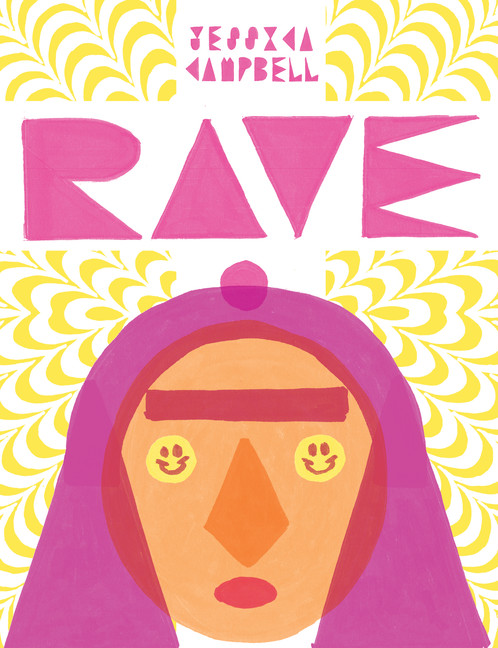
Cool Jesus: Jessica Campbell's Rave

The genius of Jessica Campbell's work is her fastidious attention to detail. Her first two books were broad satires of gender, culture, and art that landed hard precisely because of how much she knows about art institutions and how easy it was to write a funny bit of feminist sci-fi. With Rave, however, Campbell moved into more serious territory in exploring how evangelical Christianity, by design, controls every aspect of its parishioners' lives and creates trauma and dysfunction. Campbell's attention to detail with regard to the church in this story is almost painful to read; it's the sort of thing that only an insider could have explained. 


Rave is the story of two teenage girls, Lauren and Mariah. Lauren is a good-natured, church-going girl who attends a fairly big evangelical church in what seems to be a suburb or smallish town. It's the kind of community where people tend to know each other--like it or not. Mariah is her classmate, a "bad girl" reputed to be a witch. When they are paired together on a school project on evolution, they decide to do a sleepover at Mariah's place, since Lauren's parents are offended by the very concept of evolution. Lauren's drawn to Mariah's devil-may-care attitude, and Mariah is drawn to Lauren's hidden potential. They slowly fall in love, the kind of romance that crosses naturally from close friendship into something physical. At a certain point, Lauren hears a sermon condemning same-sex marriage and starts to feel the kind of cognitive dissonance only a believer confronted with ideology that runs contrary to their lived experience can understand. She distances herself from Mariah and immediately regrets it, but it's too late. 

In the book's superb climatic sequence, Lauren attends a Christian "rave" (which is hilarious in any number of ways, but more on that later) while Mariah hangs out with a creepy guy in the forest. In both instances, the girls receive forced and unwanted sexual advances from guys they trusted. In Lauren's case, she simply runs away from the dull boy who's hitting on her; it's implied she only agreed to go with him to the rave as a nod to trying to fulfill the role the church wanted for her. In Mariah's case, she runs off into the woods and accidentally drowns in the river; it's implied that she was not just drunk, but drunk from something the guy brought and had drugged. Lauren eventually sees through all of the hypocrisy and storms out of church, smoking a cigarette from a pack she found in the garbage--a small tribute to her friend. 


It's the astounding verisimilitude of the cloying, manipulative quality of the church that makes this such an unsettling read. Christianity's ace in the hole has long been its ability to co-opt local religions and customs throughout history, repurposing these familiar mores and stripping of their original meaning while retaining the trappings. This viral quality can be seen in modern iterations of worship in churches using lingo and tropes familiar to kids while using the latest technology, like headset microphones. The core of the ideology remains unchanged for evangelical Christianity in particular: salvation can only come through Jesus, same-sex relationships and pre-marital sex are evil, Satan is actively trying to get you to stray off the path, etc. This played out in the DJ who ran the Christian rave, saying that Jesus was the first raver and wants people to dance and move--but not have sex. The use of lingo like "Can we talk?" in an attempt to dress up the archaic and repressive nature of these beliefs is the essence of this playbook, and Campbell just nails painful detail after painful detail. It would all feel like an exaggeration if it wasn't 100% true.

There's a scene early in the book that reveals just how much the church was simply theater. The daughter of the pastor (who of course revealed his struggle with masturbation that he supposedly conquered) got knocked up and was forced to go through the pregnancy. She was called onstage to repent and talk about God's love. When Lauren said hello to her at school the next day, the girl (smoking a cigarette while pregnant) simply said, "Fuck you." It was all a charade, all for show. Love, mercy, and compassion were stage dressing for controlling the lives of the believers. Lauren didn't truly understand this until the end of the book, and who can blame her? 

Campbell has her limitations as a draftsman, but it doesn't matter much because her skills as a cartoonist are so sharp. Her use of gesture is top-notch; there's a scene where Lauren is talking to Mariah on the phone, sitting in a plush chair, moving in different positions. Her relaxed poses in each panel reveal just how comfortable she was feeling with her best friend in ways that felt natural until the authority of the church told her otherwise. Similarly, the plastic quality of the pastor and rave DJ are reflected in the way they have their hair sculpted. Her satire is as trenchant as ever in Rave, but its surprising emotional depths point to her evolution as a cartoonist. 


Wednesday, April 13, 2022

Announcing the North Street Book Prize


Aimed at creators of self-published comics and graphic novels/memoirs, art books, and five other genre categories, the North Street Book Prize offers cash awards to artists. Now in its eighth year, The North Street Book Prize values entries which portray lives underrepresented in traditional media; diverse characters and themes are especially welcome. 

The Grand Prize is $8,000 and the First Prize in each entry category is $1,000. Grand Prize and First Prize winners also receive a marketing consultation with a book publicity expert, as well as other benefits. One honorable mention in each category will receive $250 each. The 2022 deadline is June 30th, and the entry fee is $70. It can be submitted online or by mail. All winning entries receive publication of an excerpt from their book on winningwriters.com alongside a critique from our judges.

Recent winners include Ingrid Pierre, for her graphic memoir Do Not Resuscitate, and Dmitri Jackson, for his slice-of-life comic Blackwax Boulevard. I reviewed the latter comic on High-Low here

All entrants will receive free gifts from our co-sponsors geared towards the development of their self-publishing careers. This will include free access to paid subscription services such as Book Award Pro, a company that analyzes your book and finds the contests most suited to it, and Self-Publishing Mastermind, a workgroup for authors that covers every aspect of the self-publishing and book marketing process. The price of entry also includes free downloads of PDFs about self-publishing and marketing from experts like Book LaunchersC.S. LakinBookBaby, and Carolyn Howard-Johnson. Every entrant comes away with materials to help them develop their craft and career, not just the winners.  
 
 
The North Street Book Prize is sponsored by the website Winning Writers in partnership with the Alliance of Independent Authors (ALLi), a designation for "contests which are organized for the benefit of the author rather than the profit of the organizer." Winning Writers has been running writing contests for over 20 years. We are one of Writer's Digest's Top 8 Online Resources for Publishing and Marketing. We seek to be a welcoming place for diverse authors and stories, with a culture of listening to people of all genders, backgrounds, and abilities. We look for high-quality original writing that portrays under-represented perspectives with sensitivity, accuracy, and passion.


Please note that this post is sponsored by Winning Writers. 


Friday, December 31, 2021

31 Days Of CCS, #35: Michael Sweater

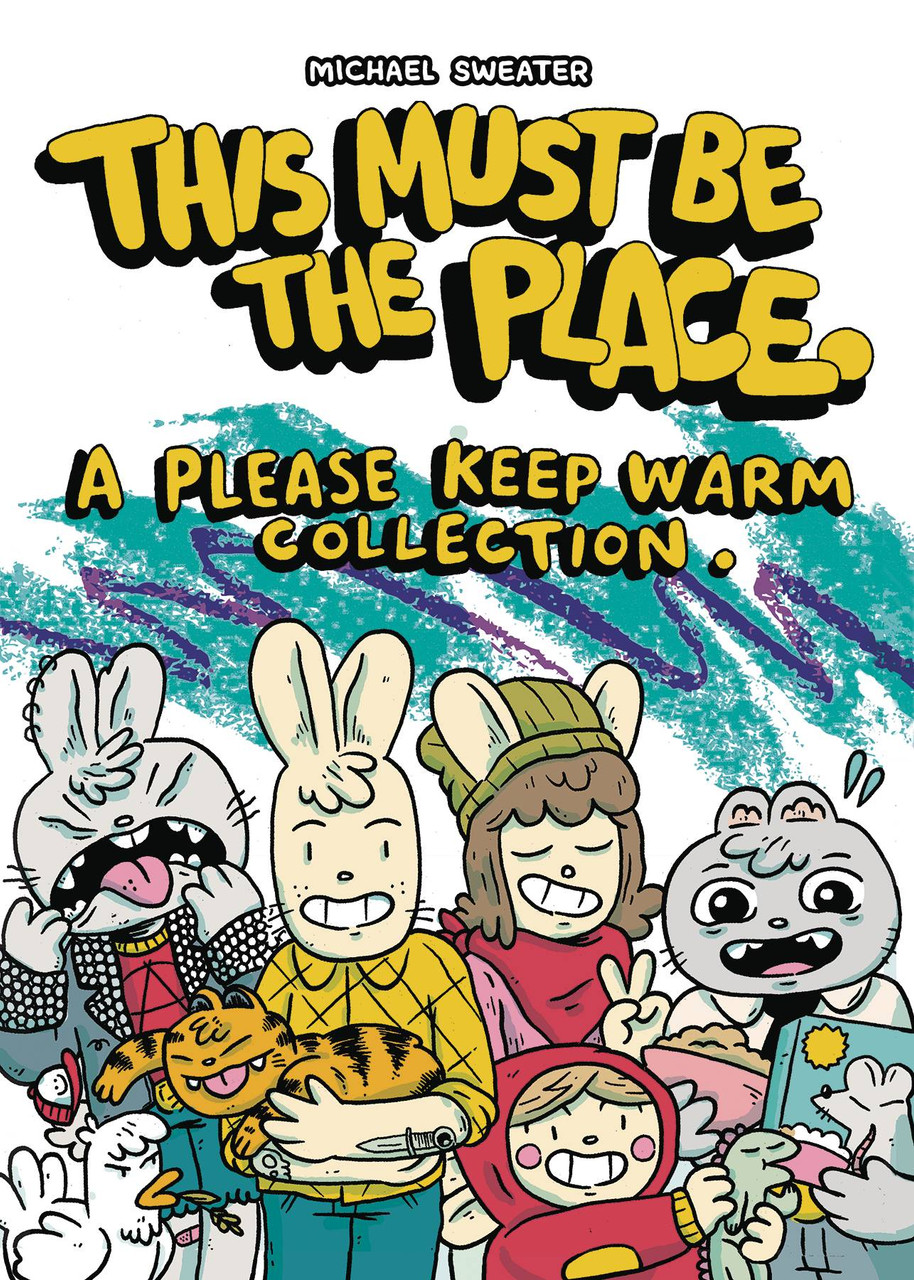
Michael Sweater's comics are often aggressively cute. That cuteness is cut by his funny satires of hipster culture, making what initially looks like YA comics into classic slacker slice-of-life comics. His collection of "Please Keep Warm" comics, This Must Be the Place., has a line-up of quirky and mostly lovable writers, kids, punks, toughs, weirdos, and working people. Using a formula that goes back to Peter Bagge and Hate, and more recently Simon Hanselmann with Meg, Mogg, and Owl, Sweater gently pokes fun at his characters while also clearly displaying a great deal of affection for them. 


The comic is a series of vignettes featuring an inquisitive kid named Clover, her Uncle Stan (a writer with perpetual writer's block), an accountant-type named Catman, and a slacker woman named Flower. They're all housemates whose relationships are undefined in the way group houses often are. They're visited by a punk anarchist type named Kevin, a trucker hat-wearing, cigarette-smoking chicken, and have all sorts of adventures. It's all done in an anthropomorphic style that's all about strong expressions and gestures. 


Sweater keeps the stories short and snappy, with plenty of humor before eventual punchlines. For example, Clover decides to record a black metal demo and gets a bad review on Pitchfork, prompting Catman to try to cheer her up by regaling her about his goth days in high school. Stan, Clover, and Catman go on a camping trip without inviting Flower, causing her to get depressed. She's cheered by punk rabbit James, who is a marvel of character design with multiple piercings in one of his very long ears. Stan is always trying to write a novel but finds multiple excuses and reasons not to work.  

It's all very leisurely paced, which is part of its appeal. No one is in much of a hurry to do anything, inviting the reader to do the same as they stroll through the lives of character archetypes who will be familiar to many. It's Punk Lite in the best sense of what that means, poking gentle fun at the scene and the kind of group houses so familiar to people in their youth. Sweater's character design and storytelling chops are what make it feel so lively and polished. 

31 Days Of CCS #40: Aaron Cockle

Aaron Cockle keeps cranking out oblique, bizarre takes on capitalism and culture in the form of a world-exploring video game called Andalusian Dog, and he released four issues of the comic named after the game between February of 2021 and January of 2022. The word "surreal" gets over-used in popular culture to mean "weird" or "uncanny," but the roots of the art movement are deeply involved in an exploration of the unconscious mind and its symbols. How we encounter and process these symbols is not the same as it was a century ago when the movement began, and Cockle's comics are a response to both modern art and technological movements, their intersection, and their being co-opted by industry and capitalism.


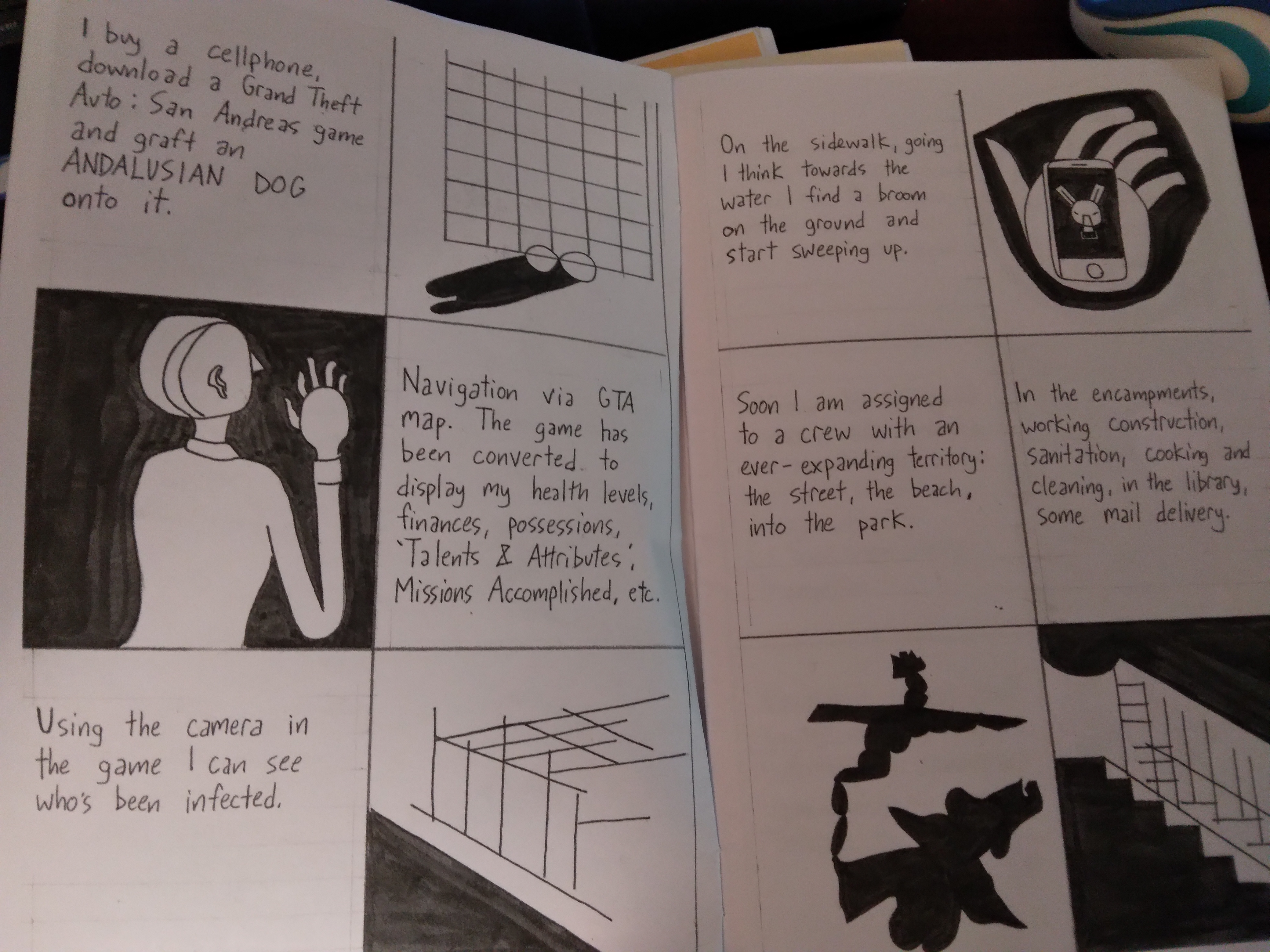
The February 2021 issue of Andalusian Dog is titled "Ladder of Fire," a reference to the Rene Magritte painting of a key, an egg, and a wad of what looks like paper all on fire. Ordinary objects, all in the process of change and possible purification; ordinary objects in the process of being destroyed. In this issue, the paranoia and conspiracy attached to the game take on a different aspect as the narrator is dropped off in Los Angeles with a tent, a sleeping bag, a $100 gift card, and a backpack. His first move is to download Grand Theft Auto: San Andreas and then overlay Andalusian Dog over it. The overlay lists the narrator's own health while providing a map to navigate his environment (since the game was based on Los Angeles). The distance between game and reality becomes nil, and the whole experience is a punishment for various crimes--real and imaginary. There's a desperate sense in this story and the next of secretly and surreptitiously working on borrowed laptops about theories of salvation; in the former story, it's the Ladder. In both stories, there's a sense of total societal abjection for the narrator, of being thrown down and thrown out of society. Yet there's a kind of desperate freedom in that. 


The November 2021 issue may be my single favorite issue of the series. Titled, "The Pit," there's once again a press-ganged aspect of the story as the narrator must help build a structure where the pit must be as deep as the tower is high, and the wall must be as long as the height of the tower. It's all for a mysterious Count as Cockle heads straight into Kafka territory, as he talks to his friends and becomes the founding and sole member of the Franz Kafka Fan Fiction Society. Later, he is thrown out of his own organization, of which he is still the sole member. Later still, he and his friends (all labeled X) are sent on a mission to an outpost for for work, Finding the outpost abandoned, part of the group searches for the group that left the outpost, leading to more abandoned outposts, more lost people, and more expeditions. Eventually, it becomes an existential game where one's own identity is in question, a sort of open-world video game where the mission eats itself. Cockle overlays maps and diagrams with less to do with standard cartography and more with game logic. 


The December 2021 issue goes back to Chile, a frequent setting in Cockle's comics. The makers and developers of the game find that the game is affecting real life, and real life is affecting game play, and they don't know how this happened. Cockle himself is a character, referring to his own comics and finding reviews of work that he's never published or even conceptualized. Once again, there's a sense of always being on unfamiliar or dubiously claimed ground, squatting in abandoned houses and finding ways to work and even throw parties. All along, the images are nightmarish but clinical; office buildings, cubicles, strange geometry in a Lovecraftian sense. Cockle is deliberately conflating dream logic with virtual reality, trying to find the line between the two--if there even is one. 

Finally, the January 2022 issue betrays almost a kind of mania, as huge walls of text appear on each page, overlaid with diagrams, sketches and scribbles that sometimes border on the abstract. It's difficult to even begin to parse, as it's a stream-of-consciousness journal about traveling to Chile once again. The back half of the issue goes in the opposite direction: oblique bursts of text paired with clip-art, diagrams, photos, blotches of ink, maps, and other ephemera. Providing an appendix perhaps only for himself, there are also excerpts from an essay about Kafka and The Decameron. This is the most oblique and self-referential of all of Cockle's comics, seeming lost in its own maze of logic, having long ago abandoned clarity with regard to narrative and plot. It's also barely what I would consider to be a comic.