Friday, December 24, 2021

31 Days Of CCS, #24: Ashley Jablonski

Ashley Jablonski's comics have a sincerity to them that extends to whatever genre they happen to be working in. In Ghost Lights, for example, Jablonski explores the titular phenomenon which goes by other names, like will o' the wisp, where mysterious lights appear. While there are various scientific theories, others view this event as a portent--for good and ill. What I liked about Jablonski's approach here is that they used historical data in discussing the sightings before revealing their own experience. Jablonski's approach is always to approach an event from a number of different perspectives; they never force an interpretation on the reader. At the same time, their vulnerability in sharing this and other personal and private moments is one of the best qualities of their work. The use of an expressive watercolor palette here is crucial to the comic's success. 


Burn is a compilation of short dream comics, once again done in watercolors. One was about a vampire masquerade and being pursued by a real vampire. This showed off Jablonski's sense of humor, as the bat left behind a bloody valentine in order to woo them. The other was a dream of being on the star Vega and being told telepathically by the dead members of the civilization that Jablonski had been one of them. It ended with a silly pun. While neither of these comics are personal or deep, it shows Jablonski's willingness to go all-in on an assignment. 


Rituals exemplifies the best of Jablonski's work. It's a short comic, done entirely in rough pencils, about the rituals they use as an artist prior to beginning. Jablonski notes the rituals they've seen other artists use and how they've adapted these rituals for themselves, but this mini was also done as a way of passing it on to others. There's something deeply humane and generous about their work; Jablonski seems to be most interested in establishing a connection with their reader, to reach them at an emotional level, that is rare for artists. The pencil lines are expressive and make an immediate impression, further solidifying this direct appeal. 


p...a...r...a...m...n...e...s...i...a... is a different look from Jablonsi. Printed in landscape with a single image per page, it has a flip-book quality to it. That physical quality of the book is apt for the subject matter, as it's about a young woman who's being questioned by the police for an unknown reason. Jablonski slowly eases the reader into this chain of events that starts off with pleasant memories of being outside, then reveals the inquisition, then slowly clues the reader in that there's a serious lacuna going on here and some sinister events. Many of the pages are entirely black, signifying how trauma can blot out memories altogether in order to protect the victim. 

A technique Jablonski uses there and in other comics is the classic dissonance between word and image. It's the tool of the unreliable narrator. It can also be used for humor, like in their small minis Autocorrect Fails and What The Duck?! #2. In Autocorrect Fails, Jablonski draws precisely what the fail depicts; in a fail that used the word "blubber" instead of "number," they drew a walrus. In What The Duck?!, the words "dick" and "fuck" get replaced by "duck," leading salacious or angry texts to be depicted with a duck or duck toy instead. It's a good gag, and Jablonski is good at getting mileage out of them. 

Jablonski is ambitious in their drawing, and their skills as a draftsman sometimes aren't up to their level as a storyteller. Other technical aspects of their work, like lettering, need a lot of work. Jablonski does well when using something to enhance their line like watercolors or using that expressive pencil approach, but simplifying their line in all aspects as they develop those skills would probably lead to more cohesive results. It's clear that their storytelling and cartooning have become rock-solid in a variety of different genres, so this is simply a matter of just continuing to develop and getting better in public. e

Thursday, December 23, 2021

31 Days Of CCS, #23: Al Varela

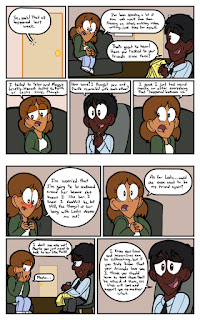
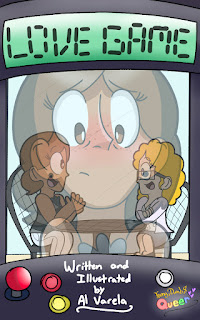
Al Varela's work is different from a lot of their classmates, but in many respects is representative of comics at large, especially with regard to webcomics. This mini, Love Game, is part of a larger series called Young, Dumb & Queer (an all-time great title!). The art style is clear manga-influenced, and the character design is clear, consistent, and highly expressive. While it's full color, the color doesn't overwhelm the line art and things like gesture and body language. 


From a technical standpoint, I just wished it was bigger. The art felt cramped. The text overwhelmed the art in a lot of panels, in part because in a character study like this, there was a lot of dialogue that needed to be used. I often speak of a rough 2:1 rule in panels and on pages: Two-thirds of your panel should be an image, and no more than one-third should be text. This is a rough rule that can be worked around, but when the text overwhelms the art on multiple pages (especially if it's a talking heads story), it leads to feeling cramped. I also appreciated Varela hand-lettering the whole thing, but their lettering suffered from the same cramped quality. They'd probably benefit from using an Ames guide to letter, in addition to alloting more space to the art.


As for the story, Varela effortlessly weaves multiple relationships in multiple states for a group of young queers who are trying to figure things out. The aspect of the story that I found most interesting was that there were heroes or villains in this story--only people trying to figure things out as best they could, often while trying to combat their own limitations and mental illness. For example, Leslie is a character who hurt Maggie. Maggie was concerned when she spotted Leslie making out with Faith, both because she was worried that Leslie might hurt faith but also that her lovesick friend Pearl would freak out, because she was into Faith. Leslie does and says a lot of insensitive things in this comic, but she's not a villain. Her self-loathing has painted her into a corner where she feels "bad" and hence does "bad" things, but those are ultimately her own choice and ineffective as behavior. The story explores the limits of each of the characters as they ultimately share empathy and work things out, with some funny and awkward steps along the way. Varela has a keen understanding of character dynamics that's enhanced by their skilled use of gesture and an understanding of how bodies interact in space. In other words, their storytelling is quite good; it's just some of the details that need to be cleaned up.

Wednesday, December 22, 2021

31 Days Of CCS, #22: Annabel Driussi

Annabel Driussi's comics delve into some serious topics surrounding love, intimacy, and vulnerability. However, there is an upbeat quality to almost all of her work that shines through, even in the most difficult of reads. Driussi has a background in neuroscience and has done a lot of science illustration work, but her personal comics here are frequently funny, sexy, dark, probing, and horny. While she has a particular aesthetic that carries over to all of her projects, she's also capable of truly varied work, especially in terms of tone. 

Fig Leaf was her first minicomic, and it showed in terms of layouts, lettering and sequencing. However, Driussi's style was quickly in place and the black/white flip in terms of negative space was highly effective in this harrowing conversation between father and daughter about sexual preference and their own fraught relationship. Sure On This Shining Night is an assured howl of anger, depicting (presumably) the artist riding a bike at night, being sexually harassed and then followed by a man in a car, and her frustration and anger once she was safe. The fact that she even had to ponder being safe when she was just trying to get from point a to point b was the reason for this explosion. The use of color is meant to add a sense of visual dissonance to the proceedings, doubling as a way of expressing the emotional narrative of the story. 

Deeper! is sort of Voyage To The Bottom Of The Sea meets H.P. Lovecraft, only as lesbian erotica. It takes itself exactly as seriously as you would expect, to its great benefit. There's not any actual sex or nudity depicted, but the salaciousness is amusing, as is the genius virgin-related gag the defeats the deranged villain. Driussi was forced to work a little small, as she crammed a lot of panels onto each page. That sometimes hurt her character renderings, as she couldn't quite decide at times when to drop out detail and when to do a more detailed rendering, and the results were mixed. 

The Bull & The Gnat was the Aesop's Fable assignment, but it was completed with her left (non-dominant) hand because of an injury to the other hand. It looks like it was done with colored pencils, and it speaks to the idea of cartooning and illustrating being two related, but different skills. The rendering was actually quite good, even if the lettering was rough, but the whole story is really about the gnat's actions being irrelevant to the bull, so the gnat may as well do what it wants. Rice Krispies is the Ed Emberley assignment, and Driussi made this a sort of stoner break-up story, where the main character is hung up on his ex, regrets his actions, and later learns he was totally forgotten. The animal heads of every character turn out to be a result of his being high. Driussi really nails the setting and these particular character types, and their style was well-suited to work in the stripped-down Emberley style. 


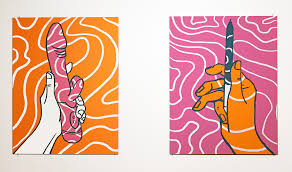
Finally, Touch Your Self! was Driussi's most interesting comic. Not because of the obviously salacious subject matter regarding masturbation, but because of her incredible vulnerability and the critical faculties she brings to bear on the idea of not only catering to male fantasies by her very existence, but that masturbation for her was always performative and never only for her. She then turns the tables and asks the reader to think about masturbation and what it means to them. In so doing, she is both engaging the reader in an intimate connection and also putting the reader in that same performative space that she finds it hard to get out of. The visuals are frank and stark, tinged with the slightest touch of humor but mostly played completely straight. 

Driussi is a thinker as a cartoonist. It's interesting take her work in a vastly different direction from her applied comics work with regard to science, yet still use that sense of composition in some of her work. It's also fun to see her loosen up while zeroing in on these issues related to intimacy and vulnerability. I'm curious to see what her thesis will look like and what she pursues in the future.

Tuesday, December 21, 2021

31 Days Of CCS, #21: Kit Anderson

Kit Anderson is an exceptional young talent. With years of graphic design experience, it's obvious that her comics are well-considered in terms of composition. However, despite her obvious skill as an illustrator, there's a welcome lack of slickness in her work. It is just visceral enough to really draw in the eye instead of repelling it. Anderson is also the rare CCS artist explicitly interested in literary/alternative comics, a form of comics storytelling that's become less dominant in the past few years. It's clear that they excel in this milieu. 

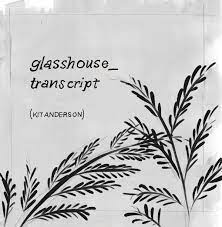
Anderson is interested in the emotional ramifications of being caught betwixt and between. Her comics also deal explicitly with memory and identity. "Glasshouse Transcript" is an interview with a woman about a past memory of meeting with a friend during the lunch break of her job. Formally, Anderson does a number of interesting things here. Each page is a single image. We never see any people, except in faint outlines as part of memories. The narrative captions are one-sided, entirely from the woman's point of view. We never learn why she's being interviewed or by whom. The focus of the "action" is on a bench in the glasshouse, a visual metonym for longing, happiness, and then loss. The ink wash gives the entire thing an atmosphere of nostalgia and regret, and the slightly enigmatic ending doesn't mute the sense of what was lost--and why, as this was a queer relationship that could never be. 


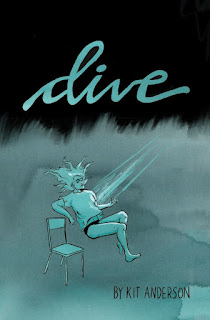
Dive, an entry for a CCS anthology, is another story about an in-between space in a journey. One can see Anderson experimenting with figure work possibilities, with some drawings more successful than others. The real attraction here is a quiet, desperate kind of storytelling as Anderson depicts an abusive relationship defined by poor communication, a crisis that becomes literal as a woman at first seems to drown, and a surreal ending that metaphorically depicts the end of a transformative journey. There's more than a little touch of David Lynch here, and the blue color wash that appears highlights that use of light and color as a transformative narrative element. 

Quests is something completely different. It's cartoony, but also carefully cross-hatched. It's in full color, but the colors are muted and restrained. The short story here may as well be a metaphor for being an artist: it's an eccentric man who may be a wizard and whose motivations are unclear. He works to save a baby bird using certain techniques, including some yarn he's purchased, then moves on. It's a story about the ways in which narratives brush against each other, briefly existing in the same orbit before moving on. 

Country Lane is about another relationship and another liminal space. It's about a couple where one half isn't ready to fully commit by moving in, in part because that adds a certain finality to the decision. She also has trouble sleeping (a symptom of being betwixt and between to be sure), and her partner downloads the sort of sleeping-guide app that is familiar to anyone who's ever had trouble sleeping. The comic concludes with her listening to the recording and it turning into something else, concluding with standing outside out of a house at night, seeing someone waiting for them. The guiding voice asks, "Are you going to go in?" It's a brilliant, subtle exploration of the subconscious, where one knows what the right answer to the question is but can't quite pull the trigger. The narrative is left unresolved, because the story is about this indecision and self-inflicted misery. The use of yellow as a spot color is careful, because the girlfriend's shirt is yellow, and that color is repeated throughout the story. 


The Whorl is the first part of a larger story that also stands on its own. Here, Anderson dips further into horror. Not so much gore or monsters, but the ways in which the unexplained and a loss of identity is a terrifying experience. It's about two sisters going through a morning routine. One of them (Allie) is an early riser who loves to go running, and the other (Claire) prefers to get up later. One morning, Allie finds something unusual out in nature: some kind of whorl phenomenon. Whether it's light or energy or water or sound or something else is unclear and irrelevant. However, when she photographs it and sends it to Claire, there's a gap of time. The only clue that there's something amiss is that the cat freaks out. Later, Claire shows the unusual photo of Allie and the whorl to a friend...but has no idea who Allie is. She has never existed. It's a moment of existential terror to lose track of one's own identity, but it's just as bad for the reader when someone close to her disappears as well. Anderson uses a graywash here as well and a naturalistic approach, but this time it's all used to establish mood. 

Anderson seems like she's trying to figure out exactly what kind of cartoonist she wants to be, as she dips in and out of genre in interesting ways. Each mini is quite good on its own, but taken together it really informs the reader that this is a restless, probing talent matching her themes against her use of technique in genre in a restrained, mature fashion. 


Monday, December 20, 2021

31 Days Of CCS #20: Ross Wood Studlar

It's always good to see a new comic from Ross Wood Studlar, the forest ranger/cartoonist. His comics always center around nature and folk tales. His latest, Can Jumping Spiders See The Moon?, is one of the more technically accomplished comics of his career as it focused on an interesting arachnid. Studlar details the story of the Jumping Spider, an arachnid interesting because it can see in color and each of its eyes acts like a camera with greater range of visibility than other spiders or insects. Furthermore, it is a patient and strategic hunter, using techniques not unlike big cats, which is unusual considering a jumping spider's brain is tiny compared to that of a lion. 


Studlar's feathery, beautiful line is equal to the task of making the spider come alive. Studlar captures their movements and general lively quality, then shifts over to an equally well-drawn fantasy scene of a jumping spider playing a lion in a game of chess. Studlar's throughline is wondering about what these spiders think about; what do they make of sights like the moon? How much of their cleverness as hunters is tied into their sensory apparatus, and how much of it is tied to larger cognitive capacity? These are interesting questions, and Studlar's natural curiosity rewards the reader in a comic that is informative but is far from a dry recitation of facts. There's always an element of narrative in his work. This feels like a chapter in a longer work about Studlar's observations, and it seems he's been building them for quite some time. 

Sunday, December 19, 2021

31 Days Of CCS, #19: Emil O Melia

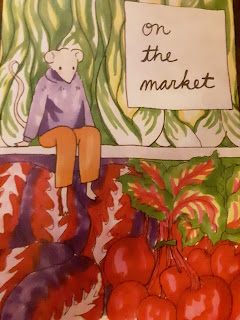
Emil O Melia is an example of a first-year CCS student who makes the most of the standard assignments. In On The Market, for example, this is the Aesop's Fable assignment about a young mouse who thought a rooster was threatening and a cat was friendly, until her mother told her not to judge appearances. Melia drew a story featuring anthropomorphic characters, as a mouse named Yon took a job at a farmer's market and was immediately seduced by a cat. The next day, when she was befriended by a rooster, the cat revealed that she was just trying to make her girlfriend jealous when she made out with Yon. It's a gentle jab of a story, one where Melia's delicate touch with their pencil and vivid use of colors carried the gently amusing narrative. 


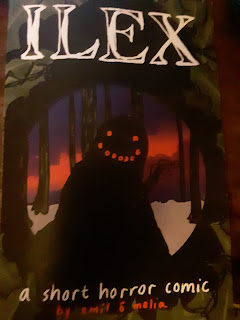
Ilex is the classic CCS application comic, which must feature a robot, a snowman, and a piece of fruit. Melia turned it into a horror comic. Melia spotted a snowman with a tangled piece of downed power line as an arm on a walk after contracting food poisoning. What they slowly realized was that the snowman's arm was dropping poisonous holly berries into their meds and tea in an effort to murder them. The comic doesn't outlive its welcome, and though it looks like it was drawn quickly and digitally, there's a spontaneity to the line that's appealing. 


Twin Flame is the Ed Emberley assignment. Melia really got into the spirit of absolute minimalism, with the slight cheat of relying heavily on color for narrative clarity. It's a story of two best friends who seem to have some kind of godlike or spiritual role in the world. Separated by distance, they meet in dreams and in the forms of their creations, who are all in their image. It's a touching, gentle romance of a story. Melia is clearly just trying to figure things out as an artist, but there's a light touch to their storytelling that's highly appealing. 

Saturday, December 18, 2021

31 Days Of CCS, #18: Leeah Swift

Leeah Swift's comics have a searing quality owing to her willingness to churn through a lot of issues in public, especially with regard to mental health. As a result, I braced myself for the stories in her collection Tit Bits, given the plethora of content warnings at the beginning and an apologia at the end. However, the collection felt quite restrained and reserved, leaving much to the imagination in its examination of various kinds of tensions. Which is not to say that they weren't interesting or emotionally resonant, just not as heavy as Swift implied.

"A Talk" was my favorite of the three stories. It depicts an outdoors adventure with two trans women, Violet and Jane, who have diametrically opposed ideas as to what it means to live as a trans person. Of course, the ridiculous adventure, including tiptoeing over a suspension bridge, going over rough ground, and up rope ladders, was all a funny visual metaphor for the rough ground they were experiencing as friends. Jane couldn't stop framing every idea and personal interaction as a political one, and Violet was tired of jargon and politics and just wanted to be a woman. Moreover, she didn't want to be talked down to just because she didn't want to engage politically. In the afterword, Swift said she didn't want to make specific, grand statements about being trans; while that may be true, she still touched on something that really landed here. 


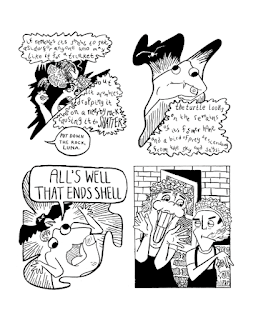
"A Joke" is about a deeply depressed and anxious woman named Luna, and the story is about not just the awkwardness of social interactions and social anxiety in general, but about how sometimes the possibility of communication seems impossible. This plays out in the form of a joke that Luna tells after she's late for work yet again, and it also points to the ways in which boundaries play out in situations like this. Swift's distorted, grotesque, and funny cartooning is the star here, especially as Luna's face twists into grimaces and forced smiles. 

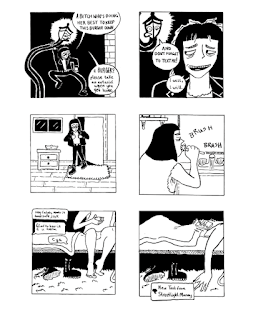
"A Show" is the simplest of the three stories, but also the most emotionally powerful in its way. It's about a trans woman named Alexa who simply wants to get a bite to eat before she walks home from work and her fear in being pursued by an overbearing asshole. It speaks to both the possibility of sexual violence that women face in situations like this, and how this is often even more dangerous for trans women. In the story, she makes it home safely (thanks in part to a bit of magical realism and a lamp post that helps hide her) and texts someone who cares about her. That last page, a splash page where she's safely in bed, is an expression of not just relief but connection. Swift's storytelling is an absolute delight, and its singular stylistic quality will actually work for any number of stories.