Monday, November 30, 2015

Thirty Days of CCS #30: Irene

In the sixth volume of the premier CCS anthology Irene, editors DW, Dakota McFadzean and Andy Warner continue to bring together established but overlooked talents, up-and-coming cartoonists, and artists from all over the world into one challenging volume. The fact that each of the three editors has a totally different aesthetic (both in terms of the contributors they bring in as well as their own work), yet they somehow work together to create something coherent and disquieting.

Part of that coherency is the use of two different sets of interstitial material. One is a silent narrative from Jai Granofsky, wherein a rabid man running from a rabid tiger is eviscerated, creates a smaller version of himself, is eaten by a penguin, gets the penguin sick and comes out as an ice cube and finally gets put in a drink. It's a funny palate cleanser of a story, as each panel gets one page and plenty of negative space around it so as to create clear divisions between stories. The other recurring feature is a series of one-page strips from Kramer's Ergot veteran Leif Goldberg in crisp, cartoony and silly pencils. Each of the strips is about consumption in some way, be it squirrels collecting nuts, police eating sentient hot dogs after a crash, a robot collecting bananas for a rave or a man pondering a love potion.

Marta Chudolinska's "Genesis" splits neatly into bored aliens working a shitty job and the life they accidentally create on the backwater planet they visit, combining greyscaling with cartoony figures. Carolyn Nowak's "Girl Town" starts off with the premise that three young women started living together after being "kicked out of astronaut school for being too good-looking to be sent into space". Mixing slice-of-life narratives, ritualistic oddness, and painful romantic feelings in an amusing and heartfelt stew, Nowak's confident and sharp line fits both the strange and mundane aspects of the story.

Tillie Walden's "Dreaming" is a completely different aesthetic approach: a naturalistic line that employs an extensive use of negative space surrounding the protagonist's face. It's a series of interlocking nightmares that bleed into each other and daily life, as Walden makes the clever move of not differentiating the visuals from nightmare to nightmare. Lebanese cartoonist Lena Merhej's story mixes a dream-like reverie with abstracted women's bodies that focus on genitalia.

While Irene is certainly anchored by narrative, there are certainly more abstract and non-narrative pieces as well. Natsuko Yoshino's drawings feature swirling human bodies interacting with each other, while Marc Bell's typically loopy drawings are pointedly titled "Not Comics Department". Bell's sly sense of humor is certainly on display here, both in terms of how he titled it and the hilariously daffy internal logic in each drawing. Ben Juers' "Flowerpot Heads" features beautiful, strange figures juxtaposed against each other in a fluid manner. Of course, there's DW himself, whose piece combines his intense pattern work, simple figures and repurposed text.

There are several works that touch on personal reportage and political issues. Nick Cartwright's "Station Life", for example, is a funny and sometimes unsettling account of life in an Antarctic station during both summer and winter. His thin and scratchy pencil drawings in an open-page layout add to the sense of vast whiteness, stillness and isolation, with funny visual interpretations of text leavening the sheer anxiety of life at the South Pole. Warner's own "An Unravelling" encapsulates the idea of "the personal is political" as he relates a story of travel during his stay in Lebanon. With his typical naturalistic style, he drew parallels between old civil wars in Lebanon, the current civil war in Syria (including a town he visited with friends) and the real collateral damage that's been done to his friends who are still there, all while connecting it to his own career and ideas. It's one of his best stories to date. Egyptian artist Shennawy's scribbly and distorted silent story concerns the real human cost of political demagoguery. Ben Passmore's funny "It's Not About You" is about a guy being introduced to a female-appearing person who goes by a they/them pronoun, provoking a paroxysm of anxiety, doubt and resentment that is only resolved in his head when his inner mentor tries to eat him. I love Passmore's sweaty and cartoony line that nonetheless has rock-solid fundamentals.

It's hard to describe McFadzean's own aesthetic sometimes, but "personal and unsettling stories set in isolated locales" comes close. His "Good Find" is a slice-of-life story about two kids looking for stuff in an abandoned (and possibly haunted) house. What goes unexplained is that every character is grotesquely disfigured, with various boils and growths on their bodies. It's meant to throw the reader off-balance, to given them something to think about in addition to the pleasant little escapade they just read. Along the same lines is No Tan Parecidos' "Indian Rope", which is a story about waiting with each character rendered in a distorted and elongated fashion. It's more a fragment than a story, but it adds to the book's atmosphere.

Luke Howard's "You Come To A Strange Town" is the book's best story, and it certainly fits in the McFadzean wing of aesthetics. Drawn using a minimalist and angular style that recalls John Porcellino and Warren Craghead, Howard spins vignette after vignette about a small town and the weird things that happen in it. From the woman who can't get off a swingset to a taxi with no driver to a hotel that traps certain of its guests to the hilarious story of the Ghost Bike (it shouts "Human Blood" while threatening no one at all), Howard nurtures a bunch of disparate gags, images and characters into a single, coherent environmental narrative.

There are also a number of more personal stories. Norwegian cartoonist Froydis Sollid Simonsen's "Siberian Stillness" cleverly transposes an anecdote about life in ancient Siberia with a turbulent relationship. Katie Parrish's "Drink More Water" smartly uses word balloons to describe thoughts gone awry in a relationship with a scrawled, intense line. Lucy Bellwood's "Salt Soap" and Jackie Roche's "Hopes Up" are more conventional slice-of life stories, with the former being about slowly recovering from a bad break-up and the latter about the continual disappointments of being in school. Both employ a smooth, naturalistic line. Sean Knickerbocker's "Killbuck" excerpt shows him at his best: depicting the hopes and fears of young people in small towns who are desperately hoping for something better.

Finally, there's an in-your-face, underground inspired piece by Kevin Uehlein called "Dozens of Cousins", which features anthropomorophic characters doing disgusting things. Uehlein's own sense of self-awareness has him doing meta-jokes about hillbillies that turn into a series of hilarious running gags. It's a scatological romp with brains. It also points out that the editors may have their own tastes, but they've gone out of their way to include as many different approaches to comics (in terms of style and aesthetic as well as making sure it was balanced in terms of gender and had an international bent as well) as possible.



Sunday, November 29, 2015

Thirty Days of CCS #29: Kazimir Lee

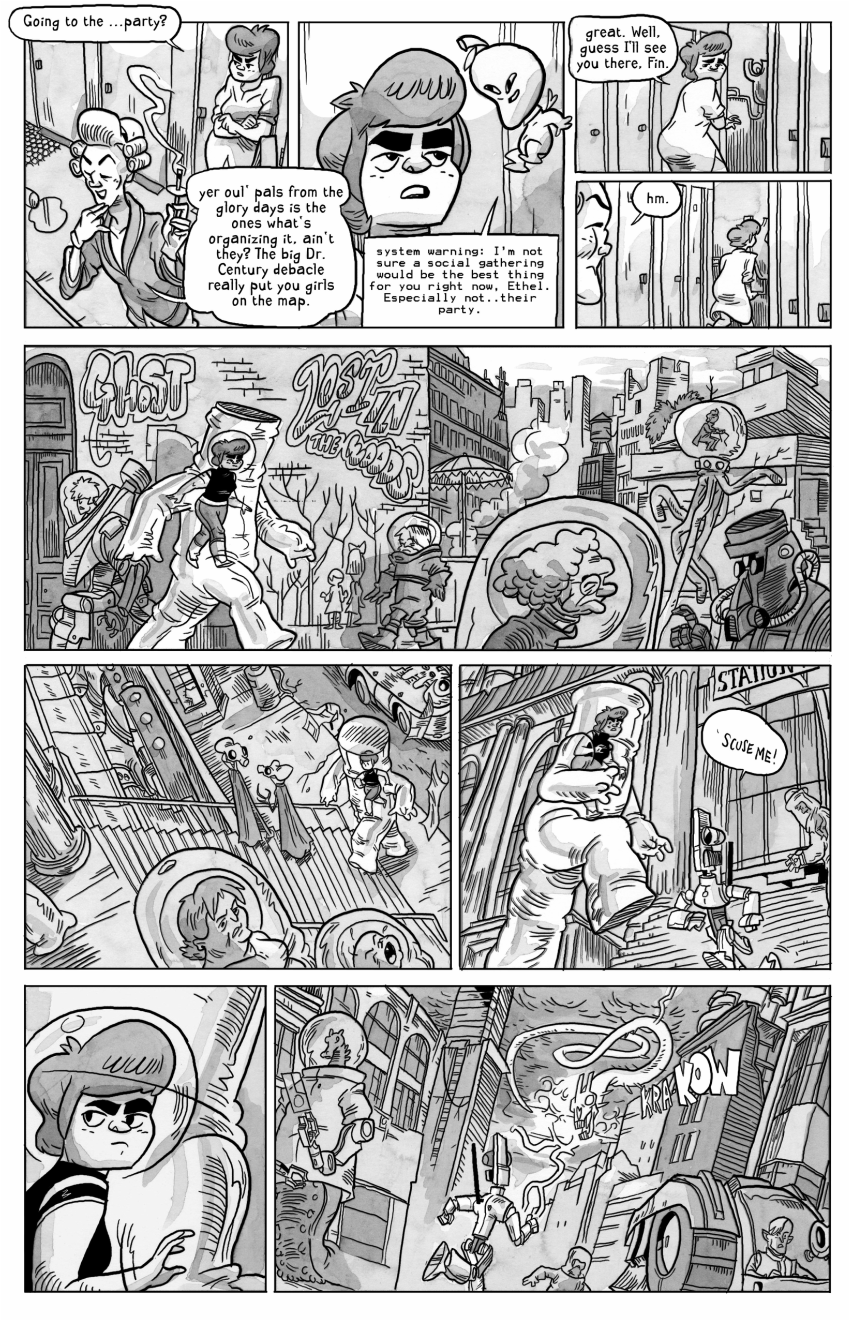
Kazimir Lee is one of the more versatile and polished of CCS grads, and his output reviewed here certainly reflects that variety of styles and facility in any number of genres. For example, End Of A Century is a marvelously well-realized mash-up of superheroics and slice-of-life drama. Using an appealling, cartoony line with character design reminiscent of the sort of thing that Brandon Graham (by way of Bob Fingerman) does-- that mix of manga, street art and Archie comics. Lee cleverly makes slow reveals in this story, as we first meet Ethel and the equivalent of her conscience /Microsoft paperclip. We immediately see that this is a futuristic world, that Ethel was formerly a superhero, and finally that she's a robot. The fact that she has to upgrade her "self-esteem software" is both a running joke and a clever plot point. Lee manages a genuinely exciting action climax and a quiet character moment at the end.

Here, After is another sort of mash-up: horror and existential character drama. It's the story of a young man housesitting for the family of his dead best friend. With character design that once again employs a sort of cartoony, grotesque doodle, Lee creates an atmosphere of tortured guilt and thick suspense as the reader is left guessing what's real and what's imagination. It's a story about someone who's adrift in part because of his guilt, and partly because the relationship he had with his friend was so ambiguous and clearly tortured. The metaphor that Lee employed, of the protagonist being unable to relate to his friend's love of horror movies, resonated as him being unable to connect to his friend while acting as the story's horrific fuel.

The City That Cried Wolf! was an Aesop's Fable assignment at CCS that Lee turned into a Black Lives Matter metaphor. The shepherd in this case was a kid who fabricated evidence against wolves, inciting city-wide fear and resentment against them that led to real rioting. While the story is far from subtle, the cleverness of Lee's visual set-ups mixed both modern and ancient appects of the story in an amusing but pointed manner.

Curtain Call is "adapted from writings by A.M.L" and is certainly a thematic departure. It's a "same time, next year" story about a drama professor's sexual encounter with a former student in a hotel room. This time around, Lee uses a brushy approach with a cartoony style that looks a bit like a New Yorker strip. It's frankly sexual but not erotic, as the thick and curvy lines, pointy noses and other anatomical exaggerations tell the story in a manner that's emotionally realistic but not exploitative. Lee nails the swirling emotions as well as the small talk and the pillow talk here.

Finally, Lee was the editor of the CCS anthology It Is The Bad Time, whose theme was dread. Dread is very carefully selected as opposed to horror, because dread is a feeling of anxiety and fear of the unknown as much as it is the actual experience of horror. Emily Parrish's "Monstrum" connects a young woman's encounter with a possibly cursed bracelet with certain growing and unpleasant appetites. Anna Selheim's "Wasted" is about a young writer frittering away her time, only be visited by a ghastly spirit who warns her about this. The ending is predictable but still high-impact, especially given her emotionally resonant character design. Cooper Whittlesey's "Autopoesis" is a manically scrawled story of survivalism gone horribly wrong, while Lee's own "Ugly Boy" is about bullying, bad parenting, a monster in a pool and the way children manage to still love their parents in even the worst of circumstances.

Tillie Walden's one-pager "Muscles" uses dense cross-hatching to get across the fear of feeling one's tendons and muscles simply snap, while JD Lunt's "State College" uses the metaphor of a college football town to express the horror of crowds and cults of personality in a dizzying swirl of silhouettes, shadows and bizarre images. Finally, Angela Boyle's "Spores" is a fitting capper, as her pleasing line soon turns to utterly disquieting and nightmarish images as a young woman is slowly infected by a monstrous creature disguised as an old woman. The device of the barking dog as a warning sign that's ignored is especially effective here.


Saturday, November 28, 2015

Thirty Days of CCS #28: Ben Wright-Heuman

Ben Wright-Heuman is unusual for a CCS cartoonist in that his concentration on horror. Perhaps it's not so unusual in that Steve Bissette is a long-time faculty member at CCS and is one of the most notable of horror cartoonists, and it's clear that Bissette's gritty style is a strong influence. CCS of course requires cartoonists to experiment in a number of different genres.


Phantom is an autobiographical story that's almost a mission statement of sorts. It's about Wright-Heuman making a friend with a musician in college and becoming part of a welcoming guitar circle. His friend, a native New Orleansian, wrote a song about the devastation that Hurricane Katrina wrought on his city. That song became a local sensation, even if the author was always and ever unsatisfied with it. The story is really about the power of creation, collaboration and inspiration. Wright-Heuman is not especially comfortable as a naturalistic artist, so he was wise to concentrate on color and contour instead of line.


Trinary is a wordless story about robots in the future who create art in a factory, and a robot who rebels against her programming. The story's extended metaphor about free expression and the oppressiveness of conformity is heavy-handed, but Wright-Heuman's scribbly line and use of browns and oranges livens up an otherwise predictable story. Predictable isn't so bad when a story is well-executed, and that's certainly the case for Wendigo. In that classic scratchy, Bissette line, Wright-Heuman does a compelling job in telling the myth of the Wendigo, a voracious, cannibalistic deep woods spirit that infects those unlucky enough to come near it. Wright-Heuman uses a couple of clever tricks to make the story interesting, as he first keeps the reader in suspense by narrating the story from the point of view of a man who didn't believe in the Wendigo--and then continuing that narration when he becomes one of them.


The Light Outside The Window is Wright-Heuman's best-realized work. With a scribbly but detailed line and a highly effective use of digital coloring. Based on legends surrounding his own college, the story is about a college freshman who moves into her dormitory, only to learn that it's haunted in an especially unnerving way. During the winter, the room grew especially hot, as a young female ghost would appear, begging to be let inside. What was especially clever about the story was that after the backstory reveal, the story takes an unexpected and even humane turn as the protagonist becomes friends with the poor ghost, which made the final twist all the more chilling. Figure drawing is Wright-Heuman's biggest weakness as an artist, and finding a way to create his own particular style instead of relying on over-rendering in a naturalistic manner will be the key to his future development. He certainly has solid storytelling chops.


Friday, November 27, 2015

Thirty Days of CCS #27: Jai Granofsky

Jai Granofsky's Waiting For Baby is ostensibly the story of Granofsky and his partner Shira coming together and going through the process of having a baby. What it really is is a frequently disturbing, bracing and brutally honest account of depression, addiction, despair and the light at the end of the tunnel. Granofsky's account of his own self-loathing and bad behavior is almost wince-inducing, even as he punctuates it with moments of humor and a remarkably even-keeled, even dispassionate overall tone. Everything is at stake in terms of happiness and meaning, yet Granofsky fights that pressure by depicting himself almost as a bystander in events that concern him but in some ways are happening to someone else.

The story starts with the anxious, exciting early moments of a relationship, the blissful honeymoon period, and the joyful reveal that his girlfriend Shira was pregnant. That early excitement turned into anxiety about the future, which turned into full-blown depression that manifested as relentless hatred toward everything and everybody--especially himself. There's an early climax where Jai takes Shira's annoying dog for a walk after he saw it chew up a book, the dog jumped on someone, and he snapped and punched the dog. It's a shocking scene, one that is magnified when he decides to smoke pot again after having quit.

Things don't exactly get resolved, but the book turns more toward discussion of the future baby, family, names and getting rid of the dog, that turns into Jai "practicing" killing himself with a belt and eventually getting help. As the book speeds to the inevitable birth, I was amazed at how Jai was just barely able to keep himself together, unable to feel like he could trust himself as a father while anxiously wondering if his baby would one day kill him. Cleverly, Granofsky doesn't give the reader a specific resolution, ending the story just as his son was about to be born and he was ready to use the one thing that kept him sane and in the world: his ability to draw.

Granofsky's work and slightly dispassionate but intense storytelling style reminds me a bit of Chester Brown. There's a plainness to his character design that reflects life as it's lived, not an idealized version of it. Even Granofsky's use of color is muted, more for informational purposes than to liven up the story. Ultimately, this story is one of simply living from one day to the next, understanding that there are no simple answers and that anxiety can be faced down but never eliminated. It's in that simple honesty that the story has its power, as Granofsky's admitting his own sense of hopelessness and helplessness on paper clearly aids him in coming to grips with his own demons as well as the new responsibility in front of him.

Thursday, November 26, 2015

Thirty Days of CCS #26: Dean Sudarsky

Dean Sudarsky will be graduating from CCS in 2016 and has tried a number of different ways to express himself through comics. Side A: Work Dance/Side B: Sinkhole sees him experimenting with comics-as-poetry. "Work Dance", drawn in a scratchy, angular and open style not unlike Sophie Yanow, ritualizes the act of getting ready to go to work, with the text being both suspicious of "work" in the context of a societal whole and grateful for work done on a personal level. "Sinkhole" is a denser, darker story that addresses the mind/body split, with every facial expression a rictus of agony. The image of the body being so pressurized that it's practically liquid is a vivid one, with clever lines like "I'm just so ambitious! I won't stop 'til I secrete success" getting at that sense of being pushed and pulled. Sudarsky's line is thicker and his use of zip-a-tone and other effects helps create that oppressive atmosphere.

Sudarsky submitted some short and incomplete work as well. One of my favorites was about a rock band called The Bureau started by agent 3181 of some government agency in order to infiltrate the underground music scene. While they were a failure, their music got sent back in time to 1979 and became highly influential, so by the time the band was formed, they suddenly became popular. The art is a mix between Yanow and Tom Kaczynski, with Sudarsky's own biting sense of humor. "The Dysfunctionals" is a single page strip done in the style of a Sunday old-school drama/romance comic, in full color. Sudarsky goes to town on using the formal elements of the strip for humorous purposes, like the middle column being variations on the same tearful pose, distorted body positions and absurd situations. It subverts romance comic tropes with modern relationship politics. "Song Of The Left Hand" seems to be a sort of tribute to Jim Woodring's "What The Left Hand Did": surreal autobio that incorporates Sudarsky's interest in using background text as a way of commenting on the story as a sort of Greek chorus. Here, the "left hand" is essentially the invisible hand of fate, pushing Sudarsky to and fro with regard to where he goes, whom he meets and what he cares about, illustrating the ways in which he feels like he's drifting through life. Offered a doomsday weapon that allows him to wipe out his own world, he eventually pushes it while imagining this fantasy person he's singing to in the background urging him out. It's a clever strip that combines despair, loneliness and that sense of drifting that comes with being depressed, drawn with a combination of his angular style and a more naturalistic style.

His comic Lachrymator is a collection of brief, mean, political, funny and often existential strips, mostly drawn in a flat and naturalistic style that again owes a lot to old comics pages. "Dawn Of The Red Sun" sees a downtrodden Superman buying fair-trade chips as a way of being "a considerate and well-informed citizen", only to be foiled by a kid wearing a propeller beanie who says "There's no such thing as ethical consumerism under late capitalism". The strips are somewhere between the nihilism of Ivan Brunetti's early work, David Rees' pointed and scorched-earth political commentary, and Evan Dorkin's blunt and frequently visceral sense of humor. His nameless art commentary comic featuring horses committing acts of violence is profane and rough much like a western, but it gets at the heart of why creating is not about a pose or being liked, but rather is about expressing truth and experiencing the joy of creation. Finally, Murderworld Comix was my favorite of Sudarsky's work in this batch. A series of interconnected strips, it starts off with the President declaring all crime to be legal, which created a field day of murder. He zips between genres in each of the strips, hilariously and viscerally satirizing both genre and culture in a Hobbesian nightmare. Sudarsky is a smart, promising cartoonist who has a lot to say and the tools with which to succeed no matter what direction he chooses.


Wednesday, November 25, 2015

Thirty Days of CCS #25: Aaron Cockle

As Aaron Cockle's storytelling aims become ever more opaque, his actual storytelling has ironically become clearer and clearer. That's primarily because he has a greater understanding of how to make his limitations as a draftsman work for him by simplifying and even abstracting his line in the service of his mystifying tales of paranoia, conspiracy and intelligences beyond human comprehension. In particular, Cockle writes about the use of language itself as a weapon and the ways in which subject and object blur and intermingle. In his ongoing series, Annotated,  #17 features a series of interrelated and even interlocking short stories.

The first story, about a woman who attends a luncheon with coworkers she despises, is suddenly abjected from her understanding of reality when the entire party leaves when she's in the bathroom and no one in the restaurant acknowledged their existence. That led into an amazing short story that featured a text narrative wherein a woman is being questioned about going into a particular sub-basement and what actually happens when she does, which is communing with an intelligent chair looking for a human to work as their agent. All of this starts to coalesce with other stories about surveillance, chairs, art, zine-making and the stultifying routines of office life taking on new and sinister contexts. As the comic proceeds, we learn more about the conflict between chairs and the corporation, with the latter becoming acutely aware of their enemies and the ways they work to subvert knowledge through means like office porn. The essence of the stories is the way they ultimately address the intentional alienation of the individual by the corporate identity, by way of separating and isolating its participants. Cockle gets at this with dizzying formal decisions: lots of shadows, lots of unusual angles that stretch the eye across the page and a method that instills mundane items like chairs with a sense of dread.

Cockle was also kind enough to pass along the latest installment of an anthology he's involved with entitled Derring Do. This issue focused on "True Crime/False Crime", which covered a range of activities, both true and unverifiable. There's a lot of excellent young talent in this anthology with a wide range of approaches. E.A. Bethea (an artist I became aware of through Austin English) had a remarkable story that began with the artist Vigee Le Brun drawing portraits of Marie Antoinette that segues into Bethea recalling a school friend who later went missing. The fact that her friend was African-American meant that fewer people in the media and police cared, a chilling understanding that Bethea tries to process through drawing the story. The final story, by Jude Killory, focused on a brilliant sex worker friend of his who was murdered and had connections to local politicians. Both stories point out the astounding lack of empathy for those of color or do whatever they can to survive. Josh Bayer is always an MVP of any anthology he's in, and his scrawled, manic accounts of John Hinckley and Richard Nixon as deeply disturbed individuals from an early age speak to how mental health warps decision-making.

Jennifer Camper's account of a woman who murdered her children inadvertently becoming an art gallery star points to any number of different crimes--the murders, of course, but also exploitation. Sarah Schneider's story is an oblique, silent account of a crime with an axe; Laurus gets silly with a story about a soiled book that she tries to get rid of; and Carlo Quispe relates a personal tale about stealing a pen, getting harshly punished and it being all worth it. Cockle uses giant pixelated imagery that further deals with paranoia and government inquests regarding uncertain topics. Other highlights include Sara Lautman's scribbly account of a dinosaur being exploited by Thomas Edison, Whit Taylor's grim account of Beach Boy Dennis Wilson chilling meeting with Charles Manson prior to Manson becoming infamous, Brendan Leach's futuristic account of a junk bond trader deftly exploiting others and Katie Fricas' hilarious and speculative story about Nancy Kerrigan meeting up with Tonya Harding years after their ill-fated dust-up. Her grotesque, exaggerated line and absurd resolution to the story still managed to incorporate everything that was hilarious and terrible about the original incident.

Tuesday, November 24, 2015

Thirty Days of CCS #24: Sophie Goldstein

In the span of just a few publications, Sophie Goldstein has distinguished herself as one of the top cartoonists to ever graduate from CCS. What's interesting is that the work that garnered her so many accolades, The Oven, isn't nearly as accomplished or complex as her other ongoing work, House of Women. Let's look at each in turn.

Originally serialized in the Maple Key Comics anthology, Chris Pitzer's AdHouse picked it up for publication, giving it a sort of 70s sci-fi image with the spare cover and choice of font. The Oven starts off with a mild sci-fi twist: a couple travel to a remote commune on a planet with two brutal suns in order to have the opportunity to have a child, something denied them in mainstream society because of increasingly-stringent and absurd laws. What they find is either utopia in the form of a pathetic, glorified garbage dump or something of pure and noble intent inevitably corrupted by outside influences.

In terms of theme, her sense of storytelling restraint and general subject matter, the closest thematic comparison to Goldstein is Megan Kelso. Both are interested in the personal and political implications of motherhood, both in terms of raising children and having them. Goldstein has become a more accomplished writer as she's let the characters act as flawed humans instead of mouthpieces, allowing the reader to make their own interpretation of the work. There's also a spare and beautiful quality to Goldstein's line (not unlike Kelso's) that's bold, confident and crisp.

Goldstein's themes also dovetail a bit with Eleanor Davis in terms of using science fiction tropes as a way of dramatizing certain themes, but only as a way of setting the stage. While Goldstein has an eye for detail and the reader gets a strong feel for the character of each fantasy setting, she's not so much interested in world-building as she is figuring out how her characters will react to the restraints and possibilities each environment provides.  In terms of the quality of the line itself, The Oven's characters were clearly influenced by the Archie artists in terms of cartoony simplicity. A sleazy, lazy drug dealer looks like Jughead Jones if he grew his hair out, for example.

The book's title refers to the deadly environment the couple comes to live in, as it's unprotected from the double sun's deadly rays. It's also a double-entendre, as "oven" also refers to a woman's uterus, especially when she is pregnant. There is a lot of push and pull here in terms of the choices characters make and the kind of life they think they are leading. Some are dirtbags simply there to live outside the law. Some are idealists there to raise families in natural environments, though the way the politics work out seem regressive. Life in the Oven is hard, farming work; this raises the question of whether it's worth it.

The key piece of information that Goldstein gives the reader is that Eric was the reason why he and his partner, Syd, weren't allowed to have children. When he found out about the Oven, he suggested moving there to realize their dream (or was it his dream?) of having children. In the end, he chooses a life of disconnection as he gets high and misses the technology that made life so easy, but he simply can't stand the nature of the community he has found. She chooses to stay and create a community on her own terms. One gets the sense that she's not going to become "one of them", as he fears, but rather has figured out a slightly different path.

The Oven is nuanced and well-executed but ultimately a relatively simple story. It is no knock to say that it's not as complex as House Of Women, because the latter story is remarkably intricate and even more ethically ambiguous. The second issue continues the story of four women sent from The Empire (which combines both church and state in the manner in which it colonizes other worlds). Goldstein's skill as a designer and providing intricate, decorative flourishes that don't interfere with her actual storytelling is remarkable. With a double die-cut cover that features three separate images as the reader turns the cover and the first page, Goldstein imparts the reader with both the sense of warmth the Empire's emissaries feel and the lingering sense of menace on the planet.

Once again, Goldstein is quick to establish that the protagonists are not necessarily heroes. The book thoughtfully but subtly examines the dynamics produced by colonialism, paternalism, science without empathy, religious dogmatism and the way that sex throws a monkey wrench into everything. Above all else, the book is about the nature of gender and motherhood. Once again, the science-fiction tropes of having four-eyed, feathered humanoid aliens as stand-ins for any number of oppressed and exploited people during history allows Goldstein to go to extremes in exploring the logical outcomes of certain experiments in creating a new society.

Goldstein creates easily-understandable, almost archetypical characters for this story, ranging from mother figure to crone to seductress to the main character, who is something in-between. The only male-identified character first appears as a sort of fantasy figure for the main protagonist but also becomes an object of obsession for the scientist character who is cold with regard to their subjects but almost sociopathically obsessed with the male character. The second issue rudely brings reality crashing down on the all-female environment the Empire has created, as the aliens they're working with are all women--because the men are warlike. Goldstein layers conflict on conflict here, with the smaller interpersonal conflicts being every bit as important as the larger plot.

Goldstein's stunningly crisp, clean line is elegant but also functional. Her use of black and white contrasts, especially in depicting long shots of environments, is used to often dizzying or menacing effect. Despite these visual pyrotechnics, her use of gesture and expression is what's most remarkable about her art. Harkening back once again to the Archie influence, the art here has the precision of Jaime Hernandez with the wild expressiveness of Gilbert. When this book is inevitably sold to a publisher, I hope that they're able to retain Goldstein's DIY flourishes and print it on paper that best shows off the sharpness of her images.

QUICK UPDATE, 3/24: Goldstein is selling the original art from The Oven on her website.