Showing posts with label rebecca schuchat. Show all posts

Thursday, December 15, 2022

31 Days Of CCS, #15: Rebecca Schuchat and Juniper Kim

Four short comics by Rebecca Schuchat. These are all 4" x 4" minicomics, each of which is a combination of information and polemics. Prop 22 is a comic about a measure passed in California that essentially repudiated a law passed that forced businesses like Uber and Lyft to pay their employees overtime and give them insurance. Not only did the companies spend over $200 in favor of the measure, they forced their employees to carry bags that were in favor of it. Schuchat has a keen understanding of design. Each page almost always obeyed the 2:1 rule, wherein (other things being equal) each panel should contain no more than 1/3 text to 2/3 image. In places where this wasn't true, Schuchat cleverly cut the text in half so as to make the page more readable. 


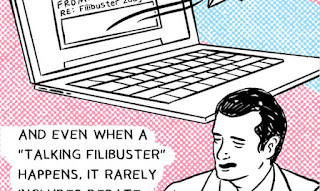
In OK, Here Is What You Should Know About Bail, Schuchat works with writer Madi Ordway, and the result is a graphic design mess. There are walls of text on each page, the lettering is hard to follow, and the dark purple wash also makes this hard to read. It's important information regarding a corrupt system and the inequity surrounding bail, but it's hard to read. On the other hand, Schuchat's adaptation of the IWW labor song I Dreamed I Saw Joe Hill Last Night uses stark imagery and a bold yellow wash to make the lyrics to this standard truly stand out. The Filibuster may be the best comic in the bunch. The red and blue zip-a-tone effects create a wavy pattern throughout the background of the comic, helping to mitigate the heap of text in the comic. It talks about the toxic history of this procedure in Congress, how it's being used to impede democracy now, and how it could be changed. It's strong political cartooning, although the thoroughness of Schuchat's research is such that she could easily write a book about virtually any subject and make it look interesting. 


Juniper Kim is one of the more intriguing recent CCS students. There is something powerfully raw, ugly, and blunt in the way she discusses trauma, identity, gender, and the mixed feelings surrounding desire. A Girl's Guide To Becoming Asian-American is a howl of anger done using collage. It's an emotional narrative that touches on the sheer pain of assimilation and touches on grief, desire, and images of whiteness while also discussing a debt to ancestors. 


Her Koreans Sing In English got nominated for an Ignatz Award, and for good reason. Using a stacked series of three horizontal panels, Kim weaves three related narratives in and out with each other. One is her own narrative, as she jumps back and forth in time and talks about various events that shaped her relationship to music, both as a player (classical violent) and listener. The middle tier narrative is about her father's time in the DMZ as part of his compulsory military service in South Korea. The bottom tier is about the history of South Korea itself. 

This is all done in watercolors that seep and blur into each other, just as each of the three narratives inevitably blur together. This comic, and much of Kim's work, is the ways in which the cultures and governments of Japan and the United States imposed themselves on Korea. It led to a Westernized Japan imposing similar cultural demands on Korea, like making people study and listen to Japanese military songs composed in a classical Western style. For her father, growing up in the 80s, Western pop music was sought after by young South Koreans as a symbol of Western freedom and economic power. The comic centers around a single event: her father patrolling the DMZ alone, with the South Korean side blasting in western rock and the North Korea side blasting in their own propaganda, and he's surrounded in this no-man's-land by flourishing flora and fauna that exists because people aren't there to endanger them. 

Kim incorporates a particular guitar instrumental he heard with the swirling, bruised colors of the sunset, collapsing her tiered panels into a single splash page. Kim's own recollections about her relationship with music, including the feeling that practicing violin was more important than her father playing his guitar, speaks to the kind of anger that pervades all of her work. There's also a tenderness toward her father and his experiences, and a sense of understanding of her parents' country and why its people do the things they do. That same feeling of feeling betwixt and between as an Asian-American and a country whose last 150 years are all about being colonized at every level (including culturally) and by every ideology are the backbone of this provocative, smart, beautiful, and sad comic.

Saturday, December 11, 2021

31 Days Of CCS, #11: Rebecca Schuchat

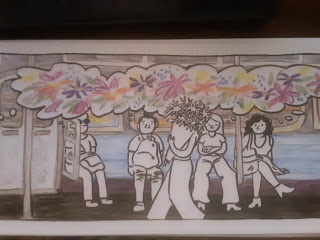
Rebecca Schuchat's work at CCS has been interesting because I'm not quite sure what kind of cartoonist she wants to be, and I'm not sure she is either. She has wisely used her time at CCS to explore a lot of different approaches to cartooning. One thing that is clear is that she has an observer's sharp eye. In Train, for example, this is a landscape-formatted comic that's spiral-bound, with a plastic cover. Using watercolors, she tells the story of the kind of people who get on the Q train in New York, starting with Coney Island and ending on 96th Street in Manhattan. 


It's an entirely wordless comic, (other than announcements from the PA) but it's not without communication. Indeed, she follows each of the passengers with thought balloons that contain images. This is what carries the narrative, and they vary from people thinking about food, sex, pets, aliens, Karl Marx to everyone thinking about flowers when someone walks in with a big bouquet. Schuchat's use of color is bright and bold but still restrained, as that particular technique lends itself to a more nuanced use of palette than standard computer coloring. However, what really stands out here is Schuchat's use of line. Even with a relatively stripped-down figure drawing style, Schuchat's thick line is highly effective in not letting color overwhelm her pages, and her use of gesture and body language is top-notch. 


Her other entry, an accordion version of a webcomic called The Filibuster, is straight-up comics journalism and advocacy. ("Applied comics," as they would say at CCS.) It's well-researched and well-written, as she creates a compelling case for why the Congressional filibuster needs to be ended. She lands a particularly good point when she says that the spirit of the filibuster--lively debate--is all but dead, given that people no longer actually discuss issues and can actually do it online. That said, it's not especially visually compelling. I realize that Schuchat was trying to go for red and blue to represent the parties, but the light blue and purplish-red acted as distractions, especially with the zip-a-tone effect that she used. Schuchat had to use a lot of caricature and naturalistic drawing, which I don't think is a particular strength. Of course, this comic (originally published at The Guardian) had a wider audience, and her storytelling was certainly clear enough to do the job, especially with her use of infinite scroll instead of a standard grid. The art felt secondary to her writing and bordered on being illustration instead of being a comic. That said, her even-handed descriptions of hot-topic events make her well-suited for comics journalism, but a more interesting visual approach would better serve her advocacy. 

Saturday, December 12, 2020

31 Days Of CCS, #12: Rebecca Schuchat

Rebecca Schuchat contributed two comics with different purposes. Shame is an adaptation of Numbers 12, highlighting her skill using tonal contrast. On virtually every page, Schuchat flips black and white in terms of which color dominates a panel, and the way she spots blacks and uses negative space so effectively gives the story a highly fluid and visually exciting charge. Combined with her use of spot reds to accent the page and highlight the narrative, and the result was a visual approach that set the stage for this story about shame, patriarchy, and femininity. It's the idea of shame as an externalized force set on women that they did not choose to take on; indeed, it's really the shame of men forced on them. The red accents of the bright scene, the apple that Eve ate of, and veins popping out of dry skin popped off the page, emphasizing suffering and the original object of shame and desire. This is a visually inventive comic that goes all-in on its dense line weights and stripped-down naturalism.

(Somehow) Only Five Months was a diary of the first five months of Schuchat's experience with the pandemic and quarantine that doubled as an Inktober project. The prompts were vague enough so as not to overwhelm her own narrative, but they did guide it in interesting ways. For example, a page with the prompt "floating" was used by Schuchat to talk about floating in a river, and how this also made her "feel a tranquility that I haven't felt in months--not tied down to reality or my own body..." What makes the page effective is the intense light/dark contrast between the white space of her body and the black ink of the surrounding water. Schuchat's hand-lettering is also an important part of the image. Schuchat also widely varies her page design, from a standard grid to splash pages to open-page layouts. The character design is not quite as stylistically precise as in Shame, but that's the nature of time-sensitive projects like Inktober. 

The fact that the comic is so visually cohesive is a tribute to how Schuchat approached the project. This is also a well-constructed comic in terms of the actual narrative, as Schuchat's focus on the instability of her life as she moved out of a shared house and back in with her parents contributed to her sense of abandoning and being abandoned by her friends. Finally leaving Oakland revealed just how beloved she was by her circle of friends. It's also a powerful account of lurching from pandemic ennui to engaged activism, when the protests in Oakland and other cities became a powerful, daily activity. I'm not quite sure what kind of cartoonist Schuchat is going to become, but she certainly has the skills to do memoir, comics journalism, and comics-as-poetry.