Showing posts with label philippa rice. Show all posts

Thursday, August 14, 2014

Brit Comics: The Hic & Hoc Illustrated Journal of Humour: Volume 2

The Hic & Hoc Illustrated Journal of Humour Volume Two: The United Kingdom, is a follow-up to the publisher's first volume of humorists from the United States. One of the reasons why Hic & Hoc is one of my favorite new publishers is Matt Moses' dedication to printing actual humor comics, something that had gone out of style for many publishers over time. This volume, edited by Lizz Lunney and Joe List, focuses on quick-punch single page stories for the most part. A few key contributors have multiple strips throughout the book, giving it a nice rhythm while varying the style of humor. Some of the pieces are outright gags, while others are more humorous slice-of-life stories. I'm going to go creator by creator and focus on the most interesting strips in the book.

Luke Pearson: The NoBrow star is better known as being whimsical rather than out-and-out funny. In this book, however, he goes to all sorts of extremes. His first strip is a gross-out effort built around the expectation of a different punchline, subverting the comedy of manners that is the explicit punchline. His second strip once again subverts an initial interaction and goes in a far more absurd direction, as a man ends up in a romantic relationship with a robin and winds up falling out of what turns out to be a tree after sex. His third strip borrows from the Michael DeForge playbook, as what appears to be a personal ad written by a cartoonist is in fact written by a horrifying monster that's a DeForgian nightmare. The fourth strip also plays with his style in a different way, looking more like something out of Paper Rad, as a snooping roommate looks at someone's internet cache and finds some rather distressing search histories. Pearson really stretches his cartooning muscles here rather than do what is expected of him, and as a result he shines the brightest here. 

Lizz Lunney: Lunney's "Alternative Greeting Cards" are one of the funniest things in the book, with entries like "Congratulations on finding your long lost father/commiserations on finding out he's dead" being one of the darker and funnier bits. She uses a simple line to get across her humor that ranges from the absurd to the morbid.

Joe Decie: The autobio cartoonist consistently delivers the laughs here, whether he's talking about the "untidy Decie DNA" that afflicts three generations of slobs, a gag about his brain needing a system update, burying a remote battery and digging it up a week later to gain the satisfaction of having a working remote again, and (best of all) advising the reader to sell things to door-to-door solicitors as a means of driving them away. That's an especially artfully delivered strip, even with the backfire of having one of the salesmen enjoy the comic that Decie tries to sell to him. As always, Decie's slightly scratchy and naturalistic style and extensive use of greys creates a dreamy, pleasant atmosphere for the reader to latch on to.

Philippa Rice: Her strips about sisters are pleasantly grotesque and knowing about familial relationships; here, two sisters try to trick each other into putting raw eggs into tea and cereal. Rice employs a scribbly, scrawled style here where those scribbles filling in space are meant to be apparent. These are funny drawings meant to be looked at as drawings that nonetheless get across a certain kind of familial emotional truth.

Kristyna Baczynski: Her strips about aliens shopping and fossils arguing about whose eternal view is worse are mildly funny, but they are exceptionally well-drawn. Her funny and exaggerated style sells most of the jokes in both cases.

There are some strange strips that aren't conventionally funny, but they are of interest because of their sheer weirdness. Becky Barnicoat's entry about a bear who tries to make friends with children is lovingly rendered with a level of detail not unlike Anders Nilsen; the poor bear makes bizarre statues of children that partly frighten them but mostly drive the brats to get their parents to drive the bear away. James Downing's story of a demented child's show host who has a woman on to recite Pi is the single weirdest story, as she fails and goes on to hide on a mountain for a hundred years. The exaggerated character design and absurd (and occasionally non sequitur nature of the jokes) remind me a lot of Paper Rad. Donya Todd's story about crash landing on a planet is along the same lines visually, leaning toward more DeForge-style use of tiny, squiggly arms in what turns out to be a romp. Isaac Lenkiewicz has an anthropomorphic walrus attacked by naked children, creating a weird atmosphere where they accuse him of being a pervert. It's a story without a pat resolution that is nonetheless absurd in the most anxiety-provoking sense of the word, aided by his clean, beautiful line.

There are silly and less interesting gags as well, like Fred Blunt's scrawled monkey & elephant story where they take turns hurling things at each other, Jonathan Edwards' nonsensical story about onion curses, and Gary Northfield's extended sci-fi ass joke. The two outstanding slice-of-life bits both revolve around popular internet memes/games. Timothy Winchester turns a moment of appreciating nature into a typically demented game of "Would you rather?", expertly turning a rant of protest into a clever resolution thanks to a well-placed story beat panel. Stephen Collins' strip about a teenage boy trying to get over on a girl with a game of "Zombie Bunker Apocalypse" is funny and knowing, especially since the boy doesn't come close to getting over. The other really notable strip belongs to Gareth Brookes, even if it is a bit meta: he lists any number of stupid suggestions for comics people have given him over the years, with one example being the only two worthwhile topics: Chelsea and Chelsea Under-21s. The rest either don't really have much of a punchline or fall into the absurd or parody categories. The anthology clocks in at a tight seventy pages but easily could have been fifty pages and had more of an impact. It was nonetheless a solid effort that spotlights a number of young British cartoonists.

Wednesday, February 20, 2013

Checking In WIth Hic & Hoc

Let's check in with some of the recent comics published by interesting new micropublisher Hic & Hoc.

Demontears, by Bernie McGovern. The title is a play on another way of representing "DTs", or "delirium tremens", a severe form of alcohol withdrawal. The comic follows the struggles of the artist with alcohol and how to overcome its debilitating effect not only on his life, but on his imagination as a creative person. When he starts getting the shakes and finds himself drinking again, the specter of alcohol is literally a shadow that forcibly pushes his skull into walls and pushes him into blackout states. In those states, McGovern is reduced to being a brain attached to a spinal cord, floating through a devastated environment. As the story proceeds, he understands that this wasteland is what's happened to his imagination and ideas as alcohol wreaked havoc on him, and the rest of the book is an extended metaphor about recovery. It's beautiful, strange and more than a little harrowing, yet has moments of whimsy and humor, especially at the end, which ends with a crude but appropriately funny joke. McGovern's thin and even fragile line is perfect for evoking his sad world of imagination, populated with all sorts of funny-looking and slightly terrifying characters. Despite the darkness of the material, there's an almost visceral joy of drawing that pops off these pages, which is fitting for someone whose very control over his hands was weakened when the DTs came on. Simply being able to get back the sheer pleasure of having total control of making marks on paper is evident on every page of the book. The visceral quality of the imaginative sections of the book are able to get across the desperation of addiction in a more poetic and powerful manner than a naturalistic approach would have been able to, and that's what makes this comic so effective.

Jammers, by Lizz Hickey. Some comics appear to have flowed effortlessly from the pen or pencil of their creator. In the case of Hickey's bizarre, frequently hilarious and sometimes distressing comics, it seems more like her images escaped from her pen, taking refuge on the page. There's actually a genuinely frightening streak of violence and danger to be found amongst the many absurd and downright stupid images and situations portrayed in this comic. The Australian frog with a knife (Tim-Tam), the "very dumb girl" Carol and her obsession with love and the other strange characters go through adventures that remind me a bit of the sort of out-there comics one might have seen in the 80s; there's hints of early, weirder Chester Brown in here along with a general NuWave sensibility. Portions of the comic are deliberately drawn to resemble children's art, a conceit that ties it into its overall sense of being outsider art. That said, one can see the mind behind the weirdness exorcising the darker parts of its id in a very direct and deliberate manner. It's as though Hickey is working out all of her worst impulses as well as the things she hates most about herself on the page.


Looking Out, by Philippa Rice. I was happy to hear that Hic & Hoc Publisher Matt Moses was publishing a comic by Rice, who's one of the exciting young talents on the British comics scene (she's a frequent contributor to Solipsistic Pop). This comic is a mix of simple figures and cluttered backgrounds about a future world where technology is complicated but doesn't always serve to make life better, especially when it breaks down. Indeed, in the same way that texting and social media serve in some ways to isolate people, this future world reduces people to tiny units in their little living pods. It's a failure of technology that pushes two people who happen to live in the same building together in that familiar and slightly clumsy & awkward way, where both parties are clearly interested but neither is exactly sure to what extent. When the main character reveals why she's alone much of the time to her potential suitor, it comes from an angle that's convoluted and science-fiction, yet also speaks of the way that obsession can drive us. The clutter and chaos of this world helps thin the more twee aspects of this romance story (both in terms of the cute figures and the situation), giving the emotions expressed a surprising amount of weight and even a sense of bittersweet delight. 


Why Is My Easy Life So Hard?, by Dina Kelberman. I blurbed the back cover of this book, so allow me to share that quote: "Dina Kelberman's comics are all about contradictions, as she tries to balance living in her own head with that desperate, nagging need to interact with others. With her minimalist line, her avoidance of conventional narrative, her counter-intuitive use of color and her focus on the decorative aspects of lettering, Kelberman cuts a unique figure in comics as a guileless provocateur as well as a humorist with surprisingly traditionalist roots." This comic really focuses in on and ruthlessly excoriates her own narcissism that borders on solipsism as her little, hair potato-shaped stand-in theatrically ignores a crying friend ("I mean, is this really all you're bringing to the table."), tries to atone by hanging out with her boyfriend (a sort of smudgy cat), and finally mocks herself by introducing TV as a cure-all for every one of her relationships. It's a funny, weird and at times powerful visual experience, thanks to that bizarre color sense of hers.

Bowman: Earthbound, by Pat Aulisio. Aulisio seems to be trying to serialize the further adventures of 2001: A Space Odyssey's Dave Bowman with as many different micropublishers as possible. The central shtick of the series is that it's as balls-out crazy and profane as the Stanley Kubrick film is austere and cold. Indeed, this comic has more in common with the kinetic craziness of Jack Kirby's 2001 adaptation than the film, other than the use of the Bowman character. Aulisio also packs his pages with crazy amounts of eye-melting detail, drawing in scads of wavy lines and debris that leave the reader off-balance when simply looking at the page. There are times when this technique goes a bit off the rails and makes it difficult to parse his pages, but he usually finds a way to rein things in a bit and return to a more conventionally solid kind of storytelling. This chapter of the Bowman saga finds him getting bored with being an all-powerful space warrior on a planet with creatures that fear and obey his every whim, until the enigmatic Monolith returns. Bowman steps through the Monolith and winds up in a Road Warrior-type earth in the far future, which suits him just fine.I don't know how tightly plotted Aulisio has made the story so far or if he's improvising it along the way, but he makes just enough nods to the original source material to keep things coherent before he runs off on some crazy, visceral and frequently nastily funny tangent.

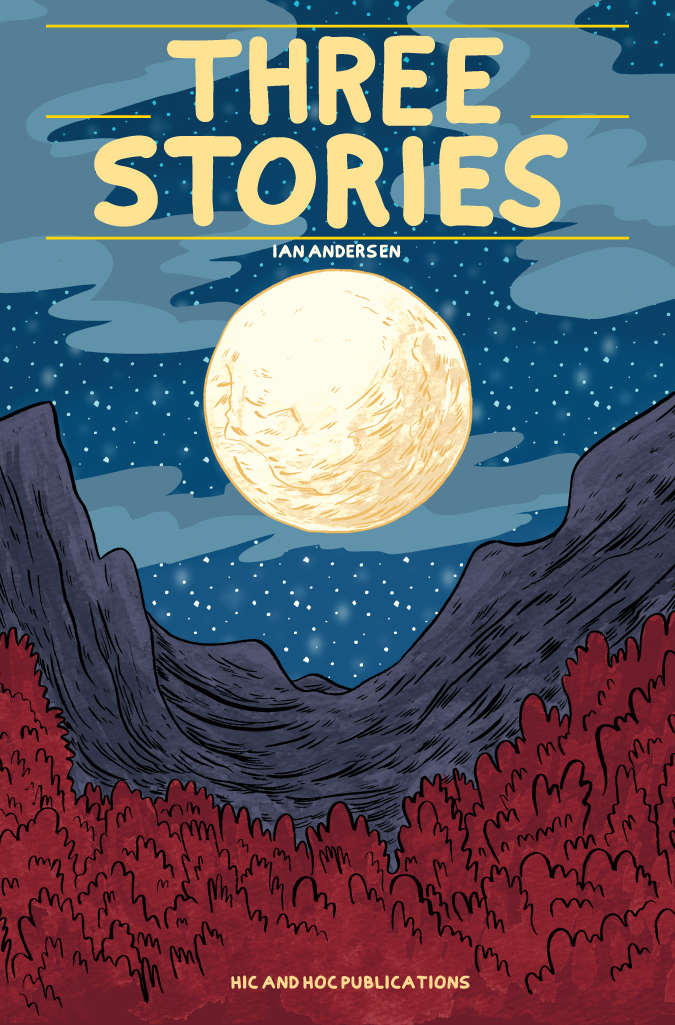
Three Stories, by Ian Andersen. Each of the titular three stories is stripped down and simply told. The first story, "Pack Rat", is a sort of visual exercise as a blank-faced character first finds a face on the ground (two dot eyes and a line for a mouth), and then proceeds to acquire more and more material goods as he walks along, until he collapses under the weight of his possessions and loses everything--including his identity. I't unclear just how much meaning Andersen is choosing to inject into this story beyond the neat visual trick of a simple character adding more and more detail and weight, until it's all gone. The second story, "Pear", concerns what seems to be the gentle eating adventures of a river turtle. He tries to dodge a loud animal that winds up eating his food, until he devises a method to get rid of it--once and for all. Andersen likes to inject a bit of cruelty into his stories at their conclusions, and the turtle's eventual "reward" for his actions is an effective surprise. In the last story, "Howl Hole", a couple of forest tree creatures follow a howling wolf to his hole, making fun of him when they can't understand him. The reveal here is a creature suffering heartbreak, with a lack of understanding denying any possible empathy. This is a comic with modest ambitions and an understated visual approach; it's quite different from the crazier, flashier and less conventional material that Moses usually publishes. That said, there's a surprising amount of emotional depth to this comic that belies its otherwise mundane trappings.