Showing posts with label michel rabagliati. Show all posts

Monday, January 2, 2017

Michel Rabagliati's Paul Up North

The final volume (for now) in Michel Rabagliati's Paul series features many familiar delights, but it's ultimately the most lightweight. Rabagliati has gone on record saying that he decided to quit the semi-autobiographical series that jumped back and forth in time after he and his wife got divorced, noting that it was now just too painful to delve into the past. To be sure, Paul Up North's virtues are simple, and it has the least amount of depth of any of the books in the series that has spanned nearly 20 years. It more-or-less picks up right after the end of the last book, Paul Joins The Scouts. The running theme in every Rabagliati book is that of transition and the difficulty of accepting change. It's also about people trying to find their place in life, be it Paul, his family or his friends, there's always a tension between the instant nostalgia of the moment and the desire for things to never change and the need for growth at different stages in one's life.

This book follows Paul's family moving to a new town when he was sixteen and his adolescent tendency to pull away from his parents. Along the way, he makes the kind of close friends that are so valuable to a teenager, has some wild adventures with his new best friend and has something close to his first mature relationship--and first real heartache. Rabagliati is superb at relating the small details in friendships that give his stories a real sense of authenticity, especially with his slightly bigfoot, cartoony style of character design. Every character is distinctive in their own way, but it's clear that his friendship with fellow smart-ass Marco was the most important. The key sequence in the book was their hitch-hiking adventure that nearly got them killed when a powerful snowstorm rolled into northern Quebec. Marco represented that friend who was a little cooler than you are who introduced you to all sorts of music and culture while pushing one beyond their comfort zone in an effort to get them to try new things. The snowstorm sequence saw Rabagliati in peak form as a cartoonist, using swirling whites and grays to surround his clueless protagonists with increasing (if denied) levels of danger. The color dream sequence that followed was also an unexpected delight, especially after the reader was subjected to such an intense and harrowing series of panels.

That said, Paul in this book was especially whiny and immature. Rabagliati wasn't necessarily trying to make Paul look good, to be sure, but rather to normalize him. In other words, "here's a teenage asshole boy, just like all the other ones". Doing so was an effort to neither let Paul off the hook nor judge him too harshly, especially given his naivete. However, the inexplicable and tedious attitude he gave his parents did not make for great storytelling, even when Rabagliati went over the top in ham-handed metaphors at the end when Paul burned his old childhood playhouse and helped his father on the project he had been requested to work on from the start. While Rabagliati mercifully made this a silent sequence, that's all that saved it from cliche'. There are other problematic elements in the book: there's a deep undercurrent of sexism that pervades it, especially with regard to how men treat women as objects. From his uncle taking him to a strip club and sexually harassing women (played for laughs) to the way he and his friends treated and talked about girls, there's a tacit acceptance, a sort of boys-will-be-boys understanding of their actions. There's a homophobic sequence regarding a guy picking up the boys as well as a sequence that was simultaneously fat-shaming and slut-shaming of a girl who wanted to fool around with several of the boys. I found that tacit homophobia to be especially surprising given Rabagliati's sensitive handling of the subject in Paul Joins The Scouts. While one can appreciate Rabagliati's honesty in telling it like it was with regard to how a teenage boy might approach things (freaking out about a guy coming on to him and freaking out about sexual contact with someone he was not attracted to), there was little to indicate in the text that Rabagliati found any of these behaviors regrettable now.

While Rabagliati made it clear that Paul in this book was to be considered an unreliable and immature narrator, there was enough of a sense of nostalgia running through the book to blur the line between reporting on things as they were without celebrating them (like the sexism) and cheerfully recalling the good ol' days. There are other problems with the book as well: a subplot regarding his mother getting a face-lift goes nowhere, as does a subplot involving her sister dating a possible criminal. Every storyline, including Montreal hosting the summer Olympics in 1976, is inevitably sucked into the teenage Paul vortex, which concludes with the hilariously over-the-top sequence of him listening to the same sad song for over two weeks in a row as he lay in his underwear in his bedroom. To be sure, Rabagliati is in no way trying to glorify himself when his girlfriend broke up with him, even if she tried to avoid him instead of telling him. Rabagliati does suggest that finally facing up to his heartbreak was what enabled him to make the transition from adolescence to early adulthood and an acceptance of his responsibilities. It's unfortunate that Rabagliati concluded a series filled with emotionally powerful moments earned through his storytelling prowess with what amounted to the melodrama he usually managed to avoid. That's especially true given how wonderfully deft his cartooning has become, as it carried many an underwritten sequence in the book.

Friday, April 4, 2014

Tribute: Paul Joins The Scouts


Each of the loosely-autobiographical volumes of Michel Rabagliati's Paul series tends to fold itself around a particular theme or phase of development. The Song of Roland is all about the acceptance of death. Paul Goes Fishing is about finding one's way in life as well as struggling with trying to create new life. Paul Moves Out is about becoming an adult. However, his newest book, Paul Joins The Scouts (the second volume published by Conundrum Press) doesn't seem to have a particular theme or goal in mind for most of the book. There's a subplot about growing up in 1970 Montreal and dealing with the reality of the Quebec separatist terrorist group the FLQ kidnapping members of the government, but that ultimately proves to be a red herring. There's a running subplot about a first romance for Paul, but that's not the meat of the story either. There's yet another subplot about Paul taking up cartooning, but that's somewhat integrated into his general development as a person through the Scouts. It's not til the gut-punch of an ending that we learn why Rabagliati has chosen to spend so much time talking about the significance of joining the Scouts, the boys he made friends with in his cohort of six, and the Scoutmasters who were kind to him. Rabagliati is paying tribute to their presence in his life at that time and mourning their absence, both their literal absence as well as the way it inexorably shaped his life, one that would become far more tumultuous in just a few years.

As is his wont, Rabagliati begins the book with a page filled with the mysterious image of a sneaker hanging in a tree, with smoke blowing by it. When that image is reprised later in the book, its meaning becomes instantly clear, especially with regard to why Rabagliati chose to open the book in such a manner. Rabagliati is such a powerfully effective storyteller because of his knack for using nonverbal clues to set up each book's events in short order. In the first ten pages of the book, we see Paul as a carefree teen, idling moments away in a park with a kite. Then we meet the girl who would become his love interest as the initial sparks are laid out in the form of a casual conversation fraught with meaningful body language. Walking home, we see separatist graffiti on a storefront wall. Then the reader is introduced to Paul's family and the tense dynamic between his mother and her mother-in-law, who lives in the apartment across from theirs and demands an "open-door policy". Just like that, an entire book's worth of characters and character interactions is neatly and seamlessly introduced in Rabagliati's attractive, clear-line style. 


After every subplot and character is swiftly introduced, they get moved to the background so Rabagliati can concentrate on telling Paul's odyssey as a Scout. He delves deep into the stories of each of the three Scoutmasters. One is gay (and has a boyfriend jealous of the time he puts into scouting, which is the one time the matter of pedophilia is raised), another is a working stiff he lives to provide direction for the young, and a junior scoutmaster is a college student interested in radical politics. It's those politics that provide a tenuous link to the FLQ and their increasingly violent methods and give the reader a sense of suspense while reading the story. However, that suspense is less important than the loving detail Rabagliati gives to Paul's first camping trip. Other than the gravity of having to camp outside in the open by himself for one night, there's no dramatic tension in this sequence. It's simply a collection of character sketches and bonding rituals that detail how much being a Scout came to mean to Paul, and by extension how much the members of his troop came to mean to him. Rabagliati depicts the occasional personality clash, but it's nothing on the scale of something like Mike Dawson's Troop 142. There's simply a tremendous amount of warmth in Rabagliati's depiction of Scout life, and he depicts this as an unambiguous positive in Paul's life during the same period where he has his first love and discovers how much he loves to do comics. That he has so much of this yanked from under him at the end leads to a downbeat denouement. The resolution of his mother's feud with his grandmother is equally tragic in its own way; their inability to co-exist robs Paul of that intimate family connection (even if it' with good reason). The final, silent pages of the book are Rabagliati's tribute to his fellow Scouts, each one its own powerful image. Rabagliati has been accused by some of being emotionally manipulative and sentimental. While that can be true at times because of his tight control over the emotional content of his stories, I see him as earning the right to draw out that emotion from readers with carefully-laid details that allow the reader to take each character as they are, both positive and negative, and see them as fully fleshed-out human beings. It's easy to feel moved by the triumphs and tragedies in a Rabagliati book because of his genuine sincerity and his skill at painting complex portraits of each character, not the least of which is his own stand-in.


Friday, February 8, 2013

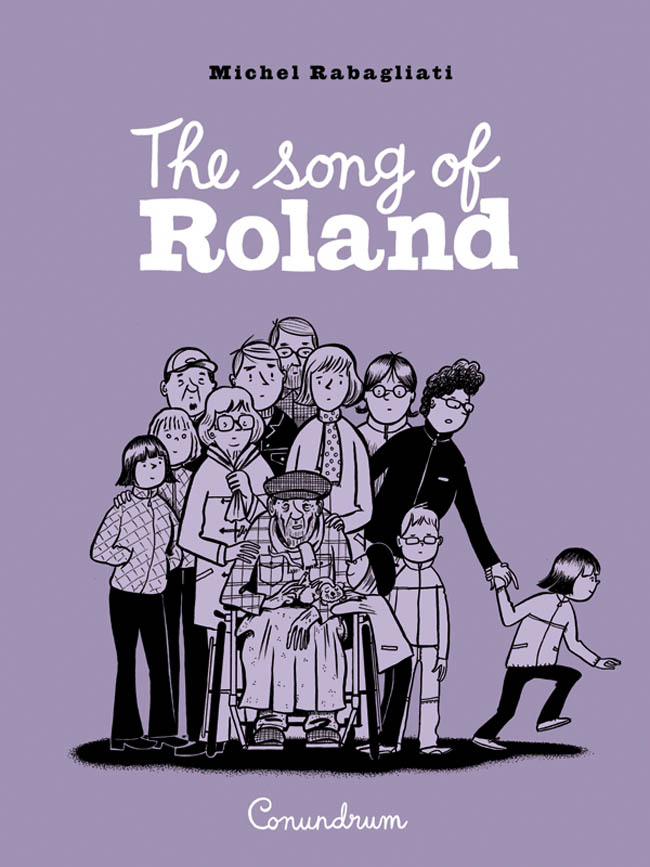
On Making An Exit: The Song of Roland

Michel Rabagliati's The Song of Roland (titled Paul in Quebec in its original French release) is the first of his books to be translated into English by a publisher other than Drawn & Quarterly. Indeed, it was released by the formidable Conundrum Press, a publisher that's now publishing some cartoonists formerly published by D&Q as well as a host of other Canadian cartoonists. I've said it before elsewhere, but Canada has an incredibly deep, diverse and ever-expanding range of cartooning talent, and it deserves to have a number of different publishers active to curate, nurture and publicize its talent. Rabagliati's slice-of-life Paul series of books offer a gentle, humane, funny and ultimately very real account of how lives are lived. His last book, Paul Goes Fishing, was about life and death, creativity and parenting. Rabagliati's books are always about the intersection between memory and how we process our current emotions, and The Song of Roland is no exception.

What's different about this volume is that Paul is really just a supporting character. The book is really about the family of Paul's partner Lucie and her father in particular. Rabagliati sets the scene in the early part of the book, as her parents always made their country cabin a place of vacation for their children and grandchildren, relishing a busy and loud house. The tracks of memories are laid down in this section of the book as Lucie and her sisters recall funny and sometimes vaguely traumatic memories of coming out there. In a book that's about the death of a beloved family member, Rabagliati is careful to vividly create a set of characters before assigning them roles in a tragedy and also inserts a number of moments of both tranquility and levity into the proceedings. We get to inhabit the lives of the people in this book, to get a sense of their eccentricities and how they interact with each other, before tragedy strikes.

Rabagliati does clue the reader in right away that Lucie's father Roland has cancer, though at the time we meet him he's still robust and gruff. As the book proceeds, Paul and the reader get to know him better: he was raised in an orphanage and had a hardscrabble life, until he worked his way up through various companies to become a vice-president. While Roland never quite escaped that feeling of being a defensive, gruff orphan, he made sure to become the sort of father and grandfather that he never had. He is paid back, at the end of his life, in the love he felt from his family. The final third of the book, when Roland is in a hospice facility, neatly encompasses the various stages of accepting death. There's a beautiful stillness to this section that contrasts nicely to the louder, more rambunctious storytelling earlier in the book. Roland is initially rude to the staff when he enters the facility but soon understands both his fate and the role of the people taking care of him. His children and surprising friends show up to see him, many stunned by the sight of a once-vital man wasting away. Through the whole experience, Paul and Roland grow closer and closer after years of slight distance between the two men. The one mawkish note Rabagliati does inject into the proceedings was Roland telling Paul to call him by his first name after years of insisting he call him by his surname. The minute Rabagliati introduced the latter bit of information, it was obvious how this would play out.

On the other hand, what I didn't see coming was a scene on a park bench involving Roland's three daughters getting high as a kind of pressure valve and laughing uproariously at all sorts of nonsense. During a long and austere set of sequences, some drug & scat humor was just what the doctor ordered, as the scene breaks an almost unbearable and inevitable tension in the narrative. It's also a palate cleanser for the real end of the story when Roland dies. The epilogue is a mix of the same sort of heartfelt emotion and quotidian comedic fare that makes up the rest of the book, as the priest at Roland's funeral mispronounces his name, one of his daughters gives a stirring speech, and his granddaughter sees his spirit moving on. That scene could have been cloying, but it felt earned after the way that Rabagliati so gracefully depicts the passing of a forceful personality--especially since there's a funny callback to be found. All told, The Song of Roland isn't quite as complex or powerful as Paul Goes Fishing, but it's a strong effort that addresses downbeat themes with grace, wit and genuine warmth.

Thursday, August 16, 2012

Sequart Reprints: Paul Goes Fishing


One of the most difficult things for an artist to do is to portray emotion without wallowing in Spielbergian sentiment. It's incredibly easy for a skilled artist to manipulate an audience into being moved with cheap, tragic stunts. Tugging one's heartstrings is the only goal, and there's not much difference between this and an action movie shuffling around its characters so as to move them to the next fight or explosion. This sort of manipulation has nothing to do with actual emotion and has all the subtlety of a sledgehammer. If one was to seek out a primary reason why as a reader I feel angry at being manipulated in such a way, it's because the characters presented to me are either weak protagonists or lazily sketched-out and one-dimensional.

In contrast, Michel Rabagliati's "Paul" series works so well precisely because each character is given a rich inner life. Rabagliati is a master at portraying the small but crucial moments that make up a life and give readers enormous insight into each character. He also expertly balances the themes and plot of the overall narrative while frequently going off on seemingly unrelated but absorbing tangents. These tangents inevitably tie back into the main story but never in a way that seems ham-fisted or obvious. Most of all, by making the small moments the meat of the story, he's able to shift gears and address a series of tragic events with enormous sensitivity, subtlety and a minimum of mawkishness. The latest edition, Paul Goes Fishing is by far his best book to date. This one's themes revolve around innocence (both lost and taken), parenthood, the creative process and the precarious balance between life and death. These are heavy themes, but Rabagliati navigates them gracefully with a light storytelling touch. For example, on pages where Paul and his father are on the lake,  Rabagliati avoids using extreme close-ups of their desperate faces and instead pans way back to show us a tiny drawing of the sinking boat on the vast lake. Even the panels where Paul's father bursts into tears aren't dragged out--we instead get a real sense of the tension and emotion of the moment where they both nearly died and his father's feelings for him. This is further set up a few pages earlier, as Paul's amiable father is singing to him and Paul notes how meaningful this moment of extremely quiet time with his father is so important to him.

Rabagliati flashes back and forth in time like this as Paul and other characters recall moments of great importance to them in a setting that is intentionally set up as a remote, still location. The contrast in setting and story is obviously deliberate and quite effective. The plot is simple: a 20-something man named Paul takes a vacation with his pregnant girlfriend Lucie to a fishing cabin site on a remote man-made lake in Canada. They meet up with Lucie's sister Monique and her family. This basic set-up triggers a number of memories for Paul: his traumatic past fishing trip with his father, his brother-in-law Clement's obsession with fishing being a result of working in a job that becomes increasingly soulless, a poignant and painful memory of Monique's as a case worker for at-risk mothers and their children, and Paul's own memories as a teenager. All of the memories relate to current events, but not always in obvious ways.

Rabagliati carefully constructs a narrative that addresses birth, death, growing up and the creative process--and how they all interrelate. The relationship between work and creativity is an important theme--for Clement, the intrusion of bottom-line corporate concerns into his job destroyed creativity, camaraderie and a real sense of accomplishment. For Paul, his job as a graphic designer lost its sense of soul when it became entirely computerized. Dehumanization and detachment are the great enemies in this book. A couple of teenagers who capture and leave a rabbit for dead are representative of a certain deadening of spirit--an inability to have meaningful relationships with others, which in turn leads to potentially monstrous behavior.

The first two thirds of the book give us a variety of points of view on children and how they're being raised. Paul's own recollection of hating school and running away, only to meet a kid in a far worse spot than he was, was the only portion of the book that felt slightly over-the-top. This street kid who lived with a sister that was a prostitute with an abusive pimp of a boyfriend felt like a bit of overkill, as did some of the narration. Rabagliati quickly redeems himself when Paul comes home from running away. The scene where his parents don't acknowledge that he's done anything wrong or hurtful and that he's not in trouble--indicating that they understand that he's going through a tough time-- is one of many emotionally powerful moments in this book.

The languid pace of the book takes a sudden shift when Lucie starts bleeding and is rushed to a hospital. She miscarried, which begins a time of great pain for the couple, as they try to have another child and the same thing occurs. This is where Rabagliati's skills as an artist are at their best. The brutally efficient technology of the vacuum pump used to take care of Lucie and the blood it pumps out represent the sense of defeat and dejection that they feel--and this ties in perfectly with earlier imagery from the book. The anger and fear that Lucie feels when others around her are pregnant, the desperate rage she feels when her parents insisted on buying baby items before the second baby came and then the second time she miscarried are powerful moments that have an almost visceral quality to them.

What's impressive is that Rabagliati's iconic, angular artwork that normally has such an amiable quality manages to mute a potentially histrionic presentation of such raw emotion. Rabagliati's line is witty and lively, spare and economical, and yet so full of expressiveness. His sense of composition is peerless, his character design is clever and varied, and he cleverly solves storytelling problems through the use of unusual lettering techniques. The Paul stories are said to be semiautobiographical, and Rabagliati manages to fuse the emotional verisimilitude of his real-life experiences with a carefully-constructed narrative. That fictive element forestalls the kind of navel-gazing that can plague some autobiographical work, while the real life elements provide fuel for his characterization. It's a delicate balance that he navigates expertly.

The final payoff of the book in its last four pages are so exquisitely constructed and pack such a powerful emotional punch that I was moved to tears. That is rare for me with any media, especially since I despise most media whose goal is to evoke that sort of reaction. Rabagliati cleverly ties the last four pages of the story with a seemingly-unrelated prelude, and then provides the final scene with most of its power by keeping it so stripped down. Again, there are no close-ups, no overselling of its importance with gratuitous narration. The sense of gratitude Paul feels for his child being born is conveyed in such a clever manner leads the reader to understand that Rabagliati was solving a storytelling problem in addition to conveying the feelings of his vividly animated characters. That he was able to act as both craftsman and artist with equal facility in Paul Goes Fishing makes this his most ambitious and most accomplished work to date. There's no question that this will be a "best of 2008" selection.
***
This article was originally written in 2008.