Showing posts with label leeah swift. Show all posts

Wednesday, December 28, 2022

31 Days Of CCS, #28: Leeah Swift

Leeah Swift crafted a number of beautifully-drawn, confrontational, and hilarious comics for her CCS thesis package, but the one that sums up their work the best is probably Freex. Subtitled "Somewhat of an artist's statement/pseudo-manifesto," this comic gets at the very heart of cartooning itself. Swift likes to draw figures that can be described as grotesque: distorted, rubbery, weird, monstrous, fluid, and fantastical. She says she likes this style because "freaks allow me to be more honest than most of the social and moral conventions of the world do." This reminds me of some drawings that Marnie Galloway recently published on her Substack. She drew herself at the board--a basic, realistic drawing. It was accurate, she said, but not true. She drew another one of herself as a snail, with her three loving but demanding kids reminding her that she is going at a steady snail's pace in her work. This was true, but not accurate. Then she drew herself as a werewolf for fun--neither accurate, nor true. 


Leeah Swift draws comics that are not accurate, but they are true. And the weirder she gets, the more vulnerable and intimate the comics feel. Those terms fit better than something as nebulous as "true" is when describing anything, much less a subjective set of feelings around art. Swift zeroes in on something else: the spontaneity and immediacy of drawings that may be "mistakes"; their energy often brings something that is absent in a more labored, craft-centric drawing. At a deeper level, and from the perspective of a trans woman, these drawings make her question beauty standards and how they can promote cruelty. Concluding this series of illustrations by saying "Love every freak," it's a challenge for both herself and the reader. 


Swift describes a lot of her comics as "stream-of-consciousness." This is especially effective with several of the shorter, beautiful little art objects she creates, like I. Drawn like an ever-expanding maze, it's about being caught in an emotional labyrinth where things don't matter much. For Swift, who usually goes pretty big in terms of images, this micro-mini relies solely on a minimalist line. Butt Or What is a color experiment with a short, singular punchline that Swift critiques with a character coming saying it's merely "mildly amusing." Swift's self-caricature has a marvelously deranged quality to it, especially in the way her eyes bug out. Once again: freaky. Wiggle Water is a series of images with a Seussian labeling scheme, going from "wiggle water" to "cannon fodder" to "helpful otter." There's a precision of line, absurdity of character design, and restraint in color scheme that reminds me a bit of Paul Hornschemeier's early comics. The last of these shorter comics is Aaahh, Yes! I'm Back On My Medication!. It's another comic that shows off the crispness of her line and the vivid but tasteful use of color, as she feels invincible back on her meds, then goes off her meds because she feels invincible. 


The first of her two longer works is a eulogy/history about the punk-cabaret singer Jack Terricloth, aka Peter Ventantonio, titled I Want To Know That It Mattered. He's exactly the kind of cult figure that a teenage Leeah needs: a weirdo who defies and walks amongst conventions, veering between the sincerity of a crooner, the sneer of a punk rocker, and the self-aware showmanship of a carny barker and tent preacher. His music and performances not only had a profound influence on Swift, they also let her be a part of his cult fanbase, giving her a sense of safety in a setting where everyone was constantly redefining themselves. Swift's tone veers from personal to historical/analytical and goes straight to crass, grief-deflecting humor. She recalls she and her friends snickering at Terricloth's bulging dick in a tight-fitting suit, and then wonders allowed if she could have saved him if she had given him a blowjob. Swift is quite self-aware with what she's doing here, and her liquid and fantastical art reflects it as we see her melt into goo. Jack Terricloth mattered to her, and that's what's important. 


Leeah Swift's Stream-Of-Consciousness Comics is essentially Swift's brand at the moment: fantastical, intellectually curious, slightly lurid, and confessional. Graduating from CCS reveals an artist with considerable technical skill, a deep understanding of comics storytelling, and a probing mind. It's still not entirely clear what kind of cartoonist Swift will be. Confessional memoir? Short, humorous stories? Detailed historical analysis along the lines of what Sasha Velour was doing before she went into drag performance full time? I could see Swift doing any and all of that; their drawing and cartooning skill is such that she could go in a more commercial direction if she wanted for some projects but stay in freak realm for more personal work. In this comic, she writes an interesting essay critiquing Marvel movies but also detailing why these movies have personal significance. This is probably the weakest entry in the book, in part because the art feels a little less out-there than in their other work. Conversely, Swift's comics essay on why they find Nick Cave and his music simultaneously irresistible and problematic, with a detour into a critique of queer people desperately trying to find crumbs of queer content in otherwise aggressively mainstream work while ignoring scores of actual freaky, queer artists. The other strips are about turning 30 and also getting sober, thinking about her future, and turning away from the cynicism of her past. Both are short and sweet and a fitting end to a decade and a sustained thesis. Leeah Swift's best comics are certainly yet to come, but the path she's taken is well worth examining. 


Saturday, December 18, 2021

31 Days Of CCS, #18: Leeah Swift

Leeah Swift's comics have a searing quality owing to her willingness to churn through a lot of issues in public, especially with regard to mental health. As a result, I braced myself for the stories in her collection Tit Bits, given the plethora of content warnings at the beginning and an apologia at the end. However, the collection felt quite restrained and reserved, leaving much to the imagination in its examination of various kinds of tensions. Which is not to say that they weren't interesting or emotionally resonant, just not as heavy as Swift implied.

"A Talk" was my favorite of the three stories. It depicts an outdoors adventure with two trans women, Violet and Jane, who have diametrically opposed ideas as to what it means to live as a trans person. Of course, the ridiculous adventure, including tiptoeing over a suspension bridge, going over rough ground, and up rope ladders, was all a funny visual metaphor for the rough ground they were experiencing as friends. Jane couldn't stop framing every idea and personal interaction as a political one, and Violet was tired of jargon and politics and just wanted to be a woman. Moreover, she didn't want to be talked down to just because she didn't want to engage politically. In the afterword, Swift said she didn't want to make specific, grand statements about being trans; while that may be true, she still touched on something that really landed here. 


"A Joke" is about a deeply depressed and anxious woman named Luna, and the story is about not just the awkwardness of social interactions and social anxiety in general, but about how sometimes the possibility of communication seems impossible. This plays out in the form of a joke that Luna tells after she's late for work yet again, and it also points to the ways in which boundaries play out in situations like this. Swift's distorted, grotesque, and funny cartooning is the star here, especially as Luna's face twists into grimaces and forced smiles. 

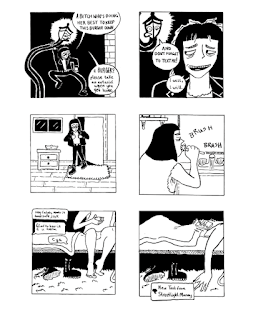
"A Show" is the simplest of the three stories, but also the most emotionally powerful in its way. It's about a trans woman named Alexa who simply wants to get a bite to eat before she walks home from work and her fear in being pursued by an overbearing asshole. It speaks to both the possibility of sexual violence that women face in situations like this, and how this is often even more dangerous for trans women. In the story, she makes it home safely (thanks in part to a bit of magical realism and a lamp post that helps hide her) and texts someone who cares about her. That last page, a splash page where she's safely in bed, is an expression of not just relief but connection. Swift's storytelling is an absolute delight, and its singular stylistic quality will actually work for any number of stories. 

Saturday, December 19, 2020

31 Days Of CCS, #19: Leeah Swift

Leeah Swift is an interesting talent, as an example of a cartoonist who already has a highly-developed personal style as a young cartoonist but is clearly still figuring out what kind of cartoonist she wants to be. Initially springing out of the Minneapolis scene, Swift's comic Meet Cedar The Giraffe was published by Caitlin Skaalrud's Talk Weird Press. This is a comic that deliberately plays with social conventions, as the unseen interlocutor who attempts to engage Cedar is a role that Swift inherently questions from the beginning. Cedar is a woman, writing a note, sitting in a booth, but in some ways, the "giraffe" part of the title comes from the narrator treating her as though she were an animal in a zoo. Cedar's reluctance to engage and general guardedness regarding her name and past both seem more like well-established defense mechanisms than the sign of a disaffected character. However, this understanding for the reader comes slowly, as Swift slowly subverts the cheerfulness of the narrator and Cedar's prickly response into something much darker and more personal. Ultimately, however, Cedar is reluctant to let go of the conversation, needing a connection of some kind, any kind at that moment. 

In terms of the drawing, Swift's character stylizations are deeply rooted in a thorough understanding of gesture and body language. The wooden booth, drawn as old and deeply pitted, anchors each page, giving Cedar something to play off of. There's a fundamental sense of restraint in both writing and drawing, even given the subject matter and Swift's character design. 

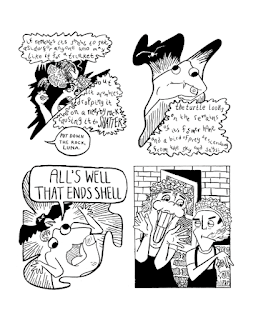
The opposite is true in her Aesop assignment, the classic The Tortoise And The Hare. Subtitled "Race Through A Silly Metaphor For Depression," Swift is highly self-aware that this comic is all over the place. It's less a narrative and more a deeply personal pause at the fork of a road. The first three pages are devoted to the story proper, and they're a showcase for Swift's increasing skill as a draftswoman, with tight hatching and fine details. Swift has a confident and bold line and has a great sense of comic timing as well with regard to visual gags. 

The back half of the story is Swift relating to both tortoise and hare. She felt the malaise and depression of the tortoise but also understood that slow labor was the only way she could make the kind of art she wanted. She related to the hare's energy, confidence, and ambition, but recognized that it also led to an overinflated sense of self and arrogance. I think for a cartoonist like Swift, CCS is an ideal environment because it likely forces her to draw on on the positive aspects of both of these selves. It puts her in a supportive environment but also one where collaboration, deadlines, and the expectation to publish are all expectations of the program. She has to do the work and thus avoids the impatience of the hare. She has to do the work and thus avoids the malaise of the tortoise. What will be interesting is when Swift is ready to tackle a more ambitious assignment in her second year and what that might look like.