Kazimir Lee's soft, chunky, and warm cartooning style is perfect for emotionally intimate comics. As such, this made him a perfect illustrator for Blue Deliquanti's story SCFSX!, a porn novella featuring Miles and his trans partner Honesty. Lee's work is in what I call the Sorese School (after Jeremy Sorese), along with Kevin Czap, Sophia Foster-Dimino and a few others. It emphasizes warmth and fluidity in its figures, which makes it perfect for depicting trans people in particular. This is a funny story about a couple who go to a sex party with a science-fiction theme. Deliquanti truly nails the fundamental nerdiness of much of the swinging/poly community, and Lee grounds it while managing that thin line between campy costumes and geeky behavior and full-out eroticism.
The story follows Miles being shy but game in trying to fulfill Honesty's needs and being surprisingly receptive to the scene. Meanwhile, Honesty panics a bit when she realizes that the public nature of the scene, while a turn-on, triggered some latent anxiety and pre-programmed self-loathing. This was managed in a sensitive yet super-hot scene in a public park that expertly addressed all of the emotional issues in a heartening way. This is a comic where people are heard and seen in the ways they want and deserve, and the communication needed for sex that's both physically and emotionally fulfilling is a crucial part of the narrative. It also is not only explicitly about queer perspectives with regard to sex, it also centers the experience on trans characters in a way that feels completely organic.
Second year student Emma Hunsinger made a splash in the New Yorker with "How To Draw A Horse," a marvelously deadpan and personal bit of storytelling. It's a story about longing and hiding that longing as one tries to gain the attention of someone else. For the narrator, it was trying to get the attention of another girl in class through these horse drawings, which are enormously difficult to do. Hunsinger's scribbly scrawl of a line is fantastically expressive and immediate, reminding me a little of Saul Steinberg.
Her book Chunk delves into a group of students in a sculpture class at art school. Plenty of people have done art school comics, but Hunsinger's is not only one of the best I've ever read with regard to the subject, it's one of the best comics of 2019. It's done in the style of a personal journal or diary of a bushy-haired student named Charlotte. Her narrative appears on the page with ruled lines underneath to give it a quick visual signifier that it is a journal. The book, in many respects, recapitulates the themes of her short story and replays it in several different ways. The theme of the book is Charlotte's quest to understand what makes a person special, because if she became special, she would have the courage to talk to her T.A. in her sculpture class, Crystal. Crystal was cool, went to Yale, and had great hair...which put her out of Charlotte's league in her own view.
That one connective thread leads to her roommate Tanya's eventual romance with another student, Li, whom Tanya dubbed as special. When asked about it, Li notes that she's not special, but that this guy named Darren is. So they track him down, and he is indeed the kind of magical presence who just exudes a sort of manic awesomeness. When Charlotte realizes that his specialness is innate, she just gives up...and gets a big surprise. Hunsinger's pacing, use of negative space, and almost painful verisimilitude with regard to dialogue make each page a special pleasure to read.
Her skill with regard to depicting emotion and exaggeration of movement is particularly noteworthy. There's a sequence where Charlotte sees Tanya working manically on some drawings, surprising her (lots of popped-out eyes here), and seeing that she drew seven pages of having sex with Wonder Woman. It is both hilarious and raw, as so much of this comic is, with regard to people trying to figure themselves out. It's thematically complex, with each character given a unique interior life. It's visually sophisticated, with the composition of each page deceptively simple yet all part of the book's gestalt. Hunsinger's comic is a mixture of restraint and excess as a storyteller, and her ability to dole them out when appropriate is her greatest gift as a storyteller.
Showing posts with label kazimir lee. Show all posts
Tuesday, December 10, 2019
Sunday, November 29, 2015
Thirty Days of CCS #29: Kazimir Lee
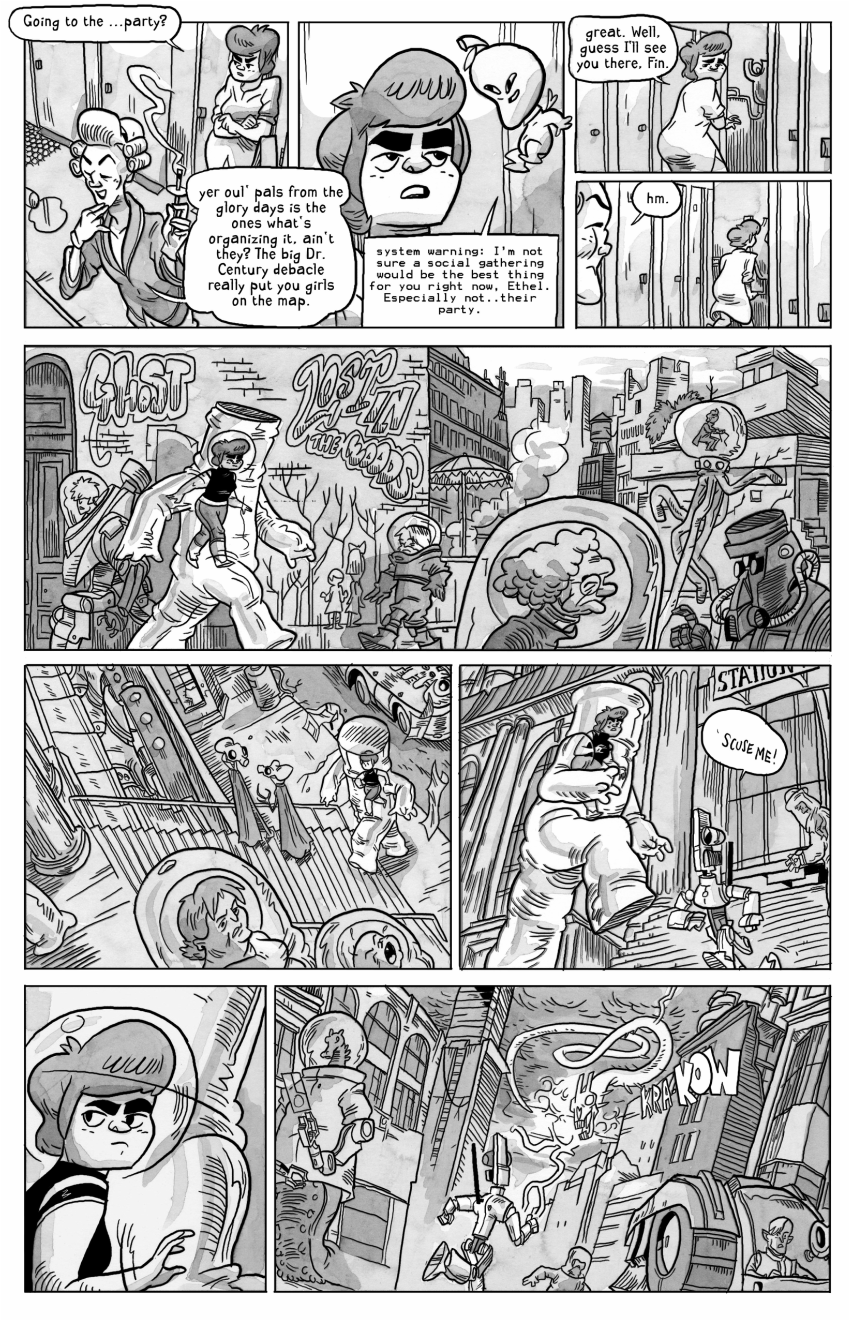
Kazimir Lee is one of the more versatile and polished of CCS grads, and his output reviewed here certainly reflects that variety of styles and facility in any number of genres. For example, End Of A Century is a marvelously well-realized mash-up of superheroics and slice-of-life drama. Using an appealling, cartoony line with character design reminiscent of the sort of thing that Brandon Graham (by way of Bob Fingerman) does-- that mix of manga, street art and Archie comics. Lee cleverly makes slow reveals in this story, as we first meet Ethel and the equivalent of her conscience /Microsoft paperclip. We immediately see that this is a futuristic world, that Ethel was formerly a superhero, and finally that she's a robot. The fact that she has to upgrade her "self-esteem software" is both a running joke and a clever plot point. Lee manages a genuinely exciting action climax and a quiet character moment at the end.
Here, After is another sort of mash-up: horror and existential character drama. It's the story of a young man housesitting for the family of his dead best friend. With character design that once again employs a sort of cartoony, grotesque doodle, Lee creates an atmosphere of tortured guilt and thick suspense as the reader is left guessing what's real and what's imagination. It's a story about someone who's adrift in part because of his guilt, and partly because the relationship he had with his friend was so ambiguous and clearly tortured. The metaphor that Lee employed, of the protagonist being unable to relate to his friend's love of horror movies, resonated as him being unable to connect to his friend while acting as the story's horrific fuel.
The City That Cried Wolf! was an Aesop's Fable assignment at CCS that Lee turned into a Black Lives Matter metaphor. The shepherd in this case was a kid who fabricated evidence against wolves, inciting city-wide fear and resentment against them that led to real rioting. While the story is far from subtle, the cleverness of Lee's visual set-ups mixed both modern and ancient appects of the story in an amusing but pointed manner.
Curtain Call is "adapted from writings by A.M.L" and is certainly a thematic departure. It's a "same time, next year" story about a drama professor's sexual encounter with a former student in a hotel room. This time around, Lee uses a brushy approach with a cartoony style that looks a bit like a New Yorker strip. It's frankly sexual but not erotic, as the thick and curvy lines, pointy noses and other anatomical exaggerations tell the story in a manner that's emotionally realistic but not exploitative. Lee nails the swirling emotions as well as the small talk and the pillow talk here.
Finally, Lee was the editor of the CCS anthology It Is The Bad Time, whose theme was dread. Dread is very carefully selected as opposed to horror, because dread is a feeling of anxiety and fear of the unknown as much as it is the actual experience of horror. Emily Parrish's "Monstrum" connects a young woman's encounter with a possibly cursed bracelet with certain growing and unpleasant appetites. Anna Selheim's "Wasted" is about a young writer frittering away her time, only be visited by a ghastly spirit who warns her about this. The ending is predictable but still high-impact, especially given her emotionally resonant character design. Cooper Whittlesey's "Autopoesis" is a manically scrawled story of survivalism gone horribly wrong, while Lee's own "Ugly Boy" is about bullying, bad parenting, a monster in a pool and the way children manage to still love their parents in even the worst of circumstances.
Tillie Walden's one-pager "Muscles" uses dense cross-hatching to get across the fear of feeling one's tendons and muscles simply snap, while JD Lunt's "State College" uses the metaphor of a college football town to express the horror of crowds and cults of personality in a dizzying swirl of silhouettes, shadows and bizarre images. Finally, Angela Boyle's "Spores" is a fitting capper, as her pleasing line soon turns to utterly disquieting and nightmarish images as a young woman is slowly infected by a monstrous creature disguised as an old woman. The device of the barking dog as a warning sign that's ignored is especially effective here.
Here, After is another sort of mash-up: horror and existential character drama. It's the story of a young man housesitting for the family of his dead best friend. With character design that once again employs a sort of cartoony, grotesque doodle, Lee creates an atmosphere of tortured guilt and thick suspense as the reader is left guessing what's real and what's imagination. It's a story about someone who's adrift in part because of his guilt, and partly because the relationship he had with his friend was so ambiguous and clearly tortured. The metaphor that Lee employed, of the protagonist being unable to relate to his friend's love of horror movies, resonated as him being unable to connect to his friend while acting as the story's horrific fuel.
The City That Cried Wolf! was an Aesop's Fable assignment at CCS that Lee turned into a Black Lives Matter metaphor. The shepherd in this case was a kid who fabricated evidence against wolves, inciting city-wide fear and resentment against them that led to real rioting. While the story is far from subtle, the cleverness of Lee's visual set-ups mixed both modern and ancient appects of the story in an amusing but pointed manner.
Curtain Call is "adapted from writings by A.M.L" and is certainly a thematic departure. It's a "same time, next year" story about a drama professor's sexual encounter with a former student in a hotel room. This time around, Lee uses a brushy approach with a cartoony style that looks a bit like a New Yorker strip. It's frankly sexual but not erotic, as the thick and curvy lines, pointy noses and other anatomical exaggerations tell the story in a manner that's emotionally realistic but not exploitative. Lee nails the swirling emotions as well as the small talk and the pillow talk here.
Finally, Lee was the editor of the CCS anthology It Is The Bad Time, whose theme was dread. Dread is very carefully selected as opposed to horror, because dread is a feeling of anxiety and fear of the unknown as much as it is the actual experience of horror. Emily Parrish's "Monstrum" connects a young woman's encounter with a possibly cursed bracelet with certain growing and unpleasant appetites. Anna Selheim's "Wasted" is about a young writer frittering away her time, only be visited by a ghastly spirit who warns her about this. The ending is predictable but still high-impact, especially given her emotionally resonant character design. Cooper Whittlesey's "Autopoesis" is a manically scrawled story of survivalism gone horribly wrong, while Lee's own "Ugly Boy" is about bullying, bad parenting, a monster in a pool and the way children manage to still love their parents in even the worst of circumstances.
Tillie Walden's one-pager "Muscles" uses dense cross-hatching to get across the fear of feeling one's tendons and muscles simply snap, while JD Lunt's "State College" uses the metaphor of a college football town to express the horror of crowds and cults of personality in a dizzying swirl of silhouettes, shadows and bizarre images. Finally, Angela Boyle's "Spores" is a fitting capper, as her pleasing line soon turns to utterly disquieting and nightmarish images as a young woman is slowly infected by a monstrous creature disguised as an old woman. The device of the barking dog as a warning sign that's ignored is especially effective here.
Subscribe to:
Posts (Atom)