It seems as though Vermont may well have the densest concentration of cartoonists per capita, and that's not just because of the Center for Cartoon Studies. To be sure, CCS's presence and workshops have influenced and inspired many to start cartooning, but there are many others as well. The Ladybroad Ledger is a broadsheet anthology (with a very clever title), done in black and white with a color cover strip. The fourth issue of this all-women free anthology is typically solid and varied in its stories. At sixteen pages, it's also just the right length for this kind of format.
Rachel Lindsay leads off with a funny strip, done with a green and yellow wash. It's about her outrage over technology, especially with regard to music, as she decries her formerly record-player loving friends' use of Alexa. The ending is a straight-up EC Comics spoof, with an ironic twist that's meant to be easily guessed. Lindsay's exaggerated line and exasperated expressions reminded me a bit of Roberta Gregory in some places. There's also a nice interview with her on the back page of the issue.
Another highlight of the issue are two pages from the Fawkes women: Glynnis and her young daughter Helen. Any long-time reader of Fawkes' work knows that her daughter has always been obsessed with bunnies and creating bunny characters, and this has crossed over into her own comics work. Glynnis drew a strip that Helen wrote about a nervous bunny who impresses a royal bunny by simply being themselves and running through the forest to get twigs and burs on them. There's also a page of Helen's written-and-drawn bunny stories that are very amusing. Helen clearly gives a lot of thought to things like panel composition and perspective, because most of her panels are very well-framed. She also gives a lot of thought to character design and how to differentiate characters who all look roughly alike.
Elise Dietrich and Bridget Comeau both contributed recipes/crafts. For Dietrich, her chicken lentil soup reminded her of a visit to Morocco. For Comeau, it's a way of reducing plastic use by making reusable food wraps. Susan Norton and Kara Torres both use thick lines and dense panel design for different purposes. For Norton, it's a story about feeling constantly uprooted, as defined by having to constantly pack and unpack her record collection. For Torres, it's for a humor strip about "art. anon.", a twelve-step support group of people addicted to the artist lifestyle. Torres nails the language of recovery and addiction for humorous effect.
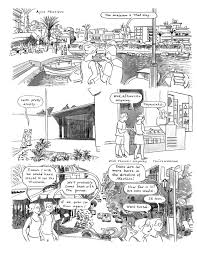
Other stories include a funny, scribbly, open-page layout strip by Mary Lundquist about tiny elves drinking her coffee; a dense, silent story about a woman braving strange conditions to reactivate a power switch on an island by Abby Pearl; a scribbly and gray-washed series of drawings by Natania Nunubiznez discussing her simple desires; an unfortunately pixelated page from Michelle Sayles about trailblazing hiker Emma Gatewood; a Feifferesque strip by Janet Biehl in terms of figure drawing and shading about inspiring some kids in Izmir; and shorts by editor Stephanie Zuppo and Frances Cannon. They all contribute to the relaxed quality of the broadsheet, as most of the pieces take their time in telling their stories instead of adhering to strict plot and pacing.
Showing posts with label glynnis fawkes. Show all posts
Wednesday, August 7, 2019
Monday, October 15, 2018
Minis: G. Fawkes
Hitting some more interesting minis...
Exit Archaeology, by Glynnis Fawkes. This is both a self-contained work and a sequel to her much longer Greek Diary as well as a companion piece to her other comics about being an illustrator at an archaeological site in Greece. Greece is a country that holds a great deal of meaning for Fawkes, and Kenchreai in particular. That's the eastern port of Corinth, where she had for nearly a decade worked drawing pottery shards and other items from an excavation site of Roman items. One of the running themes in Fawkes' comics is the notion of how difficult agency can be as a creative person. While artistic freedom and freedom in general is important, Fawkes found herself drawn to a job that had no creative nor academic value to her personally. She was an artisan, paid to do a job as an illustrator. No more, no less.
Being freed from the pressure of academia or comics deadlines--and even the responsibilities of having a family--was hard to give up. She could simply work, swim, sketch, drink and explore the area with friends. One gets the sense that Fawkes is constantly restless, her mind going in a million different directions. Only a mindless physical activity like her job or walking around seemed to soothe that buzzing brain. Even at that, the fact that she knew that she couldn't justify another trip out for this job ate at her a little, as time suddenly became a limiting factor for what was usually a more open-ended experience.
Her sketches of the local area are delightfully vivid and loose, as are her drawings of her friends. Indeed, the one major change is that this comic was much less of an interior exercise than some past efforts, and the second half of the comic focuses on the camaraderie of her work group. It wasn't just the labor that was important to her but also the fact that she was part of a team. She was an important cog making the machine run smoothly, and she took great pleasure in bouncing off of people who had become close friends over the years. More than anything, that's what Fawkes emphasized in this comic. Just as working in Corinth had become something she did for herself, so too is this comic a gift for herself. It's slowly paced and has a number of sketches of local sights. It lacks the interpersonal or family drama of her other comics set in Greece, and its only structure is that of the time spent in Greece itself. It's a breezy read at 44 pages, but it could have been even shorter without losing the essence of the story. Of course, self-indulgence was not only a theme of the comic, it was also the format of the comic. This is a comic that invites the reader to stop, slow down, and breathe as we join Fawkes soaking it all in as much as she could.
Exit Archaeology, by Glynnis Fawkes. This is both a self-contained work and a sequel to her much longer Greek Diary as well as a companion piece to her other comics about being an illustrator at an archaeological site in Greece. Greece is a country that holds a great deal of meaning for Fawkes, and Kenchreai in particular. That's the eastern port of Corinth, where she had for nearly a decade worked drawing pottery shards and other items from an excavation site of Roman items. One of the running themes in Fawkes' comics is the notion of how difficult agency can be as a creative person. While artistic freedom and freedom in general is important, Fawkes found herself drawn to a job that had no creative nor academic value to her personally. She was an artisan, paid to do a job as an illustrator. No more, no less.
Being freed from the pressure of academia or comics deadlines--and even the responsibilities of having a family--was hard to give up. She could simply work, swim, sketch, drink and explore the area with friends. One gets the sense that Fawkes is constantly restless, her mind going in a million different directions. Only a mindless physical activity like her job or walking around seemed to soothe that buzzing brain. Even at that, the fact that she knew that she couldn't justify another trip out for this job ate at her a little, as time suddenly became a limiting factor for what was usually a more open-ended experience.
Her sketches of the local area are delightfully vivid and loose, as are her drawings of her friends. Indeed, the one major change is that this comic was much less of an interior exercise than some past efforts, and the second half of the comic focuses on the camaraderie of her work group. It wasn't just the labor that was important to her but also the fact that she was part of a team. She was an important cog making the machine run smoothly, and she took great pleasure in bouncing off of people who had become close friends over the years. More than anything, that's what Fawkes emphasized in this comic. Just as working in Corinth had become something she did for herself, so too is this comic a gift for herself. It's slowly paced and has a number of sketches of local sights. It lacks the interpersonal or family drama of her other comics set in Greece, and its only structure is that of the time spent in Greece itself. It's a breezy read at 44 pages, but it could have been even shorter without losing the essence of the story. Of course, self-indulgence was not only a theme of the comic, it was also the format of the comic. This is a comic that invites the reader to stop, slow down, and breathe as we join Fawkes soaking it all in as much as she could.
Wednesday, August 29, 2018
Glynnis Fawkes' Alle Ego
Glynnis Fawkes mini Alle Ego is the middle chapter of a longer work about becoming an archeological illlustrator, but it's also a story about personal agency. As the book begins, Fawkes (at the time, a recent college grad) is on her way to Athens, pondering her relationship with her fiance'. The trip was a working one at the American School, but Fawkes' wandering eye (and feet) led her off on the first of her many side adventures when she arrived. She quickly met Svetlana, a Russian woman whose strong personality and fierce independence combined with great empathy and perceptiveness made her a close friend right away. In many respects, Svet served as her own personal Greek chorus, causing Fawkes to rethink a number of her choices without directly trying to influence her.
The comic is a cross between absolutely academic rigor with regard to places, people and dates and a whimsically fluid series of fantasy sequences where Fawkes sees herself in the past. The key sequence is one where Fawkes tells Svet that her fiance' Ingo "has a hold on me." In the fantasy, she's a Minoan in occupied Knossos and her fiance' is a conquering Mycenean. The Mycenean way was not just to conquer an area, but to utterly dominate them culturally, starting with their iconography on the pottery and sculptures. The pictorial, ornate Minoan drawings were out, and the abstract Mycenean methods were in. This is all historically true, but it also served as an extended metaphor for a man who basically told Fawkes what to do, how to paint, what to eat...everything. It isn't stated, but this behavior is clearly abusive and controlling.
Now there are dominance and submission relationships where the dom dictates a number of things, but that's done within the specific and understood rules of the relationship as a mutual and loving exchange, not as a one-sided way of controlling your partner's every move. Fawkes, who is clearly an intelligent and independent woman, hints about this to some degree when she notes that in her fantasy "I don't mind Mycenean domination!..In fact, it's what I've been waiting for my whole life. Clear rules about how things are done. No more self-doubt. And he...cares about me." Intentional or not, this is very much the language of a sub, of someone who longs to enjoy that paradoxical sense of freedom felt when surrendering to a trusted other. It's the agency of choosing to give that control to others.
That sense of agency pervades the comic, as Fawkes is paradoxically a rebel who doesn't want to go along with all of the touristy stuff and stereotypical nights out with the other Americans at the bars, but at the same fantasizes about that sense of total, willing surrender. She relates a story of when she was younger and in Italy, having drunk something particularly potent. She went outside for air and the numerous lecherous men in Italy immediately started hitting on her and one started making out with her...but she found herself totally drawn into the experience before a friend came along and rescued her from a potentially dangerous fate. Fawkes once again returns to mythology and speaks longingly of the idea of being a Maenad, one of the followers of Dionysus, whom in the context of ritual are completely uninhibited in terms of raving, running, drinking (and presumably) fucking. As she explained this to Svet, she wondered which part of her was going to be with her fiance'--the Maenad, or the "sane and decent" Nymph, to which Svet replied "Aren't you always both?"
It's a fascinating and open-ended exchange, as Fawkes makes herself quite vulnerable here in discussing the ways in which her desires contradicted her rational self and fiercely independent academic identity. Svet's reply implies that until Fawkes was able to reconcile all of her different selves, she wouldn't truly be happy. The very title of the book can mean both "good friend" and "other self". Svet fills the bill for both of these roles, but Fawkes being honest about her desires and sense of feeling split also refers to her various other selves. This comic (and chapter) feels like a kind of crucible of self, where Fawkes did a lot of the hard work on her discovery quest but didn't quite put it all together yet. I'll be curious to see how these themes conclude when she finishes her larger project.
Thursday, August 3, 2017
Comics-As-Poetry #9: Inkbrick #3
Alexander Rothman, Paul Tunis and the rest of the Inkbrick gang have been quite busy since I reviewed the first two issues a while back. They've taken on an incredibly difficult task: publishing a journal of comics-as-poetry on a semi-regular basis. Given that it's still a fledgling sub-art form of an art form that itself is still in relative infancy (or perhaps young adulthood by now), finding good candidates can't be easy. There's also the problem of defining just what comics-as-poetry is. Some might include what I would simply call "poetry comics": poems with some illustrations. Such work lacks the interdependence of word and image that poetry comics has, even if making such a distinction is of the "you know it when you see it" kind.
Still, there's no question that even when some issues are a little thin on the best of comics-as-poetry, it's unquestionably true that they still publish the best of the best as well. Anna Grzton's "Gert" is a good example of a great find. In relating this story of his father and an imaginary friend, creating an immersive environment that takes the metaphor of tears cried by peonies falling like diamonds. Rothman continues to grow more daring in his experiments, sticking to concrete imagery (like a bird and a walnut as actors in a play) but more abstract ideas. His images are becoming more abstracted while still retaining some literal roots by using techniques like negative space to create foreground figures and a dense use of colored pencils.
Sabin Cauldron's "Water Damage" was an interesting piece that considers the micro and macro ramifications of a humble kitchen sponge. There's a micro level of the internal structure of the sponge and of bubbles, and the macro level of a hand about to disturb this equilibrium of moisture and dryness. The orange used in the comic adds an alien feeling to the whole thing, down to the shadowy, spidery black fingers reaching for the sponge at the end. Wynn's "Unanswered" uses negative space to talk about identity in the form of one's self-image. In some ways, it seems to be a reference to proprioception, the sense that we know where our body is even when we don't see it. When that sense goes awry, we literally can't feel ourselves. Expanding that idea to identity itself (as opposed to one's position in space) is a clever idea, perfectly suited to comics to quickly explain.
Paul Tunis' matches images to text in a way that doesn't quite jibe. It's not random, but there's a false solidity in the way in which the naturalistic images and the short narrative bursts of text don't contrast in ways that seem very meaningful or interesting. Similarly, the rhyming structure of Laurence & Myra Musgrove's is a big distraction with regard to the simple image of a crow singing about its world. A lot of the artists take a big chance with the visual structure of their pieces, and not all of them are successful. John G. Swogger's "The Shrine" successfully redacts aspects of archaeological drawings to compose a beautiful poem about an abandoned space from all four cardinal directions. On the other hand, Alexey Sokolin's "Panopticon" uses 3D art effects that veer, paradoxically into total abstraction and the uncanny valley effect. It's distracting more than disorienting, and the font used for the lettering doesn't aid the reader in grasping the work.
Other notable contributions include Anthony Cudahy's mixed-media entry "No Eyes", which features drawings and photos of statues from antiquity and obsesses over the way they stare, even when they've been torn out. Catherine Bresner's excerpt from "January 2nd" is also a mixed-media piece reminiscent of Julie Doucet's recent collage work mixed with text. She also took images that look like they came from 1950s and 60s lifestyle magazines and inserted images of dominance, violence and in general elements related to patriarchal oppression. Maelle Doliveux and Alyssa Berg both rely on a sharp use of color and the passage of time in their pieces. Doliveux's is a clever one about a woman with a blossom for a head that slowly wilts over time when her lover leaves and doesn't come back. Berg's strip is rougher, using color to create the crest and fall of an ocean wave and comparing it to the rise and fall of a (presumed) lover's chest. The use of color crosses panel borders as we see two images simultaneously, just as she does.
The two long narratives in the book come from Glynnis Fawkes and the team of Marguerite Van Cook & James Romberger. The former story is a funny one that focuses on Fawkes' established fascination with Greek mythology, as she tells the tale of how she met her future husband as though she were a wild nymph and he was a charming faun, trying to lure her away from her busy life. There's a lushness to her brushwork and use of color that matches the heat of the sexual tension depicted in the book, but there's also that lasting sting of no longer being able to frolic in quite the same way as she did before she and her husband had their sun. Fawkes also expertly depicts that push-pull feeling of loving someone but desperately wanting to retain independence, until the attraction and affection wins out. Van Cook & Romberger's "Perfectly Manicured (To the Bone)" sees Romberger doing a take on the illustration style of Hal Foster's Prince Valiant strip, down to the flourishes selected for lettering. It tells the tale of the garden of dead children, the remnants of war, and horror and exploitation, waiting to bloom again in the wake of disaster. The question is, bloom for good or ill, as a young girl walking through the garden takes one of the "flowers" with her, against the advice of the gardener. It's a fold-out that doubles as a dust cover, and it's a spectacular, beautiful work. It's one of many chances the editor-publishers were willing to take, and it was a success.
Still, there's no question that even when some issues are a little thin on the best of comics-as-poetry, it's unquestionably true that they still publish the best of the best as well. Anna Grzton's "Gert" is a good example of a great find. In relating this story of his father and an imaginary friend, creating an immersive environment that takes the metaphor of tears cried by peonies falling like diamonds. Rothman continues to grow more daring in his experiments, sticking to concrete imagery (like a bird and a walnut as actors in a play) but more abstract ideas. His images are becoming more abstracted while still retaining some literal roots by using techniques like negative space to create foreground figures and a dense use of colored pencils.
Sabin Cauldron's "Water Damage" was an interesting piece that considers the micro and macro ramifications of a humble kitchen sponge. There's a micro level of the internal structure of the sponge and of bubbles, and the macro level of a hand about to disturb this equilibrium of moisture and dryness. The orange used in the comic adds an alien feeling to the whole thing, down to the shadowy, spidery black fingers reaching for the sponge at the end. Wynn's "Unanswered" uses negative space to talk about identity in the form of one's self-image. In some ways, it seems to be a reference to proprioception, the sense that we know where our body is even when we don't see it. When that sense goes awry, we literally can't feel ourselves. Expanding that idea to identity itself (as opposed to one's position in space) is a clever idea, perfectly suited to comics to quickly explain.
Paul Tunis' matches images to text in a way that doesn't quite jibe. It's not random, but there's a false solidity in the way in which the naturalistic images and the short narrative bursts of text don't contrast in ways that seem very meaningful or interesting. Similarly, the rhyming structure of Laurence & Myra Musgrove's is a big distraction with regard to the simple image of a crow singing about its world. A lot of the artists take a big chance with the visual structure of their pieces, and not all of them are successful. John G. Swogger's "The Shrine" successfully redacts aspects of archaeological drawings to compose a beautiful poem about an abandoned space from all four cardinal directions. On the other hand, Alexey Sokolin's "Panopticon" uses 3D art effects that veer, paradoxically into total abstraction and the uncanny valley effect. It's distracting more than disorienting, and the font used for the lettering doesn't aid the reader in grasping the work.
Other notable contributions include Anthony Cudahy's mixed-media entry "No Eyes", which features drawings and photos of statues from antiquity and obsesses over the way they stare, even when they've been torn out. Catherine Bresner's excerpt from "January 2nd" is also a mixed-media piece reminiscent of Julie Doucet's recent collage work mixed with text. She also took images that look like they came from 1950s and 60s lifestyle magazines and inserted images of dominance, violence and in general elements related to patriarchal oppression. Maelle Doliveux and Alyssa Berg both rely on a sharp use of color and the passage of time in their pieces. Doliveux's is a clever one about a woman with a blossom for a head that slowly wilts over time when her lover leaves and doesn't come back. Berg's strip is rougher, using color to create the crest and fall of an ocean wave and comparing it to the rise and fall of a (presumed) lover's chest. The use of color crosses panel borders as we see two images simultaneously, just as she does.
The two long narratives in the book come from Glynnis Fawkes and the team of Marguerite Van Cook & James Romberger. The former story is a funny one that focuses on Fawkes' established fascination with Greek mythology, as she tells the tale of how she met her future husband as though she were a wild nymph and he was a charming faun, trying to lure her away from her busy life. There's a lushness to her brushwork and use of color that matches the heat of the sexual tension depicted in the book, but there's also that lasting sting of no longer being able to frolic in quite the same way as she did before she and her husband had their sun. Fawkes also expertly depicts that push-pull feeling of loving someone but desperately wanting to retain independence, until the attraction and affection wins out. Van Cook & Romberger's "Perfectly Manicured (To the Bone)" sees Romberger doing a take on the illustration style of Hal Foster's Prince Valiant strip, down to the flourishes selected for lettering. It tells the tale of the garden of dead children, the remnants of war, and horror and exploitation, waiting to bloom again in the wake of disaster. The question is, bloom for good or ill, as a young girl walking through the garden takes one of the "flowers" with her, against the advice of the gardener. It's a fold-out that doubles as a dust cover, and it's a spectacular, beautiful work. It's one of many chances the editor-publishers were willing to take, and it was a success.
Monday, June 26, 2017
Two More From Kilgore: Noah Van Sciver & Glynnis Fawkes
Slow Graffiti #3, by Noah Van Sciver. This is a minicomics version of Van Sciver's daily diary strip that his Patreon readers get to see. This one's from November of 2015 through April of 2016, when he was a fellow at the Center for Cartoon Studies. He famously fictionalized his experience in Blammo #9, depicting his own alienation from the students and how he unintentionally further alienated them, but these diaries depict a somewhat different experience. The reality was that he felt nervous about having to perform and teach, but at the same time, he wanted to connect with them as well. He goes into some detail about how much of this is related to anxiety, and how one student went out of his way to to offer someone to talk to if he needed it. Van Sciver then connected by helping students with a task; at heart, he's always shown that he's a team player.
There are stories about pushing through on drawing tasks, going out in the forest, going to an impromptu Thanksgiving dinner, going to lectures, meeting weird people at shows, and more. This is Van Sciver at his roughest and rawest, and there's a powerful immediacy on each page as a result of that. A cartoonist grappling with depression and anxiety on the page is almost a cliche' at this point, yet the way Van Sciver finds ways out of these states seems directly linked to his ability to draw and write about it. Quite contrary to the cliche' of the whiny autobio cartoonist, Van Sciver's strips are almost always solution-oriented, introspective or self-deprecating in the search of a really good joke. For lack of a better word, the sketchbook reveals a real sense of maturity for Van Sciver, both as an artist and person who is trying to be the best version of himself possible.
Reign of Crumbs, by Glynnis Fawkes. Fawkes has written about her children before, but much of her work tends to focus on either mythology or archaeology. Not in this book, as Fawkes expertly and honestly captures the ways in which children (and pre-teens in particular) are both terrible and wonderful. Her husband makes the occasional appearance as well, but most of the book is about her interacting with her eleven year old son Sylvan and her nine year old daughter Helen. Much of the book looks like it was drawn with a brush pen, giving her spare drawing style a lot of weight and power on each page. The characters are all well-defined as a result, and she fills in other details with a tool that produces a thinner line. There's a real sense of ease and looseness on each page, though it's obvious that she spent a lot of time considering the composition of each individual panel.
Her children are depicted as loving, funny, creative, intelligent and silly. They are also depicted as lazy, incredibly entitled, messy, picky eaters, argumentative and hypersensitive. In other words, human beings at a particularly dramatic stage of development, one where the tug of dependence and the need to be independent create some personality conflicts. It doesn't help that her two children want nothing to do with each other, each (correctly) thinking that the other will monopolize the conversation--especially when they are with their mom. The best scenes were the bedtime tuck-ins, especially when they demand better tuck-ins that she's given. Fawkes points out the ways in which her children are still very much children, and the ways in which they are pushing her away. She depicts herself as a pushover mom who perhaps spoils her kids a bit too much (especially with regard to their eating habits), but she's also aware of this tendency and makes fun of her kids when they take advantage of her or her husband. When "little Helen" requests a last glass of water after being tucked in, Fawkes makes fun of her and Helen simply moves on by yelling "Daddy!". There's a real sense of joy in this comic as the kids are still at an age where the kids are still demanding her presence even if they're pushing back a bit, and Fawkes can still get silly with them and draw a reaction.
There are stories about pushing through on drawing tasks, going out in the forest, going to an impromptu Thanksgiving dinner, going to lectures, meeting weird people at shows, and more. This is Van Sciver at his roughest and rawest, and there's a powerful immediacy on each page as a result of that. A cartoonist grappling with depression and anxiety on the page is almost a cliche' at this point, yet the way Van Sciver finds ways out of these states seems directly linked to his ability to draw and write about it. Quite contrary to the cliche' of the whiny autobio cartoonist, Van Sciver's strips are almost always solution-oriented, introspective or self-deprecating in the search of a really good joke. For lack of a better word, the sketchbook reveals a real sense of maturity for Van Sciver, both as an artist and person who is trying to be the best version of himself possible.
Reign of Crumbs, by Glynnis Fawkes. Fawkes has written about her children before, but much of her work tends to focus on either mythology or archaeology. Not in this book, as Fawkes expertly and honestly captures the ways in which children (and pre-teens in particular) are both terrible and wonderful. Her husband makes the occasional appearance as well, but most of the book is about her interacting with her eleven year old son Sylvan and her nine year old daughter Helen. Much of the book looks like it was drawn with a brush pen, giving her spare drawing style a lot of weight and power on each page. The characters are all well-defined as a result, and she fills in other details with a tool that produces a thinner line. There's a real sense of ease and looseness on each page, though it's obvious that she spent a lot of time considering the composition of each individual panel.
Her children are depicted as loving, funny, creative, intelligent and silly. They are also depicted as lazy, incredibly entitled, messy, picky eaters, argumentative and hypersensitive. In other words, human beings at a particularly dramatic stage of development, one where the tug of dependence and the need to be independent create some personality conflicts. It doesn't help that her two children want nothing to do with each other, each (correctly) thinking that the other will monopolize the conversation--especially when they are with their mom. The best scenes were the bedtime tuck-ins, especially when they demand better tuck-ins that she's given. Fawkes points out the ways in which her children are still very much children, and the ways in which they are pushing her away. She depicts herself as a pushover mom who perhaps spoils her kids a bit too much (especially with regard to their eating habits), but she's also aware of this tendency and makes fun of her kids when they take advantage of her or her husband. When "little Helen" requests a last glass of water after being tucked in, Fawkes makes fun of her and Helen simply moves on by yelling "Daddy!". There's a real sense of joy in this comic as the kids are still at an age where the kids are still demanding her presence even if they're pushing back a bit, and Fawkes can still get silly with them and draw a reaction.
Tuesday, September 1, 2015
Static and Motion: The Comics of Glynnis Fawkes
Glynnis Fawkes is a part-time archaeological artist, meaning that she sometimes goes to digs in places like Corinth and is paid to draw various artifacts. Having a skilled artist can actually bring greater insight into the artifact than a simple photograph. Her own personal work as a cartoonist centers around travel, her children and her place in the world of comics, as well as her interest in retelling old myths with a modern slant. She compares her work to that of Guy Delisle's in her mini Time Out In Palestine, which she was just finishing up when Delisle finished his comic. She rued the timing and similarity of the comics but was self-deprecating in terms of how Delisle seemed to handle the experience as well as what he had to say compared to her experience and comic.
However, those differences are precisely why I like Fawkes' work better. While Delisle is clearly a skilled cartoonist, there's an other effect that's at work in his comics that I find off-putting. It's not quite a colonialist attitude, but it's very much a Western perspective (that's especially true of his books about his experiences in China and North Korea). He also has a way of smoothing out the experience and his line that takes away the rough edges of the experience. Fawkes' work and attitude is truly warts and all. That's especially true when she talks about being a mother to two high-energy, lovable but highly difficult children.
The Palestine mini is a combination of Fawkes' sharp eye relating the details of daily life while living in Palestine and her desperately trying to keep her children entertained with very little outside support. With a tearful thought of "I might actually hate the kids! I'm a failure!" showing just how real she was getting with herself on one page, there are moments of triumphant days of keeping the kids intellectually occupied on others. The real treat here is her no-nonsense line getting down details as quickly as she could, because her children gave her few opportunities to work. Her loose line nonetheless allows her to capture essential details of each subject, especially with regard to to how they move in space and interact with their environment. In the image above, Fawkes captures how bored her daughter is with both the pose of her head and a single line of an eyebrow. There's no narrative to speak of in this comic other than a basic chronological one, and the comic is at times hampered by repetitiveness. That said, Fawkes gets that slow passage of time across with a great deal of force, so while the comic can be a slog at times, it's a slog that she experienced as well.
The Story Of The Cheese is centered squarely around her children and her experience taking care of them as a full-time mom. Fawkes delightfully manages to nail down the details of the ways in which her children are bizarre individuals. Her son, the incredibly intense and willful character whose in-store tantrum actually drove a merchant to shame her over his behavior, is mostly a witty but odd bystander in this comic (other than screaming "I DON'T WEAR PANTS!" when winter came). The more eccentric of her children is clearly her daughter, who has a crying jag when she thinks of her cheese being thrown away after she didn't want to eat it, of saying "You hate me" to her mother after an incident where some toast was thrown away, etc. Fawkes gets at that sense of time spent with children as simultaneously incredibly valuable and incredibly frustrating. She wants time to work, but she also knows that there will be a time when her kids will want nothing to do with her as teens. Once again, her body language is the star in these comics, especially the facial expressions of her kids that scream a thousand words.
Not having other people close to her to bounce off of made her Corinthian Diary less cohesive. There were certainly interesting moments, like when she discussed her career and method, or she reveled in the casual friendships she had made. At the same time, half of the book seemed to be about Fawkes scheming up ways to go to the beach or lamenting that she wasn't really part of the academic crew that hired her. The drawings are no less beautiful, but one got the sense that a comic about half as long as this one would have been just as effective and better paced. On the other hand, the short mini Woods Hole, based on a map of where her husband grew up, is succinct, evocative and revealing. She talks about the experiences that her husband had growing up in a tiny seaside village as well as her own experiences as a new mother living in the town. This is a comic about coming to terms with one's physical surroundings and looking for the most joyful aspects of them.
Fawkes' adaptations of the classics and myths are where she really gets a chance to go all-out with her storytelling capabilities. Bad Dad Agamemnon (an adaptation of Euripedes' Iphigenia in Aulis) is all about Agamemnon trying to get out of using his daughter as a sacrifice to please the gods and give his fleet wind so that the Greeks could finally attack Troy. The slightly abstract but highly emotive figure work in black and white reminds me a bit of Steve Ditko's work in some places, as Fawkes hits the high notes of grief, betrayal and loyalty.
Fawkes is also quite adept with a paint brush. Her four-page story about Alatiel from The Decameron is lusciously painted, highlighting dark blues, reds and exotic greens. The open panel storytelling style makes this an especially fluid read, as the images and narrative flow quickly into the next, creating a heady experience for the reader. Her Kinyras comic, on the other hand, was written by her husband, John Franklin, and drew on the academic side of things, as he contextualizes the myths behind this figure. He was known as a king who was seduced by his own daughter, as a king who defied the requests of fellow Greeks in attacking Troy, how in another account he hosted Helen and Paris, and his divine talent as a lyre player. Fawkes' experience in academia, combined with her lighthearted approach and figure drawing, made her a perfect partner for Franklin's research, anecdotes and theorizing about how certain mythological figures pop up again and again in different cultures.
While Fawkes could do quite well in illustrating comics about history, it's clear that her heart is in something more expressive, as The Homeric Hymn To Dionysus displays. Here, Fawkes seems to be using colored pencils and water colors, using sweeps of red and purple to tell this story of Dionysus being kidnapped by a group of sailors, only to meet their doom when the captain revealed a plan to try to extort the god. A lot of cartoonists have taken on mythology in their works, but Fawkes' experiences and contacts (this comic was translated by Gregory Nagy) make her uniquely qualified to really run with this idea, either as a longer project or an anthology of shorter stories. To a certain extent, Fawkes seems to be dabbling in comics more than jumping in with both feet. Her talent is obvious, but it feels like she's trying to find a project that's really worthy of spending an extensive amount of time on, given her status as a caretaker. When she does find that project and pours herself into it, I expect her to be able to shop it to a variety of places.
However, those differences are precisely why I like Fawkes' work better. While Delisle is clearly a skilled cartoonist, there's an other effect that's at work in his comics that I find off-putting. It's not quite a colonialist attitude, but it's very much a Western perspective (that's especially true of his books about his experiences in China and North Korea). He also has a way of smoothing out the experience and his line that takes away the rough edges of the experience. Fawkes' work and attitude is truly warts and all. That's especially true when she talks about being a mother to two high-energy, lovable but highly difficult children.
The Palestine mini is a combination of Fawkes' sharp eye relating the details of daily life while living in Palestine and her desperately trying to keep her children entertained with very little outside support. With a tearful thought of "I might actually hate the kids! I'm a failure!" showing just how real she was getting with herself on one page, there are moments of triumphant days of keeping the kids intellectually occupied on others. The real treat here is her no-nonsense line getting down details as quickly as she could, because her children gave her few opportunities to work. Her loose line nonetheless allows her to capture essential details of each subject, especially with regard to to how they move in space and interact with their environment. In the image above, Fawkes captures how bored her daughter is with both the pose of her head and a single line of an eyebrow. There's no narrative to speak of in this comic other than a basic chronological one, and the comic is at times hampered by repetitiveness. That said, Fawkes gets that slow passage of time across with a great deal of force, so while the comic can be a slog at times, it's a slog that she experienced as well.
The Story Of The Cheese is centered squarely around her children and her experience taking care of them as a full-time mom. Fawkes delightfully manages to nail down the details of the ways in which her children are bizarre individuals. Her son, the incredibly intense and willful character whose in-store tantrum actually drove a merchant to shame her over his behavior, is mostly a witty but odd bystander in this comic (other than screaming "I DON'T WEAR PANTS!" when winter came). The more eccentric of her children is clearly her daughter, who has a crying jag when she thinks of her cheese being thrown away after she didn't want to eat it, of saying "You hate me" to her mother after an incident where some toast was thrown away, etc. Fawkes gets at that sense of time spent with children as simultaneously incredibly valuable and incredibly frustrating. She wants time to work, but she also knows that there will be a time when her kids will want nothing to do with her as teens. Once again, her body language is the star in these comics, especially the facial expressions of her kids that scream a thousand words.
Not having other people close to her to bounce off of made her Corinthian Diary less cohesive. There were certainly interesting moments, like when she discussed her career and method, or she reveled in the casual friendships she had made. At the same time, half of the book seemed to be about Fawkes scheming up ways to go to the beach or lamenting that she wasn't really part of the academic crew that hired her. The drawings are no less beautiful, but one got the sense that a comic about half as long as this one would have been just as effective and better paced. On the other hand, the short mini Woods Hole, based on a map of where her husband grew up, is succinct, evocative and revealing. She talks about the experiences that her husband had growing up in a tiny seaside village as well as her own experiences as a new mother living in the town. This is a comic about coming to terms with one's physical surroundings and looking for the most joyful aspects of them.
Fawkes' adaptations of the classics and myths are where she really gets a chance to go all-out with her storytelling capabilities. Bad Dad Agamemnon (an adaptation of Euripedes' Iphigenia in Aulis) is all about Agamemnon trying to get out of using his daughter as a sacrifice to please the gods and give his fleet wind so that the Greeks could finally attack Troy. The slightly abstract but highly emotive figure work in black and white reminds me a bit of Steve Ditko's work in some places, as Fawkes hits the high notes of grief, betrayal and loyalty.
Fawkes is also quite adept with a paint brush. Her four-page story about Alatiel from The Decameron is lusciously painted, highlighting dark blues, reds and exotic greens. The open panel storytelling style makes this an especially fluid read, as the images and narrative flow quickly into the next, creating a heady experience for the reader. Her Kinyras comic, on the other hand, was written by her husband, John Franklin, and drew on the academic side of things, as he contextualizes the myths behind this figure. He was known as a king who was seduced by his own daughter, as a king who defied the requests of fellow Greeks in attacking Troy, how in another account he hosted Helen and Paris, and his divine talent as a lyre player. Fawkes' experience in academia, combined with her lighthearted approach and figure drawing, made her a perfect partner for Franklin's research, anecdotes and theorizing about how certain mythological figures pop up again and again in different cultures.
While Fawkes could do quite well in illustrating comics about history, it's clear that her heart is in something more expressive, as The Homeric Hymn To Dionysus displays. Here, Fawkes seems to be using colored pencils and water colors, using sweeps of red and purple to tell this story of Dionysus being kidnapped by a group of sailors, only to meet their doom when the captain revealed a plan to try to extort the god. A lot of cartoonists have taken on mythology in their works, but Fawkes' experiences and contacts (this comic was translated by Gregory Nagy) make her uniquely qualified to really run with this idea, either as a longer project or an anthology of shorter stories. To a certain extent, Fawkes seems to be dabbling in comics more than jumping in with both feet. Her talent is obvious, but it feels like she's trying to find a project that's really worthy of spending an extensive amount of time on, given her status as a caretaker. When she does find that project and pours herself into it, I expect her to be able to shop it to a variety of places.
Friday, March 30, 2012
Three Flavors of Autobio: McNinch, Mari Naomi, Fawkes
This column looks at three different sets of autobiographical comics. One addresses being in relationships, one addresses being alone, and one addresses being part of a family.

Sleep-Deprived, Not-so-butch, and Sister Spit Tour 2011 Diary, by MariNaomi. Self-described "oversharer" Mari Naomi has made a career of talking about the history of her sex life in terms both moving and witty, and the first two minis here are further examples of the sort of stories found in her book Kiss and Tell. The latter mini is an account of the artist going cross-country with poet Michelle Tea's group of artists, poets, and writers to read and perform excerpts from their work. Being a first-time published author made the experience nerve-wracking but exciting, and her diary of the event was funny in that the trip was entirely sex-free, which is a bit funny considering that sex and sexuality are the dominant concerns in that book. As one might expect from a scribbled road diary, the images here are small, cartoony and frequently sketchy. Mari Naomi makes up for that by adding flourishes like a pair of birds hanging out at the bottom of each page cracking jokes and commenting on the proceedings, as well as other decorative elements. It's an interesting account of the ways that community can form in a short span of time given cramped quarters and intense activity.

Not-so-butch is less a comic than it is a sparsely-illustrated zine, but it's a wonderfully attractive package that is highlighted by MariNaomi's self-deprecating wit. She's a fine raconteur who has a way of framing specific anecdotes in a way that allows for a smooth narrative flow. This zine is about her first couple of attempts at finding a girlfriend after yet another man had broken her heart, and the disastrous results that ensued. The artist describes herself as sexually aggressive with men but shy with women, and the power struggles that resulted were both amusing and predictable. Sleep Deprived is one of her longer "Kiss and Tell" comics, but it's as much about her battles with bedbugs as it is a troublesome relationship. To put a finer point on it, the parasitic insects (literally sucking her blood away) were not unlike the emotionally parasitic man she wound up with. Naturally, when she finally fully committed herself to the relationship, he grew distant and eventually broke up with him. This was obviously an unsettling experience and the result is an unsettling zine, as she relates the lack of sleep from fearing bug bites is what eventually drove her batty.

You Don't Get There From Here #21, by Carrie McNinch. McNinch has been doing autobiographical zines and comics for something like two decades now, and the current incarnation of her autobio takes the form of daily, three to four panel strips. With no context, he plops the reader straight into her life and daily rituals. Like Jesse Reklaw's Ten Thousand Things To Do, the act of writing a cartoon diary becomes a kind of therapeutic release where one can discuss one's problems in public without immediate fear of judgment or shame. Such discussion is always in the context of walking a dog, eating Indian food, going for a run in the desert and finding ways to enjoy the small, poetic moments in life. McNinch alludes to a former drinking problem and how it continues to tug at her even now that she doesn't drink; an injury to her shoulder that's been a cause of frustration; her feelings of being depressed, both generalized and because of the change in season. I love her loose, cartoony line and delightful self-caricature, as they are perfect matches for her bracing honesty and unflagging sense of optimism.

Oh No! Children!, Dust and The Terrible Story of Kinyras and Myrrha, by Glynnis Fawkes. Fawkes, among other things, is an archeological illustrator who has spent time at ruins, drawing layers of strata. Her comics are largely autobiographical reflections on being a mother, an artist, a wife and a professional, and how she balances (or doesn't balance) her various demands. Her line is loose and sketchy, emphasizing the hint of line rather than the fullness of line. In that way, she's quite adept at depicting bodies in relation to one another--especially with regard to her and her children. That's especially important because this approach de-emphasizes the cuteness factor of depicting children and instead focuses on actual closeness. With two children at home that she's in charge of, it's clear that she learned the brutal lesson that a second child is not twice as much work, but ten times as much work with fewer respites. Oh No! Children! is funny and knowing, and certainly doesn't spare her children her frequently annoyed stance on their behavior. Her son in particular is a giant handful, constantly looking to push buttons and expand boundaries. He's also hilarious and sweet, even when he's annoying and provoking conflict with his younger sister.

Dust is a series of short stories that focuses on Fawkes' adventures overseas and how important that time is to her, the incredible amount of difficulty she has in finding time to get comics work done, her feelings about her actual work and whether it's worth it, and ruminations she has while cleaning. I admire Fawkes' honesty regarding the direction her life has taken as a mother, and how it's satisfying in some ways and limiting in others. It's obvious that Fawkes is happiest in ancient cities filled with ruins, yet even those cities are less than ideal in many ways, apart from being separated from her family. That restlessness pervades all of her work, and she's not willing to provide easy answers for her readers. Finally, Kinyras and Myrrha is an adaption of a story by Ovid that is especially lurid. Ostensibly a myth about how the myrrh tree was created, it's about a young girl who is only attracted to her father, despite the consequences that forbidden love entails. When she manages to bed him (unbeknownst to him), she demands punishment from the gods, and so she gets turned into a tree as she gives birth to Adonis. Fawkes manages to keep tongue firmly in cheek while relating this story, even as its subject matter is especially salacious and scandalous.

Sleep-Deprived, Not-so-butch, and Sister Spit Tour 2011 Diary, by MariNaomi. Self-described "oversharer" Mari Naomi has made a career of talking about the history of her sex life in terms both moving and witty, and the first two minis here are further examples of the sort of stories found in her book Kiss and Tell. The latter mini is an account of the artist going cross-country with poet Michelle Tea's group of artists, poets, and writers to read and perform excerpts from their work. Being a first-time published author made the experience nerve-wracking but exciting, and her diary of the event was funny in that the trip was entirely sex-free, which is a bit funny considering that sex and sexuality are the dominant concerns in that book. As one might expect from a scribbled road diary, the images here are small, cartoony and frequently sketchy. Mari Naomi makes up for that by adding flourishes like a pair of birds hanging out at the bottom of each page cracking jokes and commenting on the proceedings, as well as other decorative elements. It's an interesting account of the ways that community can form in a short span of time given cramped quarters and intense activity.

Not-so-butch is less a comic than it is a sparsely-illustrated zine, but it's a wonderfully attractive package that is highlighted by MariNaomi's self-deprecating wit. She's a fine raconteur who has a way of framing specific anecdotes in a way that allows for a smooth narrative flow. This zine is about her first couple of attempts at finding a girlfriend after yet another man had broken her heart, and the disastrous results that ensued. The artist describes herself as sexually aggressive with men but shy with women, and the power struggles that resulted were both amusing and predictable. Sleep Deprived is one of her longer "Kiss and Tell" comics, but it's as much about her battles with bedbugs as it is a troublesome relationship. To put a finer point on it, the parasitic insects (literally sucking her blood away) were not unlike the emotionally parasitic man she wound up with. Naturally, when she finally fully committed herself to the relationship, he grew distant and eventually broke up with him. This was obviously an unsettling experience and the result is an unsettling zine, as she relates the lack of sleep from fearing bug bites is what eventually drove her batty.

You Don't Get There From Here #21, by Carrie McNinch. McNinch has been doing autobiographical zines and comics for something like two decades now, and the current incarnation of her autobio takes the form of daily, three to four panel strips. With no context, he plops the reader straight into her life and daily rituals. Like Jesse Reklaw's Ten Thousand Things To Do, the act of writing a cartoon diary becomes a kind of therapeutic release where one can discuss one's problems in public without immediate fear of judgment or shame. Such discussion is always in the context of walking a dog, eating Indian food, going for a run in the desert and finding ways to enjoy the small, poetic moments in life. McNinch alludes to a former drinking problem and how it continues to tug at her even now that she doesn't drink; an injury to her shoulder that's been a cause of frustration; her feelings of being depressed, both generalized and because of the change in season. I love her loose, cartoony line and delightful self-caricature, as they are perfect matches for her bracing honesty and unflagging sense of optimism.

Oh No! Children!, Dust and The Terrible Story of Kinyras and Myrrha, by Glynnis Fawkes. Fawkes, among other things, is an archeological illustrator who has spent time at ruins, drawing layers of strata. Her comics are largely autobiographical reflections on being a mother, an artist, a wife and a professional, and how she balances (or doesn't balance) her various demands. Her line is loose and sketchy, emphasizing the hint of line rather than the fullness of line. In that way, she's quite adept at depicting bodies in relation to one another--especially with regard to her and her children. That's especially important because this approach de-emphasizes the cuteness factor of depicting children and instead focuses on actual closeness. With two children at home that she's in charge of, it's clear that she learned the brutal lesson that a second child is not twice as much work, but ten times as much work with fewer respites. Oh No! Children! is funny and knowing, and certainly doesn't spare her children her frequently annoyed stance on their behavior. Her son in particular is a giant handful, constantly looking to push buttons and expand boundaries. He's also hilarious and sweet, even when he's annoying and provoking conflict with his younger sister.

Dust is a series of short stories that focuses on Fawkes' adventures overseas and how important that time is to her, the incredible amount of difficulty she has in finding time to get comics work done, her feelings about her actual work and whether it's worth it, and ruminations she has while cleaning. I admire Fawkes' honesty regarding the direction her life has taken as a mother, and how it's satisfying in some ways and limiting in others. It's obvious that Fawkes is happiest in ancient cities filled with ruins, yet even those cities are less than ideal in many ways, apart from being separated from her family. That restlessness pervades all of her work, and she's not willing to provide easy answers for her readers. Finally, Kinyras and Myrrha is an adaption of a story by Ovid that is especially lurid. Ostensibly a myth about how the myrrh tree was created, it's about a young girl who is only attracted to her father, despite the consequences that forbidden love entails. When she manages to bed him (unbeknownst to him), she demands punishment from the gods, and so she gets turned into a tree as she gives birth to Adonis. Fawkes manages to keep tongue firmly in cheek while relating this story, even as its subject matter is especially salacious and scandalous.
Subscribe to:
Posts (Atom)