Showing posts with label eric haven. Show all posts

Monday, May 5, 2025

Eric Haven's Damned #1

Eric Haven's comics exist in this weird liminal state between EC horror comics, 1970s Marvel monster/science-fiction epics, John Stanley comedy, and otherwise uncategorizable pulp fiction. Dating back to his Tales To Demolish days with Sparkplug Comic Books, his publishers have clearly always understood how his comics work on multiple levels and have an appreciation for their pulp aspects. 

There's often an autobiographical component to all of this weirdness, as a lot of his comics feature himself as a bespectacled, stoic observer of the absurd. In his latest comic for Fantagraphics, Damned #1, there are three separate but connected storylines, all told with Haven's trademark unsettling, deadpan style. The first, "Meg Tempera," is a strange romance-style comic featuring the reluctant title character fending off the advances of the cartoonish buffoon Ned (a highly warped version of Haven) who won't take no for an answer and is obsessed with ham. 


The second feature is titled "Deathika," who is a very Golden Age-coded hero who's chasing down an assortment of monsters who yell out "Protective the Collective!" The olive-and-purple hooded outfit is right out of a four-color comic, and the total lack of an explanation (other than killing monsters, of course) is part of the fun. The third story, "Modern Boating," features that oaf Ned somehow driving a high-tech boat, a ham next to him. ("The cured meat, silent, lies beside him on the seat.") This draws the attention of the "Lake Patrol's Elite Killer Shrike Unit," who start shooting at him. Finally, in "Worlds In Collision," Meg discusses her nightmares of being Deathika with a friend, Ned barges in with a ham, and Meg's friend starts going in on a theory about how we need a modern-day figure to "protect the collective." Things are connected but don't entirely make sense. It ends on a non sequitur. There are more questions than answers. There's no guarantee that there will even be a Damned #2. It's all part of the continuing Eric Haven project whose visual appeal is halfway between deliberately stiff and fluidly exciting. You can see Haven deliberately emulating the same kind of flat but curiously compelling 50s art that Dan Clowes does, only Haven genuinely loves playing in this sandbox. The exchange about Ned buying Meg's Micronauts toys but professing that he's really a "Shogun Warriors guy" is hilarious to those who have the same cultural touchstones, but they resonate as absurd even to those who resonate with those references. This comic is a perfect little dose of absurdity. 

Monday, May 8, 2017

Fantagraphics/Hic & Hoc: Vague Tales & Dad's Weekend

Vague Tales, by Eric Haven. In a lot of ways, Vague Tales, is the logical conclusion to the sort of comics Haven's been doing for a long time. The weird attachment to barbarian stories, witchcraft, monsters, superheroes and regular guys standing their living room have all formed the background of his storytelling interests for years. The level of craft he attaches to each demonstrates a familiarity and an affection for genre tropes that is undeniable, yet he comes at them in such an odd way that it's hard not to chuckle at his storytelling decisions. This is not naive storytelling that is funny in spite of what the author intends; rather, Haven's approach is clearly entirely calculated. The riffs on slice-of-life comics spinning out of control make that obvious. The reason why it works is because his use of mostly silent storytelling adds a level of dryness to the proceedings that is often lacking in overheated genre potboilers, where writers insist on purpling up the prose to within an inch of the story's life. Instead, Haven focus on what a kid would see: striking images, strung together in such a way where it's easy to understand what's happening, even if the reader has no clue as to why.

That titular vagueness helps make the stories funny. What sets apart this very slight book (just 74 pages, including the end papers) is the way Haven throws story after story at the reader and then has them bleed into each other in unexpected ways. It opens with a man standing in his living room, but the first story proper is "Psylicon", which is four pages of a crystalline man with thoughts like "ponder" and "brood" whose head explodes on the last page. It's a parody of 70s Marvel comics filled with cosmic characters who moped around the universe. "Ruin" features an emaciated ghoul of a woman (a favorite Haven trope) who flies around in a biplane, shoots down a spaceship and sucks the souls out of the pilots before they crash. "Pulsar" features a barbarian character who looks uncannily like the 1970s Captain Marvel character with his costume all but torn off, and he decapitates a monster. "Sorceress" finds the titular character going into a mountain until she encounters the head of the crystalline man.

That's the pivot point for Haven, who suddenly brings all the characters crashing together. There are fights, mysterious connections, and as is often the case in a Haven comic, the end of the world. Only it isn't--it might be just a thought in the crystal man's head, or in the imagination of the man in his living room, who is only flesh and bone, as both the cover and the last page of the story indicate. What does it mean? Well, it's vague. Every story is about pointless violence, pointless destruction and a general dealing in pointlessness. Why does anyone do anything in these stories do anything? They obviously feel compelled, which is funny considering the man in the living room seems to have no compulsions or agency of his own, other than to daydream and imagine other characters with a purpose, no matter how banal or pointlessly violent. They're vague because the limits of the man's imagination allow them no further shape. They're the images of a man-child, and it seems that Haven is satirizing that tendency toward indulging this sort of infantile fantasy as much as he is celebrating it.

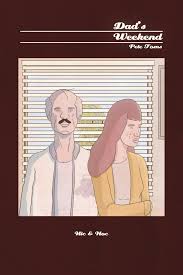
Dad's Weekend, by Pete Toms. This is a character study that is impeccably structured. It's about a conspiracy theorist and his young adult daughter, and their attempt to reconnect over a weekend. It's a funny, slow-burning, slow-building story that is also genuinely sad. The story is mostly told from the highly sardonic point of view of his daughter Whitney, and the story starts with her friends telling hilariously detached stories about their horrible futures, including one who plans to be a "failed arthouse film director", going into great detail how he will accomplish such a thing. Whitney has her own "20 year plan" of failure which is equally funny, as she and her dad exchange quips. Then the already-strange story takes a weird turn, when Manny (the dad) finds out that a friend of his is missing. This leads to a hilarious but unsettling series of events where he talks to his wife, detects something off about her and then throws a hot drink in her face.

Essentially, he was so deep in conspiracy theory decoding that he had altered his own perceptions, or rather lived in a world where what was coincidence or a trick of the ey. e became proof that his friend's wife was a lizard person. When he was found dead ("he ran himself over in a parking lot"), Manny attends the funeral and screams "This funeral is a false flag!" Eventually, he reveals the source of his paranoia: the existence of his daughter. When he saw what he perceived as the sheer terror of being alive in her eyes as an infant, it drove him from being a person who saw meaning in nothing to someone who desperately yearned to find the secret meaning of everything. It's classic conspiracy thinking, in that it's better to believe that some horrible force is in control of the world (and hence your life) than to believe that nothing and no one is control, and that everything is random and chaotic. Toms is playful at times with regard to the reality of the situation (especially in the last panel of the story), but the reality is less important than that conspiracy theorist's state of mind. The paradox is that "awareness" of the conspiracy induces a kind of debilitating madness that's exactly what They would want for you anyway. Visually, the comic has an odd flatness to it. It looks like it was drawn on a computer, and it relies on color fills quite a bit to tell the story. The strange visual tone of the comic is a perfect match for the flatness of affect of both of the main characters, who both deflect the sad reality of their situations by denying it in some way

Monday, November 12, 2012

Sequart Reprints: Sparkplug Comic Books

This article was originally published at sequart.com in 2006. Please note that Dylan Williams passed away in 2011.
**************
A welcome trend in the comics world in recent years is the rise of the boutique publisher. With modest publishing goals and realistic release schedules, a small publisher can carve out a nice niche for their artists. One of my favorite publishers of this nature has been Sparkplug Comic Books, headed by Dylan Williams. Williams is himself an artist, having self-published several issues of the intriguing crime comic Reporter. Williams has said that he's looking to publish artists who have been overlooked and whose work is focused on storytelling. That's still a pretty wide net, and there are definitely some artists he has published who certainly push the envelope of what one might consider to be a standard narrative.

Jeff Levine's comics are observational studies of daily life, while John Hankiewicz's work is often abstruse and mysterious. On the other hand, Williams also gleefully publishes comics that are much more lighthearted, like Eric Haven's Tales To Demolish (a tribute of sorts to trashy 60's comics and monster movies) and Matter (Phillip Barrett's trippy and hilarious quasi-science-fiction stories). I've already discussed the delightful Asiaddict by Mats!? in my article on travel comics, but I'm pleased to report that there's isn't a stinker in the bunch of comics that Williams has published this year. Furthermore, there are a couple of legitimately great books: Hankiewicz's Asthma collection and minicomics maven Trevor Alixopolous' graphic novel debut Mine Tonight. I will have more to say about those latter books in future articles, but I wanted to use this space to discuss the other recent books from Sparkplug.


Jeff LeVine's Watching Days Become Years is an apt series title. The most recent issue (#3) is a continuation of the sort of thing LeVine does so well: sketching striking images from his everyday life and juxtaposing them against fragmented thoughts. The narrative here is the story of one man's life as he muses about what he's doing, where he's going and what it all means. Sometimes his thoughts are straightforward recollections of his days, wherein he simply draws interesting things that he saw and relates small anecdotes. On other occasions, LeVine becomes more abstract and poetic. There's one great panel where we see a drawing of a large, unmade bed with the caption "She was made of maybes." No further exploration of this point was made, but the melancholy and longing that LeVine feels is almost visceral. LeVine also struggles with the desire to stay inside all day and enjoy art, music and books and trying to connect with the outside world.

Ultimately, what makes this a surprisingly intense experience is that LeVine doesn't hold back. He relates a fantasy of strangling a neighbor with her own wind chimes and talks about his frustrations with women. At the end of the issue, he talks about days rushing by quickly as we see an image of a hand hoisting a beer: "Only now, one begins to understand just how fast a lifetime can go." This comic is contemplative and unassuming, reminding me a bit of John Porcellino's work in terms of its narrative content but with the immediacy of a sketchbook.

As quiet as LeVine's comic is, Tales To Demolish #3 is loud and lurid. Published in full color, the cover shows a superhero battling a reptilian creature over a pool of lava, with a half-naked girl in distress nearby. Eric Haven somehow manages to get across the fun of campy, pulpy comics and movies while at the same time telling his stories with a straight face. The first story "Mammalogy", depicts the struggle between mammal and reptile. We see an early mammal elude a reptilian predator and then later eat the eggs of its young. The story then cuts to an average schlub making an egg sandwich. The scene then shifts to a superhero (The Mongoose) battling a reptilian humanoid about to devour an innocent woman, part of his greater mission in the secret war between humans and reptiles. She breaks the spell of the story by asking him "Are you some kind of...um...you know... uh...furvert?" Haven's ability to go back and forth between silly and pulpy, often on the same page, is what makes his comics so fun. He's not afraid to let a silly idea play itself out with serious execution. Considering an offering like "The Gunslinger", about a western hero who kills a snake by slinging his gun at it as though it were a boomerang, with spectacular results. Haven's all about Big Dumb Fun, but done with clever self-awareness. The results are perfect for a 24-page comic book.

In the hard-to-categorize department is Philip Barrett's Matter Summer Special. This mini-comic formatted comic looks like an old-style Archie digest. The content is altogether different. The best way to describe the high concept of this comic is Half-Baked meets Primer by way of Ed The Happy Clown. Two guys sitting around getting high (one of whom, Whitey White, is depicted as almost completely blank and devoid of detail) get mixed up with experimental weed that somehow opens a door into another dimension. What's great about the story is that Barrett manages to breathe life into what very easily could be two-dimensional characters. Like Tales To Demolish, it's a fun, unpretentious and loopy story that is effective on its own terms.

One thing I like about all three of these comics is that Williams is dedicated to actually publishing comic books, not just graphic novels or collections. The comic book still has a throwaway, ephemeral quality that is part of its charm, and the comics I discuss here exemplify that trait nicely. They traverse a number of comics traditions: weird 4-color adventure, trippy underground escapades and quiet, personal ruminations. These comics nicely balance the longer and more complex books that Williams also publishes and show that while there's a certain feel that Sparkplug comics have, it's difficult to pin down.

Friday, September 4, 2009

Three From Buenaventura: I Want You #1, Injury #3, The Aviatrix #1

Rob reviews the upcoming three-pack of single issues from Buenaventura Press. Included are I WANT YOU #1 by Lisa Hanawalt; INJURY #3 by Ted May, Mike Reddy, & Jeff Wilson; and THE AVIATRIX #1, by Eric Haven.

As I've noted in other columns, Buenaventura Press has found a clever way around Diamond's more demanding minimum order mandate that has led to several cancellations of well-regarded alt-comics series. By bundling the publication of three single-issue comics into one package, Buenaventura was able to raise both price point and ordering interest, given that a fan of one of these comics was likely to be a fan of the other two as well. It's great news for the comics community, given that all three of the comics in the bundle are best-of-the-year candidates.

Let's start with Eric Haven's THE AVIATRIX #1. Haven's TALES TO DEMOLISH series with Sparkplug highlighted his impeccable sense of absurdity and merged it with a fondness for Kirby/Ditko era monster comics. In the tradition of Lewis Trondheim, Haven tells a straightforward adventure story filled with ridiculous concepts, trappings and asides. His nameless protagonist (a stand-in for the artist) is a wonderfully blank canvas, attempting to negotiate situations that soon spin out of his control. After insulting an anteater at a zoo, he is horrified to find the beast attack him and suck out his brains. On a date with a 6-inch high woman dressed in some sort of jungle queen outfit, he suffers extreme gastrointestinal distress (which nearly kills her due to the odor) and leaves. He isn't worried because he's wearing a tie, which was supposed to bestow some sort of immunity that he kept repeating up to and including the time he is eaten by a shark.

Haven eschews any sort of explanatory exposition, knowing better than to overwrite his gags. He lets the images speak for themselves, and his steady refinement as an artist has only served to add even more of a deadpan quality to his pages. That was certainly highlighted in "Confluence", the long story that featured the comic's title character. This is Haven's best story, highlighted by the many wordless panels at the beginning that make it feel like an ambling, quotidian autobio story of some kind. Our protagonist looks at porn on his computer (his drawing board noticeably unused), drinks a beer, gets high and then takes a walk around his neighborhood in four slowly-paced pages. Only a bizarre panel of him popping up on some sort of sci-fi device on the second page of the story gives any indication that something odd is going on here.

The protagonist then sees a mountainous monster and a World War I style biplane engage in battle, as he is saved by the Aviatrix. In a hilariously impassive series of pages, she rescues him from being stomped, leaps onto the beast and finds a convoluted way to kill it--complete with heroically expository dialogue. When he asks her who she is, she flashes back in her mind's eye to her "Secret Origins", a ridiculous story of invisible avian beasts taking away her parents and secrets revealed by a weird mountain mentor on how to fight them. A scene where she told an over-eager government agent keen to gain access to the secrets of her craft to "suck my dick" speaks to the way Haven builds up one set of expectations in the reader and then gleefully bludgeons them. Haven wrapped up the issue in roughly the same way he began it: with a bathroom emergency and a longing for love. When we realize the Aviatrix has been spying on him all along, it adds an amusing level of creepiness to the whole story.

Haven's art is genuinely thrilling and his character design enormously clever--especially the monsters, of course. The Aviatrix's goggles give her a marvelously inscrutable expression; Haven is careful to never show the reader her eyes without them, even in the account of her origin. All that we know about her came from the out-of-nowhere narrative captions that told us of her motivations, and which promptly disappeared as that story ended. There's a rock-solid structure to this very silly comic, one that allows the artist to insert awkward pauses, weird images and explosions from the id without it becoming incomprehensible or self-indulgent. Haven's comics have always seemed to me to be about repression and the way that repressed desires inevitably surface. There's a flatness of affect to be found in his characters, even in the weirdest of situations, that speaks to a total disconnect between consciousness and repressed needs. That played out with the weird voyeurism of the Aviatrix countering her bad-ass persona, and the protagonist's ongoing battles with his own digestive system whenever potential romance reared its head. It's exciting to see Haven's chops catch up with his ambition as an absurdist; like Michael Kupperman, being able to draw something blandly but precisely only helps to heighten the humor of a deadpan story.

All three of these comics are funny in their own way, with Lisa Hanawalt's I WANT YOU #1 spotlighting a similar sense of absurdity, this time fused with autobio anecdotes and a touch of the grotesque. Hanawalt follows Laura Park as an artist who came from seemingly out of the blue to become an artist everyone was talking about. This comic felt like a mix between Lauren Weinstein, Renee French and Phoebe Gloeckner, yet that only scratches the surface of the compelling weirdness found between its covers. This comic is a loosely-related collection of personal hygiene anecdotes, bodily fluids, anthropomorphic animals (drawn in disturbingly exact detail), raunchy sex talk and off-the-wall concepts. The absurdity reminds me a bit of early Weinstein, especially the first page where Hanawalt rattles off lists of things like "Things I Should Probably Hide Before A Date Comes Over For The First Time" and "What Did We See Today". That page encapsulated the issue as a whole: dada observations, gross anatomical drawings (in the tradition of French and Gloeckner), and frank but decidedly unerotic sex talk.

That strip acts as a table of contents and answer key of sorts for the rest of the issue, as Hanawalt veers from a laundry list of "Mistakes We Made At The Grocery Store" (including "We were too sexual when we checked our eggs for cracks") to a story about sex bugs inhabiting her keyboard at work. In highly naturalistic detail, we see a cute little sex bug ejaculate on her face, setting off a chain of events both disgusting and hilarious. What I liked about this piece is how low-key it was drawn, despite the subject matter. The flatness of affect of the characters made the various bodily fluids spewed all the more shocking. Hanawalt purposely avoided using funny drawings or grotesque figures, which heightened the eventual punchline.

In some of the strips, Hanawalt the artist drives the humor. In "Love Letter", "Lunch Break" and "I Love She-Moose", the heads of her anthropomorphic animals are drawn so much like animals that they are unsettling to look at. There's no cuteness to be found in those stories (despite the trappings of same), only a weird sort of neurotic energy. That's heightened by the intense detail of the backgrounds--finely rendered patterns in wallpaper and carpets, checkerboard patterns in clothing, and tons of cleanly rendered bric-a-brac. With the reader already disoriented, Hanawalt drops the hammer with She-Moose getting her "scent" across a computer screen, He-Horse's losing his nerve and his erection, and the moose and cat getting their minds blown by irrational numbers.

In other strips, Hanawalt the conceptual gag writer is dominant. Her laundry list comics start from great concepts (like "Common Dirty Talk And The Questions It Raises") and go in some truly deranged directions ("8. I want to be your little slut. Q: How little?"). "Top Causes Of Freeway Accidents" all somehow involve horses, including "Pretending to be a horse". "Menstrual Terminology" is ruthless in the detail it immediately goes into regarding tampon use, including "Bento Box: inserting tampon while traveling by car or train" and "The Death Valley Stuffer: Trying to insert applicator-less tampon into dry orifice"--complete with the skull of a buffalo. Hanawalt is quite aware of what she's doing here, ending this strip with a list of ways people use to avoid hearing about menstrual terminology. "The Faux Jack-Off" is "a thing you can do while driving" that warns the reader to be careful not to think sexy thoughts while doing it, lest they actually jack-off while driving. Why someone would want to do this in the first place is a question that is not considered.

This comic has a relentless quality reminiscent of the first time I read Ivan Brunetti's SCHIZO. On page after page, there's an assault straight from the artist's id. In that respect, it doesn't seem like Hanawalt is out to shock readers deliberately, but that these are simply the topics she finds funny. Despite the unflinching nature of I WANT YOU, there's also a sense of restraint as well. The blandness of some images play off of the outrageousness of the concepts, while the funny drawings all have an unnerving quality to them. Hanawalt instantly became one of my favorite humorists after reading this comic, and I can't wait to see what's next from her.

I've long been a fan of Ted May's anthology comic INJURY, especially the ways in which he works with collaborators. My favorite ongoing feature in the comic may be Jeff Wilson's 80s high school metal saga. It strikes a chord initially because I went to high school during this era and knew lots of kids like those featured in the story. The way May & Wilson depict overwrought teen emotions is both hilarious and true to life, giving these stories a self-inflated but epic sense of importance for the principal members. This issue featured young Jeff going through in-school suspension (an especially humiliating process) after tussling with a brutal bully. As always, May excels at fight scenes both visceral and comic, and he expertly captures the sense of excitement and malaise of their fellow students when the fight spills into a classroom. The scene where his eager counselor gets him to come up with a list of three things he felt thankful for, and that the exercise not only helped with his depression but proved to be a useful resource throughout his life, was funny for a different reason. It was almost heartbreaking to see a teen try to come up with the cognitive and emotional tools needed to recognize depression, and while his answers "metal, squid, Sagan" were those of a juvenile, they also proved to be keys to unlocking his imagination. The extended fantasy sequence he has with Carl Sagan telling him about the potential for glorious heavy metal played by squid creatures on other worlds was a sweet one, helping his hopes trump his fears.

The other major story of the issue was written and laid out by May, but drawn by illustrator Mike Reddy. He hasn't done a lot of comics (mostly doing art for CD releases), but he reminds me a bit of Kaz Strzepek in terms of his character design (especially the eyes). The "Beast Biplane" is a typically ridiculous May character--a furry Bigfoot character known for his skywriting prowess from his souped-up biplane. (What are the odds of two biplane-related comics from the same publisher at the same time?) May just keeps upping the deadpan weirdness factor of this story as it proceeds, mixing up the titular hero with aggressive drag queen drug pushers forming a human pyramid, hippies selling hemp-based soap products, and turning his biplane into a giant bat. It's a hilarious bit of nonsense, and the greyscaling that Reddy uses adds to the overall density of the strip.

What these three comics share in common is a total commitment to concept. That deadpan nature, where the author never winks at the reader so to tell them that it's all a joke, is a crucial element to the success of all three comics. The reader is never told when to laugh in any sort of obvious way, in part because each comic is meant to work on multiple levels. All three of these comics are also very much from the id. Sex, an obsession with bodily functions, food and simple desire drive the characters in every story--and in a more direct way than most stories. These are all incredibly dense comics, inviting multiple readings and perusals of art. Hopefully all three books will find audiences, but there's no doubt that Alvin Buenaventura's strategy in this regard was enormously clever.