Showing posts with label dean sudarsky. Show all posts

Sunday, December 17, 2023

45 Days Of CCS, #17: Mannie Murphy and Dean Sudarsky

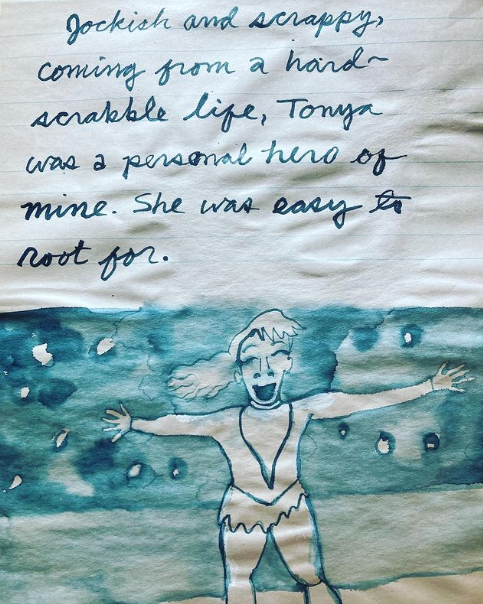
Mannie Murphy's impassioned tour through the seedier and racist aspects of their hometown Portland in I Never Promised You A Rose Garden became one of my favorite books. Of course, that book had its origins as minicomics first, and they've released a sixth chapter as a follow-up: The Tonya Issue. In the same style as in their book, Murphy's watercolor technique is presented here in grayscale, and the lined paper they drew on gives this the feeling of a high school student goofing off from their real assignment in order to write about the things that mattered. The issue indulges in Murphy's childhood obsession with disgraced figure skater (and Portland native) Tonya Harding, a figure that in the early 90s drew an astounding media frenzy after her skating rival Nancy Kerrigan was injured in an attack staged by Harding's abusive boyfriend. However, no matter how avid a fan she was, Murphy's clear-headed and even judgment regarding the facts of the matter are what add even greater depth to the story.


The story is so familiar that Murphy doesn't even bother introducing Kerrigan with her full name, referring to her simply as "Nancy." Like the other stories Murphy tells in this narrative, it's one with a great deal of personal meaning to them. Murphy reveals their obsession with figure skating as a child, and the sport was never more dramatic (not more beset by racism and classism) than it was then. Murphy recalls trying to get Harding's autograph at an art show featuring portraits of her, only to be denied. Murphy called it a tragic fall from grace from a figure who in many ways, never really had a chance. Much of this series is about detailing the cultural touchstones and figures that Portland got to call its own, and Murphy's reference to the Portland Trail Blazers NBA team makes me wish they'd tackle that topic next. 


Published by the excellent Entropy Editions, Dean Sudarsky's 65 Bugs is reminiscent of early Michael DeForge comics. This is a series of titled comic strips, most of which are three panels, following the lives of anthropomorphic insects. The way Sudarsky draws their bodies with human anatomy twisted into insectoid poses (most similar to a praying mantis or cricket) is genuinely unnerving, and his treating their speech completely within the context of what the insects would actually do is a stroke of genius. My favorite strip was "Crab," where we see an anthropomorphic crab (complete with oversized hands in place of claws) amused by a tiny insect until a bird picks it up and carries it off, with the crab helplessly yelling "Face me!" to its avian captor. The strips are about mating, trying to avoid mating or thinking about mating, devouring, being devoured, and even trying to seek out a few moments of peace. Sudarsky's line is fine and delicate as he carefully renders each figure with great clarity, emphasizing the expressive nature of each insect's faces as well as their twisted body language. 

Monday, December 11, 2017

Thirty Days of CCS #11: Dakota McFadzean, Dean Sudarsky, Mitra Farmand


That Was Awkward 1-2, by Mitra Farmand. Farmand draws funny, four-panel strips featuring little thumb-shaped characters. That said, it's amazing to see what she can accomplish with such simple shapes, especially in terms of both humor and expressiveness. Seeing one with a pony tail is an inherently funny sight, for example. That said, the strips are funny because of Farmand's wit and sense of timing. Farmand turns her attention toward awkward social interactions on herself (with a fourth panel that says "I DID THIS") as much as she does others ("THIS HAPPENED"). Farmand is especially sharp when doing strips about relationships and dating, racism, workplace drama and aging. She'll occasionally dip into full color experiments that work quite nicely with the ultra-simple figures. Despite the sense of formula from strip to strip, Farmand keeps the audience off balance because the punchline panel can vary from anywhere from the second to the last panel, with either the text noted above to fill out space and emphasize the joke, or else a silent beat panel. I could have read a dozen more issues of this.

Untitled (Last Mountain #4), by Dakota McFadzean. This nerve-wracking, silent story about capitalism and advertising gone horribly awry gets its message across with a number of suspenseful 24-panel pages. It's the story of a young girl who's eating her typical morning sugary cereal with a nauseatingly cute mascot on its box. When it comes to life with its incessant smile on its face, it's unnerving but still interesting to the girl, until the bear wants to play hide-and-seek and its eyes appear on its hands. Not only are its eyes now blank, but dozens of tiny bears can be seen spilling out like maggots. What's real and what's an illusion are questions she's constantly asking herself, as the bears disappear and later come back to haunt her at night, as they've invaded the world and (worse) her mother. There's a nasty image of the girl stabbing her mom in the yes with scissors, only to be met with that unrelenting leer. The girl eventually triumphs, and years pass.

A guy comes into the cafe where she's a barista, and he's wearing a t-shirt with that image. Horrified, she asks about it, and he shows her a video of the bear being back in full-force...and there's a creepy set of panels where we see a close-up of his face, and the image of a bear forming as a kind of boil. In the way that time passes differently as an adult, so are these panels 2x3. It turns out she had kept the evil cereal box in a safe for a number of years, and when she opens it up again, she wishes her present away, and winds up being trapped in the past with the monster, forever eating bowls of cereal. She's sacrificed herself to a past of boredom, cavities and the annoying, invasive and omnipresent nature of advertising. McFadzean's control of his line is superb as he crams so many drawings onto single pages and loses no readability in doing so.

Hyperlydian, by Dean Sudarsky. This is a series of strange aphorisms in the form of letters between the unseen Darla and Ronald. Ronald begins the dialogue with a bunch of statements about ends, means, babies and respect, and the line is deceptively plain, especially with the off-putting font that he uses. Everything about this comic is off-putting, strange and yet familiar by way of deja vu. Darla tells him things like "You are as hostile to grace as rhythm to the future" and urges him not to dance again, with drawings of anthropmorphic notes rushing toward a puddle soaking in musical notes. These letters are interspersed with strange images, jokes, violent scenes that have nothing to do with the epistolary narrative, and these climax in a nail desperately trying to not get hammered, to no avail. There's something beautifully liquid about both text and images that swept me along quickly; I often had to stop myself to retrace my steps and really take in each page. This is a comic in the immersive tradition, filled with poetic passages and images, and it's worth many readings.

Thursday, November 26, 2015

Thirty Days of CCS #26: Dean Sudarsky

Dean Sudarsky will be graduating from CCS in 2016 and has tried a number of different ways to express himself through comics. Side A: Work Dance/Side B: Sinkhole sees him experimenting with comics-as-poetry. "Work Dance", drawn in a scratchy, angular and open style not unlike Sophie Yanow, ritualizes the act of getting ready to go to work, with the text being both suspicious of "work" in the context of a societal whole and grateful for work done on a personal level. "Sinkhole" is a denser, darker story that addresses the mind/body split, with every facial expression a rictus of agony. The image of the body being so pressurized that it's practically liquid is a vivid one, with clever lines like "I'm just so ambitious! I won't stop 'til I secrete success" getting at that sense of being pushed and pulled. Sudarsky's line is thicker and his use of zip-a-tone and other effects helps create that oppressive atmosphere.

Sudarsky submitted some short and incomplete work as well. One of my favorites was about a rock band called The Bureau started by agent 3181 of some government agency in order to infiltrate the underground music scene. While they were a failure, their music got sent back in time to 1979 and became highly influential, so by the time the band was formed, they suddenly became popular. The art is a mix between Yanow and Tom Kaczynski, with Sudarsky's own biting sense of humor. "The Dysfunctionals" is a single page strip done in the style of a Sunday old-school drama/romance comic, in full color. Sudarsky goes to town on using the formal elements of the strip for humorous purposes, like the middle column being variations on the same tearful pose, distorted body positions and absurd situations. It subverts romance comic tropes with modern relationship politics. "Song Of The Left Hand" seems to be a sort of tribute to Jim Woodring's "What The Left Hand Did": surreal autobio that incorporates Sudarsky's interest in using background text as a way of commenting on the story as a sort of Greek chorus. Here, the "left hand" is essentially the invisible hand of fate, pushing Sudarsky to and fro with regard to where he goes, whom he meets and what he cares about, illustrating the ways in which he feels like he's drifting through life. Offered a doomsday weapon that allows him to wipe out his own world, he eventually pushes it while imagining this fantasy person he's singing to in the background urging him out. It's a clever strip that combines despair, loneliness and that sense of drifting that comes with being depressed, drawn with a combination of his angular style and a more naturalistic style.

His comic Lachrymator is a collection of brief, mean, political, funny and often existential strips, mostly drawn in a flat and naturalistic style that again owes a lot to old comics pages. "Dawn Of The Red Sun" sees a downtrodden Superman buying fair-trade chips as a way of being "a considerate and well-informed citizen", only to be foiled by a kid wearing a propeller beanie who says "There's no such thing as ethical consumerism under late capitalism". The strips are somewhere between the nihilism of Ivan Brunetti's early work, David Rees' pointed and scorched-earth political commentary, and Evan Dorkin's blunt and frequently visceral sense of humor. His nameless art commentary comic featuring horses committing acts of violence is profane and rough much like a western, but it gets at the heart of why creating is not about a pose or being liked, but rather is about expressing truth and experiencing the joy of creation. Finally, Murderworld Comix was my favorite of Sudarsky's work in this batch. A series of interconnected strips, it starts off with the President declaring all crime to be legal, which created a field day of murder. He zips between genres in each of the strips, hilariously and viscerally satirizing both genre and culture in a Hobbesian nightmare. Sudarsky is a smart, promising cartoonist who has a lot to say and the tools with which to succeed no matter what direction he chooses.