Showing posts with label brendan leach. Show all posts

Monday, May 13, 2024

CRAM, Part 4: CRAM #3

CRAM #3 has one of the funniest covers I've ever seen for an anthology. In an image that encompasses both front and back covers, artist Laura Lannes (her work is missed!) has a fairly familiar image on the right-hand (front) side: a young woman, lying down, reading a comic. It's something out of NON from some years ago. However, a closer look reveals that the image is...odd. Her legs are up in the air and there's a random hand on her left thigh. Opening the whole thing up reveals that someone is going down on her while the cover woman's attention is on the comic. It's a solid gag. 


There's the usual array of vastly different styles on display here, Alexander doesn't have any art in this issue, which isn't surprising, considering how hard putting together an anthology is. Angela Fanche opens up the issue on the inside front cover with a short comic; it's a good space for this kind of tightly-compacted storytelling. Her style continues to evolve, going from more basic diary comics to this slightly fantastical anecdote about a memory that acts as a song stuck in her head. She plays on this metaphor until it transforms into music and nearly suffocates her partner. Fanche's drawing is so delightfully scratchy and spare in some panels, and then she swoops in with big swathes of black patterns in others. It's a fascinating strip to attempt to decode. 


Steve Grove's "Potboilers" is done in the sort of unfussy, slightly cartoony naturalism that I see in a lot of comics these days. It's the kind of story where the characters have one narrative, but there's another narrative at play with the visuals and backgrounds, in particular. The premise of the story is that there's an agency that will send someone over to boil water for you so when you arrive back home, you have a boiling pot of water ready to go for cooking. While this is an absurd and funny idea, the premise is far less interesting than the interplay between the employees. The strident Peggy, trying to make a sale over the phone, has to deal with the distraction of boil specialist Bumphus' failure out in the field. She loses the sale, he goes off the deep end, and she does a "reset" by looking at violent imagery on the internet and then fantasizing about him being killed in a variety of ways. All around them, the house they're working out of is mysteriously dilapidated, and the final scene sees Bumphus on the sidewalk, slumped over after he's clearly slit his wrists with a broken bottle. Everything about this story is off-kilter and anxious in a way that requires multiple readings to absorb its nuances. 


Audra Stang's short comic features a couple of her "Star Valley" characters cozily watching a fantasy show of some kind. In pages with a 20-panel grid, Stang offers pieces of the show with no dialogue, creating a sort of bubble of fascination for the duo that's broken when a commercial comes on and they make a crude joke about it. Stang has an uncanny sense of recreating that sense of mundane magic felt at that age when two friends can share a common obsession together; it's a sort of ritual that still lets them be teens. 


Jack Lloyd's cartoony "Pickles" fantasy story reminds me a lot of Vaughn Bode's stuff, down to the color scheme and eccentric character design. It also has a touch of futuristic urban stories that touch on graffitti as a cornerstone aesthetic. It's one of many stories in the anthology where that aesthetic is more important than the actual narrative. Michelle Kwon's "Autobio" is another such story and self-consciously so. She starts off by declaring that she's tired of drawing herself and so chooses to draw herself as a sort of cute anthropomorphic animal. This is after she turns down other potential character designs, as though she's building a character in a video game. The comic itself is all about treasuring memories on her travels despite her anxiety about the future, and the cute characters turn what is otherwise a routine diary comic into something that's fun to look at visually. 


Steven Christie's "Punchline Sinker" might be my favorite story in this issue. It's a sci-fi story abot a young woman named Zander who recalls her first job, which was a fulfillment center in a satellite orbiting Earth. She worked the job with her friend Peanut, and at first the story seems like a pleasant bit of slice-of-life fiction. She announces to Peanut that she's going to quit in order to get married at precisely the same time Peanut's girlfriend breaks up with her. This leads Peanut to snap as she comes up with a theory: whenever something goes well for one of them, something bad happens to the other. This leads to a surprising and clever turn of events, which turns the story from slice-of-life to a tense action story. Christie uses a classic 9-panel grid to create a particular tempo, and then stays with it as the tension ramps up, but the reader (and protagonist) are unclear on where this is all going. Christie's thin line and limited pallette all help play into this aesthetic repetition. 


After the first half of the issue was mostly conventional narrative, Alexander returned to the weird stuff in the second half. Nicole Rodrigues' "We Hold On To Things" is a colorful bit of comics poetry, using an open page layout and a narrative mostly told in captions that illustrate the feelings of the narrator. She's depicted as a monarch in her own mind, even as she has to fend off her own destructive feelings. The textual meter sets the pacing in this comic, as opposed to a truly integrative approach between word and image. Grayson Bear's "Relatable Richard" is a lampoon of diary comics, featuring a lisping protagonist who sets off on a date, only to slip on a banana peel, fall down a mountain, and get sliced to pieces. The Riso colors are all jacked up to neon levels in four pages of pain hilariously piled on its protagonist. 


After non-traditional-narratives, Sam Sharpe offers "Annie and Alex at the Heartland Cafe." It's one of those narratives that appears to be one thing at first, then quickly becomes something else. A waiter is having a normal day at his job until a man and woman dine at a table outside. It quickly becomes apparent that he's autistic and she's his aide, taking him out for a meal. However, he's disregulated, which manifests as shouting, then throwing his food on the ground, and then eventually punching his aide in the face. All of this is being seen from the waiter's point of view, who is at a loss at what to do, until the aide tells him pointedly: "Don't get involved and do not touch him!" She calms him down, they pay, and then leave. What makes the story interesting is that the waiter can't let this go, and when he sees the woman at the train station, he expresses his remorse for not doing anything. She reminds him that it had nothing to do with him--all of his machismo, all of his need to be a main character (so to speak), was irrelevant. Sharpe's cartooning is top notch as always, blending a slightly cartooning quality into what is otherwise naturalistic work. 


The anthology ends with a trio of stories that are more about sensory impressions than story. "Rangers," by Ethan Means & Ashton Carless, is a gritty black & white war story that may be in some kind of post-apocalyptic setting. A group of soldiers (or prisoners?) sets out to tag things with bright yellow happy faces, until they try and head back. Brendan Leach (a welcome presence!) offers up "Storm and Stress," about a violenist who sees one of her colleagues menaced by a guy on a subway car, but she winds up looking away despite her colleague's pleading eyes. The bright splashes of color contrasted with the black & white images of her anxiety lead to a loose, free-floating sense of guilt and despair. Finally, Aidan Fitzgerald's "Contestants" uses deliberately crude, 8-bit digitally-created color images of contestants in some bizarre game show. The game is about slowly rising while recounting a memory, with that memory being judged by a panel. Fitzgerald is riffing on the public distillation of memory and identity (on social media, presumably) but doing it in a way that doesn't repeat the obvious downsides to social media participation. 

Alexander seems determined to never do the same issue twice, and the result is an anthology that's greater than the sum of its parts. The pieces by Bear, Rodrigues, Means/Carless are somewhat slight on their own, but they make a great deal of sense within the context of the issue. Alexander is adept at pairing more conventional (if odd!) narratives with more experimental pieces, resulting in an anthology that's challenging at points but also entirely readable. 

Thursday, September 8, 2016

Secret Acres: Reid Psaltis, Brendan Leach

The Order of Things, by Reid Psaltis. The Secret Acres publishers, Leon Avelino and Barry Matthews, have as quirky an aesthetic as any publishers I know. Their tastes are unusual but wide-ranging, making it impossible to pin down an overall Secret Acres aesthetic the way one can with say, Drawn & Quarterly or NoBrow. Take the new book from Reid Psaltis, for example. It's a non-narrative set of drawings of animals and dinosaurs that at first is painstakingly accurate in terms of the drawings and then eventually devolves into wordplay and total silliness. I can't think of a single comparison in the SA family as an access point, and that's what makes the publisher so unpredictable. There's a drawing of a Bald Eagle talon that's as good a scientific illustration as you will ever see. The stippling and overall detail is remarkable. The text describing it is a joke at the expense of the Founding Fathers. Other illustrations are gorgeous, almost impressionist water-colors of animals like the Pronghorn, and there's no amusing commentary at all.

Psaltis mixing things up keeps the reader off-balance in that regard, as one never knows what's coming next. The commentary gets stranger and funnier as the book goes on, like the remarkable drawing of the Great Horned Owl where its bones are arranged to form the shape of the animal, with only its piercing eyes appearing as per normal. The only comment is "Nightmare fuel for all species of rodents." As Psaltis leaves behind modern animals and starts to draw dinosaurs, things start to get really silly. Dilophosaurus is depicted eating "spicy, brothy, sauropad soup" (i.e., pho). Dinosaurs are dressed as X-Files characters, Star Trek characters, Game of Thrones characters, etc., with the most tenuous of puns stretched out to create gags. What's remarkable is that his skill as a cartoonist drawing funny images is just as sharp as his skill drawing scientific illustrations, and that's what makes the jokes work (because the wordplay is groaner-worthy). This is an odd duck of a book, ideal for someone less interested in comics and more interested in funny illustrations.


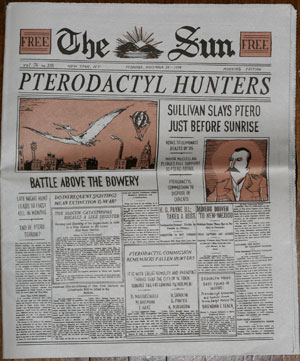
Pterodactyl Hunters In The Gilded City, by Brendan Leach. Leach first sent this, his masters thesis at the School of Visual Arts, out as a broadsheet on cheap paper, as it was meant to resemble a typical newspaper in the early 20th century. It was soon picked up by Top Shelf, went out of print, and is now being published by Secret Acres. This ambitious first work retains its status as an art object by way of cheap, mass-produced methods in the way the book was printed at a large size and the way it reproduced its original cover as the first page of the book. That fake newspaper cover is all part of its reimagining of New York City if it had been terrorized by pterodactyls.  This book is all about the end of an era and how young people coming of age during that time don’t want it to end–no matter how horrible it actually is.

The book follows two brothers, Eamon and Declan Sullivan, who both work on the pterodactyl patrol.  No explanation as to why these dinosaurs are still alive and how they came to menace the city was given, nor was one really necessary.  The only important bit of information that we were given was that the dinosaurs had been hunted almost to extinction, due in no small part to the heroic efforts of the arrogant and off-putting Eamon.  Declan, his younger brother, toiled in his shadow as a watchman, hoping that he’d somehow get a shot at glory before the monsters were all dead.
Leach turned what could have been a cheap gimmick into a genuinely affecting story.  He drew his visual inspiration from sources few young artists seem inspired by these days: David Mazzucchelli (his thesis advisor), Ben Katchor and Eddie Campbell.  From Mazzucchelli, he seemed inspired by his Rubber Blanket-era stories, especially in terms of how he used pauses and stillness to tell the story.  Leach’s scribbly line is not unlike Campbell’s, especially when he used a skeletal line to depict quick motion in a single panel.  Katchor obviously inspired Leach’s development of the alternate history of New York from a bygone era.  In addition to using the same kind of evocative gray-scaling that Katchor employs, there’s also the same level of attention to detail.
While there is a remarkable amount of detail, what makes this comic such a success is Leach’s restraint as an artist.  He’s subtle in evoking the changes that would grip a city afflicted with this particular kind of terror, like merchants hurriedly closing up shop before sundown (hunting time for the pterodactyls) and particular ethnic groups clustering to the industry that sprang up to kill the monsters.  Leach lets the reader read between the lines of what’s motivating Declan, for the most part; he has a character reveal a plot detail late in the comic that explicitly spells out his motivations, which I thought was unnecessary.
The ending of the book is spectacular, as Declan is on the verge of killing the last pterodactyl, an act that would simultaneously fulfill his life’s goal of becoming a hunter and completely nullify that goal by making his dream obsolete.  The “Gilded City” subtitle is a telling one, as the book is set a few years after the world-weary “Gilded Age” in US history, an era of tedious decadence and little heroism.  "Gilded" also gets at the "golden age" angle of the story; it's an era of horrors for the populace at large, but a golden age for heroes and heroism. Killing the pterodactyl, Declan believed, would end that age of heroism, something he had always wanted to be a part of.  Leach is careful not to glamorize this in a couple of different ways.  First, the pterodactyls are killers and especially enjoy preying on children (no doubt because they’re easy targets).  At the same time, the dinosaurs are living beings with mates and nests; killing them is not a vanquishing of evil, but rather the culmination of a kill-or-be-killed process. The reader was brought in at the end of an era, building tension between the genuine benefits that this end augured and the desperate, selfish desire of a young man who didn’t want it to end but knew it was wrong to wish so. 

Monday, May 5, 2014

Street Fightin' Men: Iron Bound

Brendan Leach is building up a resume of works that focus on specific urban environments in specific historical eras. Behind that urban setting lies the real theme for his comics. For example, in his first book, The Pterodactyl Hunters In The Gilded City, Leach uses a fictionalized New York around the turn of the 20th century as his backdrop. However, the story was really about a young person who desperately wants to be in on the end of an era before it comes to a close, especially because his older brother was such a key part of it. In his new book, Iron Bound (Secret Acres), Leach grounds his story in the gritty streets of New Jersey in the early 1960s, as we follow two young toughs with different goals in Eddie and Benny. As the story begins, the duo are riding a Greyhound bus back to Newark when the twitchy, angular Benny picks a fight with another passenger and winds up stabbing him to death.

There's a grimy, squalid plot involving a crooked detective and some corrupt small-time operators in Newark and Asbury Park. That plot is beside the point and acts just as a structure for Benny and Eddie to react to and be manipulated by. The real essence of the book is the relationship between Eddie and Benny and the ways in which they want to evolve. Benny is a psychopath who glamorizes the idea of being a gangster thug, but it's his inability to distinguish between fantasy and reality that make him unstable and unreliable. Eddie takes a taste of gangster life and regrets it, wishing to get out of the life, only to find that once you've eaten the forbidden fruit, it's not so easy to cross back. That first scene, though out of context for the reader, is really the scene where both men reach a crossroads in their life. Having tasted being the pawn of a manipulative gang boss, one who gave him the assignment of murder, Eddie decides he wants no more part of it. Having crossed the line into murder, Benny wants to be a player, not kept on the sidelines.

The book bobs and weaves its way through time, filling in events via flashbacks. Other characters, including sisters and love interests, are introduced to provide context and subjects of frustration. Eddie is a character who has earned the respect of others but knows that he's made a mistake he can't take back. Benny is completely incapable of owning up to his actions ("Jeez--chill out, Eddie!") and winds up nearly getting killed for his stupidity. Like a shark, he's too stupid and vicious to die. Eddie's loyalty to his friend is one of his several admirable qualities, but being loyal to a psychopathic killer is something likely to bite you in the ass, and that's precisely what happens here when it comes time for the characters to either accept or deny their roles in the scheme of things. In the end, Benny is content to be a murderous cog because it makes him feel like a big man, and Eddie isn't quite smart enough to realize that loyalty means nothing. It's a bleak ending to a bleak story, but one that rings true in every respect.

Leach brings the era to life with a scratchy, expressive line that looks like Gipi and Ben Katchor teamed up to draw a squalid tale about losers in a bygone American urban setting. The heavy use of blacks and the tastefully employed grey wash is reminiscent of Katchor, especially in the way he draws buildings and cars in a manner that feels real and authentic without going for naturalism. Benny in particular looks and acts like a Gipi character--all angles and attitude, with any semblance of an inner life left entirely opaque to the reader. If Benny is drawn like a jagged piece of glass, then Eddie is drawn all in squares--solid, dependable and even a bit slow. Their relationship is fascinating to me because the story doesn't depict it as symbiotic in any way; if anything, Bennie is a leach. His relationships with women reveal that any deviation from his desires might result in violence. Yet Eddie stands by him for no discernible reason other than history, a decision that winds up dooming him. Like in The Pterodactyl Hunters, Iron Bound is a story of two young men linked together in differing positions of power, and how those positions change by the end of the story. The tragedy of the book is that while Benny relishes flicking his switchblade into its killing mode, he really possesses no more power than he did at the beginning of the story--and in some ways, he is considerably diminished. The lesson that Eddie learned is one that Benny won't be able to process; one day, he'll just be tossed aside. The way that Leach creates a tense and exciting story without glamorizing the violence and gang lifestyle is perhaps his greatest achievement with this book.

Friday, January 25, 2013

Past and Future: Vermilyea, Cardini, Chad, Leach


Battle Burger, by Jon Vermilyea. This isn't a comic, but rather a series of illustrations of Vermilyea's violent, creepy anthropomorphic food characters done up in full gladiatorial garb. Silkscreened in full color, these drawings are funny, beautiful and disgusting--all at the same time. My favorite images include a two-page spread of a Road Warrior-inspired armored tank driven by a bloodthirsty slice of pizza and cut of meat. Even better is a monstrous doughnut, its hole encircled by sharp teeth. Vermilyea has done too few comics by my estimation, which is unfortunate because he's a big-time talent. He probably has done enough minis and anthology entries to fill up a collection by now, but as it is he's underexposed.

Vortex #3, by William Cardini. I love the increasingly abstract and artificial texture of Cardini's series, which will likely wrap up with #4. It's a fascinating take on the Mat Brinkman/Fort Thunder school of exploring a space, as the protagonist, the Miizzzard, struggles to regain coherence while traveling through a dreamspace. Using a variety of repeating patterns, zip-a-tone and other effects, and simple shapes, Cardini keeps the reader's eye moving across the page without leaving them in the dark for too long. Cleverly, he makes the artificial feel of each page part of the story itself, as the Miizzzard breaks free of the illusion to reach the final stage of his journey, which is where the issue ends. It's interesting to see a book done in the "mark-making" school of comics drawn entirely on a computer, as it heightens reader tension and makes the contents all the more alien in its coldness.

New Sludge City, by Brendan Leach. This is a tight, moody futuristic caper story by the talented, emerging Leach. Published by Retrofit Comics, Box Brown's innovative venture, it's a modest-looking comic that looks like it was shot straight from pencils with some grayscale effects. It's a deliberately ugly, low-fi look for an ugly little story about a pair of thugs who plan to use boutique body-switching technology to pull off a big score. The scuzzy underbelly of the city is highlighted by its otherwise futuristic and even utopian trappings, like cars that drive themselves and fully automated homes. Of course, the punks aren't rich and are trying to get over by getting paid for allowing rich people to inhabit their young bodies for an evening, a sort of obscene cosplay for the futuristic 1%. When it becomes evident that there's no honor among thieves, one only wonders how long the eventual triple-cross that concludes the book was actually in place. The scribbly pencils and heavy atmosphere of the piece do a lot of the narrative heavy lifting in this comic, leaving the reader only to wonder about the nature of the relationships in this comic prior to its events. In this and his earlier The Pterodactyl Hunters, Leach seems to enjoy exploring cities and societies in their decline. In the former comic, certain characters will do anything to maintain their status. In New Sludge City, certain characters will do anything to escape their societal standing.


Maser, by Jon Chad. Chad's rightly received a lot of attention for his all-ages Leo Geo series, but his genre-inflected stories sometimes go in a darker direction. This mini he was selling at SPX is a short, funny and nasty story about a social outcast scientist who perfects his maser (different from a laser--Microwaves Amplified by Stimulated Emissions of Radiation) and calls up a random co-worker in the middle of the night to talk about it. Of course, when the co-worker curses at him and later belittles him at their job, the scientist first takes drastic measures, then takes even more drastic measures in order to get what he really wanted: a chance to talk about his maser with this random co-worker. Chad's a superb draftsman and draws the horrific scenes where someone's face gets burned with an almost loving attention to detail. This one's well worth reading if you can track it down.