Showing posts with label andy lindquist. Show all posts

Friday, January 3, 2025

45 Days Of CCS, #34: Sofia Martin, Ria Garcia, Andy Lindquist


Sofia Martin's Our Days Here is a lovely, scratchily-drawn comic about a tea kettle and a coffee pot who fall in love, dreading the news that they are soon going to move from their house. Martin gives them both personality without going to a fully anthropomorphic approach, and the comic benefits from the slow, languid pacing as they are used and put away, never quite together until after the move. It's a simple comic about trying to find one's place and appreciate who you're with on a day-by-day basis. 


Andy Lindquist's No Thing is an excellent memoir comic (part of Paper Rocket's Mini Memoir Project) about being a teenager and how reading Shakespeare inadvertently led to Lindquist's self-discovery to become a trans man. What I liked about this comic was that apart from it being personal, Lindquist was careful to craft an engaging narrative that had a satisfying ending. Studying Romeo & Juliet, he learned some interesting Shakespearean slang: "thing" meant a penis, and "no thing" or "nothing" meant vagina. The revelation that "Much Ado About Nothing" meant "Much Ado About Pussy" was a hilarious realization for young Lindquist. The narrative follows pre-transition Lindquist slowly piecing together the clues that they did not feel comfortable in their AFAB body, best represented by his body falling apart when he tried to masturbate. When he gets a fake mustache as part of a school skit, that starts him down the path of "I feel something!", ending in a Mercutio and Benvolio fantasy sequence. Lindquist's cartooning is sketchy and effective, with some flights of fancy that only enhance the wish fulfillment aspects of the narrative.


Ria Garcia's HTTRNSBTCHCTY is a companion piece to last year's comic, Dark Piss. That comic used a brutally blunt and satirical text narrative and paired with an abstract visual accompaniment. It was about trans women being subjected to dehumanizing, public punishments using a pornographic lens to amplify its satire. The title of Garcia's new comic ("Hot Trans Bitch City") turns this idea on its head with Garcia's dense, colorful, cityscapes. The comic can be read forwards, backwards or sideways, and each reading offers a different experience. This is a mix of both the disorientation that trans people experience in a hostile society as well as the fluidity and possibilities that being trans provides. Once again, Garcia's ability to confront the reader with an experience that conveys both pain and possibility sets them apart from more naturalistic narratives. 


Friday, December 15, 2023

45 Days Of CCS, #15: Kit Anderson and Andy Lindquist


Kit Anderson is one of the most interesting artists to emerge from CCS in recent years, as she's been doing visually innovative and clever comics with unusual themes. Anderson's comics often focus on the relationship between memory, character, and a sense of place. Their House (a MICE mini-grant winner) is very much about this. The unnamed narrator (presumably Anderson) is describing, from memory and nothing else, the appearance of a house whose owners are unspecified, but the assumption once again is that it's her grandparents' house. This is a comic-as-diagram, an interesting subgenre that connects the concept of a descriptive map with an emotionally revealing drawing. The narrator goes room by room, describing them by memory. The most evocative rooms have smells associated with them (like the laundry room) or repeated, pleasant memories of feeling safe and loved. To indicate her own ghostly presence as a narrator, Anderson draws herself as a kid in a cartoony style in black & white, while the house itself is in vivid and varied color. There are some memories the narrator clearly attempts to ignore, while they hold others tight, such as a Parcheesi board and the kitchen she played it in. One of Anderson's great strengths is formal curiosity blended with emotional resonance, and this comic, modest as it is in its ambitions, is a perfect example of this.


Andy Lindquist's comic What You Owe And What You Own is a powerful story not just about being trans but about what it means to be gendered as a woman. Lindquist's narrative voice is assured and powerful, while their line, though mostly spare, does the job in expressing the frequently awkward and anxiety-producing situations that he found himself in prior to his transition. The comic takes a hard look at Lindquist's teenage years as a self-described "lovely young woman" who was the best soprano in school. Lindquist notes that a narrative that often forms around trans men is that of cis people mourning the loss of a beautiful girl, which Lindquist cynically describes as a "public good." This gets into not just the male gaze and being desired as an object (though that is a big part of it), but also an understanding of being an exemplar for cis women as well. Mostly though, as Lindquist explains through the many arias that involve women being objects of desire where the outcome of that desire is almost always ruin or death, he had no concept of what it formerly meant to be a woman without having to bear that constant, unrelenting burden. The thematic and decorative touches of the comic heighten its themes, with the swelling aria matching the almost inchoate rage and doubt that had plagued them. 

Thursday, December 22, 2022

31 Days Of CCS, #22: Andy Lindquist and Kit Anderson

Slipping, by Kit Anderson. Anderson has such a great knack for portraying loneliness, longing, alienation, and liminal places in a way that feels lived-in, gritty, and authentic. There's a question of the connection between reality and insanity and what exactly is real in her comics, a question that is rarely answered directly. Take Slipping, for example. This comic follows the monologue of a character (what seems like a trans man or non-binary person) as they explain the titular concept of "slipping." As relayed by their mother, it's a lack of awareness of one's surroundings that causes the Other Place to reach out and get us. Whether it's hell, oblivion, or something else is unimportant; what is clear is that it represents non-being at an ontological level. Anderson's scratchy line immerses the reader in every slow, painful moment, from stray body hair to pocked skin to slumped gestures. 

The monologue is aimed at a woman named Monday, who lived with the narrator until their neuroses (in the form of filling every empty second with sound) drove them away. Anderson imbues every quotidian moment in the comic (waking up, making breakfast, smoking a cigarette, taking a walk) with unspoken menace, as the reader is led to expect a "slip" for the narrator. When it comes, it hits especially hard because the narrator is making one, last desperate attempt to connect. The character's existential self-absorption inadvertently leads to their final, tragic fate, even as Monday is revealed to be worried about them. 


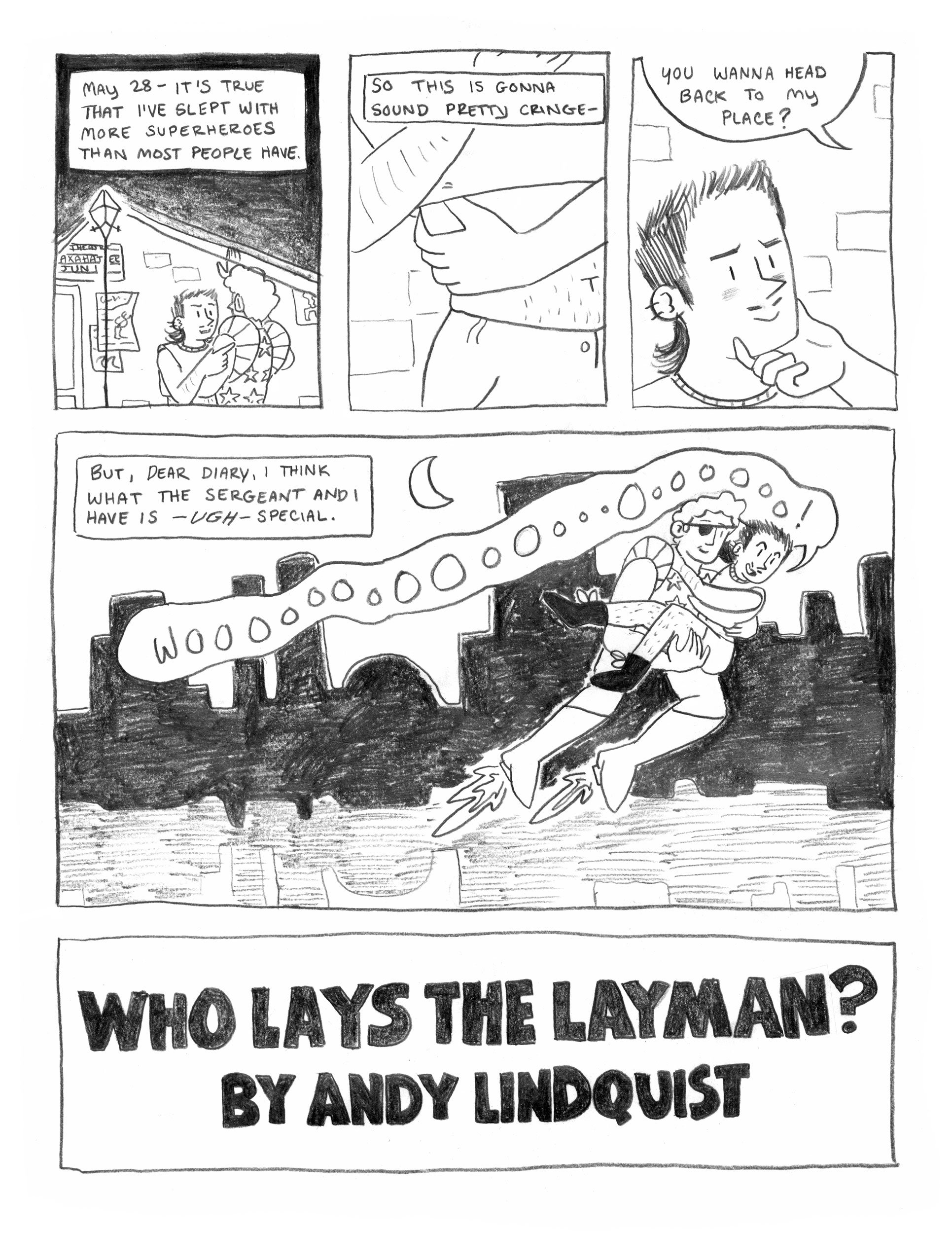
It's Going Fine and Who Lays The Layman? by Andy Lindquist. Lindquist's own takes on alienation are quite arresting. Lindquist zeroes in on character design, and it's got that slightly grotesque and distorted quality that Dash Shaw and Lillie Carre' both possess. In It's Going Fine, for example, the character of the mother is weathered and bespectacled, hiding years of pain behind those glasses. The story is about her daughter trying to talk to her in a very intentional way, trying to draw out her mother and engage with her as an equal instead of simply being ignored and lectured at. The daughter blows it by losing her tempo, leading her mother on an interesting segue: she tells her daughter about hearing about Sylvia Plath's death as a teenager. It was a shattering experience, so much so that she avoided the kitchen for weeks. It shaped her approach to fear: don't look. When her daughter asks if she's afraid of her, the other simply says that she loves her without answering the question. The horrifying last image is a visual representation of the mother's fear as she sees her daughter walk away. This is a sophisticated and devastating portrayal of generational trauma. 

Who Lays The Layman? is funny and sad, as it's about a superhero groupie who frequently uses a grindr-style app to hook up with a variety of metahumans. When they (a trans man) fall for a gritty superhero named the Sergeant, they feel the foolish, flushed feelings of connection that may not be real. When promises of meeting up again fade and a flirty text gathers dust, the groupie finds other company, and finds it lacking. One of the heroes, Glamorpuss, is hot and outgoing, but is not only lacking in bed, but is chatty in a way that the groupie doesn't connect with. Indeed, they are casually cruel to poor Glamorpuss, who wants to hang out and watch funny videos after sex, but the protagonist just wants to go home. 

There's a remarkable sequence where the protagonist compares being lonely at night and looking at dating apps like being high and watching fast food ads. Nothing seems better in that moment than getting that cheeseburger--and nothing makes you feel worse afterward. That materializes when they meet a hero named Funny the Strongman, who is not only weird about being queer, he also misgenders them (twice), and then claims that his condom broke. It all ends as horribly and awkwardly as one would think, with our hero swearing off apps for a bit, only to get a text from the Sergeant. Lindquist touching on the essential queerness of superheroes is an homage to Watchmen, of course, but by touching on trans issues and issues related to both BDSM and consent, they take it a step further. In both of their comics here, Lindquist demonstrates razor-sharp storytelling instincts with interesting swerves, bringing a touch of horror into a story about family trauma and bring grief and deep alienation into a story about sex and superheroes.