
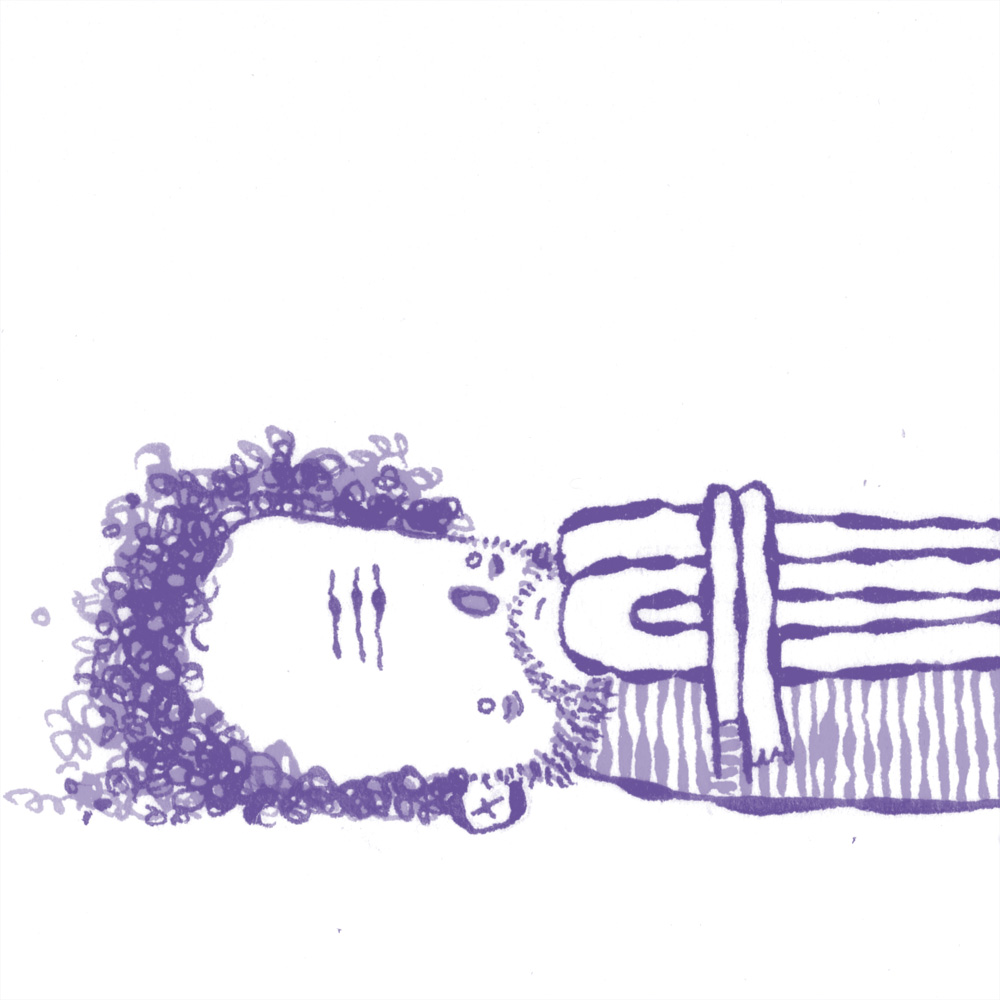
Hone, Brothers and We'm, by Andrew Fulton. Fulton loves to work small, and these three minis are very much in the same vein as his other weird, visceral and slightly disgusting but cute work. Brothers is a surprisingly touching comic that starts off with the horror of one's brother turning into a huge, formless blob of a creature, then turns into a matter-of-fact description of living with him and ends on a warm note of familial love. Fulton's cute line and use of effects like spot color and zip-a-tone spice up what is otherwise a sparely-illustrated comic. Hone is a sort of mad scientist break-up comic, wherein a handyman uses a giant phone to send himself across the line to an ex-girlfriend now living with another man. He's scrambled and reduced to thousands of tiny versions of himself, several of whom manage to wind up on her. It's a creepily endearing comic, especially in the way he drew the tiny floating men to look almost like sheep. We'm is another unsettingly cute comic about the last survivor of humanity landing on a far-off planet and discovering that he'd been cloned, and that the clones kept coming--except most of them were defective. It's a story about loneliness, company and doing what is necessary to not only survive, but also to recreate civilization. This one uses a thicker but also more fragile line, reflecting the tenuous nature of that society.

Then What and Progress Reports, by Robyn Jordan. Jordan is a thoughtful memoirist with a line that reminds me a bit of Ellen Forney's appealing and simplistic style, especially with regard to her character design. Then What is in full color, featuring two stories about loss. "Ten Lives" is about grieving and connections, as a beloved cat became attached to Jordan's father-in-law before his death. There's an amazing page where Jordan and her partner take their cat to the vet to put him to sleep, only to see him die precisely when they arrived. The text is straightforward and the page features the two of them drinking wine on a couch, but the backgrounds feature a thunderstorm, the rain on a left-to-right slant that pushes the reader's eye across the page. The expressionist and fanciful use of muted tones provides the emotion absent from the text and only hinted at by the figurework, giving a sense of both restraint and pouring out emotion. "Just The Two Of Us" is about dealing with the grief of a miscarriage, but it's also about one's relationship with one's own physical form. A session of cranial-sacral massage brings the two together in a dramatic, painful but ultimately cathartic manner, and her color scheme of body and self being two different, independent colors comes to a dramatic close.
.jpg)
Progress Reports is another in the burgeoning memoir sub-genre of teacher comics. Along with Aron Nels Steinke and Cara Bean (to name two), That Forney influence is even more evident in the way she draws kids and works in black & white, but her sense of pacing and humor is certainly her own. The comic is a mix of Jordan's own anxiety about teaching and the obvious comedy gold that is interacting with young children. What's interesting about this comic is her focus on special needs-kids and the ways in which schools can let them down, and even well-meaning individuals clash with others on how best to work with them. Her experience with affluent schools as well as inner-city schools provides her a unique perspective.

Scorched Earth #2 and Eat Eat Eat, by Tom Van Deusen. These are hilariously brutal, take-no-prisoners satire that puts a torch to braggadocio and swagger. Van Deusen's comics are nastily self-deprecatory but avoid the "woe-is-me-why-won't-these-mean-girls-have-sex-with-me" templates of other cartoonists, including clear inspiration Robert Crumb. The prior issue of Scorched Earth featured the loathsome "Tom" character having a one-night-stand but revealed the perpetually lonely but highly deluded loser thought he had a girlfriend. This issue showed off Tom's narcissism in increasingly nasty ways, ditching his roommate when he couldn't get into a bar, comically getting thrown out of a bar when he clumsily buys cocaine, and best of all, exploring polyamory. Pretending she was his "primary" while trying to hit on college women at a party was especially squirm-inducing. It's like this character is every worst instinct Van Deusen could think of regarding the "dude-bro" mentality. It all crests when he buys a fedora and snake-skin boots and then realizes he doesn't have enough money to actually take his date to dinner and she breaks up with him. The subsequent chapter, when he wishes cancer on her, is amazingly over the top and awful--but not as bad as the "happy" ending where he learns absolutely nothing.
Eat Eat Eat also features a slightly different version of Tom, one who shares the ridiculous swagger in Scorched Earth but is a tiny bit more human. This Tom has an eating (and of course) a self-image problem, one that he plays for laughs but also for pathos. The art here is a bit rough at first, as Van Deusen notes it was done over a four-year period, but his mature, sparer but grotesque style is in full effect by midway through the comic. When Tom realizes that he's fat, his attempts at working out are mercilessly cruel but also hilarious. Once again, Van Deusen springs a "happy" ending on the reader despite a drunken accident and coma, comically equivocating the wasting away of a coma with actually losing weight in a healthy way. Van Deusen's comics are incredibly mean, but he lands solid and smartly-aimed barbs again and again. The relentlessness of the humor can be overwhelming at times, as he doesn't allow the reader to sympathize with his self-destructive character, only to laugh at his pathetic qualities. The way he sells the acidic nature of his attacks with the exaggeration of his line contributes to the overwhelming nature of the comic: a double-barreled blast of and against narcissism and misogyny.

The Fatal Marksman Act II, by Jaime Willems. The second part of this adaptation is even more sure-footed visually than the first. That's especially true with regard to the craggy, heavily-lined faces that dominate the book. Willems went all-in with regard to her line width creating an almost grotesque effect. That grotesque quality makes it easy for Willems to have her characters wear their hearts on their metaphorical sleeves, as jealousy, delight, rage and fear are etched on their faces. Her lettering is also appropriately unsettling, battering the reader with its textual qualities as well as the actual words spoken. The page compositions are loose and fluid, with the powerful use of blacks creating an overall atmosphere of dread. All of this shows up in the literal text, as the man who made a deal with a demonic figure in order to win his love's hand is now forced to pay up, with disastrous results in this issue. Willems isn't afraid to go big on every page, in terms of both drawing and in terms of doubling down on the fairy tale nature of the story.




 Posts
Posts


