Showing posts with label aaron lange. Show all posts

Thursday, February 28, 2019

Catching Up With Aaron Lange

Aaron Lange's talent is far-reaching, especially as a draftsman. He can work convincingly in any style, though he's a humorist at heart. Despite reaching out for pornographic and "edgy" punchlines at times, he really is just a solid gag man underneath it all. Lange is more than that, however. He's a take-no-prisoners autobio artist who's willing to look at his worst excesses, past and present, and portray them in an unflinching manner. All that said, I think his greatest strength is as a biographer. He has a way of taking even the most unsympathetic or difficult figures and laying their humanity bare for the reader, generating respect if not affection for them. Lange is an excellent writer and gets at the heart of events and achievements while never losing sight of the underlying and often tortured humanity of his subjects.

His Cash Grab series of minis is a perfect sampler of Lange's interests, plucked from sketchbooks and older publications. Issue #7 is a sketchbook sampler, mixing in gags, brief biographical comics and portrait sketches. A page about a high school friend who just passed away absolutely nails his bemused sense of curiosity, and the text Lange wrote about him is detailed without being too florid. Then Lange turned around with a gag titled "MK-Ultraman," combining the Japanese character with the CIA mind-control program. Then there's a study on logos and rides from an amusement park from his youth in Ohio, combining quotes from Sherwood Anderson and his own childhood recollections. There's a joke about a public service announcement-style character named "Cis" which is funny because Lange keeps piling on details, and that's followed by a drawing and brief bio of the actress Kari Wuhrer. There's a savage comics parody involving Emil Ferris and Ed Piskor, followed by a loving portrait of Lange's wife Valerie. Lange looked like he was channeling Gene Colan a bit there. This is a great introduction to Lange's general interests, and his use of color adds a lot of depth to his drawings.

Cash Grab #8 is all black and white, and Lange labels it as a "Deep Cuts" issue. There's a fascinating story he titled "The Aesthetics Of Grief" about the public appearances of Nick Cave and Susie Bick after their son Arthur died. It's about how they maintained their sense of style even in the face of grief because that's simply part of who they are. Later, he talks about his own alcoholism and how he wished at times the decision to stop would be someone else's, like a doctor. A note regarding his comics in general: Lange is one of the best letterers in all of comics. He is adept at using multiple, personal fonts, line weights and spaces between letters to create a number of different effects and add to the mood of each piece. His portraiture is truly superb, with his drawing of comedian Janeane Garafolo being a case in point. Using key squiggles, lighting effects, hatching, and some spotted blacks, Lange breathes life into a drawing that goes way beyond the photo reference he used for it. Most of the rest of the issue is devoted to portraits of comic book figures and characters from the film Boogie Nights. Lange could make a career out of these portraits in the way that Drew Friedman does; Lange is almost as good at it as Friedman is.

Issue #9 is in his wheelhouse, as it's most gags and stories about the world of porn. Instead of simply doing porno gags, Lange does a series called "Porn Stars I Like." He provides biographical data, quotes, and reasons why he likes them in descriptive and almost poetic terms. Those pages are interspersed with drawings of cats "speaking out" about various topics, as well as collages of porn images with jarring effects. It's a voyage through Lange's id, to be sure, but it feels honest instead of glib. Some of the images (like of a random asshole) are odd, to be sure, but fit into what he's doing in this comic. It's less titillating than it is raw and honest, and he counterbalances exploitation with exploration and humanization of his subjects. To be sure, Lange still attempts to be transgressive at times, with mixed results, but his increasing level of craft as a writer is what's taking him to the next level as a cartoonist.

Tuesday, August 29, 2017

Yet More From Aaron Lange

Let's take a look at another round of minis from Philadelphia's own Aaron Lange:

Cash Grab #4-6. This series is Lange's grab-bag of sketchbook stuff, out-of-print material and other ephemera. #4 is a sketchbook issue wherein Lange starts to play with color, mostly of either people he knows personally or actors that interest him for some reason. Lange is an exceptionally perceptive portrait artist, even when working from photos, and he is able to nail eyes in particular. The other thing about Lange is that there's no gag or pun too dumb enough for him; once he grabs on to it, he doesn't let go, like in "Spock of Seagulls" or "Adamantium" (featuring the singer as Wolverine). On the other hand, some of these jokes are laugh-out-loud inspired, like the psychedelic, full color "Wuv Me 2 Times", a Jim Morrison drawing by way of Margaret Keane's big eyes-style. My favorite drawing was that of his portrait of the great Mary Fleener, when she confessed, "'Trim' means pussy?! No shit."

The fifth issue is more focused, as it's portraits from movies that made an impact on him as a teen, from Hollywood productions to b-movies. It's a case of autobiography by way of the artists that spoke to him. In many cases, he tends to add a touch of angularity to his poses, like the way Gillian Anderson's face is framed, or the way the hair on Milla Jovovich is drawn. He also has a way of touching on the most noir characteristics of his subjects, partly through his use of effects like dense hatching, spotting blacks and even stippling. The latter was true for his drawing of Michelle Pfeiffer as Catwoman, for example. That darkness and even a tinge of madness is especially present in the slightly uneven way he drew her eyes. It's not all darkness, however; his drawing of Miranda July befits her whimsical nature, and the way the lettering of her name melts and frames her head perfectly completes the overall quirkiness of the composition.

Issue #6 is his "deep cuts" grab-bag, including an interesting strip called "Time Release" about a pill-addicted comics retailer. Lange's drawing would get both more refined and more stylized later on, but he captures the degradation of the dealer trying to score pills off of a cosplaying Star Trek fan that ends in violence. The final joke, that the pills aren't what he expected, just added to the absurdity and nihilism of the story. Lange taps into that desperate loser vibe in his stories in much the same way that Noah Van Sciver does, getting across a real sense of empathy. As Lange notes, he very well could have ended up like that dealer if his life had taken a slightly different turn. Other than his film reviews (which are excellent), most of the rest of the issue consists of fairly disposable gags and anecdotes.

Those comics are interesting, especially for Lange fans, but the real main event is Trim #5. This is his current one-man anthology that has seen him take a step up in terms of sophistication and ambition as a writer. Starting with an incredible letters column that features praise from R.Crumb and an admonition from Van Sciver to cut back on his more juvenile, shock-value material. I think the sweet spot for Lange is somewhere in the middle, telling biographical or autobiographical stories that explore disturbing events or unusual people. Take "Pastor Dan!", for example. I loved the touch that made the title look like an old-time MAD title a la Harvey Kurtzman. This story details Lange's childhood as an altar boy at his church and his favorite pastor, the titular Dan. Lange was drawn to this weirdo, who recommended a Monty Python movie to him, recounted killing a cat as a youngster and generally was a positive if odd adult presence in Lange's life. Lange is very much one to provide little commentary in his stories beyond moving along the narrative, preferring to let the reader ponder what it all might mean.

Another sweet spot for Lange's sensibilities are his "Art School" short strips. They are roughly autobiographical and aren't a repudiation of art school like Dan Clowes, but rather a hilarious exploration of who he was at the time and what the rest of the school's culture was like. From hissing at a bunch of hackey-sack hippies to dropping acid at the wrong time in class to an exquisitely drawn weirdo classmate smoking dope with an "x" carved in his head, Lange has a real sense for surveying sheer weirdness and making it funny. It also helps that he takes aim at himself as a butt of jokes as much as he does anyone. There's another story about him coming home drunk and coked up, watching porn and then throwing out his entire collection--only to get locked outside in his underwear. Lange's ability to range between naturalism and exaggeration helps to establish place and tone while still allowing ground for absurdity.

There are a couple of stand-out longer pieces. "Blood and Soil" is another in a series of strips about his family that examines his German heritage, including his great-uncle Erich who was in the Luftwaffe in World War II. He did his job as a pilot but was not accepted to college because of his "perceived political leanings" (anti-Nazi?). Amusingly, his great aunt once told his father that she never had children because "she couldn't stand to bring another German into the world", which is hilarious and awful all at once. Lange is at once fascinated by German military imagery, uniforms and pins while being acutely aware of their impact and the ways others appropriated the imagery to spread terror or to simply shock. Lange neither glorifies nor wishes to forget his family's history, poking fun at it with pop culture and rock references.

"Parco Dei Mostri" is a tribute to his skill as an artist, as he brings to life a monstrous sculpture garden dating back to the 16th century but only recently rehabilitated as a tourist destination. This is an excellent example of the sharpness but also slight distance of Lange's narrative voice. As a writer, Lange clearly spends a lot of time thinking about his subjects. The way this story was arranged, as images taken from his mom's vacation, frames these pieces once considered to be pornographic by his contemporaries but are now harmless and for the whole family. No matter what kind of artifice is at work in one of Lange's stories, he compulsively pulls away the curtain to let the reader in on exactly what's happening and why.

Wednesday, February 8, 2017

Aaron Lange Sells Out

One of the most talented of the latest generation of underground artists (the Mineshaft generation?), Lange's comics are a mixture of brilliant drawing, challenging insights and juvenile humor. For Lange, his idea of selling out came in the form of his CaSh Grab comics, issues one through three. Published by The Comix Company, they are meant to mostly be sketchbook highlights but Lange inevitably adds his own ideas and meditations on any number of subjects, starting with his struggle to get sober. There is a remarkable power to be gained in understanding one's own sense of powerlessness in the face of addiction, and going sober not only did nothing to dull Lange's edge as an artist, but it gave his work a great sense of clarity. The first issue of Ca$h Grab has a lot of portraits drawn at bars, and Lange is superb at capturing the essence of his subjects with a naturalistic style the emphasizes weariness and even pain on his subject's faces, like that of a "horny mom threw teen daughter a naked twister sex party, AA sponsor says". Lange drew her as sad and searching with big eyes and a sense of desperation, not as a lurid figure.

Which is not to say that there's not any filth to be found here. No one does it better than Lange, but even here, he uses it for more than just shock. Depicting addiction as a beautiful, naked woman begging him to come back gets at his lament of "oh, gawd, it's just so awful sometimes". A lot of the drawings here were clearly done as a way to keep his hands busy and his mind active, from drawing pictures of Scully from the X-Files to old superhero logos to an account of a recent acid trip. Without perhaps even meaning to, Lange created a sobriety journal with a remarkable amount of impact. The second and third issues are more conventional, as they are mostly assembled from reprints of the kind of Hollywood portraits that Drew Friedman does. That is, the portraits, though mostly naturalistic, often offer a kind of commentary about each figure. Every now and then, Lange made a joke about the subject's appearance or their role (Elizabeth Montgomery). There are punk figures, figures from old Hollywood and cult figures. Lange ranges from his standard, thick black line to a painstaking use of stippling. The effect is different from Friedman, who uses a hyper-real style to make his figures seem more rubbery, while Lange seems to want to create a noir, sleazy atmosphere for all of his subjects to be a part of. The third issue has more of Lange's silly jokes, like changing the DeNiro film to "Uber Driver", with DeNiro holding up two phones that have pictures of guns with them, saying "Are you texting to me?" A lot of the images in this issue came from commissions, but the funniest image was that of Klaus Nomi as The Punisher.

Lange's real work comes in the pages of his series Trim, and the third issue has a lot of highlights. I find Lange's casual use of racist and homophobic terms to be kind of dumb, because it's obvious that he's a smart person who actually thinks about social and political issues. Part of that stems from his "I don't give a fuck" attitude, which adds energy to a lot of his work but also detracts from it at times. Opening the issue with images from his high school yearbook and the creepy feeling he gets from looking at them now is Lange at his best: confronting his id without letting himself off the hook. "Where Have All The Cool Faggots Gone?" is actually an interesting piece in its analysis of the conflation of outsider culture with gay culture as he discusses a number of historical figures, but coming at this culture from a position of obvious privilege was not only obnoxious, it refused to do the hard work of actually trying to investigate the current avant-garde of gay culture.

As always, his autobio is top-notch. "Bummer Vacation" finds him quitting his awful job and running off to his mom in Cleveland, leaving his long-suffering wife behind. It's a fascinating account of literally trying to go home again, finding some aspects of it sweet and other aspects bitter as inevitable decay struck at beloved childhood memories. More than anything, the trip served to calm him down. "Float" is about him finally getting to try a sensory deprivation tank and feeling ready for whatever hallucinations and/or revelations it might bring, only to panic after just a couple of minutes in the tank. As someone curious about the experience yet knowing that I would also resist the experience, I could sympathize. The back half or so of the comic was dedicated to the sort of "horrible, horrible" gag cartoons that Ivan Brunetti used to do, only Lange relies heavily on visual and verbal puns. This is where Lange goes all the way to the edge and beyond, with jokes about Rwandan genocide, Nazis, Anne Frank, desperately wanting a drink and more. My favorite features included the running "Sassy Bartender", which plays on the increasingly dumb and dirty names for drinks and "Bill Fingered", a Batman joke I couldn't help but laugh at. Lange's approach, as always, is to pummel the reader with joke after joke, delicately-rendered & filthy image after image. For every dumb or gross joke, Lange lands two smart and pointed gags. Lange's comics are high-risk, high-reward and packed with content from cover to cover.

Trim #4 may be the best issue yet, anchored by the excellent biography of musician Peter Laughner that also serves to act as a sort of history of Cleveland itself. With a flowing, open-page layout that mixed in naturalism, caricature, stippled portraits that had a ghostly quality (an intentional effect), Lange told the short, unpleasant story of an influential but highly self-destructive musician who was in a number of bands, including the first iteration of Pere Ubu. In Lange's view, Laughner and Cleveland were inseparable: two doomed, isolated and underappreciated entities consumed by disaster. There's no question that he was a genius, but he was also violent, unpredictable and frequently anti-social, making him difficult to work with in a band setting. Throughout the story, Lange peppers it with repeating jokes, lyrics and images that reflect the "Ain't No Fun" quality of the story's title and also a title of one of Laughner's songs. This is punk as true nihilism, seeking nothing but total immolation of everything, including oneself. This is Lange at his best: cogently critiquing Laughner without either judgment or sentiment, letting the facts speak for themselves even as he improvised a different visual technique to anchor each page, be it a psychedelic background for Laughner's high school band days or a savage pencil-dominated drawing of animals reclaiming Cleveland. Lange's research was clearly extensive, and it was clearly relayed with a minimum of tedium and a high degree of focus on its most interesting aspects. The rest of the issue is also solid, as Lange puts his remarkable observational and raconteur skills on display in a story about the strange behavior of his new neighbors and unleashes the usual array of pretty funny, filthy gags, the best of which were the hilariously weird "Pig the Fucks" (involving putting pig noses on cops) and "Twerk Will Set You Free", which is perhaps the most absurd Nazi-related filth I've ever seen.

The collection of Washington Beach strips basically showed that a little of that concept went a long way. Compiled in one place, the strip mostly feels like a waste of Lange's talent, as he takes fish-in-a-barrel aim at hipsters and their assorted drug habits, obsessions and sexual habits. While the structure and rhythm of the strip is drum-tight, the gags are often groan-inducingly obvious or cheap. That said, some of the running gags (one of the hipsters often saying "I better txt andy about this!") were sharp and Lange is superb at creating callbacks. On the other hand, his My Dad collection is tremendous, with each strip building on the next to create a hilarious, nuanced portrait of his father that gently mocks him and also displays Lange's genuine affection and admiration. The mini is also a document of Lange's growing skills as an artist over the past few years, as his figure drawing in particular has become much more confident and bold, even as his versatility in terms of drawing style has blossomed. There's one sequence of strips where we see a completely naturalistic image of his dad, a stripped-down/geometric Brunetti-style drawing, a cartoony version and a number of in-between versions--all of which made sense depending on the nature of the anecdote. Two fun running gags: Lange throwing in a blatant lie about his father that his dad would yell about, and Lange's father yelling at his brother (drawn either as a hippie or a punk) about all sorts of things. Lange's use of layout is unusual, as he packs a lot of material into a small space but uses carefully-placed and differently-shaped panels (often circles) to break up the page and let the eye rest a bit.

Finally, there is Huge, a double-barreled blast of putrid filth aimed at the Trump administration and all of the associated cronies. In other words, when they go low, Lange responds by plunging his targets into oceans of bile, shit and filth. He actually starts out in smartass mode, using various slurs as Trump's hair, but then goes into full Ralph Steadman mode, creating hallucinatory nightmares of monstrous Trump figures with penis pustules all over his face, dripping blood and other fluids. Other targets like Mike Pence and Steve Bannon are barely human predators, eating rats and drowning in semen--barely able to grunt. It is an all-out assault that hits as hard as any Trump caricatures this side of Warren Craghead. Lange really hits a nerve with depicting these leaders as luxuriating in death, decay and their own depraved sickness. Unlike Lange's usual filthy drawings, there's no joy or fun to be had here: just a powerful mirror held up to those in power. These images are drawn as much as they seem to be vomited straight from Lange's mind onto the page, and their impact is more visceral than anything I've ever seen the talented Lange do.

Wednesday, August 13, 2014

Getting Filthy With Aaron Lange

Aaron Lange is one of a handful of the few truly skilled underground comics pornographers. This is a class of cartoonist that goes beyond the merely perverted, like Robert Crumb and later Rick Altergott, and exploits sex for shock and humorous purposes. Whereas Josh Simmons fuses filth with horror (especially body horror) and Robin Bougie's porn is explicitly and unflinchingly satirical, Lange plays it strictly for laughs. For Lange, there are no lines when it comes to jokes; like the brutally acidic stand-up comedian Anthony Jeselnik, Lange gleefully crosses and erases all lines of propriety and respect for others. His material is frequently racist, sexist (to the point of misogynistic and beyond), homophobic and sometimes anti-Semetic. He is not only unapologetic about this, but in fact gleefully revels in crossing the line. Perhaps the most offensive of his cartoons was "Anorexic Jew", from Romp #3. At the end of this gag, he asks, "Do I have an Eisner Award yet?" acknowledging and sneering at the comics establishment (and really, polite society as a whole) in one fell swoop.

Of course, like Jeselnik, Lange is extremely skilled in how he constructs his taboo jokes. One thing that's true is that while Lange's Romp material in particular is shock humor, he never lets the shock alone act as the humor. He always has a solid, smart punchline crafted that blends perfectly with his superb drawing ability, all in the service of his decidedly politically incorrect jokes. What sets Lange apart from your average smut-peddler is a willingness to really "spill some ink" about himself and his family in his autobiographical pieces, all of which are uniformly excellent and entertaining. Not since Denny Eichorn started Real Stuff has there been an artist tell so many sordid tales about himself and others, only Lange's stories are more organically whole because he handles both writing and art duties. (Not surprisingly, Lange has drawn a couple of features for Eichorn's newest iteration of his series.)

For example, his "My Grandad" (from Razor Burn #?) is a warts-and-all, matter-of-fact account of his beloved grandfather, who happened to be a member of the Hitler Youth who then fought in the German navy in World War II. It revels in his grandfather's contradictions as a human being; a self-professed "hippie" who nonetheless recalled the good old days when everyone had jobs in Germany because of Hitler. That personal complexity is the key to understanding and enjoying Lange's work, because his personal accounts reveal a loving and caring individual who is also neurotic and possessed a huge self-destructive streak in the past. A good example of this playing out is "Second Handed" (also from Razor Burn), a remarkable story about working with junkie grifters as a used record store clerk. It shows tremendous empathy for the junkies and desperate people he encountered without mythologizing or romanticizing them. These stories are Lange at his best.

On the other hand, "Dumb Cunt Funnies" and "LSD Genie" and "Apocalypse Period" are pandering underground fodder. There's not much humor to be found here, as jokes about women on their menstrual cycle were tired a long time ago. Much better are his "Loneliness is..." and "Sexual Frustration is..." features, which combine stereotypes and cliches with real truths, both personal and generalized. His Archie-inspired "Washington Beach" feature is outstanding as it mocks hipster culture. Admittedly, his targets are a little on the easy and obvious side, but his excellent comic rhythm is at its best when channeled through actual characters. Another highlight of the mostly great Razor Burn is "My Dad", another warts-and-all feature about his father. His dad is a far less polarizing figure than his grandfather but is no less full of contradictions. There is real affection in this portrait and a sense of a no-bullshit relationship between the two of them.

The three issues of Romp that Lange sent on have their moments but are generally less interesting than his more personal work. That said, there are a number of inspired moments. "Incest and Peppermints", a tale of brother-sister incest designed as a form of protest, is so over the top that it can't be taken the least bit seriously. Lines like "Take that, Henry Kissinger!" made me laugh out loud. Similarly, the strips featuring his sexual sad-sack character Hesh tend to be some of the strongest work in these comics because of how ridiculous they are. These are the strips that remind me most of Altergott's gross absurdism, with a strip featuring an Indian man eating Hamburger Helper out of a woman's vagina being the most over-the-top and yet undeniably clever. Hesh and his friends Jazz and Veronica (an S&M enthusiast) all try to push the limits in a deadpan manner that becomes ridiculous thanks to Lange's mastery of perverted situation comedy. He wisely positions Hesh as a loser who's the object of pretty much every punchline, be it humiliating "baby play" or being unable to participate in piss play because he's got an erection.

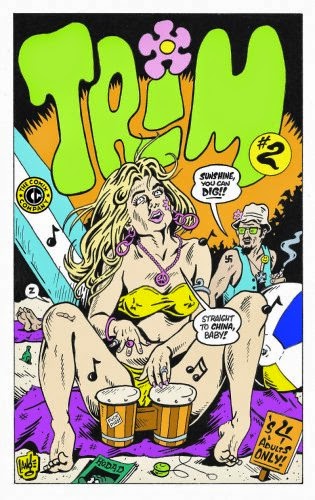
His most recent comic, Trim #2, displays Lange's best and worst instincts as a cartoonist. On the one hand is a weak-sauce gag like "White Male Privilege." It feels less like a strip by a cutting-edge cartoonist and more like one by a Men's Rights activist. In the strip, there are three scenarios: 1) A woman on a date with a man, telling him that sex is out of the question and asking him to pick up the check; 2) A woman telling a professor he's being denied tenure because of a sexual harassment claim; 3) A young black man harassing a white couple on the street. Lange's attempt at deflating the concept of white male privilege fails spectacularly, because even the examples he brings up are lame. The first panel seems to suggest that men are owed sex, especially if they pay for dinner; the second suggests that sexual harassment is either always falsified or else unimportant; the third conflates the discomfort of being harassed on the street with being harassed (or worse, murdered) by police, discriminated against in real ways that affect quality of life, etc. It's Lange punching down against easy straw man targets. The worse part about the strip is not that I disagree with the politics, but the hacky nature of the gags. It's a disingenuous strip.

On the other hand, his fantasy story "Sexy Alcoholic Girlfriend" takes a certain kind of stereotype and personalizes it in such a way that makes it both funny and intimate. "Clear Autumn Day", Lange's encounter with the Church of Scientology, is equally revealing in that it confronts his depression. The "free personality test" promised at Scientology storefronts showed that all of his test scores were deeply in the negative, with the exception of "motivation", which was high. This alarmed the tester, who said "I'm afraid of what you're motivated to do!" Lange's art is at his best here; a cross-eyed self-portrait with beads of sweat flying off his head and the vastness of outer space behind him, really get at dizzying patter that was thrown his way by the scientologist. Lange's "Six Drawings of Zoe Lund" is a fascinating, affectionate take on the actress/writer/model; each image is naturalistic, yet bears Lange's unique illustrative stamp. Lange loves spotting blacks, uses curly & thick lines liberally and stipples details like lipstick and pupils. He nails Lund's mesmerizing on-screen persona, that sense of great intelligence and unpredictability. "Do You Wanna..." is another one of Lange's dirty, Seussian rhyming schemes, this time devoted to getting drunk. It's disposable but amusing at times.

Lange certainly blurs the line between edgy and puerile. There's a certain palpable glee present in his more transgressive material, like a little kid being caught writing dirty words on a bathroom stall. There's an energy present in these comics that lifts many of them above simple pornography, as Lange takes genuine pleasure in drawing filth and making it funny. The energy in his more serious strips is different; it's manic but almost desperate. Lange obviously has things he wants to get off his chest, and while he usually manages to make the worst of situations sound funny, there's no hiding the desperation, the loneliness and the sheer frustration he feels. That defines his work more than anything: he's an underground cartoonist fully capable of unleashing his id in the most puerile way possible, but he's also in touch with his emotions and how to grapple with them on the page. That freeing of the id is balanced by the weighing of his ego, creating a unique reading experience that's often uncomfortable and frequently hilarious.

Friday, January 3, 2014

Going Underground Again: Lange, Schubert, Valasco


Misc., by Liz Valasco. This is a mysterious little six-page mini about a bullying incident on a bus involving a kid with a Moon Pie for a head. Valasco's cramped, scribbly style is a good match for the story that begins with the absurd, moves into the tragic and ends on a mystical note. The Moon Pie kid, it is hinted, is some kind of immortal being who nonetheless appears to be a child and who goes to school with other children. Valasco's dialogue is pitch-perfect in the way that she depicts a particular kind of cruelty, one that's almost inquisitive and inviting, and then turns on a dime into fantasy material. It's solid work.

Blobby Boys, by Alex Schubert (Koyama Press). I've been seeing dribs and drabs of this comic in anthologies, minicomics and various other places for quite some time. Even this slim, collected edition feels like yet more prologue to a larger, denser work. I'll repeat what I said in an earlier review: "Schubert is a funny cartoonist whose work seems heavily influenced by Dan Clowes' early Eightball work. There's a large array of gag-oriented strips that take on cultural detritus that feature cartoony, grotesque characters. Schubert also touches on true absurdity in his takedowns of tough post-modernist posing with his title characters, who are literally slime-shaped people who get into all sorts of mischief, including killing members of a rival band after a gig at a club. With characters like Aging Hipster ("Have you heard the new Arcade Fire?") and Punk Dad as well as Schubert's own observations like Paper Blog and a review of a bizarre musician called The Spoiler, there's a tremendous amount of skill and polish on display here for such a young cartoonist." There's additional material in here involving Cyber Surfer and Killer Driller, wherein Schubert invokes some Michael DeForge style "drippy drawing" in a more overtly humorous and deliberately stiff style. There's also an extended strip featuring Art Critic, another Clowesian send-up that aims to generate more laughs than particular satirical points. Indeed, even if many of Schubert's comics have an aesthetic or cultural point of view and make that point in a forceful manner, the joke is still the thing. His peculiar drawing style transcends his influences as they mesh together computer drawings, graffiti, video games, album cover art and other cultural touchstones outside of but related to comics. I could read another 200 pages of gags set in this particular visual world.

Trim #1, by Aaron Lange. Speaking of Clowes, Lange draws his visual inspiration not so much directly from Clowes but from the sort of art that inspired him: advertising art, romance comics, and junk culture. Lange is a smart storyteller and observer whose work is a sort of second cousin to that of Tim Lane's, as he documents and interacts with people who are outsiders, cast out of and away from society. Take "Vietnam Tom", a story wherein Lange listens to the rantings of a Viet Nam veteran that show moments of clarity and sensitivity in-between moments of sheer, ridiculous madness. Lange keeps it light in this story, setting up the anecdotes as a series of gags.What I like best about Lange's comics is that he has an interest in underground culture without necessarily revering it. For example, "When I Grow Up I Wanna Be Like...William S. Burroughs" takes a wrecking ball to the legendary writer's mystique and hilariously catalogs all of the awful things the writer did and had happen to him. Worst of all: "be read by idiots".

There's no question that the highlight of the issue is "Dog and Kitty", an epic autobio story that reads sort of like a Denny Eichhorn story (or maybe Peter Bagge's Stinky Brown), only one where he makes nothing but bad decisions. It's a story too ludicrous to be faked, as it involves Lange and his burgeoning heroin addiction some time back, and the violent, psychopath dealer he hung out with from time to time ("Dog") as well as his crazed, bestiality-loving girlfriend ("Kitty"). It's a story that involves guns, Nazi fetish porn, accepting an offer to let Dog grow pot in Lange's basement, and the horrible numbness to everything that comes along with being a junkie. Trim has the feel of being an exploitation comic, only Lange is exploiting himself and his own observations and experiences for maximum comic effect.