Wednesday, July 12, 2023

Minis: Alli Katz

I met Alli Katz at CAKE 2023, and she was kind enough to give me a few of her minis. Two of them focused on pregnancy and the frequently dubious joys of early motherhood. Very Funny Jokes And Some Comics That Make You Think Vol 1, as one might expect, is a grab-bag of random comics. It's hit and miss, which is not unusual for this kind of mini, but some of the hits are solid. "Live Action Carebears" has a realistically-drawn, angry bear with a Carebear symbol on its chest, and simply the concept behind this made me laugh. The execution helps the gag land. There's a good newspaper typo/awkward headline gag that works because Katz just keeps pouring on the weirdness. There's a New Yorker-style gag with the punchline of someone asking "Can you explain it in Harry Potter metaphors?" that I found hilarious considering there's a large segment of the population that seemed unable to do otherwise for quite some time. Most of the actual cartooning isn't especially memorable here, but Katz's skill and timing as a humorist are sharp. 


9 Months But Actually 10 Months But Actually Forever is about Katz's whole pregnancy odyssey, from imagining a sperm giving an egg a pick-up line to the actual birth. This comic is clearly what's in her wheelhouse as a creator: memoir told in short bursts with gag punchlines that still hew closely to the more serious aspects of the experience. Katz's self-caricature (huge glasses that hide her eyes behind blank circles) is especially effective. The comic is closest in spirit to Meghan Turbitt's comics about birth, which makes sense since Turbitt is primarily a humorist. The strips about things she's worried about reflect the way that so many birthing books exist primarily to terrify expecting mothers. There are also a lot of great strips about the way she relates to her partner, especially one strip where they talk about how they think their jokes are "really landing with the doctor." Katz doesn't veer too far away from expressing her emotions in this story in service of a gag; indeed, she leans into them as much as possible, which makes totally sincere pages like having her daughter in her arms all the more effective. 


"Just Pretend Your Boob Is A Hoagie" is all about the highs and lows of breastfeeding. This was the most interesting of the three minis, in part because it's a subject that's not always discussed much, even in the increasing number of mom comics that have been published in the last decade. Katz talks about the struggles of breastfeeding, the difficulties of pumping, the judgmental lectures from lactation consultations, and the feeling of somehow failing your child if you don't breastfeed them. Katz manages to inject a lot of humor into the proceedings, but this is a more serious attempt at coming to terms with the possibility of giving her daughter formula and the shame that this concept invites. In the end, Katz manages to mostly figure it out, and the comic ends on a wistful note when the transition comes in weaning her child. The expressiveness of her figure drawing is especially sharp here. This is promising work from a young cartoonist.


Monday, July 3, 2023

Short Reviews Of Short Minis: Storme Smith & Co; S.C.A.R.

I've recently become reunited with a bunch of minicomics meant for review that had been in storage. It's time to hit that backlog with short reviews of short minicomics. 


Nightmare And Sleepy, by Storme Smith and A. Shay Hahn. This is an ashcan/mini of a longer comic from Buño Books, which seems to be interested in doing public-domain superhero comics, among other things. The titular characters are typical Golden Age heroes that appeared in a blizzard of attempts at creating saleable new characters in the early 1940s. In this case, it's a pro wrestler (Nightmare) and his manager (Sleepy), who fight crime in between bouts in the squared circle. This story sees them fight a group of crooks who can turn into "were-armadillos." It's silly and amusing, but Hahn's art is stiff and amateurish. That somewhat mimics a lot of Golden Age comics, which were not always known as bastions of professionalism (given deadlines and the young ages of the creators), but this mini does little to intrigue.


The Heroic Few #0, by Storme Smith and Matt Lesniewski. (Colors & Letters by Dan Lee). This is a very odd comic. It is essentially the Silver Age Avengers (specifically, the "Cap's Kooky Quartet" team led by Captain America with former bad guys Hawkeye, Quicksilver, and the Scarlet Witch) drawn like early 1990s Image comics. Smith really knows his way around these classic Silver Age stories, and he even makes some interesting changes and connections, like changing around the origin of the Hawkeye analog (Sharpshooter) and hooking it to a variation of the Marvel villains the Circus of Crime. Lesniewski is adept at channeling his inner Rob Liefeld in terms of the character design and the excessive number of lines on the characters. Say what you will about Liefeld's ineptness as a cartoonist, but his work had a genuinely weird energy that practically vibrated off the page, and what Lesniewski does here is pair that energy with the Jack Kirby energy of the originals. He also does a decent job of balancing Smith's extensive infodump of a script and allows the panels to breathe a bit. Smith is introducing a gaggle of new characters, and the plot device of a reporter is actually quite effective; it's just that it's a lot for a new reader to take in, even if they're in on the joke. This is a nice bit of a one-two nostalgia punch that is cleverly written.


The Fuglies, by Steve Carter and Antoinette Ryder, aka S.C.A.R. Published in 2014 by Australian outfit Pikitia Press, this is a whacked-out bit of post-apocalyptic eugenics, mutants, sex, and cannibalism. The artist-writer duo S.C.A.R. stars the proceedings with some gratuitous nudity from a young woman on the run from her best friend, but things aren't quite what they seem. While they have to deal with Fuglies,--carnivorous mutants who are the leftovers of regeneration experimentation--it's revealed that young and beautiful Rae & Gloria are also flesh-eating mutants. It's just that they look more human, are smarter, and craftier. This comic revels in its pulpy ridiculousness, as its gore and violence are depicted in a naturalistic and even heroic-looking manner. The plot takes a few surprising twists and turns that elevate it above your standard zombie/mutant storyline. The art is serviceable if a bit stiff at times; the action feels more like a poster than the fluid cartooning than it needed. 

Tuesday, June 13, 2023

The Beauty of Sloppiness: Julia Wertz's Museum Of Mistakes

In the original introduction that Peter Bagge wrote for the first Fart Party collection, he said of the webcomic proliferation of the early 2000's: "Some are professionally drawn, others cleverly written. Fart Party is neither...Yet both in spite of all that AND because of it, Fart Party is the best! It's very direct and funny and honest in a way that very, very few other comic strips ever are, and once you start reading Julia's strips, it's hard to stop."


As per usual, Bagge is right. Wertz breaks tons of rules with regard to what good cartooning is. The way characters relate to each other in space is awkward. The use of gesture is either underdeveloped or ham-fisted. There is frequently way too much text in a given panel. The thing is, none of that matters. This collection of Fart Party strips, unpublished strips, and assorted ephemera over the years is a document of how a young artist develops over time--not just with regard to drawing, but also their unique authorial voice. And no matter how sloppy her strips were, no matter how many typos there are (and there are many in this volume, including modern strips, and even on the title page!), none of that mattered. There is an enthusiasm and an immediacy in her drawings as Wertz shares her world with the reader, and the reader can't help but get swept along. Wertz world is an interesting place to be, and the hostess never runs out of stupid jokes, embarrassing anecdotes, hilarious stories, and glimpses of her pain. Her "definitive" Fart Party collection, Museum of Mistakes, includes the two original volumes and a great deal of additional material, including a note or two from 2020, updating her relationship and status as an expectant parent.


The one word I'd quibble with regarding Bagge's assessment of Wertz's comics is "honest." The concept of "honesty" in memoir is kind of a marketing device that allows for "authentic" voyeurism. It is meaningless. There is no such thing as "truth" in memoir, as the author's job is to tell a story, not recite every memory verbatim. And even if they did, it's only from one person's point of view. And Wertz herself noted that while all of the stories here are accurate, they are far from the complete picture of her life in her early 20s. She elides things like her lupus diagnosis, her older brother's addiction issues, her own alcoholism, and more that she hasn't been willing to share. Which is not to say that she should, but it should also be understood that memoir, like anything else, is a genre that demands something of a coherent story or well-threaded series of gags. In the parlance that Alex Hoffman coined, Wertz's autobio material is definitely "closed," meaning that Wertz only provides enough context to the reader to understand her jokes. 

Still, stuff bubbles up. Wertz writes about her tendency to isolate herself and her general social awkwardness that she masks with humor, attitude, and deflection. This give-no-fucks attitude is the essence of her humor, but it's also the core of a coping mechanism that went a few rounds too many. It's that need to keep others at arm's length that led to the extreme isolation that she touches on at the end of this book and details in Impossible People. The result was a whole lot of people who liked her, but few that she let in enough where she felt comfortable going to them. It reminds me a bit of reading John Porcellino's book The Hospital Suite, which reveals the true story behind his years of struggles with his physical and mental health that he just alluded to in the pages of King-Cat. When the artist is ready to share this different kind of story, it recontextualizes their entire body of work. For Wertz, it adds a weight to her silly comics that wasn't there initially but doesn't neutralize what people liked about them in the first place: a small, perpetually indignant malcontent who hilariously rails against the world, but one with an inherent sense of delight regarding so many things. 


While Wertz mostly lets things stand, warts and all, she does add context to a few things here and there. Mostly, she's content to let the book be what it is: funny, obnoxious, sloppy, and a portrait of a young person trying to figure things out in public. One can see not just her drawing and storytelling improve, but also her writing in general. In the chapter featuring strips for what might have been a third volume of Fart Party if Wertz hadn't chosen to do Drinking At The Movies, Wertz maintained her silliness and sense of enthusiasm, but there was clearly a different perspective as a humorist. "Perspective" is the keyword here. It's what made Drinking At The Movies and The Infinite Wait such excellent books, as Wertz had had a few years to consider the meaning of certain events in her life, unlike the immediacy of the Fart Party strips. I also think it's why it took so long for her to write (and finish) Impossible People; she needed time to process the events surrounding her initial rehab, struggles with sobriety, and the eventual lessons she learned about how reaching out to others is so crucial for one's mental health. 

In a sense, this is something she's done for a long time with the stories she's told in public, as they've clearly resonated with a number of readers. If immediacy was what made her early work stand out, it's her willingness to go all-in on providing context that makes her later (and current) comics so different from most memoirs. While there are any number of things that drive me crazy about Wertz's drawing (especially character design outside of her and a couple of other characters) and proofreading, her emphasis on storytelling and the complexity of her authorial voice make her a unique figure in the world of comics memoir. Museum Of Mistakes is a welcome document that allows the reader a chance to see how this voice gained its coherency and how talented she was as a storyteller even as she was still figuring out her style.

Thursday, June 8, 2023

The Exception That Proves The Rule: Julia Wertz's Impossible People

There's a scene late in Impossible People, Julia Wertz's recovery memoir, where she meets New Yorker cartoonist Roz Chast. Chast reveals that she's a big fan of Wertz, because "it's not from the cartooning world. You don't follow any rules, which makes it unique and fun!" Wertz starts to follow this up about not really even knowing the rules before she's loudly interrupted by Chast's bird saying "Who cares?" This is pretty much Wertz in a nutshell. She does a lot of things as a cartoonist that I would hate from virtually anyone else, but her ability to draw you into her particular kind of storytelling is so all-consuming that I simply don't care as much. 


Impossible People is somehow both way too long and not long enough. It covers way too much ground sometimes, and the deleted scenes that Wertz has posted on her Instagram would have added the kind of rich detail found in her best book, The Infinite Wait And Other Stories. At the same time, Impossible People meanders, loses its way, picks up loose threads again, and is held together not by the fact that it's a recovery story, but rather that it gets at what is referred to as the "root" in recovery terms. Wertz bites off a lot more than she can chew in terms of the cartooning and character design, but her sheer determination and ambition to finally tell this big story somehow makes all of that less important. There are a lot of ways to think about the book, but let's start with the obvious. 


Wertz has a profound understanding that memoir is a genre like any other genre, one where the artist can manipulate any element they want to produce the story they want. "Truth" is irrelevant so long as a good story is told, yet "truth" has always proven to be an important marketing element for memoir. If something is true, it creates a voyeuristic thrill absent from fiction, and in many cases creates a window of misery porn for readers. Wertz absolutely rejects all of this, to her credit. The subtitle of the book is "A Completely Average Recovery Story," in part because every recovery narrative, no matter where rock bottom happens to be, tends to fall along certain patterns. The key to starting recovery that actually works is coming to terms with negative emotions and all the ways in which we seek to conceal them, usually by lying. Being honest is the first and hardest thing one must do in recovery, and it has to continue throughout--especially in not lying to yourself. 


Wertz uses a lot of recovery language in Impossible People and gives us glimpses of meetings, sponsorships, and accountability partners. A key character is her brother, a recovering drug addict who provides a lot of hard advice and compassion. The thing that makes Wertz a great writer--her ability to spin anything into comedy--is precisely the thing that made recovery difficult. By minimizing her own pain and attempting to laugh it off, she delayed getting to a lot of her root issues of exactly why she started drinking. Notably, Wertz doesn't go into much detail as to these events, but the truth is that it doesn't matter much what they were, so long as you're able to talk about them out loud to a therapist, sponsor, or peers. The Blue Book of Alcoholics Anonymous is mostly filled with recovery narratives. Recovery is a kind of belief system, beginning with giving yourself over to the infamous Higher Power, and so recovery narratives are really conversion narratives. 

One very smart thing that Wertz does in the book is explore the problematic aspects of recovery, beginning with the higher power, the religiosity of AA, the misogyny inherent in its origins and execution, and much more. She doesn't linger on it, as this book isn't a critique of AA in particular, but what her brother points out and what she learns is the most profound lesson of recovery: isolation is death. 

This is the heart of the book. Wertz has always painted herself as a misanthropic curmudgeon for comedic purposes, but the reality is that she's simply a shy but socially curious and empathetic person. However, worrying that your problems aren't "big" enough, feeling unworthy of love, friendship, success, etc, feeling like a burden to others and other ways we trick ourselves into isolating. For addicts, what happens is either lapsing into addiction, or worse, trying to white-knuckle sobriety. I would argue that this is uniquely exacerbated by the rugged individualist ethos of American culture. Seeking help is weakness. Buck up and stop complaining. No one wants to hear your problems. If you don't do it yourself, it's not of value. All of this is illusory, of course, whether or not people want to admit it or not. For an addict, it takes a lot of work to purge this social pressure, but the reality is that at a genetic level, humans are social animals. They need each other. They want to communicate with each other and always have--dating before even language. Our trauma is what tricks us into isolating ourselves and making ultimately ineffective choices for our coping mechanisms. Our culture encourages us to do this. Trauma isn't a contest as to who's had it worse; rather, it should be understood as something we all experience and need to reach out to others to cope with. 

As a result, Wertz presents an array of characters who are fully fleshed out in a way that she's never done in any other book. Sure, her friends and family have had supporting roles, but not to this extent and not to this degree of openness. Cartoonist friend Sarah Glidden and recovery friend Jennifer are prominently featured, with the latter particularly grounding Wertz and calling her on her shit. There's a boyfriend (Jeff) that Wertz becomes devoted to (to the detriment of her recovery), only to have him tell her he's cheating on her as he breaks up with her. The one problem with all of this is that Wertz's character design (beyond her own iconic avatar) has always felt perfunctory at best. Furthermore, Wertz's work has always had a static quality where body language, the relationships between bodies in space, gesture, and other key elements of cartooning have felt limited. It didn't matter as much when Wertz was just going for jokes, but it made things more awkward for the deeper, more interpersonal discussions that made up so much of Impossible People. The problem is that Wertz didn't seem to be able to create avatars as interesting or evocative as her own for anyone else, giving them mostly a vaguely generic cartoony naturalism that wound up not being enough of either. As drawings qua drawings, they were sometimes distracting. 

Fortunately, Wertz is well-suited to draw the other co-star of the book: the buildings of New York City. Her level of detail, care, and precision in rendering buildings stands in contrast to drawing people, but it nonetheless added so much flavor to the book. The other fortunate thing is that Wertz's talent as a writer is so prodigious that the cartooning issues melted away not just with her always-winning one-liners, but also her deeper, more interpersonal relationships. Her frank talks with her brother, her heart-to-hearts with her best friend Jen, her hard-won wisdom from her sponsor, and even the flirty banter she has are all totally absorbing and have such a strong rhythm that it holds the very loose plot together. It's less of a plot than episodic storytelling, albeit with a strong thematic throughline. That throughline and lesson of recovery is what gives Impossible People its very warm heart. The sarcastic Wertz is really someone who is quite sincere in how much she loves so many people in her life, and the lesson of the book, as it is for all of those in recovery, is learning how to practice gratitude for the loved ones in our lives. One may not feel like you deserve it, but practicing gratitude, reaching out, and being there for others just as they are there for you is the essence of all community and the key ingredient to fostering mental health. Julia Wertz explores the lessons of recovery and emphasizes that sobriety on its own is irrelevant with community, all while never deviating from everything that made her funny in the first place. 

Thursday, May 11, 2023

Time for more Van Scivering!

As a teacher and editor, Noah Van Sciver is one of my favorite examples to bring up of a cartoonist who had to work hard to find his voice, hone his craft, and relentlessly face rejections until his talent simply became too undeniable. He simply set his mind to being a cartoonist and never stopped, studying countless other artists in order to help develop his own style. As a result, Van Sciver has now entered a groove in his career that sees him releasing monster tomes like his Joseph Smith And The Mormons while still working on multiple side projects and collections. 

Van Sciver's always had a restless curiosity to his work, never settling on any one style of storytelling. He's worked on a number of illustration jobs, he's written biographies, he's done slice-of-life fiction, he's done plenty of gag work, and also a great deal of autobiographical work that often dips into metafiction. Cartooning about cartooning can easily become dull and played-out, but Van Sciver constantly finds new ways to examine the art and profession of cartooning from fresh angles. In fact, his 2022 collection from Fantagraphics, As A Cartoonist, is all about Van Sciver dipping into his weird childhood and revisiting it here as a cartoonist who is constantly examining his own status as a creative professional. 


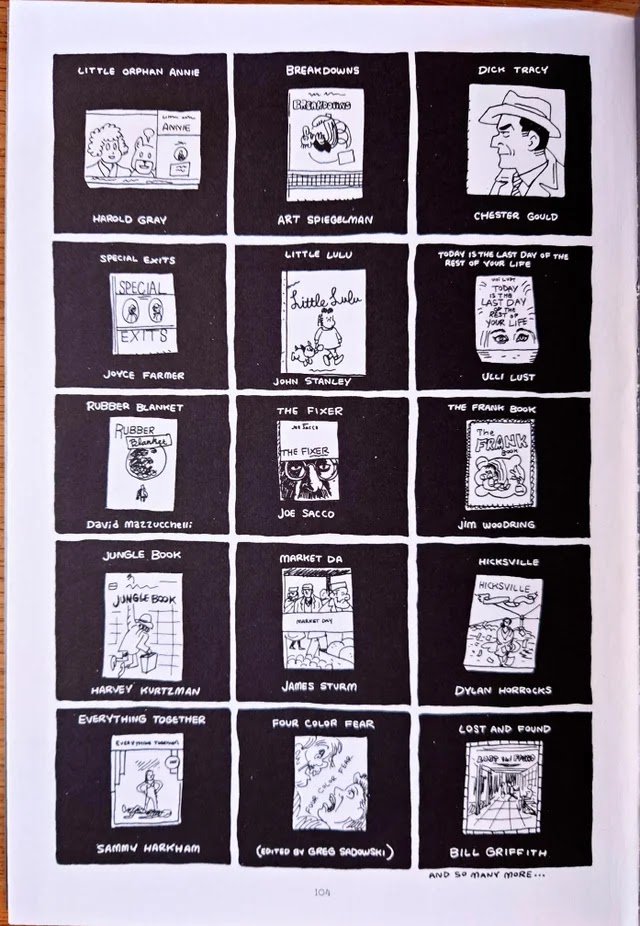
Van Sciver has become a master at creating a rhythm in his anthology work, and there's a sense in which this book is kind of an extended version of his anthology series Blammo! Indeed, it collects a few stories from the comic that fit snugly in here, as well as stories from the Fantagraphics anthology NOW and other stuff. There's also a great deal of previously unpublished work that forms a through-line for the other stories. This book is about cartooning, cartoonists, and what led Van Sciver down this path. It opens with several portraits of cartoonists like Jackie Ormes and Bill Mauldin and ends with Van Sciver delineating a number of comics and cartoonists that meant a lot to him (along with small doodles of those books). However, Van Sciver is a master of transitioning between sincere expressions of appreciation and setting up gags, as his "19th Century Cartoonist" character follows that initial lineup of cartoonists as he once again reveals his own general awfulness. This character is Van Sciver taking the piss out of the frequent overpraising of older cartoonists like this who were pretty much just hacks, but it's also of course a cautionary tale for himself and how he sees himself as a cartoonist now and how others will see his work in the future. 


The through-line for the book is "Mellow Mutt," a dinosaur toy that young Van Sciver is given that becomes a sort of personal totem. Van Sciver's strips about living in a ramshackle house in New Jersey made up his memoir One Dirty Tree, and they are the backbone of his new series with Uncivilized, Maple Terrace. Van Sciver has really struck gold with these depictions of life with a checked-out dad and multiple siblings who are all too happy to let him know his place in the pecking order as the second-youngest kid. They are funny and terrible all at once, and while young Noah is certainly put-upon, he's also presented as kind of a self-tormenting asshole as well. The "Mellow Mutt" stories in As A Cartoonist offer a brief window into Van Sciver's young life, as most of the book's stories focus more on his career as a cartoonist as an adult. 


For example, "White River Junction" is a perfect example of a modern-day Noah unable to relate to virtually anyone, in part because he's not sure what he believes in. He inadvertently manages to offend a number of students at the Center for Cartoon Studies when he tells them he used to be a Mormon, and Van Sciver really plays the awkwardness of those scenes for laughs in an exquisite manner. He's an accidental tormenter (which is rare for Van Sciver in a strip), but also the tormented. The way the strip resolves in nature is the beginning of a growing sense of peace for his character that slowly develops as the book proceeds. 

Van Sciver bookends a single-page strip titled "Fante Bukowski" (his poet character who is sort of like an obnoxious alter ego of his) where he asks Jules Feiffer for advice at a signing with "Comics Festival 2016," a highly self-conscious homage to Woody Allen's film Stardust Memories. Van Sciver is a successful cartoonist going to a show in Europe, but he has celebrity-level fame and is constantly being asked for sketches and favors. A callback to an earlier strip finds aliens saying they prefer his "earlier, funnier" comics and the story ends with a gag about not being able to provide good endings for his stories. There's something else at work here, though: an appearance from his father. In a later strip where Noah visits him, it's revealed that his dad abandoned the family at a time when Noah was in desperate need of guidance as a child. While much of As A Cartoonist is about Van Sciver coming to terms with cartooning as a profession, it's also about finding ways to grow up and come to terms with his past. 


One can see that in strips about moving to Columbus and his initial loneliness, and later strips about meeting his wife Amy and the birth of their son Remy. The story "Jonah" is also about finding ways to accept his siblings (especially his buffoonish and outlandish younger brother) as they are, warts and all. The climax of this story is at an art opening featuring Van Sciver's work, and his brother (not invited to the event) makes a ridiculous spectacle of himself, hitting on random women. What's funny is how Van Sciver lampoons himself and his own pretensions, as the story imagines him talking to art world wheeler-dealers and a writer from the New York Times. "Saint Cole" is a much more down-to-earth account of a foreign tour, where a stop in Paris yields just one fan at a signing but also the realization that cartooning has taken him to a lot of places. For Van Sciver, the disease of more gave way to an understanding of what he had made for himself and his family, as well as the grace to not only forgive his father but to make his stories part of his source material. 

This was also the period of time when Van Sciver went from good to great in terms of his cartooning and draftsmanship. The White River Junction story is so effective when he calls out for good in the forest because he had moved beyond his limitations as a draftsman and put in the work to give his work a decorative sense of beauty it had never before possessed. That's especially true of his nuanced and restrained use of color; even on the brightest pages, there's a naturalism at work that never overwhelms his linework. However, at heart, Van Sciver has always been and will always be a gag man, and his cartooning reflects a style that mixes the ridiculous and the sublime. Van Sciver's mustache is practically a character of its own, adding an arsenal's worth of expression to the face of his self-caricature. Van Sciver namechecks David Collier as an influence, and you can see it in the increasingly-gentle way he's gone about describing his world. Van Sciver, like Collier, is an observer, but he has drifted away from his put-upon schlub persona that so many cartoonists influenced by Robert Crumb seem to adopt. That keen eye, combined with his wit, has allowed Van Sciver to make a deeper dive into older ideas with renewed gusto.


That takes us to Maple Terrace #1, published by Uncivilized Books. Uncivilized is one of the few publishers releasing well-designed comics in something akin to the mini-comics format. They've already done a few series like this, with comics by the likes of Gabrielle Bell, Craig Thompson, and Tom Kaczynski himself. Van Sciver's Maple Terrace is in this vein, giving Van Sciver another low-pressure format akin to Blammo!, but with a much tighter focus. Each issue will have a single story dating back to Van Sciver's childhood at around age eight. (I wouldn't mind seeing him revisit his skater boi persona as a teen featured in My Hot Date, however.) There's a funny throughline in this comic: virtually every male character depicted reads comics. This being the early 90s and the rise of the speculator's market surrounding early Image comics, there was a mix of people reading because comics were a wise investment opportunity and people reading these dumb, quasi-literate masterpieces done by the likes of Todd McFarlane and Jim Lee because of the cool factor. The "value" of the comics, as well as Van Sciver wanting to read something scary in Spawn, provides the key to the plot. 


Mostly, this comic is about Noah trying to negotiate life with his family, being regarded as worthless by the parents of his friends, and the terror of his father and older brother Ethan. There's one amazing scene that I hope is based entirely on real life when Noah's father tells him, "Todd McFarlane is for boys, son. Barry Windsor-Smith is for men." Pious young Noah wants to avoid the wrath of his older brother when he accidentally rips the cover of his Spawn comic, and things happen to work out for the best when a bully gets his just desserts and Noah benefits. The essence of the comic is that creeping sense that children have when they sort of have to accept their surroundings and get used to, for example, sleeping on the floor like Noah does because there aren't enough beds to go around. 

However, they also get the sense that while this is what they're used to, it's not normal, like when the kids see the moldy, leaking roof and cockroaches run across Noah's face every night. It's a sort of recurring form of PTSD that has to be ignored for the sake of survival. In Van Sciver's case, he's reworking it into a kind of cringe-inducing gag strip, where his bushy head of hair and spindly limbs are all part of the visual humor of the series. The bigfoot humor and slice-of-life looks at poverty is somewhere between Don Martin and Dave Berg on the MAD scale, and Van Sciver makes it work. Above all else, this is a funny comic, even if it's frequently heartbreaking. Van Sciver spent a lot of time as an artist making his drawings like tight with tons of cross-hatching and other techniques; with Maple Terrace, he's learned to loosen up again, resulting in some of the liveliest drawing of his career.

Friday, April 21, 2023

Keith Knight's Good On Both Sides

Gentleman Cartoonist Keith Knight is a polymath. From his days as a musician, to his TV show Woke (based on his own life), to his prolific career as a cartoonist, he's always been doing it all, all the time. As a cartoonist, he has three different outlets. The Knight Life is his syndicated strip, and he has the three or four panel approach for the punchline down pat. The K Chronicles is his classic single-page strip, usually with multiple panels that talk about something personal or cultural. Then there's (th)ink, his single-panel editorial strip. While political and cultural issues are essential to all of his work, especially with regard to race and police brutality, (th)ink is notable because of its format. Knight excels at clever turns of phrase and images with regard to some contemporary issue.


His latest (th)ink collection, Good On Both Sides, tackles the fertile subject of the latter years of the Donald Trump presidency. Reading a collection of these strips, one understands that Trump was almost too fertile a subject for scorn and parody. When you have a person who feels no shame whatsoever, loves attention, and changes the outrage narrative every single day, it makes a satirist's job nearly impossible. As such, some of the comics in Good On Both Sides reference events that I can't remember. The tidal wave of toxic nonsense was just too great to keep track of everything, and there's only so much a political cartoonist can do to explain a reference without it resulting in literally spelling out every aspect of a joke. 


Knight mostly manages to get around that problem by using clever visuals to take a specific reference and apply it to Trump's wider universe of greed, sexual harassment, white supremacy, anti-intellectualism, out-and-out lies, and the general alternate reality that the ex-president and his supporters live in. If Trump's an easy target, it's because he's too vast to possibly ignore, and too crudely stupid to resist direct hits. Knight's skill is taking an outrage point (like Trump saying there were "very fine people on both sides" with regard to a white nationalist rally) and shifting the joke (there's an angel and a devil on either side of him, and Trump is feeling up the angel). Knight's stumpy, cartoony figures are exaggerated and rubbery, giving his characters a kind of sweaty, neurotic energy. Knight is not only funny, he draws funny, and he rarely varies from this style in all of his material. There's an almost gentle, welcome quality to his drawing style, providing a little distance for when he goes all-in, like his incredible "White Power Rangers" gag. He's also proficient at taking a news item (like a golf club calling the cops on a group of black women playing on the course) and pulling out a dagger of a punchline ("...they're swinging at something WHITE!")


There are also moments of sincerity, as Knight honors figures like Bill Nunn, Billie Holiday, and Thurgood Marshall with naturalistic portraits and key quotes. In this political climate, simply honoring Black figures from American history is a political act. Knight suggests that like it or not, simply being Black is a political act, and he's not afraid to say this out loud. He's even more unsparing in his lectures about police violence; if anything, he mostly pulls his punches and goes for gags in (th)ink; he could be a lot meaner. The final comics in the collection address the then-incipient Coronavirus; he nailed the conspiracy thinking surrounding it from the very beginning. Despite the fact that so much of this book is so contemporaneous of roughly 2018-2020, the strips relating to race are not only still relevant but are even somewhat understated when one considers right-wing attempts at whitewashing everything. Knight's foresight, comic timing, and cartooning skill elevate Good On Both Sides from a standard collection of editorial cartoons.

Tuesday, April 18, 2023

Julia Gfrörer's bleak Vision

An underlooked part of evaluating comics (and a highly subjective one) is the sheer visual appeal of the art. What is appealing is subjective, as some people can love the ligne claire style of drawing, some love Gary Panter's ratty line, and others like exaggerated and rubbery cartooning like Peter Bagge. As both a reader and critic, I appreciate a style that is idiosyncratic and personal for the artist, especially after reading so many mainstream graphic novels that use the same line weight, styles, and color schemes. (Note to YA cartoonists, in particular: mix it up!) As such, there are some artists whose lines are simply a sheer pleasure for me to look at, regardless of story or subject matter. One of them is most definitely Julia Gfrörer.


Having followed her career from the beginning, I've always appreciated her fragile, ratty line that often seems like it's about to disintegrate at any given moment. Given that she loves to explore the intersection between sex, bodies, and horror, her drawings have a visceral quality that is at once erotically charged, disturbing, and desperately familiar. All of this is on display in Vision, her 2020 book from Fantagraphics. At its heart, this is a story about desperate loneliness and yearning, mixed with a series of betrayals and boundary violations. It's also deeply steeped in BDSM concepts, as the lead character Eleanor is a widow tending to her perpetually-ill sister-in-law and her distracted brother. She also regularly talks to a demonic spirit in a mirror, who orders her to strip naked and pleasure herself, even as he calls her out as someone who desperately wants to be used and degraded. 


Set in the 19th century, Eleanor's choices are even more limited because of the era, and how her voice is constantly silenced by those around her. All the while, her vision is starting to go thanks to cataracts, leading to an encounter with the eye doctor that is at once a violation and arousing because it is a violation. One of the best things about Gfrörer's work is that her narrators are often unreliable, and that the reader must follow what they do rather than what they say. For Eleanor, despite all of her stiff-upper-lip performative strength, she's a shattered woman clinging only to her desire for meaning. That desire is toxic and unsustainable, whether one takes the supernatural elements of the story at face value or sees them as a manifestation of her own insanity. In the end, it doesn't matter. 


She's not allowed to grieve her husband openly, and any emotions she feels are immediately shot down by her sister-in-law Cora and her brother Robert. While the book opens with her talking to her magical, quasi-demonic mirror that is her effective voyeur dom, she really does have the best interests of her family at heart. Her brother, it is implied visually, is sexually assaulting his physically and mentally ill wife in her sleep, tearing open her nightshirt that Eleanor rebuttons. For both Eleanor and Robert, there's a sense that their desires cannot be contained and are making both of them want to act with no restraint. Only Robert is allowed to get away with it openly, however.  

When Eleanor tells the ghost in the mirror that she wants to go where he is, it's a desire to be touched and act on her sexual impulses--but it's also implied that this is a self-annihilating act. The ghost is dead, in hell, or someplace even worse, and Eleanor has a firm suspicion that she's hellbound no matter what. With her self-cutting early in the book, it's clear that she's trying to externalize the pain and scarring she feels emotionally, but the ghost feels like a chance to evade this. The ghost makes her feel desired and reads her for what she truly is: a submissive who seeks out pain, seeks out degradation, seeks out and wants to revel in sexual debasement. For a sub, being able to access this kind of emotional space with a trusted partner can be deeply healing; for Eleanor, she only has more pain to look forward to. 


When the doctor treats her cataract, the ghost demands she describe the pain in detail, with the procedure described in such a way as a dom controls and gives pain to a sub. The ghost's reaction mirrors her own in a way; it cracks, mimicking Eleanor cutting herself earlier. The mirror is possessive and jealous of Eleanor, and what remained her sole outlet for her desire is cruelly cut off. The leads to her spiralling, as her tolerance for her situation evaporates. She welcomes advances from the doctor (despite the ghost smashing a paperweight in protest), poisons her sister, and gets lost in laudanum dreams as she fantasizes about joining her ghost lover. In the end, her ghost lover never returns, and she makes a fateful decision for her brother and herself. 

This is perhaps the grimmest of all of Gfrörer's stories, and the one with the least humor. While her protagonists either tend to be in bleak situations, victims of outside forces, or predators in their own right, Eleanor is doomed from the beginning. She's grieving but given no space to grieve; her desire, need, and loneliness are all subsumed to the needs of her family; and there's no real way out. Even the doctor who wants her cares less about social calls (despite his veneer of respectability) and more about dominating her. A soft dom, perhaps, but a dom nonetheless. The only being who understands her is either a figment of her imagination or a largely malignant spirit. In the end, it doesn't matter, given the hopelessness that she understands all too well. She chooses self-annihilation over misery, as she can't see a way out. The pain expressed in this book lingers long after it's read.